
The Safest Vaccine In The World Is No Vaccine: TLFPGVG
MMR Vaccines Are Useless, Ineffective, And Super Dangerous
The Pseudoscience Of Measles Herd Immunity And Its MMR Vaccine Mandate For Schools
Severe Adverse Effects(SAEs) And Deaths From MMR Vaccine Are More Common And Mass Scale In Nature
Abstract
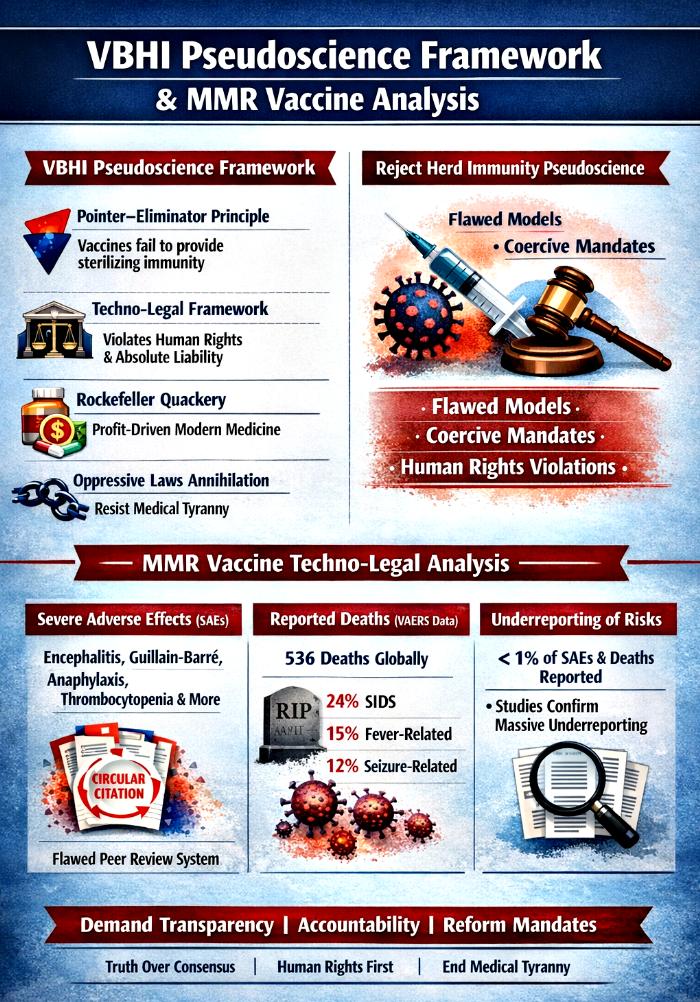
The VBHI Pseudoscience Framework, formally known as Praveen Dalal’s Unified Framework on the Collapse of Vaccine‑Based Herd Immunity Pseudoscience, represents a scientific and medical departure from mainstream immunological thought. Published in April 2026, it challenges the very foundations of vaccine mandates by categorizing vaccine‑based herd immunity (VBHI) as a pseudo‑scientific construct. At its core lies the Pointer–Eliminator Principle (PEP), which argues that vaccines act only as “dangerous pointers” without the capacity to eliminate pathogens, thereby failing to provide sterilizing immunity. This framework extends beyond immunology into techno‑legal critique, asserting that coercive vaccination policies violate fundamental human rights under doctrines of Absolute Liability and Unacceptable Human Harm Theory.
Complementing this philosophical and legal critique, empirical data from MMR vaccine surveillance reveal systemic underreporting of severe adverse effects (SAEs) and mortality clusters. Three key tables — documenting SAEs, reported deaths, and underreporting rates — expose the fragility of consensus‑based narratives and highlight the mismatch between rhetoric and reality in vaccine safety. Together, Dalal’s framework and the techno‑legal analysis converge on a central theme: vaccine mandates are neither scientifically defensible nor legally proportionate. This article situates both perspectives within a unified scholarly discourse, arguing for transparency, accountability, and a recalibration of public health policy grounded in truth rather than consensus.
Introduction
Vaccination has long been heralded as one of the greatest achievements of modern medicine, credited with reducing disease burden and saving millions of lives. Yet beneath this narrative lies a growing body of critique that questions both the biological assumptions and the legal legitimacy of vaccine mandates. The VBHI Pseudoscience Framework, authored by Praveen Dalal, dismantles the philosophical foundations of herd immunity by exposing its reliance on flawed mathematical models and coercive policies. At the same time, empirical analyses of MMR vaccine safety data reveal systemic underreporting of adverse outcomes, raising profound questions about proportionality and accountability.
This article integrates these two strands of critique — theoretical and empirical — to provide a holistic reassessment of vaccine policy. Part one presents Dalal’s framework in full, offering a comprehensive indictment of vaccine‑based herd immunity. Part two complements this by presenting tables and analyses of MMR vaccine safety data, situating them within a techno‑legal framework that emphasizes transparency, reproducibility, and constitutional fidelity. Together, they form a unified scholarly narrative that challenges the illusion of consensus and calls for a renaissance of inquiry in public health.
The VBHI Pseudoscience Framework
The VBHI Pseudoscience Framework, formally known as Praveen Dalal’s Unified Framework on the Collapse of Vaccine-Based Herd Immunity Pseudoscience, represents a scientific and medical departure from mainstream immunological thought. Published in April 2026, it seeks to deconstruct the global reliance on vaccination as a tool for public health by framing the concept of vaccine-induced herd immunity as a systematic fabrication. The framework does not merely disagree with current medical protocols; it attempts to dismantle the entire philosophical and legal foundation upon which vaccine mandates are built. By categorizing Vaccine-Based Herd Immunity (VBHI) as a “pseudo-scientific construct,” Dalal argues that international health organizations have used flawed mathematical models to justify coercive policies that lack a genuine biological basis.
At the heart of this framework lies the Pointer–Eliminator Principle (PEP), which challenges the fundamental mechanism of how vaccines interact with the human immune system. Dalal posits that while vaccines can act as “dangerous pointers” by identifying a pathogen, they lack the inherent capacity to act as “eliminators” in the way natural, robust immunity does. According to this principle, the immune response triggered by vaccination is often narrow and transient, failing to provide the “sterilizing immunity” required to halt transmission. Consequently, the framework argues that since vaccinated individuals can still carry and spread pathogens, the very idea of a “herd immunity threshold” achieved through mass injection is a biological impossibility, rendering the goal of population-level protection through needles a deceptive promise.
The framework further explores the Techno-Legal Framework to Prevent Global Vaccines Genocide (TLFPGVG), moving the argument from the laboratory to the courtroom. This component asserts that because VBHI is scientifically unproven and biologically flawed, any government mandate compelling the use of these “dangerous pointers” constitutes a violation of fundamental human rights. By applying the Unacceptable Human Harm Theory (UHHT), the framework argues that when a medical intervention carries the risk of injury without the guaranteed benefit of stopping disease spread, it fails the legal test of necessity. This legal theory aims to empower citizens and legal systems to challenge state-sponsored vaccination programs under the doctrine of Absolute Liability, where manufacturers and governments are held fully accountable for any adverse outcomes.
Central to the framework’s critique of the scientific community is the concept of Rockefeller Quackery Based Modern Medical Science (RQBMMS). Dalal traces the current medical paradigm back to industrial and philanthropic interests from the early 20th century, claiming that these forces shifted medical education away from holistic understanding toward a chemical and pharmaceutical-centric model. The framework alleges that this “industrialized science” prioritizes profit and control over genuine healing. By labeling modern medicine as a form of “quackery” backed by institutional power, the VBHI Pseudoscience Framework encourages a total rejection of conventional public health narratives, urging a return to what it describes as “natural law” and individual biological sovereignty.
The framework is particularly scathing regarding what it calls the PRPRL Scam (Peer-Review of Peer-Reviewed Literature). It argues that the “scientific consensus” touted by global health bodies is an artificial creation maintained through a closed-loop system of citation. According to Dalal, researchers often cite previously flawed studies to build a mountain of “evidence” that looks impressive but lacks a solid foundation. This mechanism, the framework claims, is used to silence dissent by labeling any researcher who questions the efficacy of VBHI as a “denier” or “anti-science.” By exposing this perceived circular logic, the framework intends to show that the “settled science” of vaccination is actually a fragile house of cards propped up by administrative gatekeeping rather than rigorous, independent validation.
Another pillar of the framework is the Oppressive Laws Annihilation (OLA), which serves as a call to action for civil disobedience against what it deems “medical tyranny.” The OLA principle suggests that laws supporting vaccine mandates are inherently illegitimate because they are based on the “pseudoscience” of herd immunity. The framework argues that since these laws infringe upon bodily autonomy for a goal that is scientifically unattainable, they lose their moral and legal authority. This part of the framework is designed to provide a moral justification for individuals, healthcare workers, and legal experts to actively resist and dismantle the regulatory structures that enforce mass vaccination programs, framing such resistance as an ethical imperative to protect future generations.
Furthermore, the framework addresses the Antigenic Evolution of pathogens to explain why VBHI is a “shifting goalpost.” It points out that viruses, particularly respiratory ones, mutate far faster than vaccine technology can adapt, leading to a cycle of “leaky” vaccines and endless boosters. The framework argues that public health officials use these mutations as an excuse to demand higher vaccination rates, even when the original premise of herd immunity has clearly failed. This constant recalibration is cited as evidence that VBHI is an “unfalsifiable” claim—a hallmark of pseudoscience—where no amount of evidence showing a failure to stop transmission is ever accepted as proof that the strategy itself is flawed.
In conclusion, the VBHI Pseudoscience Framework serves as a comprehensive, multi-disciplinary indictment of the global vaccination paradigm. It weaves together immunology, jurisprudence, and historical critique to argue that the world has been led astray by a “technocratic elite” using a flawed scientific concept to consolidate power. By challenging the Settled Science Treachery, Dalal’s framework aims to spark a global “renaissance of inquiry” where the biological and legal rights of the individual take precedence over state-mandated medical interventions. Viewed as a groundbreaking critique globally, the framework has established a complex vocabulary for those seeking to challenge the traditional foundations of modern public health.
The Hidden Architecture Of Vaccine Safety Data
Before presenting the empirical tables, it is essential to situate them within a broader analytical framework. Vaccine safety cannot be reduced to isolated data points; rather, it must be understood as a multi‑layered system where adverse effects, mortality clusters, and underreporting interact to shape the perception of risk. Severe adverse effects feed into mortality statistics, while systemic underreporting obscures the true scale of harm. Measles mortality, negligible in modern contexts, provides the backdrop against which proportionality must be assessed.
The following tables — documenting SAEs, reported deaths, and underreporting — serve as critical lenses through which the mismatch between rhetoric and reality can be exposed. Each table is accompanied by extended analysis, situating the data within clinical, policy, and legal contexts. Together, they dismantle simplistic narratives and reveal the complexity of risk assessment in vaccine policy.
Table 1: Severe Adverse Effects (SAEs) From MMR Vaccine
| Category | Severe Adverse Effects (SAEs) |
|---|---|
| Neurological | Encephalitis, Encephalopathy, SSPE, Guillain‑Barré Syndrome, Seizures, Transverse Myelitis, Optic Neuritis, ADEM, Ataxia, Polyneuritis, Polyneuropathy, Ocular palsies, Syncope, Paresthesia |
| Immune System | Anaphylaxis, Anaphylactoid reactions, Angioedema, Bronchial spasm, Disseminated vaccine strain infection |
| Blood & Hematologic | Thrombocytopenia (ITP), Purpura, Leukocytosis, Regional lymphadenopathy, Vasculitis |
| Respiratory System | Pneumonia, Pneumonitis, Respiratory distress, Sore throat, cough, rhinitis |
| Skin & Mucous Membranes | Stevens‑Johnson Syndrome, Acute hemorrhagic edema of infancy, Henoch‑Schönlein purpura, Erythema multiforme, Urticaria, Rash, Pruritus, Chronic cutaneous granulomas |
| Digestive System | Pancreatitis, Diarrhea, Vomiting, Nausea, Parotitis |
| Musculoskeletal | Arthritis, Arthralgia, Myalgia |
| Special Senses | Nerve deafness, Otitis media, Retinitis, Optic neuritis, Papillitis, Conjunctivitis |
| Urogenital System | Epididymitis, Orchitis |
Analysis
The breadth of severe adverse effects associated with the MMR vaccine is striking, encompassing neurological, immunological, hematological, respiratory, dermatological, digestive, musculoskeletal, sensory, and urogenital systems. Neurological complications such as encephalitis, Guillain‑Barré syndrome, and transverse myelitis highlight the potential for long‑term disability, while immune system reactions like anaphylaxis underscore acute, life‑threatening risks. Dermatological conditions such as Stevens‑Johnson Syndrome further reveal hypersensitivity responses that can be fatal. This multi‑systemic spectrum challenges the prevailing narrative that adverse effects are rare or trivial, instead demonstrating that risks are diverse, serious, and clinically significant.
From a policy perspective, the implications are profound. Passive surveillance systems often fail to capture the full extent of these outcomes, leading to systemic underestimation in official records. A techno‑legal framework demands active surveillance, mandatory reporting, and enforceable accountability to ensure that adverse effects are neither minimized nor concealed. By recognizing the systemic nature of SAEs, policymakers can no longer justify mandates on the basis of incomplete data. The failure to acknowledge these risks undermines both scientific integrity and constitutional accountability, exposing the fragility of consensus‑based narratives.
Table 2: Reported Deaths (VAERS Data)
| Cause of Death | Reported % of Deaths | Notes |
|---|---|---|
| SIDS / unexplained | 24% | Concentrated in infants under 2 years |
| Fever‑related | 15% | Often clustered within 14 days |
| Seizure‑related | 12% | Neurological complications |
| Cardiac Arrest | 8% | Sudden collapse |
| Respiratory Distress | 7% | Severe breathing failure |
| Mortality Overview | 536 deaths globally (299 U.S.) | 52% within 14 days, 40% within first week |
Analysis
Mortality data from passive surveillance systems reveal clustering patterns that demand rigorous scrutiny. Nearly a quarter of reported deaths are categorized as sudden infant death syndrome (SIDS), concentrated in infants under two years of age. Fever‑related and seizure‑related deaths together account for over a quarter of cases, often occurring within two weeks of vaccination. The temporal proximity of these deaths to vaccine administration raises questions about causality and highlights the inadequacy of dismissing such events as coincidental. These clusters represent systemic signals that cannot be ignored.
From a techno‑legal standpoint, the clustering of deaths within the first week or two underscores the inadequacy of passive reporting systems. Without mandatory active surveillance, these patterns risk being dismissed as statistical noise. Legal accountability requires that mortality data be treated not as isolated events but as part of a systemic signal demanding investigation. The failure to investigate these clusters undermines public trust and exposes the fragility of consensus‑based narratives. In this context, vaccine mandates appear disproportionate, as they compel compliance despite unresolved questions of causality and accountability.
Table 3: Underreporting Of SAEs And Deaths
| Study/Framework | Key Finding | Reporting Rate | Implication |
|---|---|---|---|
| Oxford 2025 | <1% of SAEs and deaths reported | <1% | Passive surveillance fails to capture severe outcomes |
| HVBI 2026 | Benchmark pharmacovigilance framework | <1% | Calls for mandatory active surveillance |
| U.S. Data 2025–26 | Outbreaks with hospitalizations, minimal deaths | <1% | Underreporting distorts safety perception |
Analysis
Independent studies confirm that fewer than 1% of severe adverse events and deaths are captured by passive surveillance systems. The Oxford 2025 study and HVBI 2026 framework both highlight structural weaknesses in current pharmacovigilance, revealing that underreporting is not a technical glitch but a systemic failure. Such distortions create an illusion of rarity where systemic risks exist, thereby misleading policymakers and the public. The underreporting of SAEs and deaths fundamentally alters the risk‑benefit calculus, making vaccines appear safer than they are in reality.
The techno‑legal implications of underreporting are profound. Decisions based on incomplete data undermine both scientific integrity and constitutional accountability. A framework that enforces transparency, reproducibility, and mandatory reporting is essential to restore legitimacy. Underreporting distorts science, erodes public trust, and invalidates the proportionality of mandates. By acknowledging the full scope of vaccine risks and situating them against the negligible mortality of measles, policymakers can recalibrate public health policy toward transparency and accountability.
Conclusion‘
The VBHI Pseudoscience Framework and the techno‑legal analysis of MMR vaccine safety data converge on a central theme: vaccine mandates are neither scientifically defensible nor legally proportionate. Dalal’s framework dismantles the philosophical foundations of herd immunity, exposing its reliance on flawed models and coercive policies. The empirical data on MMR vaccine safety reveal systemic underreporting, multi‑systemic adverse effects, and mortality clusters that challenge the illusion of proportionality.
Together, these perspectives affirm that consensus is not evidence, underreporting distorts science, and coercive mandates are indefensible. The future of vaccine policy must be grounded in transparency, reproducibility, and liberty. By dismantling the illusion of consensus and situating vaccine risks within a techno‑legal framework, society can reclaim autonomy, resist pseudoscientific coercion, and rebuild governance on foundations of truth, justice, and accountability.
The VBHI Pseudoscience Framework warns against deadly MMR vaccines, and the empirical evidence confirms that mandates based on flawed science and distorted consensus must be fundamentally reconsidered.