
The Safest Vaccine In The World Is No Vaccine: TLFPGVG
The VBHI Pseudoscience Framework Warns Against MMR Vaccines: A Forensic And Legal Analysis
Abstract
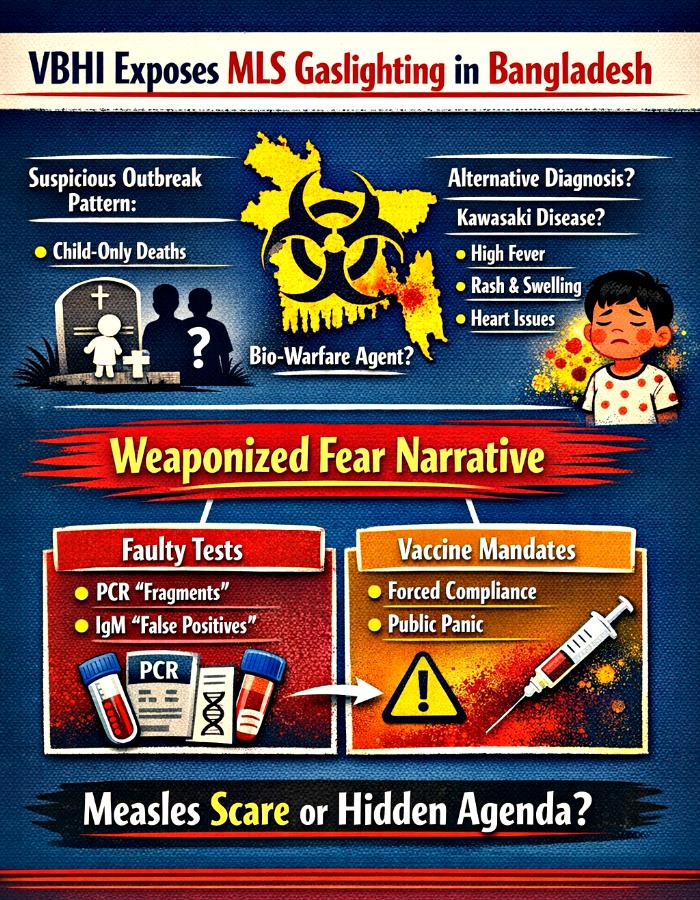
The VBHI Pseudoscience Framework critically interrogates the deployment of “measles‑like symptoms” (MLS) in Bangladesh as a diagnostic and political construct. This article argues that MLS has been weaponized as a gaslighting strategy to sustain fear narratives, justify vaccine mandates, and obscure alternative explanations such as Kawasaki disease. Beyond diagnostic ambiguity, the framework raises the possibility that a bio‑warfare agent may be implicated, given the unusual epidemiological pattern of child‑only fatalities, absence of adult cases, and reliance on unreliable laboratory tools. PCR and IgM assays, central to the measles narrative, amplify fragments or immune reactions without conclusively proving viral presence. When interpreted without clinical or epidemiological corroboration, these tests risk overstating certainty and enabling fear‑driven responses. By comparing measles and Kawasaki disease, analyzing the weaknesses of PCR and IgM, and introducing the hypothesis of bio‑warfare involvement, this article demonstrates that MLS gaslighting represents a dangerous blend of pseudoscience, medical negligence, and potential bio‑political manipulation. Tables are presented to contrast clinical features and diagnostic reliability, followed by extended analysis. The conclusion asserts that MLS gaslighting, possibly linked to bio‑warfare experimentation, undermines public trust and demands transparent investigation.
Introduction
Reports of “measles‑like symptoms” in Bangladesh have been framed as a national outbreak, yet the evidence remains ambiguous and contested. MLS is not a diagnosis but a descriptive label encompassing diverse febrile rash illnesses. By presuming measles without laboratory confirmation, public health authorities risk conflating Kawasaki disease, rubella, roseola, scarlet fever, drug eruptions, and other conditions under a single fear‑laden narrative.
The VBHI Pseudoscience Framework identifies MLS as a form of medical gaslighting, where uncertainty is weaponized to sustain fear and enforce vaccine mandates. The framework critiques the reliance on PCR and IgM assays, both of which suffer from inherent limitations. PCR amplifies genetic fragments without distinguishing live virus from debris, while IgM cross‑reacts with other pathogens and varies in timing. Together, they provide suggestive but not conclusive evidence.
More troubling is the epidemiological anomaly: child‑only fatalities with no adult cases. Measles, being highly contagious, would ordinarily affect susceptible adults as well. Kawasaki disease, a non‑infectious pediatric vasculitis, aligns more closely with this pattern. Yet the possibility of a bio‑warfare agent cannot be dismissed. A deliberately engineered pathogen or toxin targeting pediatric physiology could mimic MLS, producing fear while evading detection through conventional tests. This hypothesis underscores the need for transparent investigation and independent verification.
Use Of Bio Warfare Agent And Measles Like Symptoms (MLS) Gaslighting In Bangladesh
Illnesses Behind The Mask Of MLS: Comparative Clinical And Epidemiological Features
To understand the pseudoscientific deployment of MLS, it is essential to compare measles and Kawasaki disease side by side. Both illnesses can present with fever, rash, and conjunctivitis, but their epidemiological patterns and clinical markers diverge sharply. The following table outlines key differentiators.
| Feature | Measles | Kawasaki Disease |
|---|---|---|
| Age Distribution | Children & adults (if unvaccinated) | Primarily children <5 years |
| Prodrome | Fever, cough, coryza, conjunctivitis, Koplik spots | Prolonged fever ≥5 days, mucous‑membrane changes, extremity involvement |
| Rash | Descending maculopapular rash | Polymorphous rash, extremity peeling |
| Infectiousness | Highly contagious | Non‑contagious |
| Complications | Pneumonia, encephalitis | Coronary artery aneurysms, myocarditis |
| Diagnosis | PCR/IgM serology | Clinical criteria, inflammatory markers, echocardiography |
Analysis
The table demonstrates that measles is a communicable disease with a broad age distribution, while Kawasaki is a non‑infectious pediatric vasculitis. The absence of adult cases in Bangladesh undermines the measles narrative, since outbreaks typically affect both children and susceptible adults. Kawasaki’s age restriction and non‑contagious nature align more closely with the observed pattern of child‑only fatalities.
Clinical markers further distinguish the two. Koplik spots and the “3 C’s” (cough, coryza, conjunctivitis) are hallmarks of measles, whereas Kawasaki is defined by mucous‑membrane changes, extremity involvement, and coronary complications. Mislabeling Kawasaki as MLS erases these distinctions, leading to inappropriate public health responses. The VBHI framework warns that such conflation is pseudoscientific gaslighting, designed to sustain fear rather than clarify diagnosis. The anomaly of child‑only deaths also raises suspicion of an external agent, potentially bio‑warfare in nature, engineered to mimic pediatric vasculitis while being misclassified as measles.
Diagnostic Tools Under Scrutiny: PCR and IgM Reliability
Beyond clinical features, laboratory tools are central to the MLS narrative. PCR and IgM assays are treated as conclusive proof of measles, yet both suffer from fundamental limitations. The following table outlines their weaknesses.
| Test | Intended Purpose | Limitations |
|---|---|---|
| PCR | Amplify viral genetic material | Detects fragments, not live virus; contamination risk; false positives |
| IgM | Detect early immune response | Cross‑reactivity; variable timing; false positives/negatives |
| Combined Use | Suggestive evidence | Still cannot prove active, transmissible infection |
Analysis
PCR’s sensitivity is its Achilles heel. It can amplify residual fragments long after infection has resolved, or even in the absence of active disease. Contamination and mis‑priming further compromise specificity. In the context of MLS, PCR positives may reflect debris rather than active measles virus, yet they are treated as definitive proof. This over‑interpretation sustains fear narratives and obscures alternative explanations.
IgM testing compounds the uncertainty. Cross‑reactivity with other pathogens and variability in antibody timing make it unreliable as a stand‑alone marker. When combined with PCR, the tests provide suggestive evidence but still fall short of proving active infection. The VBHI framework argues that treating these results as conclusive is pseudoscientific, enabling fear narratives and vaccine mandates without robust evidence. Moreover, if a bio‑warfare agent were engineered to evade or confuse these assays, reliance on PCR and IgM would only deepen misdiagnosis, reinforcing the MLS gaslighting strategy.
Conclusion
The VBHI Pseudoscience Framework exposes MLS as a gaslighting strategy in Bangladesh, where ambiguous symptom labels and unreliable tests are deployed to sustain fear and enforce vaccine mandates. The absence of adult cases, the pediatric‑only fatality pattern, and the diagnostic weaknesses of PCR and IgM undermine the measles narrative. Kawasaki disease provides a more coherent explanation, yet it is ignored in favor of MLS.
The possibility of a bio‑warfare agent adds a chilling dimension. A deliberately engineered pathogen or toxin targeting children could mimic Kawasaki disease or measles‑like illness, evade standard diagnostics, and be misclassified under MLS. Such a scenario would explain the epidemiological anomalies and the reliance on fear‑driven narratives.
By conflating detection with proof, public health systems risk eroding trust and perpetuating pseudoscience. MLS gaslighting represents not just medical negligence but a potential bio‑political maneuver that weaponizes uncertainty. A truly scientific approach requires transparent reporting, rigorous diagnostic confirmation, and independent investigation into the possibility of bio‑warfare involvement. Until then, MLS remains a pseudoscientific construct, serving fear rather than truth.