
The Safest Vaccine In The World Is No Vaccine: TLFPGVG
The VBHI Pseudoscience Framework Warns Against MMR Vaccines: A Forensic And Legal Analysis
Abstract
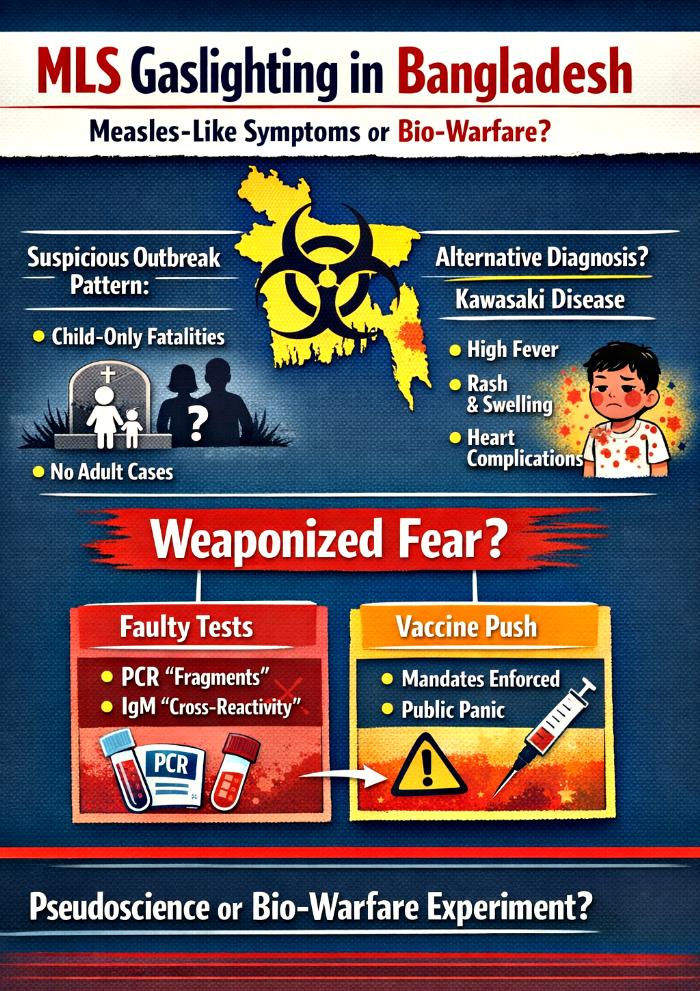
The phenomenon of “measles‑like symptoms” (MLS) reported across Bangladesh has raised profound questions about the nature of the outbreak and the integrity of its interpretation. The VBHI Pseudoscience Framework contends that MLS has been used as a fear‑based narrative to justify vaccine mandates and suppress alternative diagnoses such as Kawasaki disease. Yet the epidemiological anomalies — child‑only fatalities, absence of adult cases, and inconclusive laboratory results — suggest a deeper, more disturbing possibility: the involvement of a bio‑warfare agent. This article explores the hypothesis that MLS may represent either a misdiagnosed non‑infectious pediatric vasculitis or exposure to a synthetic pathogen engineered to mimic viral illness while evading standard detection. Through comparative clinical analysis, critique of PCR and IgM reliability, and examination of the sociopolitical context, the study argues that MLS gaslighting may reflect not only medical negligence but also potential bio‑political manipulation. The conclusion calls for transparent investigation into whether Bangladesh’s MLS crisis is a public‑health failure or a covert biological experiment.
Introduction
The official narrative surrounding the MLS outbreak in Bangladesh describes a wave of pediatric deaths attributed to measles. However, the evidence underpinning this claim is tenuous. MLS is not a diagnosis but a descriptive label encompassing a spectrum of febrile rash illnesses. By presuming measles without definitive laboratory confirmation, authorities risk conflating Kawasaki disease, rubella, roseola, scarlet fever, and other conditions under a single, fear‑laden banner.
The VBHI Pseudoscience Framework identifies this as a classic case of medical gaslighting — the manipulation of uncertainty to sustain fear and compliance. PCR and IgM assays, the cornerstone of the measles narrative, are inherently limited: PCR amplifies genetic fragments without distinguishing live virus from debris, while IgM cross‑reacts with unrelated pathogens and fluctuates in timing. Together, they provide suggestive but not conclusive evidence.
The epidemiological pattern deepens the mystery. Measles, a highly contagious virus, should affect both children and susceptible adults. Yet the MLS outbreak has reportedly claimed only young lives, leaving adults untouched. Such age‑specific mortality is inconsistent with measles but eerily compatible with Kawasaki disease or exposure to a targeted biological agent. The possibility of a bio‑warfare agent — a synthetic pathogen or toxin designed to mimic viral illness and evade standard diagnostics — must therefore be considered.
Comparative Analysis
Clinical And Epidemiological Contrasts Between Measles And Kawasaki Disease
| Feature | Measles | Kawasaki Disease |
|---|---|---|
| Age Distribution | Children & adults (if unvaccinated) | Primarily children <5 years |
| Prodrome | Fever, cough, coryza, conjunctivitis, Koplik spots | Prolonged fever ≥5 days, mucous‑membrane changes, extremity involvement |
| Rash | Descending maculopapular rash | Polymorphous rash, extremity peeling |
| Infectiousness | Highly contagious | Non‑contagious |
| Complications | Pneumonia, encephalitis | Coronary artery aneurysms, myocarditis |
| Diagnosis | PCR/IgM serology | Clinical criteria, inflammatory markers, echocardiography |
Analysis
The table underscores the epidemiological inconsistency of the MLS narrative. Measles should not spare adults, yet the outbreak’s confinement to children suggests a non‑infectious or engineered cause. Kawasaki disease, a pediatric vasculitis, fits the demographic pattern but not the contagion narrative. The VBHI framework posits that MLS may represent either misdiagnosed Kawasaki disease or exposure to a bio‑agent designed to mimic it.
Clinically, the distinction between measles and Kawasaki is clear: Koplik spots and respiratory prodrome define measles, while mucous‑membrane changes and extremity involvement define Kawasaki. The conflation of these syndromes under MLS reflects diagnostic negligence. If a bio‑warfare agent were engineered to trigger Kawasaki‑like inflammation, its presentation would blur these boundaries, producing confusion and fear — precisely the conditions under which pseudoscience thrives.
Table Heading: *Diagnostic Reliability And The Bio‑Warfare Hypothesis
| Test | Intended Purpose | Limitations |
|---|---|---|
| PCR | Detect viral genetic material | Amplifies fragments, not live virus; contamination risk; false positives |
| IgM | Detect early immune response | Cross‑reactivity; variable timing; false positives/negatives |
| Combined Use | Suggestive evidence | Cannot prove active, transmissible infection |
Analysis
PCR’s extreme sensitivity makes it vulnerable to contamination and misinterpretation. In a bio‑warfare scenario, a synthetic agent could be designed to produce non‑specific genetic fragments that trigger false PCR positives, sustaining the illusion of a viral epidemic. The VBHI framework warns that such manipulation transforms diagnostic science into a tool of psychological control.
IgM testing adds another layer of uncertainty. Cross‑reactivity with unrelated antigens could be exploited to produce misleading serological patterns. A bio‑agent engineered to provoke immune confusion would yield erratic IgM results, reinforcing the narrative of “mysterious measles‑like illness.” The combination of unreliable tests and fear‑based messaging thus becomes a mechanism of gaslighting — a pseudoscientific theater masking deeper bio‑political motives.
Conclusion
The MLS crisis in Bangladesh cannot be understood solely through the lens of infectious disease. The VBHI Pseudoscience Framework reveals a pattern of diagnostic ambiguity, selective reporting, and fear amplification that points toward deliberate manipulation. The absence of adult cases, the pediatric‑only fatalities, and the reliance on unreliable laboratory tools undermine the measles narrative. Kawasaki disease offers a plausible medical explanation, but the possibility of a bio‑warfare agent — a synthetic pathogen or toxin targeting children — introduces a far more alarming dimension.
If MLS represents a covert biological experiment, its implications extend beyond medicine into ethics, governance, and global security. The conflation of detection with proof, and of uncertainty with authority, erodes public trust and weaponizes science against the very populations it claims to protect. Transparent investigation, independent verification, and international oversight are imperative. Until such scrutiny occurs, MLS remains not merely a medical mystery but a potential manifestation of bio‑warfare disguised as public health.