
About 97% of Scientists and Doctors Agree with whomever is Funding Them, and they Tell and Do whatever they are ordered to Say and Do: Praveen Dalal.
Abstract
For half a century, Global Warming Hoax has been built upon defective models and exaggerated standards that projected catastrophic warming. Central to this narrative was RCP8.5, the so‑called “Business-as-Usual” pathway, which assumed runaway coal consumption and extreme CO2 sensitivity. This paper argues that such standards were pseudoscientific, constructed on improbable assumptions and manipulated data. Recent admissions by the IPCC and leading researchers confirm that RCP8.5 is implausible, while CMIP6 models have been exposed as “too hot,” failing to replicate historical temperatures and misattributing natural anomalies. The collapse of these models reveals how trillions of dollars in policies and investments were predicated on scenarios that were never likely to occur. By analyzing failed predictions, manipulative consensus claims, and the economic consequences of policies built on these models, this article demonstrates how the edifice of climate alarmism is unraveling. A holistic discussion of natural drivers—solar cycles, volcanic water vapour injections, and atmospheric variability—shows that the human-only narrative was never scientifically robust. The conclusion is clear: the pseudoscience of global warming doomsday standards is collapsing, and accountability for decades of fear-driven policy must follow.
Introduction
The discourse surrounding global warming has evolved far beyond the realm of scientific inquiry, becoming a high‑stakes geopolitical and economic battleground. For decades, catastrophic predictions were issued with confidence, often backed by computational models that projected extreme warming scenarios. These models, particularly RCP8.5, were treated as the “Business‑as‑Usual” baseline despite being detached from real‑world energy trends. Policymakers, financial institutions, and international organizations used these projections to justify sweeping interventions—carbon taxes, renewable subsidies, and binding accords—that reshaped economies and restricted national sovereignty. The narrative was presented as “settled science,” leaving little room for dissent. Yet, as of 2026, the cracks are undeniable. The abandonment of RCP8.5, the recalibration of CMIP6 models, and the recognition of natural drivers such as solar cycles and volcanic activity mark a profound shift. What was once portrayed as an unquestionable scientific consensus is now revealed as a fragile construct, collapsing under the weight of its own contradictions.
Exposing The Pseudoscience Of Climate Doomsday Standards
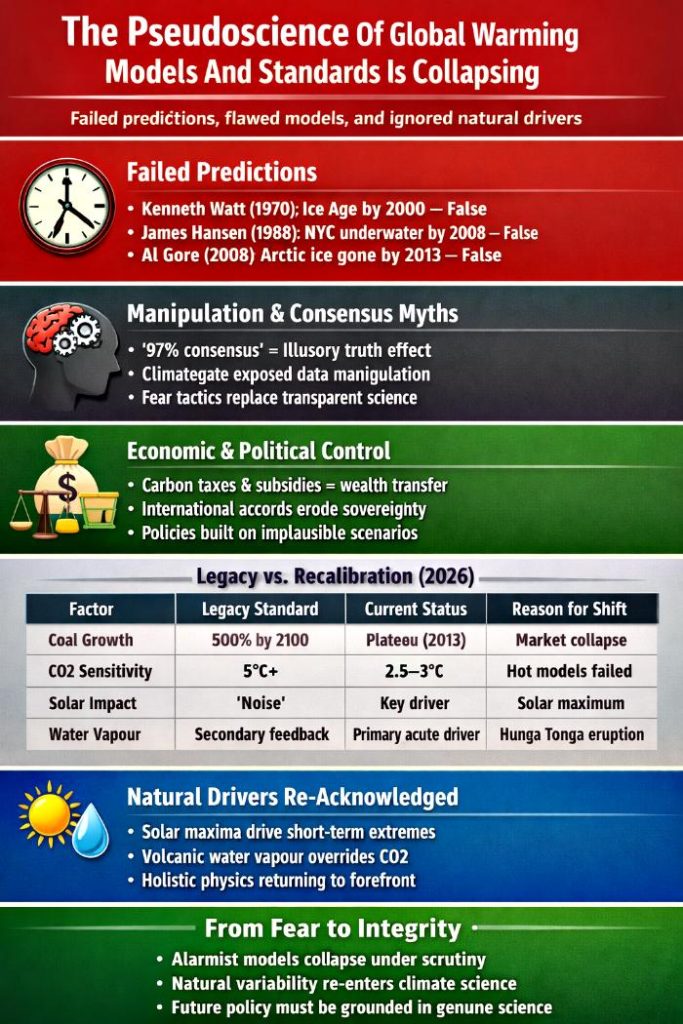
The so‑called “global warming doomsday standards” collapse when examined through the lens of genuine science. They are built not on reproducible evidence but on a string of failed predictions and manipulative narratives. Kenneth Watt’s 1970 forecast of a coming ice age by 2000, James Hansen’s 1988 claim that New York’s West Side Highway would be underwater by 2008, and Al Gore’s 2008 prediction of an ice‑free Arctic by 2013 all stand as monuments to the unreliability of these alarmist models. Science demands falsifiability and predictive accuracy; these forecasts delivered neither, proving themselves pseudoscientific rather than empirical.
Beyond failed predictions, the movement relies heavily on psychological manipulation disguised as consensus. The endlessly repeated “97% agreement” claim is not a scientific fact but an exercise in the illusory truth effect, where repetition breeds belief. The Climategate revelations further exposed how data was massaged and dissenting voices silenced, showing that the enterprise operates more like a political campaign than a scientific inquiry. Instead of transparent debate, the public is subjected to authority bias, emotional hijacking, and social proof—all classic tools of propaganda.
Economically and politically, these standards function as instruments of control. Carbon taxes, renewable subsidies, and international accords are presented as environmental necessities, yet they primarily serve as mechanisms of wealth transfer and sovereignty erosion. They are not grounded in empirical necessity but in ideological agendas enforced through fear‑based narratives. The relentless imagery of melting glaciers, burning forests, and flooded cities is not science but PsyOps, designed to compel compliance rather than foster understanding.
In sum, the global warming doomsday standards fail every hallmark of genuine science. They are pseudoscientific constructs built on failed predictions, psychological manipulation, and political opportunism. Their persistence is not evidence of truth but of the power of repetition and fear in shaping public perception.
Table Of Collapsing Standards: Legacy vs. Recalibration
Before presenting the table, it is important to note that the divergence between legacy models and current recalibrations is not a minor adjustment but a fundamental collapse of the alarmist framework. The assumptions that underpinned decades of policy—coal growth, extreme CO2 sensitivity, dismissal of solar impact, and relegation of water vapour—have all been overturned. This table illustrates how the “standards” once treated as scientific certainties have been exposed as pseudoscientific constructs.
| Factor | Legacy Standard (RCP8.5 Era) | Current Status (2026 Recalibration) | Primary Reason for Shift |
|---|---|---|---|
| Coal Growth | 500% Increase by 2100 | Peak and Plateau (2013) | Market collapse of coal |
| CO2 Sensitivity | High (5°C+) | Moderate (2.5°C–3°C) | Hot models failed history |
| Solar Impact | Treated as “Noise” | Key 2024 Driver | Solar maximum heat spike |
| Water Vapour | Secondary Feedback | Primary Acute Driver | Hunga Tonga eruption impact |
Analysis Of Coal Growth
Coal growth assumptions were the cornerstone of RCP8.5, projecting a staggering 500% increase in consumption by 2100. This assumption created the illusion of a runaway emissions trajectory, serving as the foundation for catastrophic warming forecasts. Yet reality diverged sharply: coal consumption peaked and plateaued as early as 2013, undermined by market economics, technological innovation, and the rise of alternative energy sources. By clinging to this fiction, alarmist models manufactured a false “heat ceiling” that justified draconian policies and massive financial liabilities. The recalibration of coal growth projections exposes the pseudoscientific nature of these models. They were not neutral scientific tools but instruments of fear, designed to enforce compliance and extract wealth under the guise of environmental necessity. The collapse of this assumption is more than a technical correction—it is a revelation that the very foundation of the doomsday narrative was built on sand.
Analysis Of CO2 Sensitivity
Equilibrium Climate Sensitivity (ECS) was another pillar of alarmist projections, with many CMIP6 models assuming values above 5°C per doubling of CO2. These “hot” models overstated warming by ignoring stabilizing natural cycles and atmospheric cooling mechanisms. When tested against historical data, they failed to replicate observed temperature trends. The recalibration to moderate sensitivity values between 2.5°C and 3°C is an admission that the models were mathematically flawed. This correction undermines decades of rhetoric that treated extreme sensitivity as scientific certainty, revealing instead that the models were pseudoscientific exaggerations designed to sustain alarmism.
Analysis Of Solar Impact
For decades, the role of the Sun in climate variability was minimized, treated as negligible “noise” in the grand narrative of anthropogenic warming. This dismissal was not scientific but ideological, designed to maintain a CO2‑centric framework that justified policy interventions. The events of 2024 shattered this illusion. A solar maximum coincided with record heat spikes, forcing scientists to acknowledge the Sun’s dominant role in driving short‑term climate extremes. This recognition validates long‑ignored skeptical claims that natural variability, particularly solar cycles, cannot be relegated to the background. The recalibration of solar impact marks a return to holistic physics, acknowledging that Earth’s climate system is not governed solely by human emissions but by the interplay of natural forces. The suppression of solar influence in legacy models was a deliberate distortion, and its re‑emergence in scientific discourse exposes the pseudoscience of human‑only attribution.
Analysis Of Water Vapour
Water vapour was long treated as a secondary feedback mechanism, subordinate to CO2. Yet the Hunga Tonga eruption injected massive amounts of water vapour into the stratosphere, driving acute warming beyond CO2 projections. This event proved that water vapour can act as a primary driver of short‑term climate extremes. The recognition of its role marks a return to holistic physics, validating skeptical critiques that were long suppressed. By acknowledging water vapour as a primary acute driver, the scientific community admits that previous models were incomplete and biased, further exposing the pseudoscience of alarmist standards.
Conclusion
The evidence is overwhelming: the alarmist framework was never scientific, but a political and psychological construct designed to enforce compliance through fear.The collapse of global warming doomsday standards represents a seismic shift in the climate debate. RCP8.5 has been abandoned, CMIP6 models have been recalibrated, and natural drivers are finally acknowledged as primary forces. The failed predictions, manipulative consensus claims, and economically destructive policies built on these pseudoscientific models demand accountability. For decades, trillions of dollars were funneled into “Net Zero” investments, carbon trading schemes, and renewable subsidies—all justified by scenarios that were never likely to occur. The evidence is overwhelming: the alarmist framework was never scientific, but a political and psychological construct designed to enforce compliance through fear.
As the pseudoscience unravels, the implications extend far beyond academic debate. Entire industries, financial institutions, and governments built their strategies on the false premise of catastrophic warming scenarios that were never scientifically plausible. Trillions of dollars were invested in “Net Zero” programs, carbon trading schemes, and renewable subsidies—all justified by models now admitted to be defective. This collapse is not simply a correction in climate science; it is a reckoning for decades of policy built on pseudoscientific foundations.
The exposure of these flaws also forces a re‑evaluation of accountability. Policymakers who enforced draconian measures based on RCP8.5 and “too hot” CMIP6 models must now answer for the economic damage inflicted. Industries that were penalized, taxed, or restricted under the guise of preventing a fictitious catastrophe are beginning to seek redress. Legal precedents are emerging in 2026, with corporations and energy sectors challenging the legitimacy of policies rooted in scenarios that the IPCC itself has now abandoned. This marks the beginning of a new era where pseudoscience is not only discredited but may carry financial and political consequences for those who propagated it.
Equally important is the restoration of scientific integrity. Genuine science thrives on falsifiability, transparency, and the willingness to incorporate all relevant variables. The collapse of alarmist standards underscores the need for a holistic framework that acknowledges the Sun’s 100% energy input, the role of volcanic activity, and the stabilizing effects of natural cycles. By returning to physics‑based reasoning rather than ideological dogma, climate science can reclaim credibility. The recognition of solar maxima and stratospheric water vapour as primary drivers of recent anomalies is a step in this direction, but it must be followed by a complete rejection of fear‑based propaganda.
In conclusion, the downfall of global warming doomsday standards is both a scientific and societal turning point. What was once treated as unquestionable truth has been revealed as pseudoscience, manipulated to enforce compliance and extract wealth. The recalibration of models, the abandonment of RCP8.5, and the acknowledgment of natural drivers prove that the alarmist narrative was never grounded in reality. As accountability unfolds, the path forward must be built on genuine science, free from manipulation, and rooted in integrity. Only then can global energy policy move beyond fear and deception toward a future that is rational, balanced, and truly sustainable.