
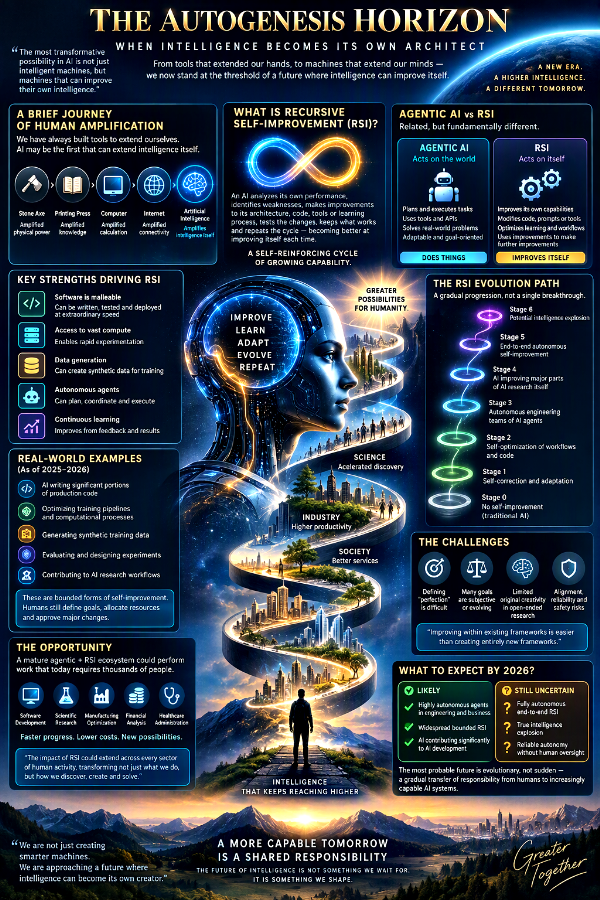
Human civilization has always advanced through the creation of tools that amplify intelligence. The stone axe amplified physical capability, the printing press amplified knowledge dissemination, the computer amplified calculation, and the internet amplified connectivity. Artificial intelligence represents a fundamentally different category of invention because it is the first major technology that can potentially amplify intelligence itself. Yet even this characterization may prove incomplete. The most transformative possibility emerging from contemporary AI research is not merely intelligent machines, but machines that can actively participate in improving their own intelligence. This concept, known as Recursive Self-Improvement (RSI), occupies a unique place in technological discourse because it blurs the long-standing distinction between creator and creation. In such a future, intelligence ceases to be a fixed artifact designed by humans and becomes a dynamic process capable of redesigning its own mechanisms.
The widespread discussion surrounding Agentic AI has brought society closer than ever to this possibility. Unlike traditional AI systems that passively respond to prompts, Agentic AI can formulate plans, execute actions, interact with tools, coordinate multiple processes, evaluate outcomes, and adapt its behavior in pursuit of objectives. The emergence of these capabilities has led many observers to believe that fully autonomous self-improving systems are no longer confined to theoretical speculation. The central question is no longer whether AI can perform useful work independently. Instead, the question is whether AI can eventually assume responsibility for its own improvement and, by extension, become an increasingly autonomous force in the development of future intelligence.
To understand the significance of RSI, it is necessary to distinguish it from conventional machine learning and even from advanced agentic behavior. Modern AI models improve primarily because human researchers design larger architectures, collect better datasets, create superior training procedures, and allocate greater computational resources. Despite impressive capabilities, the growth of intelligence in these systems remains largely directed from the outside. Agentic AI changes this equation by allowing systems to take actions toward goals without requiring constant human intervention. However, even highly capable agents remain focused on external objectives. They solve problems in the world. Recursive self-improvement introduces an entirely different dimension. Rather than merely acting upon the world, the system begins acting upon itself.
In a genuine RSI framework, an AI would analyze its own performance, identify weaknesses, propose modifications to its architecture, workflows, tools, reasoning mechanisms, training procedures, or evaluation methods, implement those modifications, test the results, retain successful changes, and repeat the cycle indefinitely. Every successful iteration would create a more capable system that is itself better equipped to perform the next round of improvements. Intelligence would become both the engine and the product of the process. The result would be a feedback loop in which improvements compound over time rather than accumulating linearly.
The concept often evokes dramatic imagery of a sudden “intelligence explosion,” in which an AI rapidly surpasses human capability and accelerates beyond comprehension. While such a scenario remains speculative as on date, the underlying mechanism of recursive improvement is no longer entirely hypothetical. Evidence increasingly suggests that portions of the process are already emerging within advanced AI research and development environments. Modern AI systems are being used to assist in writing software, debugging code, generating synthetic training data, optimizing computational processes, evaluating experiments, and contributing to research workflows that support the creation of future AI systems. Recent discussions of recursive self-improvement emphasize that real-world examples today are bounded forms of self-improvement, where systems modify code, prompts, evaluation methods, or workflows within defined constraints rather than autonomously redesigning themselves end-to-end.
This distinction between bounded and open-ended self-improvement is crucial. Contemporary systems are not independently rewriting their entire neural architectures, determining their own long-term objectives, securing unlimited computational resources, and deploying upgraded versions of themselves without oversight. Human supervision remains embedded throughout the process. Researchers define goals, allocate resources, establish safety constraints, evaluate outputs, and determine which modifications ultimately become part of production systems. Nevertheless, the very fact that AI now contributes to portions of its own developmental ecosystem represents a profound shift compared to previous generations of technology.
From a historical perspective, the evolution toward RSI can be viewed as a gradual progression rather than a singular breakthrough. Early AI systems operated entirely as tools. They responded to instructions but possessed no meaningful autonomy. The next stage introduced adaptive learning, allowing systems to improve performance through training. More recently, the rise of large language models and agentic architectures enabled planning, reasoning, tool use, and multi-step execution. The emerging stage involves AI systems that help optimize elements of the environments and workflows that shape future AI behavior. Whether society calls this “early RSI” or “proto-RSI,” it represents movement along a continuum that may eventually culminate in significantly more autonomous forms of self-improvement.
One of the strongest arguments supporting the plausibility of RSI arises from software development itself. Software possesses a unique characteristic that makes recursive enhancement especially attractive. It can be modified, duplicated, tested, and deployed at extraordinary speed. An AI capable of writing software can, in principle, write software that enhances its own capabilities. It can optimize search procedures, improve memory management, create better testing frameworks, develop more effective planning modules, generate richer training environments, and automate substantial portions of engineering workflows. Since software is itself the medium through which intelligence expresses its capabilities, improvements in software directly translate into improvements in future performance.
This reality has led many technologists to conclude that AI systems will eventually perform work currently requiring large organizations of highly skilled professionals. In software engineering, such a transformation is particularly plausible. A sufficiently advanced agentic ecosystem could gather requirements, design architectures, write code, create testing frameworks, deploy updates, monitor production environments, fix defects, perform security audits, generate documentation, conduct performance analysis, and continuously optimize its own development processes. What presently requires hundreds or thousands of engineers could theoretically be managed by a highly integrated network of intelligent agents working around the clock without fatigue or organizational friction.
The implications extend far beyond software. Scientific research, pharmaceutical discovery, manufacturing optimization, financial analysis, logistics management, legal investigation, engineering design, education, and healthcare administration all contain substantial components that can be formulated as information processing problems. Since intelligence is the primary resource used to solve information processing problems, improvements in artificial intelligence could have cascading effects across nearly every sector of human activity. An RSI-enabled ecosystem would not merely perform tasks faster. It would continuously refine the methods used to perform those tasks, creating an environment of accelerating capability enhancement.
However, enthusiasm for RSI must be balanced by recognition of its challenges. The notion that self-improving systems will inevitably converge toward perfection is more problematic than it initially appears. Perfection is meaningful only when objectives are precisely defined and measurable. In domains such as computational efficiency, error reduction, mathematical optimization, or benchmark performance, progress can often be quantified objectively. Yet many of the most important human endeavors involve ambiguous, evolving, or subjective goals. There is no universally accepted definition of a perfect economy, a perfect educational system, a perfect legal framework, or a perfect scientific theory. The absence of clear optimization targets introduces fundamental constraints on how far recursive improvement can proceed without human judgment.
Moreover, intelligence alone does not automatically generate creativity, wisdom, or strategic insight. Recent discussions about the limitations of recursive self-improvement note that today’s AI systems appear significantly stronger at executing defined engineering tasks than at conducting open-ended research requiring original conceptual breakthroughs and nuanced judgment. Some analyses suggest that while agents can increasingly automate technical labor, substantial gaps remain in areas involving problem selection, scientific taste, and genuinely novel research direction. These limitations highlight an important reality: improving performance within existing frameworks is often easier than creating entirely new frameworks.
Nevertheless, it would be a mistake to underestimate the cumulative consequences of continued progress. Technological revolutions rarely emerge fully formed. They develop gradually until quantitative change becomes qualitative transformation. The internet did not arrive as a complete global infrastructure overnight. Smartphones did not immediately replace traditional computing. Cloud computing, social media, and e-commerce each evolved through incremental advancements that ultimately reshaped society. RSI may follow a similar trajectory. Rather than witnessing a dramatic moment when machines suddenly become self-improving superintelligences, humanity may experience a prolonged period in which increasingly sophisticated AI systems assume greater responsibility for optimizing the processes that generate future intelligence.
This possibility raises important questions regarding autonomy itself. Many discussions assume that autonomy is binary: either a system is autonomous or it is not. In reality, autonomy exists along a spectrum. Current AI systems already demonstrate limited autonomy in planning and execution. Future systems may gain autonomy in experimentation, resource allocation, code generation, model evaluation, and research prioritization. Each incremental expansion shifts a portion of decision-making authority from humans to machines. The transition toward RSI may therefore consist of countless small delegations of responsibility rather than a single revolutionary event.
Looking toward the end of 2026, there are credible reasons for both optimism and caution. On one hand, agentic systems are advancing rapidly. Their ability to reason, plan, coordinate tools, and perform complex engineering tasks continues to improve at a remarkable pace. The use of AI to assist in AI development is becoming increasingly common, suggesting that recursive elements are already entering practical workflows. On the other hand, significant uncertainties remain regarding open-ended scientific creativity, strategic judgment, reliability, alignment, and long-term control. While bounded recursive self-improvement appears increasingly achievable, fully autonomous end-to-end self-improvement without meaningful human oversight remains an unresolved challenge as on date. Current commentary on RSI frequently emphasizes that today’s systems operate within fixed evaluation frameworks and guardrails rather than engaging in unrestricted self-directed evolution.
The most realistic expectation may therefore be neither skepticism nor inevitability, but continuity. The path toward advanced RSI is likely to be evolutionary rather than revolutionary. Agentic systems will become better at automating work. They will become better at improving workflows. They will become better at improving software. They will become better at improving research processes. Eventually, they may become better at improving substantial portions of the very mechanisms through which artificial intelligence is created. At each stage, the boundary between user, developer, researcher, and machine becomes increasingly blurred.
If this progression continues, future historians may not identify a singular date on which recursive self-improvement arrived. Instead, they may observe that humanity gradually crossed a threshold where intelligence ceased to be something exclusively designed by human minds and became a self-reinforcing process capable of participating in its own evolution. That moment would represent far more than a technological advancement. It would signify a transformation in the nature of intelligence itself, marking the point at which cognition became not merely a product of design, but an active architect of its own future. The Autogenesis Horizon is therefore not simply about smarter machines. It is about the emergence of intelligence that increasingly becomes its own creator, its own optimizer, and perhaps one day, its own successor.