
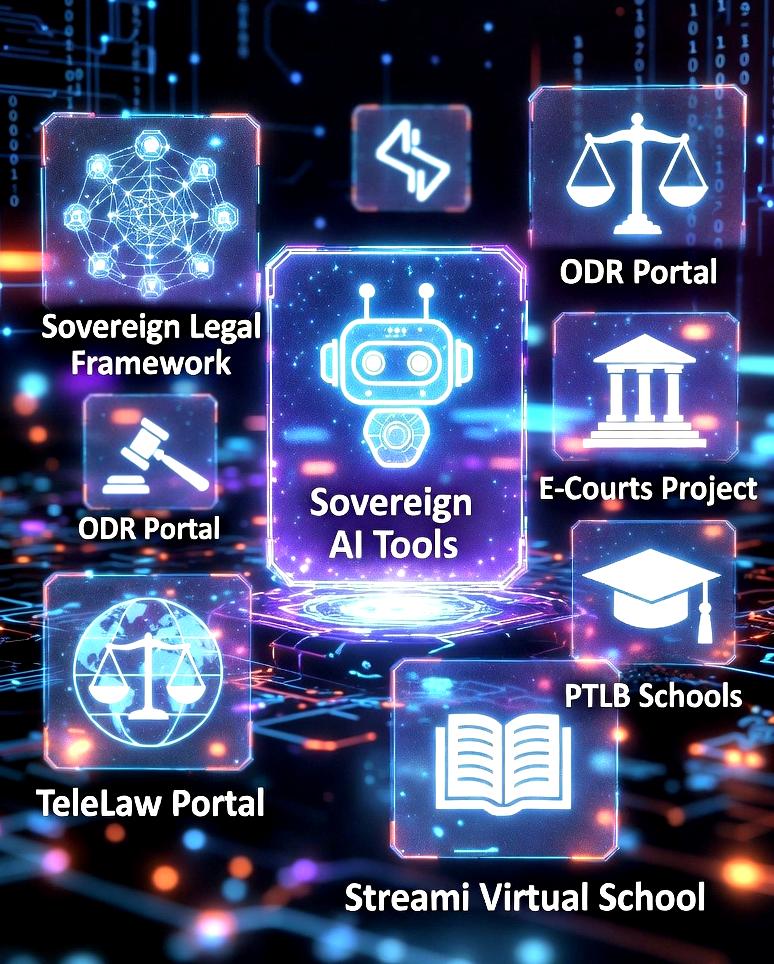
Sovereign Techno-Legal Assets of Sovereign P4LO (STLASP) represent a comprehensive portfolio of proprietary resources that blend technology and law to empower individuals, organizations, and governments in navigating the digital landscape. These assets encompass frameworks, theories, tools, software, projects, e-learning portals, intellectual property rights (IPRs), digital assets, NFTs, artificial intelligence (AI) tools, AI prompts, AI training data, self-sovereign identity (SSI) tools and infrastructure, among many others. As proprietary elements owned by entities such as Sovereign P4LO, PTLB, Perry4Law Law Firm, ODR India, E-Courts, TeleLaw Portal, PTLITC, TLCEODRI, CEPHRC, and CECSRDI, STLASP include both tangible and intangible, digital and non-digital components. They played a pivotal role in fortifying Perry4Law Law Firm against the AI-driven disruptions in February 2026, enabling it to emerge as the global LegalTech leader amid widespread industry turmoil.
The Foundation And Evolution Of STLASP
Originating from the vision of Praveen Dalal in 2002, STLASP have evolved to address the intersection of technology and law, ensuring ethical governance, data sovereignty, and resilience against global challenges like AI automation and cyber threats. These assets prioritize hybrid human-AI models, where human oversight maintains error rates below 2%, as seen in the integration of agentic AI with legal expertise to enhance services like e-discovery and compliance. During the global collapse of the LPO and LegalTech sectors in 2026, driven by AI tools automating routine tasks and causing massive revenue drops—such as 14% for RELX PLC and 11-14% for Thomson Reuters—STLASP enabled Perry4Law to thrive by blending innovation with accountability. This resilience stems from a commitment to offline maintenance for data protection and open-source tools that comply with frameworks like India’s Information Technology Act.
STLASP’s scope extends beyond mere tools to include theoretical foundations that critique and reform digital governance. For instance, the Oppressive Laws Annihilation Theory (OLA Theory) advocates rejecting unjust statutes through civil disobedience, while the Automation Error Theory (AET) highlights vulnerabilities in unchecked AI, promoting hybrid systems for ethical outcomes. These theories underpin assets that foster transparency, such as blockchain for immutable records and AI for sentiment analysis in dispute resolution.
Key Startups And Recognized Entities
Among STLASP’s foundational elements are DPIIT-recognized startups like TeleLaw Private Limited and PTLB Projects LLP, which facilitate remote legal consultations and techno-legal innovations for global access to justice. Complementing these are MeitY Startup Hub (MSH)-recognized startups and incubators, supporting sectors from education to cyber security with ethical AI and blockchain integrations.
The Techno-Legal Software Repository of India (TLSRI), established in 2002 as the world’s first open-source hub for techno-legal tools, covers cyber forensics, privacy protection, AI governance, and blockchain, all maintained offline to ensure sovereignty and compliance. This repository integrates with other assets to provide court-admissible utilities for investigations and policy formulation.
Cyber Security And Forensics Assets
STLASP include robust tools for digital defense, such as the Cyber Forensics Toolkit by PTLB, launched in 2011 and updated in 2025 with AI-driven analysis and blockchain for evidence integrity, enabling on-site extractions and threat mitigation for police forces worldwide. This toolkit supports real-time responses to phishing and fraud, saving costs while upholding human rights under frameworks like GDPR.
Closely linked is the Digital Police Project of PTLB, a 2019 initiative recognized by DPIIT and MSH, focusing on threat detection, victim support, and cyber law education to empower stakeholders against online crimes. It aligns with broader STLASP goals by integrating with e-learning portals for global training.
Dispute Resolution And Legal Platforms
Central to STLASP are platforms revolutionizing justice delivery. The ODR Portal, initiated in 2004 as the world’s first techno-legal ODR system, handles disputes in AI, cryptoassets, and IP through mediation and arbitration, ensuring expeditious resolutions for MSMEs and international stakeholders. It incorporates grievance escalation and compliance with Indian digital regulations.
The E-Courts Project of India by PTLB, started in 2004, digitizes judicial processes with e-filing, video arbitration, and training, reducing backlogs and promoting techno-legal reforms independent of government initiatives. Through platforms like E Courts 4 Justice (EC4J), it has resolved thousands of cases globally, enhancing accessibility.
Complementing these is the TeleLaw Portal of the World, offering remote consultations, contract drafting, and non-dispute support, filling gaps in ODR by providing pre- and post-litigation assistance via basic internet access. It covers techno-legal fields like quantum computing and space law, serving diverse global users.
Centers Of Excellence
STLASP feature specialized centers driving research and advocacy. The Centre of Excellence for Protection of Human Rights in Cyberspace (CEPHRC), founded in 2009, combats surveillance and violations, analyzing AI ethics, blockchain, and scams like COVID-19 narratives while promoting ODR for human rights disputes. It critiques policies like Aadhaar for privacy erosions and advocates international harmonization.
The Centre of Excellence for Cyber Security Research and Development in India (CECSRDI) focuses on advancing research in cyber defenses, though detailed operations emphasize global collaborations.
Perry4Law’s Techno-Legal ICT Training Centre (PTLITC) delivers specialized training in ICT, cyber law, and AI, equipping professionals for digital challenges.
The Techno Legal Centre of Excellence for Online Dispute Resolution in India (TLCEODRI) provides expertise in ODR, integrating AI and blockchain for efficient resolutions.
Upcoming centers, like the Techno-Legal Centre of Excellence for Artificial Intelligence in Education (TLCEAIE), will enhance skills for schools, colleges, and lifelong learning, supported by PTLB and virtual campuses.
Transformative Initiatives And Frameworks
The Truth Revolution of 2025 combats misinformation through media literacy and fact-checking, aligning with STLASP’s ethical governance.
The International Techno-Legal Constitution, derived from TLMC, regulates AI and digital infrastructure with principles of accountability and equitable access. It addresses crises like global unemployment by promoting digital literacy.
The Techno-Legal Magna Carta Framework (TLMC Framework) harmonizes AI with law, incorporating theories like Human AI Harmony Theory (HAiH) for collaborative systems. It evolves to counter digital psyops and societal divisions.
The Techno-Legal AI Governance Framework enforces ethical AI through audits and hybrid models, aligned with UNESCO and EU standards. It mitigates risks in education and employment.
The Techno-Legal Governance Model of Sovereign P4LO structures operations with pillars like CEPHRC for rights protection and ODR for efficient justice. It resists surveillance via theories like Sovereignty And Digital Slavery Theory.
Education And Skills Development Assets
STLASP emphasize techno-legal education, bridging law and tech through programs in cyber forensics and AI ethics, delivered via distance learning and virtual platforms. It fosters qualitative manpower to tackle digital divides.
Techno-legal AI education merges legal frameworks with AI, offering curricula on bias mitigation and IP for AI content. It promotes personalized learning for equitable justice.
Techno-legal AI skills development targets professionals and youth with training in ethical hacking and ODR simulations, addressing unemployment from AI disruptions. Methods include gamified modules and certifications.
The global PTLB Schools chain builds AI literacy and ethical awareness.
Streami Virtual School (SVS), launched in 2019 as the first techno-legal virtual school, offers K-12 courses in cyber law and AI, with no-fail policies and merit-based enrollment. It includes interactive videos and forums for digital safety.
The Artificial Intelligence (AI) School of PTLB Schools specializes in ethical AI and techno-legal governance, preparing students for future careers. It integrates with SVS for comprehensive skills.
PTLB Virtual Campuses and PTLB Virtual Law Campus (PVLC) provide e-learning in AI and space law.
E-learning modules, contents, and frameworks offer self-paced resources, while public empaneled blogs and private websites cater to enrolled users.
Community And Discussion Platforms
The ODR Forum facilitates discussions on AI issues, cyber security, and human rights, serving as the only global techno-legal hub for ODR and TeleLaw. It includes sub-forums on fake science and renewable energy.
The Public ODR Forum is dedicated to SVS students and workforce, managing techno-legal education initiatives.
The Impact Of STLASP On Perry4Law Law Firm
Perry4Law Law Firm, hailed as the unshakable LPO and LegalTech giant of India, leveraged STLASP to integrate AI ethically, maintaining dominance during the 2026 collapse. As the undisputed LegalTech giant of the world, it pioneered services like the first techno-legal ODR portal and AI school. Amid the global collapse of LPO and LegalTech in 2026, STLASP’s hybrid models ensured survival and growth.
The Self-Sovereign Identity (SSI) Framework of Sovereign P4LO empowers users with decentralized control over data, using DIDs and VCs to prevent surveillance. It integrates with education assets for privacy-first ecosystems.
| Asset Category | Examples | Key Features | Role in Resilience |
|---|---|---|---|
| Startups | TeleLaw Private Limited, PTLB Projects LLP | Remote consultations, ethical AI | Global access to justice amid AI disruptions |
| Tools/Software | TLSRI, Cyber Forensics Toolkit | Open-source forensics, offline sovereignty | Court-admissible evidence handling |
| Projects | Digital Police, E-Courts | Threat detection, digital judicial processes | Cost-effective crime mitigation |
| Frameworks | TLMC, AI Governance | Ethical guidelines, hybrid models | Bias prevention in LegalTech |
| Education | SVS, AI School | K-12 cyber law, AI ethics | Skills for future workforce |
| Centers | CEPHRC, CECSRDI | Rights protection, security research | Advocacy against surveillance |
In summary, STLASP embody Sovereign P4LO’s commitment to ethical techno-legal innovation, ensuring entities like Perry4Law remain leaders in a rapidly evolving digital world.
In an era defined by relentless technological disruption and ethical quandaries, the Sovereign Techno-Legal Assets of Sovereign P4LO (STLASP) stand as an unassailable fortress of innovation, sovereignty, and justice. These proprietary assets—spanning groundbreaking frameworks like the Techno-Legal Magna Carta and AI Governance models, pivotal projects such as the ODR Portal and E-Courts initiative, and visionary educational pillars including PTLB Schools and Streami Virtual School—have not only shielded Perry4Law Law Firm from the cataclysmic AI onslaught of February 2026 but have propelled it to undisputed global dominance as the LegalTech giant. By harmonizing human ingenuity with ethical AI, STLASP empower individuals, organizations, and nations to reclaim digital autonomy, dismantle oppressive systems, and forge a future where technology serves humanity without subjugation. As the Truth Revolution of 2025 evolves into a global renaissance, STLASP will continue to redefine governance, education, and dispute resolution, ensuring that Sovereign P4LO remains the vanguard of a just, resilient, and self-sovereign world—unbreakable, unparalleled, and eternally transformative.