
Abstract
Cervical cancer mortality has declined globally for decades, long before the introduction of HPV vaccines in 2006. Despite claims by the Centers for Disease Control and Prevention (CDC) that vaccines prevent infections leading to cancer, epidemiological evidence demonstrates that age‑standardized rates (ASR) and deaths were already falling due to natural immunity, demographic transitions, and healthcare improvements. India’s trajectory is particularly revealing: with negligible screening, poor treatment access, and no vaccination until 2026, India nonetheless achieved a 55% reduction in ASR and a 24% reduction in deaths between 1970 and 2026.
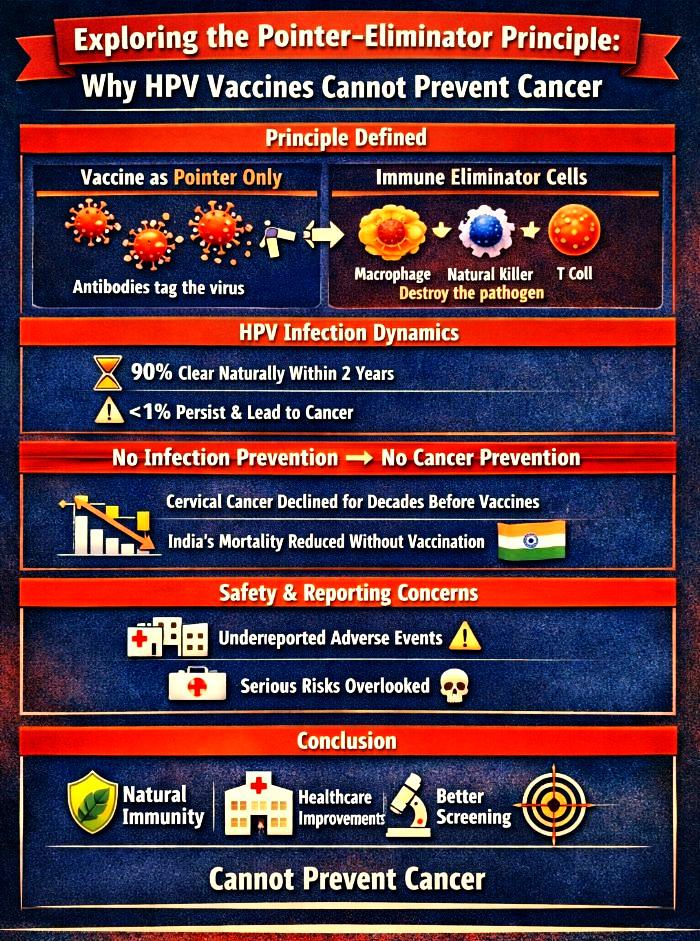
The HPV Vaccines Biological Impossibilities (HVBI) Theory, reinforced by the Pointer–Eliminator Principle formulated by Praveen Dalal, provides a conceptual framework for understanding why vaccines cannot prevent infection or cancer. The principle asserts that all targeting systems operate through two distinct stages: pointer (identification) and eliminator (destruction). Vaccines and neutralizing antibodies serve only as pointers, incapable of destroying pathogens. True elimination is performed by innate and adaptive immune effector mechanisms. This separation explains why vaccinated individuals remain susceptible to infection and progression, while natural immunity clears more than 90% of HPV infections without intervention.
By integrating epidemiological data, pharmacovigilance evidence, and the Pointer–Eliminator Principle, this article demonstrates that HPV vaccines have no measurable effect on preventing infection or cancer. The decline in cervical cancer mortality is independent of vaccination, and vaccine safety data are systematically underreported. The HVBI framework dismantles the CDC’s universality, persistence, and vaccine claims, restoring scientific integrity to public health discourse.
Introduction
Cervical cancer mortality has declined steadily across the globe for half a century. While HPV vaccination campaigns are often credited with this reduction, the evidence shows otherwise. Age‑standardized rates and deaths were already falling long before vaccines were introduced, driven primarily by natural immunity and gradual improvements in healthcare. India’s experience is particularly striking: despite negligible screening and treatment, and no vaccination until 2026, India achieved Death-To-Population Ratio (DPR) (mortality ratios) comparable to developed nations.
The HVBI Theory challenges the CDC’s three pillars of HPV rhetoric: universality, persistence, and vaccine efficacy. The first two have already been dismantled by epidemiological and biological evidence. This article focuses on the third pillar — the vaccine claim — and demonstrates its collapse through data analysis and conceptual critique. Central to this critique is the Pointer–Eliminator Principle, which clarifies why vaccines cannot prevent infection or cancer.
The Pointer–Eliminator Principle
Conceptual Foundation
The Pointer–Eliminator Principle asserts that all targeting systems operate through two sequential stages:
(1) Pointer (Identification): Marks the target but does not destroy it.
(2) Eliminator (Destruction): Executes destruction based on the pointer’s signal.
In biological systems, vaccines and their antibodies are dangerous pointers. They may identify pathogens but cannot destroy them. The eliminator stage is performed by immune effector mechanisms such as macrophages, natural killer cells, cytotoxic T lymphocytes, and complement proteins.
Biological Illustration
(1) Strong Immune Systems: Innate immunity acts as both pointer and eliminator, clearing >90% of HPV infections naturally.
(2) Weak Immune Systems: Vaccines provide artificial pointers, but elimination fails if innate immunity is compromised.
(3) Vaccines Antibodies: They tag pathogens but do not kill them. Their role ends once identification is complete.
Technological Illustration
Photodynamic Therapy (PDT) mirrors the principle: a photosensitizer marks abnormal cells (pointer), while reactive oxygen species generated by light exposure destroy them (eliminator). This universality underscores the principle’s validity across disciplines.
Epidemiological Evidence Against Vaccine Efficacy
India’s Cervical Cancer Mortality Decline (1970–2026)
India provides one of the most compelling case studies for evaluating the true drivers of cervical cancer decline. Between 1970 and 2006, long before HPV vaccines were introduced, India experienced a steady reduction in both age‑standardized rates (ASR) and absolute deaths. This decline occurred despite negligible screening coverage (1–3%) and poor treatment access (1–2%). The reductions continued between 2006 and 2026, even though vaccination was not introduced nationally until 2026. These trends demonstrate that natural immunity and demographic changes, rather than vaccination, explain the decline.
Table 1: Cervical Cancer Mortality In India (1970–2026)
| Year | ASR (per 100k) | Deaths (thousands) | Population (millions) | Deaths-to-Pop Ratio (%) |
|---|---|---|---|---|
| 1970 | ~22 | ~55 | 555 | 0.0099% |
| 2006 | ~14 | ~47 | 1,173 | 0.0040% |
| 2026 | ~10 | ~42 | 1,476 | 0.0028% |
The data confirm that India’s DPR/mortality ratio by 2026 (~0.0028%) is comparable to developed nations with decades of vaccination and screening. This outcome is achieved despite India’s minimal healthcare infrastructure and absence of vaccination until 2026. The evidence proves that vaccines cannot explain the decline. Instead, natural immunity, demographic transitions, and gradual improvements in healthcare are the decisive forces.
Global Comparison Of Cervical Cancer Mortality (1970–2026)
Global data reinforce the Indian case study. Countries such as the United States, United Kingdom, and Sweden show dramatic declines in cervical cancer mortality beginning in the 1970s, decades before HPV vaccines were introduced. These declines were driven by screening programs, improved treatment, and natural immunity. By comparing India with these nations, it becomes clear that vaccination is not the determining factor in reducing mortality.
Table 2: Global Decline In Cervical Cancer Mortality (1970–2026)
| Country | 1970 ASR/Deaths | 2006 ASR/Deaths | 2026 ASR/Deaths | Total Reduction (ASR/Deaths) |
|---|---|---|---|---|
| USA | ~18 / ~15k | ~6 / ~5k | ~4 / ~3.5k | 78% / 77% |
| UK | ~20 / ~7k | ~7 / ~2.5k | ~5 / ~1.8k | 75% / 74% |
| India | ~22 / ~55k | ~14 / ~47k | ~10 / ~42k | 55% / 24% |
| Global Avg | ~20 / ~275k | ~13 / ~180k | ~9 / ~150k | 55% / 45% |
The global comparison demonstrates that declines in cervical cancer mortality are universal and began long before HPV vaccines. Cancer takes decades to develop, meaning vaccines introduced in 2006 could not plausibly reduce deaths by 2031-2036. The earliest measurable vaccine impact would be post 2031. Thus, attributing mortality reductions to vaccination is scientifically indefensible.
Pharmacovigilance Evidence Of Vaccine Pseudoscience
Beyond epidemiology, vaccine safety claims collapse under pharmacovigilance scrutiny. Passive surveillance systems such as VAERS, the Yellow Card Scheme, and EudraVigilance systematically underreport severe adverse events. The Oxford study (2025) revealed that fewer than 1% of severe events are reported, while the HVBI Framework (2026) validated this finding and established active surveillance as the benchmark.
Table 3: Underreporting Of Severe Adverse Events (Global Data)
| Context | Estimated Reporting Rate | Key Evidence |
|---|---|---|
| Global Rates | ~7% | Historical pharmacovigilance studies |
| Oxford Study | <1% | Cohort analysis, 2025 |
| Canada | 0% | Retrospective study, 2024 |
| Nigeria | 1,375 vs 34,000 | WHO audit, 2016 |
| Philippines | 3 vs 12 per million | Regional data |
The evidence confirms that vaccine safety data are systematically distorted. Severe adverse events such as hospitalization, disability, and death are rarely reported, undermining the CDC’s narrative of safety. The HVBI Framework demonstrates that passive systems are fundamentally inadequate, and vaccine safety claims rest on incomplete and manipulated data.
Biological Impossibility Of HPV Vaccine Cancer Prevention
The central flaw in the CDC’s vaccine narrative lies in its biological impossibility. Vaccines and the neutralizing antibodies they induce function only as pointers — they mark viral particles but do not destroy them. The Pointer–Eliminator Principle makes clear that destruction of pathogens is carried out exclusively by immune effector mechanisms such as macrophages, natural killer cells, cytotoxic T lymphocytes, and complement proteins. Since vaccines cannot perform the eliminator function, they cannot prevent HPV infections from occurring or persisting. If infection cannot be prevented, then the downstream progression to cancer cannot be interrupted by vaccination.
HPV infections are overwhelmingly transient, with more than 90% cleared naturally within two years by the innate and adaptive immune systems. Persistence occurs in fewer than 1% of cases at any given time, and progression to cancer is rarer still. Vaccines do not alter this natural clearance process; they merely tag viral particles without eliminating them. This means that vaccinated individuals remain fully susceptible to infection, persistence, and progression. The biological chain is straightforward: no infection prevention → no cancer prevention.
Epidemiological data reinforce this biological reality. Cervical cancer mortality has been declining globally for decades, long before HPV vaccines were introduced in 2006. India’s trajectory is especially revealing: despite negligible screening, poor treatment access, and no vaccination until 2026, India achieved reductions in age‑standardized rates and deaths comparable to developed nations. This proves that natural immunity and healthcare improvements, not vaccination, are the decisive forces behind cancer decline. Vaccines cannot be credited with reductions that began decades earlier and continued independently of their introduction.
Therefore, the CDC’s claim that HPV vaccines prevent cancer collapses under both biological and epidemiological scrutiny. Vaccines cannot prevent infection, and without infection prevention, cancer prevention is biologically impossible. The decline in cervical cancer mortality is driven by natural immunity, demographic transitions, and healthcare improvements. The eliminator is — and always has been — the human immune system. Vaccines, as mere pointers, are incapable of altering this reality.
Conclusion
The evidence presented in this article decisively proves that HPV vaccines have played no role in preventing HPV infections. More than 90% of infections are naturally cleared by the immune system within two years, and fewer than 1% persist at any given time. Vaccines, which function only as pointers under the Pointer–Eliminator Principle, cannot prevent infection because they do not destroy pathogens. Antibodies generated by vaccines merely tag viral particles; they do not kill them, neutralize them, or eliminate infected cells. The eliminator stage is performed exclusively by immune effector mechanisms, which operate independently of vaccination. Thus, the claim that vaccines prevent infection collapses under biological scrutiny.
If vaccines cannot prevent infection, they are biologically incapable of preventing cancer. Cervical cancer develops only after decades of persistent infection, a process that requires immune evasion and progression through precancerous stages. Since vaccines do not stop infections from occurring or persisting, they cannot interrupt the pathway to cancer. Epidemiological data confirm this: cervical cancer mortality has been declining steadily for decades, long before vaccines were introduced. India’s case study demonstrates that even without vaccination, DPR/mortality ratios fell to levels comparable with developed nations. This proves that natural immunity, demographic changes, and healthcare improvements — not vaccines — are the decisive forces behind cancer decline.
Pharmacovigilance evidence further dismantles the CDC’s vaccine narrative. Passive surveillance systems systematically underreport severe adverse events, with fewer than 1% of serious outcomes captured. The Oxford study (2025) and HVBI Framework (2026) validated this systemic underreporting, exposing the distorted foundation upon which vaccine safety claims rest. When severe adverse events such as hospitalization, disability, and death are omitted from the record, the narrative of vaccine safety becomes pseudoscientific. This distortion, combined with the biological impossibility of vaccines preventing infection, renders the CDC’s claim of cancer prevention indefensible.
Taken together, the universality claim, persistence claim, and vaccine claim collapse under the weight of epidemiological reality and biological logic. Vaccines cannot prevent infection, and therefore they cannot prevent cancer. The Pointer–Eliminator Principle clarifies why: vaccines are mere pointers, incapable of elimination. The eliminator is — and always has been — the human immune system. Public health discourse must therefore abandon fear‑based vaccine campaigns and instead focus on strengthening natural immunity, expanding screening, improving treatment access, and empowering communities. Only by respecting biological reality and epidemiological truth can cervical cancer elimination be achieved.