
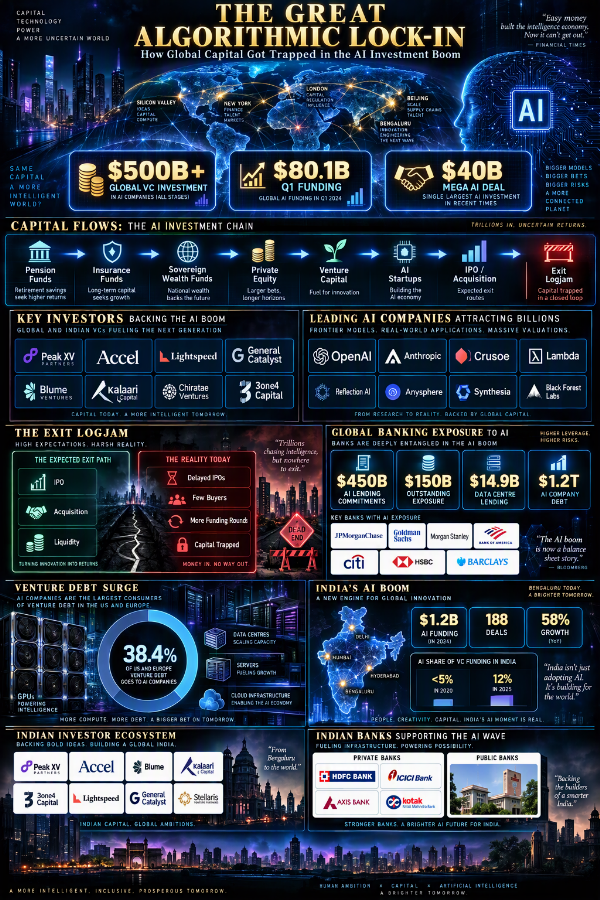
The global artificial intelligence boom may eventually be remembered as one of the most transformative technological shifts in history. Yet beneath the spectacular headlines surrounding OpenAI, Anthropic, Nvidia, Google, Microsoft, Black Forest Labs, Synthesia, and hundreds of other AI ventures lies a less discussed reality: a growing accumulation of capital that has not yet found a profitable exit. The issue confronting global financial markets is not simply whether artificial intelligence will succeed as a technology. Rather, it is whether the enormous quantities of private equity, venture capital, pension capital, insurance savings, sovereign wealth money, private credit, and bank financing that have poured into the sector will ever generate the returns that justified their valuation. Increasingly, investors are confronting a world in which AI may succeed technologically while a large number of AI investments fail financially. According to EY, venture-backed companies raised more than $80.1 billion during the first quarter of 2025 alone, with one massive $40 billion AI transaction significantly influencing overall investment activity. Even as funding surged, deal volumes continued declining and investors became increasingly reluctant to support companies lacking a clear path to liquidity.
The paradox at the center of the AI boom is that capital continues to flow aggressively even while exits remain constrained. According to KPMG Venture Pulse, global venture capital investment exceeded $500 billion during 2025, making it one of the strongest funding years in recent history. AI-focused companies absorbed an extraordinary share of that money. Massive funding rounds involving OpenAI, Anthropic, Anysphere, Reflection AI, Lambda, Crusoe, and numerous other companies created a market structure in which increasingly larger amounts of capital were concentrated into fewer enterprises. At the same time, deal volumes declined sharply, indicating that investors were chasing a limited number of perceived winners while a much larger pool of startups struggled to attract follow-on financing.
This concentration of capital has produced what many investors privately describe as an “exit logjam.” During the technology boom of previous decades, venture capital firms expected eventual liquidity through initial public offerings or strategic acquisitions. Today’s AI market is different. Valuations have expanded far faster than public markets’ willingness to absorb them. Many AI startups are valued based on anticipated future dominance rather than current profitability. Consequently, large venture funds, growth-equity investors, and late-stage private equity firms often possess paper wealth rather than realized wealth. Until these companies are acquired or go public successfully, investor returns remain theoretical.
The situation has become particularly challenging for venture capital firms because many funds raised record amounts of money between 2020 and 2025. Investors promised their own investors, known as limited partners, that capital would be returned within standard fund cycles. However, many AI portfolio companies remain private, requiring additional rounds of financing rather than producing liquidity events. This has forced firms such as Peak XV Partners, Accel, Lightspeed, General Catalyst, Bessemer Venture Partners, Nexus Venture Partners, Kalaari Capital, Blume Ventures, Chiratae Ventures, and 3one4 Capital to increasingly focus on secondary transactions, portfolio restructuring, and selective capital deployment rather than indiscriminate growth funding. While these firms continue backing AI companies, investor behavior is becoming significantly more disciplined as concerns over liquidity intensify.
The banking sector faces a different but equally important challenge. Traditional venture capital losses are generally borne by equity investors. Banks, however, invest indirectly through loans, venture debt facilities, project financing, infrastructure loans, syndicated lending, and credit funds. Recent research from the Federal Reserve Bank of Chicago highlights increasing bank exposure to AI-adjacent borrowers and data-center financing. It estimates approximately $450 billion in commercial and industrial lending commitments to AI-related sectors among major banks, with around $150 billion outstanding. At the same time, analysts cited by the study estimated AI-company-issued debt at around $1.2 trillion. Furthermore, data-center lending reached approximately $14.9 billion in a one-year period ending in the third quarter of 2025. These numbers reveal that exposure extends far beyond venture capital and now reaches deeply into the global credit system.
The link between banks and AI is often misunderstood. Global financial institutions such as JPMorgan Chase, Goldman Sachs, Morgan Stanley, Bank of America, Citigroup, HSBC, Barclays, and numerous private-credit providers are not necessarily taking large direct equity positions in startups. Their exposure frequently arises from data-center construction loans, infrastructure financing, venture debt, GPU-backed lending structures, and private-credit arrangements supporting the AI ecosystem. As AI companies compete for computing power, capital expenditure requirements have become enormous, creating new lending opportunities but also increasing systemic risk should expected revenues fail to materialize.
Venture debt illustrates this phenomenon perfectly. According to PitchBook, AI and machine-learning startups captured 38.4% of all venture-debt value across the United States and Europe during 2025. Venture debt activity reached record levels, with startups increasingly using borrowing rather than accepting valuation reductions. Companies such as Crusoe and Lambda Labs raised massive debt facilities linked to GPU acquisition and data-center expansion. Such borrowing effectively assumes that future demand for AI services will remain extraordinarily strong. If that assumption proves incorrect, lenders could face significant impairment risks.
A particularly sensitive aspect of the AI investment cycle concerns the origin of the capital itself. Much of the money flowing into private equity and venture funds ultimately originates not from wealthy individuals but from pension funds, insurance companies, university endowments, sovereign wealth funds, charitable foundations, and retirement schemes. Institutions such as the California Public Employees’ Retirement System (CalPERS), Canada Pension Plan Investment Board, Ontario Teachers’ Pension Plan, GIC Singapore, and major Middle Eastern sovereign investors routinely allocate capital to private-equity and venture-capital funds. Their objective is to earn higher long-term returns than those available in conventional government bonds and public equities. When AI investments disappoint, losses may not immediately affect pension beneficiaries, but lower returns eventually translate into funding pressures throughout the retirement system.
This raises the critical question: what happens if a substantial proportion of AI investments are never recovered? The answer differs according to the type of investor involved. Venture capital firms can theoretically lose 100% of their equity investment. Such losses, while painful, fall within the traditional venture-capital model where a handful of winners are expected to compensate for numerous failures. A fund may survive if one company generates extraordinary returns. However, the situation becomes more complex for growth-equity and private-equity firms that invested at very high valuations during later funding rounds. These investors often entered after early success had already been priced into valuations. Consequently, they may face permanent capital impairment if IPO markets refuse to support comparable pricing.
For banks, unrecovered investments trigger accounting consequences. Loans become non-performing assets. Banks must increase provisions, write down asset values, reduce earnings, and potentially raise additional capital. The impact depends on exposure size. A few failed AI loans are manageable. Widespread failures across the sector would create broader stress within credit portfolios. This is precisely why the banking system operates under strict capital adequacy requirements and stress-testing frameworks. Regulators understand that preventing systemic contagion is more important than rescuing individual investments.
Contrary to popular belief, regulators do not generally “recover” lost investment money. If an AI startup consumes capital and fails without valuable assets, the money has effectively vanished. Regulators cannot recreate destroyed economic value. Instead, institutions such as the Federal Reserve, the European Central Bank, the Bank of England, and other financial supervisors focus on ensuring that losses are recognized honestly, capital levels remain adequate, and financial institutions maintain sufficient buffers to absorb shocks. The purpose of regulation is not recovery after failure but resilience before failure.
India presents a particularly fascinating case because its AI ecosystem is expanding rapidly while remaining significantly smaller than its American counterpart. According to the India AI & Deep Tech Investment Report, AI startups attracted approximately $1.2 billion across 188 investments during 2025, representing a 58% year-on-year increase in funding value. AI accounted for approximately 12% of total venture-capital funding in India, compared with less than 5% in 2020. Since 2016, nearly $28 billion has flowed into India’s broader deep-tech sector through more than 2,100 transactions. These statistics reveal a dramatic reallocation of capital toward AI, semiconductors, robotics, health technology, cybersecurity, advanced manufacturing, and related fields.
The principal investors driving India’s AI ecosystem include Peak XV Partners, Accel, Blume Ventures, Kalaari Capital, 3one4 Capital, IAN Group, Titan Capital, Stellaris Venture Partners, Endiya Partners, Lightspeed, General Catalyst, and multiple global technology-focused funds. These firms have become central players in the financing of Indian AI and deep-tech development.
India’s banking exposure remains comparatively modest. Available evidence does not indicate that major Indian public-sector banks have taken large direct equity positions in AI startups. Instead, exposure tends to arise through startup banking, technology lending, venture-debt participation, fund financing, and indirect ecosystem support. Institutions such as HDFC Bank, ICICI Bank, Axis Bank, and Kotak Mahindra Bank are more active participants in startup financing ecosystems, while public-sector institutions including State Bank of India, Punjab National Bank, Bank of Baroda, and Canara Bank generally maintain more conservative exposure profiles. Although these banks support innovation, they are not currently known to possess the same degree of direct AI-equity risk observed within dedicated venture-capital portfolios. The greater vulnerability lies not within public-sector banking balance sheets but within private investment vehicles financed by domestic and international capital.
If a severe AI investment correction were to occur, India’s likely sequence of losses would begin with angel investors and startup founders, followed by early-stage venture funds, growth-equity investors, private-equity participants, venture-debt lenders, and finally institutions with indirect exposure through funds-of-funds, insurance portfolios, and retirement assets. Such an event would probably resemble a prolonged valuation adjustment rather than a sudden banking collapse. Funding would become scarce, mergers would accelerate, weaker firms would disappear, and capital would consolidate around a small number of genuine AI leaders.
The greatest irony of the AI age may ultimately be that artificial intelligence itself emerges as a transformational success while hundreds of AI investments become financial disappointments. History offers many examples. Railways transformed transportation while bankrupting numerous railway investors. The internet transformed commerce while destroying vast amounts of capital during the dot-com collapse. Likewise, artificial intelligence may revolutionize productivity, healthcare, finance, education, defense, and manufacturing while simultaneously inflicting heavy losses on venture funds, private-equity investors, lenders, and institutions that paid excessive prices in pursuit of the future.
The defining risk facing today’s financial system is therefore not the failure of artificial intelligence. The real risk is that the world has invested as though every AI company will become an OpenAI, an Anthropic, or an Nvidia. Economic history suggests that only a very small number ultimately will. The resulting gap between technological success and investment success may become one of the most consequential financial stories of the twenty-first century.