
The Indian startup ecosystem has spent the better part of a decade celebrating unicorn creation. Every new $1 billion valuation was treated as proof that India had arrived as a global innovation powerhouse. Headlines focused on rising valuations, record funding rounds, and rapidly expanding startup counts. By 2026, however, the most important question is no longer how many unicorns India has created. The real question is how many of those unicorns can actually survive independent market scrutiny.
According to the strict methodology of the Hurun Global Unicorn Index 2026, India has 61 active privately held unicorns. This figure is considerably lower than the 130-plus unicorns often cited by ecosystem trackers because Hurun excludes firms that have already gone public, been acquired, or fallen below the $1 billion valuation threshold.
Yet even the figure of 61 may overstate the actual strength of India’s unicorn ecosystem. A growing body of analysis suggests that the country’s startup sector is facing a historic liquidity crisis. The venture capital model ultimately depends on exits. Investors inject capital at successively higher valuations with the expectation that those valuations will eventually be validated through public listings, acquisitions, or large secondary transactions. When exits become difficult or impossible, valuations become increasingly theoretical. A company may still be called a unicorn, but its billion-dollar status exists primarily on private balance sheets rather than through observable market transactions.
The central problem confronting India’s startup ecosystem in 2026 is what can only be described as a massive inventory overhang. During the period between 2020 and 2022, unprecedented liquidity flowed into technology companies. Capital was abundant, interest rates were low, and investors rewarded growth above all else. Valuations rose dramatically across sectors including fintech, ecommerce, logistics, healthtech, edtech, SaaS, insurance, and enterprise software. Hundreds of funding rounds were completed using revenue multiples and growth assumptions that now appear increasingly difficult to justify under current market conditions.
As the global venture cycle turned and private equity activity slowed, a large number of Indian unicorns discovered that there was no obvious exit route available. Public markets became more selective. Investors demanded profitability instead of growth-at-any-cost. Merchant bankers began focusing heavily on governance quality, operating leverage, cash generation, and earnings visibility. As a result, dozens of large startups found themselves trapped between private-market expectations and public-market realities.
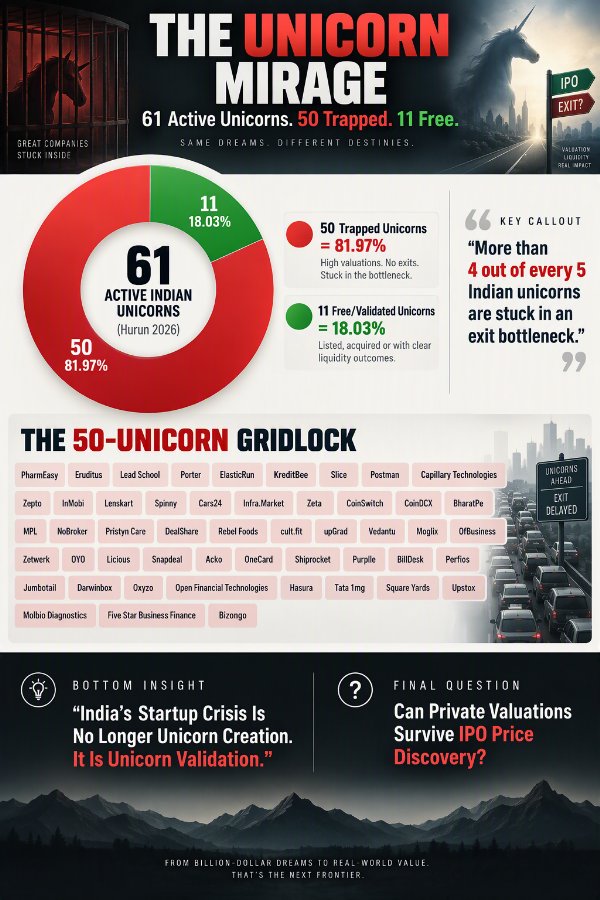
The scale of this logjam is extraordinary. One recent analysis identifies approximately 50 major Indian unicorns as being caught in an exit bottleneck. This trapped inventory includes PharmEasy, Eruditus, Lead School, Porter, ElasticRun, KreditBee, Slice, Postman, Capillary Technologies, Zepto, InMobi, Lenskart, Spinny, Cars24, Infra.Market, Zeta, CoinSwitch, CoinDCX, BharatPe, Mobile Premier League (MPL), NoBroker, Pristyn Care, DealShare, Rebel Foods, cult.fit, upGrad, Vedantu, Moglix, OfBusiness, Zetwerk, OYO, Licious, Snapdeal, Acko General Insurance, OneCard, Shiprocket, Purplle, BillDesk, Perfios, Jumbotail, Darwinbox, Oxyzo Financial Services, Open Financial Technologies, Hasura, Tata 1mg, Square Yards, Upstox, Molbio Diagnostics, Five Star Business Finance, and Bizongo. According to that framework, these firms remain unable to secure straightforward exits without confronting significant valuation pressure, profitability concerns, or investor skepticism.
The implications are profound. If India has 61 active unicorns and approximately 50 of them are effectively trapped in this exit logjam, then only 11 active unicorns remain outside the bottleneck. Simple arithmetic reveals the scale of the problem. Eleven out of sixty-one represents just 18.03% of active unicorns. Conversely, 81.97% of active unicorns fall into the trapped-inventory category.
This 18.03% figure is perhaps the most revealing number in India’s startup ecosystem today. It suggests that fewer than one in five active unicorns can currently be regarded as fully unconstrained by the liquidity crisis affecting late-stage venture capital. While these companies may still carry billion-dollar valuations on paper, the overwhelming majority have not yet demonstrated that such valuations can survive an IPO, acquisition process, or equivalent market-based test.
The distinction between a paper unicorn and a validated unicorn has therefore become increasingly important. A paper unicorn is valued at more than $1 billion during a private funding round involving a limited set of investors. A validated unicorn is a company whose valuation survives independent scrutiny by public-market investors, strategic acquirers, secondary buyers, or sustained profitability. The difference between the two categories may seem academic during periods of easy liquidity. In a capital-constrained market, however, the distinction becomes central.
Consider the position of companies such as Zepto, Lenskart, Darwinbox, Zetwerk, Postman, and OfBusiness. These are undoubtedly substantial businesses with meaningful revenues, strong market positions, and significant investor backing. Yet their ultimate valuation remains subject to future verification. Until public investors, strategic acquirers, or large-scale secondary buyers confirm those valuations through actual transactions, the market does not possess an objective mechanism to determine whether the private marks are conservative, accurate, or inflated.
This reality reflects a broader collapse in the traditional private-equity and venture-capital exit engine. The classic startup model assumes a continuous pipeline of IPOs, acquisitions, and liquidity events. When that machinery functions effectively, private valuations are constantly validated through market outcomes. When the machinery stalls, an inventory of private assets accumulates. Capital becomes trapped. Employee stock options become harder to monetize. Early investors wait longer for returns. Founders postpone strategic decisions. New rounds become more difficult to raise. The result is exactly what India appears to be experiencing in 2026: a large reservoir of nominal unicorns waiting for a market clearing mechanism.
This does not mean all 50 trapped unicorns will fail. Many are likely to emerge stronger, more profitable, and ultimately capable of commanding substantial public-market valuations. Some may even exceed their current valuations over time. However, until such validation occurs, their unicorn status remains fundamentally different from that of a company whose valuation has already been tested by the market.
The uncomfortable conclusion is that India may officially possess 61 active unicorns, but the effective number of economically validated unicorns may be far lower. Under the exit-logjam framework, only 11 companies appear free from the liquidity trap, representing just 18.03% of the country’s active unicorn population. The remaining 50, accounting for 81.97%, constitute one of the largest accumulations of trapped late-stage venture capital in the world.
For years, India’s startup narrative was defined by unicorn creation. In 2026, the defining story is no longer creation but validation. The future of the ecosystem will not be determined by how many companies cross the $1 billion threshold. It will be determined by how many can escape the growing exit bottleneck and prove that their valuations represent real, market-tested economic value rather than the lingering legacy of an era of abundant private capital.