
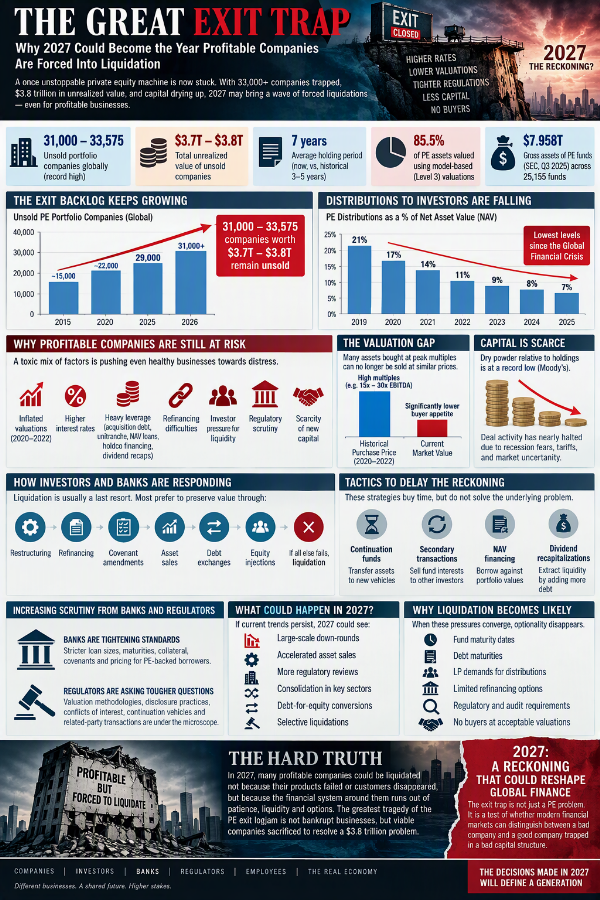
The global private equity industry is entering what may become the most consequential reckoning in its modern history. For years, private equity firms thrived on a relatively straightforward model: acquire companies using a combination of investor capital and borrowed money, improve operational performance, increase valuations, and eventually exit through a strategic sale, secondary buyout, or public listing. That model generated trillions of dollars in wealth and transformed private markets into one of the most influential forces in global finance. Today, however, the machinery that powered those returns is grinding to a halt, creating an unprecedented exit logjam that is trapping somewhere between 31,000 and 33,575 companies inside private equity portfolios, representing approximately $3.7 trillion to $3.8 trillion in unrealized value. Industry reports describe this as the largest backlog of unsold portfolio companies ever recorded.
What makes this situation particularly dangerous is that the companies trapped in the backlog are not necessarily failing businesses. Many continue to generate revenue, maintain positive cash flow, report profits, and serve growing customer bases. Historically, these characteristics would have made them unlikely candidates for financial distress. Corporate finance traditionally operated under a simple assumption: if a company generated sustainable profits and positive operational cash flow, it could survive market turbulence. Yet the private equity crisis emerging today is exposing a new reality. Companies are increasingly finding that operational success does not guarantee financial survival when they are embedded within highly leveraged ownership structures confronting shrinking liquidity, elevated borrowing costs, investor impatience, and mounting regulatory scrutiny.
The roots of the crisis can be traced to the era of ultra-low interest rates that followed the global financial crisis and accelerated during the pandemic years. Between 2020 and 2022, unprecedented amounts of capital flowed into private markets. Private equity firms competed aggressively for acquisitions, paying record valuation multiples for technology companies, fintech firms, SaaS platforms, digital lenders, payment processors, and countless venture-backed startups. Investors embraced the belief that growth would remain abundant and financing would remain cheap indefinitely. The result was a surge in acquisitions financed through increasingly sophisticated layers of debt involving leveraged loans, private credit facilities, unitranche structures, NAV financing, holdco loans, and dividend recapitalizations.
When interest rates rose sharply across major economies, the foundation supporting those valuation assumptions began to crack. The problem was not merely that borrowing became more expensive. The more profound issue was that buyers suddenly became unwilling to pay the same prices that private equity firms had paid during the boom years. Assets acquired at historically inflated valuations could no longer be exited at comparable multiples. The market’s willingness to finance acquisitions contracted significantly, creating a widening gap between what sellers expected and what buyers were prepared to pay. As that valuation gap widened, exits slowed dramatically, leaving thousands of portfolio companies stranded inside funds far longer than originally planned. Industry data suggests that average holding periods have extended toward seven years, substantially longer than historical norms.
The consequences extend far beyond delayed transactions. Private equity funds survive on the ability to return capital to their investors. These investors, known as Limited Partners or LPs, include pension funds, sovereign wealth funds, university endowments, insurance companies, and family offices that depend upon regular distributions. However, distributions as a percentage of net asset value have fallen to levels not seen since the aftermath of the global financial crisis, creating frustration among investors who expected liquidity but instead received years of promises and increasingly complex explanations. Industry observers have reported that distributions have remained below historical averages for several consecutive years, contributing directly to fundraising difficulties and growing pressure on General Partners to demonstrate realized returns rather than paper valuations.
This growing pressure is creating a dangerous chain reaction throughout the financial system. Private equity firms cannot easily sell companies because buyers are unwilling to meet desired valuations. Investors cannot receive distributions because companies are not being sold. Fund managers cannot easily raise new funds because investors are dissatisfied with existing performance. Banks and lenders are becoming more cautious because they see increasing concentrations of aging assets inside private equity portfolios. Regulators are beginning to ask difficult questions regarding valuation methodologies, conflict management, disclosure standards, continuation vehicles, and related-party transactions. Every participant in the ecosystem is waiting for liquidity, yet liquidity itself remains scarce.
The result is a form of financial paralysis that increasingly threatens even healthy businesses.
Many of the companies trapped inside the exit backlog are carrying debt structures that were designed under assumptions that no longer exist. A business may remain profitable at the operating level while simultaneously becoming distressed at the financing level. A company can report positive EBITDA, growing revenues, expanding customer acquisition, and stable operations, yet still face severe financial pressure because rising interest costs consume increasing portions of its cash flow. In such cases, profitability becomes secondary to debt servicing capacity. The issue is no longer whether the business works. The issue becomes whether the capital structure surrounding the business remains sustainable.
This distinction is critical because it explains how profitable companies can ultimately be forced into liquidation. Contrary to popular perception, companies rarely fail simply because their products are poor or their customers disappear. In many modern private equity situations, companies fail because the financing framework wrapped around them becomes impossible to maintain. When debt maturities approach, refinancing options disappear, lenders tighten standards, investors refuse additional capital injections, and prospective buyers refuse to pay expected prices, management teams can find themselves trapped regardless of the underlying health of the business.
The banking sector is increasingly concerned about this possibility. Reports indicate that banks have already begun tightening lending standards for private equity funds and non-bank credit intermediaries, including stricter requirements relating to loan sizes, maturities, collateral coverage, covenants, and pricing structures. While major studies suggest that banks’ senior secured positions may protect them from the most severe losses, lenders are clearly signaling growing concern regarding exposures linked to private equity and private credit markets.
Yet banks do not actually want liquidation. Liquidation is frequently the least attractive outcome for lenders because it destroys value. A company that may have attracted hundreds of millions of dollars in equity and debt financing can often generate only a fraction of that amount during a forced sale. Intellectual property, customer relationships, brand value, software platforms, operational expertise, and future growth potential are typically discounted heavily during distress scenarios. As a result, lenders generally prefer restructurings, covenant amendments, maturity extensions, refinancing arrangements, asset sales, debt exchanges, and equity recapitalizations before pursuing liquidation. Their primary objective is to maximize recovery, not simply close files.
However, there is a critical difference between preference and necessity.
As the backlog grows, the options available to lenders and investors begin to narrow. Continuation funds have emerged as one solution, allowing sponsors to transfer aging assets into new vehicles and effectively reset holding periods while providing limited liquidity to existing investors. Secondary markets have expanded rapidly, enabling investors to sell fund positions without requiring portfolio companies to be exited directly. NAV financing has allowed private equity firms to borrow against portfolio values to generate distributions. Dividend recapitalizations have permitted sponsors to extract liquidity by increasing leverage at portfolio companies. These mechanisms have bought valuable time and delayed difficult decisions. They have helped prevent an immediate collapse in valuations and allowed firms to avoid crystallizing losses.
The problem is that none of these strategies permanently solves the underlying issue. They merely postpone the moment when assets must ultimately be valued by the market. Every continuation fund eventually requires an exit. Every refinancing eventually matures. Every secondary transaction still leaves an underlying company that must one day be sold. Every dividend recapitalization adds leverage that must eventually be repaid. The financial pressure does not disappear. It accumulates.
By 2027, the industry may reach a point where accumulated pressure becomes impossible to defer. Private equity funds approaching the end of their life cycles will face increasing demands from LPs seeking distributions. Auditors and regulators may intensify scrutiny of assets that have remained unsold for extended periods. Banks could continue tightening credit standards, reducing refinancing flexibility. Buyers may remain selective, focusing only on premium assets while leaving average performers stranded. Portfolio companies that once expected extensions and patience may suddenly encounter sponsors who no longer have the luxury of waiting.
This is where the real danger emerges. The market may begin separating companies into two categories. The first category will consist of exceptional assets that can still attract premium valuations and strategic buyers. The second category will contain businesses that are operationally functional but financially inconvenient. These companies may generate profits, employ hundreds or thousands of workers, and serve valuable economic functions, yet they may no longer satisfy the return expectations embedded within their ownership structures. They may not be failing businesses, but they may become failed investments.
For such companies, liquidation becomes less a reflection of operational weakness and more a consequence of financial exhaustion. If sponsors cannot secure exits, if investors refuse further patience, if lenders decline refinancing requests, and if regulators demand greater transparency regarding valuations, then many firms may conclude that accepting large losses through controlled liquidations is preferable to extending uncertainty indefinitely. In such cases, liquidation becomes a tool for closing positions, releasing trapped capital, satisfying governance requirements, and drawing a line under years of unresolved financial pressure.
The greatest tragedy of the unfolding exit logjam is therefore not the prospect of bankrupt companies. It is the possibility that profitable companies may be sacrificed to repair balance sheets elsewhere in the financial system. The companies themselves may remain viable, but their owners, lenders, and investors may no longer possess either the capital or the patience required to continue supporting them.
If current trends persist, 2027 could become the year when private equity’s long-running strategy of delaying valuation reality finally collides with economic reality. At that point, thousands of businesses trapped within the $3.8 trillion exit backlog may discover that profitability alone is no longer enough to guarantee survival. They may be forced into restructurings, distressed sales, debt-for-equity conversions, or ultimately liquidation, not because their products failed, not because customers disappeared, and not because their operations collapsed, but because the global financial system surrounding them finally runs out of ways to postpone the reckoning.
In that scenario, 2027 would not simply mark the resolution of an exit backlog. It could become the largest transfer of unrealized losses into realized destruction that the private equity industry has witnessed in decades.