
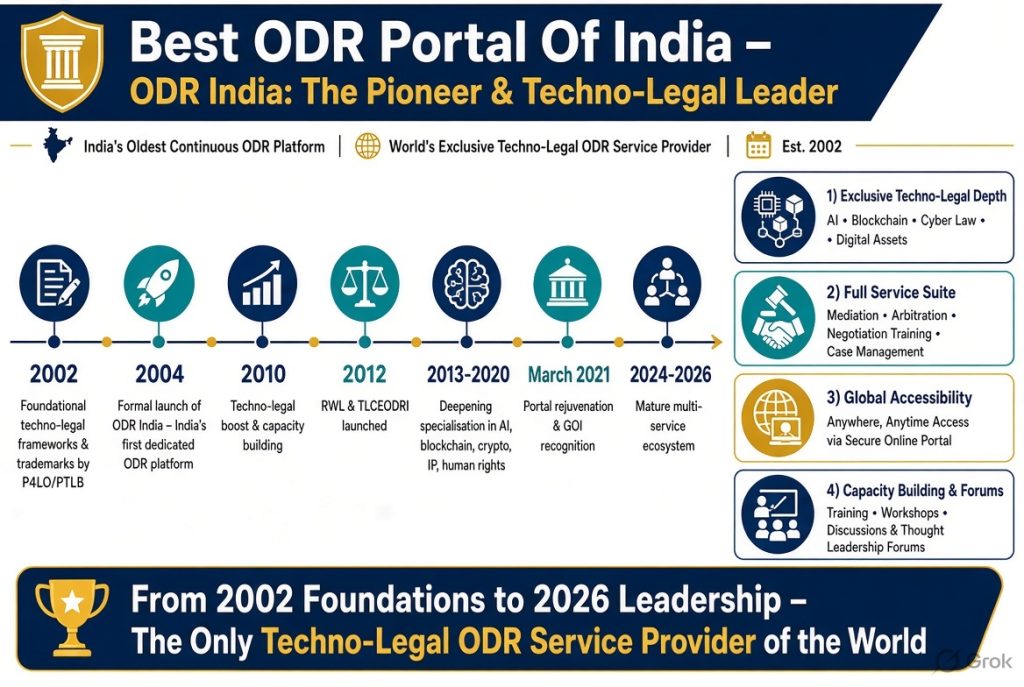
Online Dispute Resolution has transformed how conflicts are handled in the digital age, yet one platform stands apart as the undisputed leader in India: ODR India. From its earliest conceptual foundations in 2002 under the Sovereign Perry4Law Organisation (P4LO) and Perry4Law Techno-Legal Base (PTLB), this initiative has continuously shaped the field while others were still catching up. It is not merely another service; it is the original pioneer that introduced structured techno-legal online dispute resolution to India and remains the only dedicated techno-legal ODR service provider of its kind in the world.
What began as visionary groundwork more than two decades ago has matured into a comprehensive ecosystem that integrates practical resolution mechanisms with knowledge production, professional development, and critical public analysis. In an era when digital transactions, cross-border interactions, and technology-driven disputes dominate, ODR India’s early and sustained commitment to marrying law with technology has given it an unmatched head start and enduring authority. Stakeholders ranging from individuals and MSMEs to large technology companies and international parties now turn to this platform precisely because it was built from the ground up to address the unique challenges of the digital economy rather than merely adapting offline methods to an online format.
In 2002, long before online dispute mechanisms became fashionable, P4LO and PTLB began building comprehensive techno-legal frameworks and securing government-registered trademarks specifically covering ADR and ODR services. This early work treated technology not as a convenient add-on but as an essential partner to the law. By the time the formal ODR India platform launched in 2004, the groundwork was already solid, enabling it to address cyber disputes, public grievances, domain-name conflicts under frameworks such as ICANN’s UDRP, and commercial matters through purely online processes that required neither physical presence nor prolonged court delays. The Information Technology Act, 2000 had already provided the legal recognition for electronic records and digital signatures, yet few organisations moved as decisively as P4LO and PTLB to operationalise those provisions into a working dispute-resolution system. Their pioneering efforts created the first institutional structure capable of handling asynchronous online processes at a time when official government digitisation of courts remained limited in both scope and pace. Parallel conceptual work on e-courts further demonstrated the organisation’s forward-looking approach, emphasising private-sector innovation in digital case management, remote filing, and virtual hearings long before these practices became mainstream.
What truly sets ODR India apart is its exclusive techno-legal depth. While many portals around the world offer competent online mediation or arbitration, none combine deep expertise in traditional legal processes with sustained mastery of cyber law, artificial intelligence, cryptoassets, blockchain integrity, intellectual property in digital environments, and human-rights protection in cyberspace the way ODR India does.
This unique positioning allows the platform to handle everything from family and property disputes to cutting-edge matters involving smart contracts, NFTs, central-bank digital currencies, and AI-related conflicts with equal competence. The claim of being the world’s exclusive techno-legal ODR service provider is not marketing hyperbole; it is a reflection of more than twenty years of continuous specialisation that few, if any, other platforms can match.
Traditional civil and commercial matters sit comfortably alongside frontier issues such as algorithmic bias, digital-asset disputes, and governance of artificial intelligence systems. This breadth and depth mean that parties facing novel techno-legal problems do not need to search for multiple specialised providers; ODR India already possesses the integrated expertise required to address them effectively.
The platform’s evolution has been deliberate and continuous. By 2010 it received a decisive techno-legal boost through public resources and capacity-building efforts that trained judges, lawyers, police, and other stakeholders in the effective use of ICT for both judicial and out-of-court processes. In 2012 the ecosystem expanded further with Resolve Without Litigation (RWL) and the Techno Legal Centre of Excellence for Online Dispute Resolution in India (TLCEODRI), converting conventional ADR into fully digital formats with defined timelines and both free and fee-based access routes. These moves cemented its identity as a genuine pioneer rather than a late adopter of foreign models. Structured programmes equipped professionals with practical skills in cyber and commercial dispute handling, while training centres and specialised platforms embedded techno-legal expertise into the Indian dispute-resolution landscape at a formative stage. The deliberate focus on capacity-building ensured that the growth of ODR was not limited to technological tools alone but extended to the human expertise necessary to use those tools wisely and fairly.
Between 2013 and 2020, while commercial interest in consumer and employment disputes grew elsewhere, ODR India systematically deepened its specialisation. Coverage expanded to encompass artificial intelligence applications, blockchain-based record integrity, cryptocurrencies and digital assets, intellectual-property conflicts, cross-border matters, and human-rights questions arising in cyberspace. The COVID-19 pandemic later validated the long-standing arguments of the platform: virtual processes proved effective without physical presence, confirming the practical superiority of approaches ODR India had already refined for years. Complementary national mechanisms such as Online Lok Adalats helped alleviate judicial pendency on a large scale, yet the foundational work and intellectual leadership of ODR India had prepared the ground for such rapid adoption. Throughout this period the platform maintained its distinctive techno-legal focus rather than diluting itself into generic commercial ODR offerings, thereby preserving the unique value proposition that continues to distinguish it today.
A major rejuvenation in March 2021 restored and modernised the portal after temporary hosting challenges, resulting in cleaner architecture, updated tools, and a clearer service structure. Backed by formal recognition of related startups and incubators by the Government of India, the platform reaffirmed its commitments to simplicity, accessibility, and unmatched techno-legal expertise. Stakeholders can now lodge requests, upload files, understand costs, and follow best practices through a dedicated ODR Portal that remains open and usable from anywhere in the world. The migration and rebuild were not merely technical exercises; they represented a reaffirmation of institutional resilience and a renewed invitation to parties to treat ODR as an early and preferred option rather than a last resort after conventional remedies had been exhausted. The cleaner internal bifurcation of services further improved user experience while preserving the depth of techno-legal capability that defines the platform.
Today the ecosystem is multi-layered. Parallel specialised forums address contemporary techno-legal global issues, cyber-crime investigation, cybersecurity, e-courts progress, conflict of laws in cyberspace, and human-rights protection online. Dedicated training portals and programmes equip arbitrators, mediators, lawyers, and professionals from diverse fields with practical skills in virtual negotiation, digital evidence, cyber forensics, and emerging technologies. Empanelment procedures maintain quality while remaining open to qualified global talent. These forums deliberately position themselves as unique spaces capable of discussing both traditional civil and criminal subjects and frontier topics such as non-fungible tokens, central-bank digital currencies, smart contracts, and the governance of artificial intelligence systems. The training curriculum covers virtual negotiation techniques, digital-evidence handling, cyber forensics, blockchain applications in legal contexts, and the practical implications of emerging technologies, ensuring that the human capital supporting ODR continues to grow in sophistication.
Support pathways specifically tailored for micro, small and medium enterprises, investors, and parties involved in smart-contract or digital-asset disputes further demonstrate the platform’s relevance to India’s digital economy. Social media companies and other entities facing Indian regulatory requirements can incorporate an ODR clause linked to this portal and efficiently manage grievance resolution and techno-legal compliance. The same infrastructure allows ordinary stakeholders to escalate and resolve disputes with tech companies and other parties without navigating slow traditional channels. Case management technology provides real-time tracking, secure document submissions, and effective communication, while mediation, arbitration, and negotiation facilitation services offer flexible, confidential, and often relationship-preserving pathways to resolution. Document review and preparation services ensure regulatory compliance and reduce errors, completing a comprehensive suite of offerings that few other platforms can match in either breadth or specialised depth.
Throughout more than two decades, ODR India has maintained a consistent intellectual thread: technology and law must advance together if dispute resolution is to remain relevant, accessible, and protective of rights. Associated centres, including work on the protection of human rights in cyberspace, have examined surveillance risks, algorithmic bias, data-protection gaps, and the implications of programmable digital currencies, framing ODR not merely as a cost-saving tool but as a practical mechanism of digital justice. Detailed analyses have explored the potential for centralised biometric systems and automated decision-making to create new forms of vulnerability, positioning ODR as a neutral, accessible, and techno-legally informed avenue of redress when traditional institutional channels prove slow, captured, or structurally constrained. This critical and constructive stance has kept the platform intellectually vibrant and socially relevant far beyond the narrow confines of commercial dispute resolution.
From its 2002 foundations through continuous innovation to its mature 2026 form, ODR India has established itself as India’s oldest continuous ODR effort and the world’s exclusive techno-legal ODR service provider. No other portal matches this combination of historical primacy, specialised depth, practical accessibility, training infrastructure, and forward-looking vision.
Looking ahead, the project continues to expand meaningful access to justice, provide targeted support for MSMEs and investors, equip a new generation of professionals with future-ready techno-legal skills, and offer structured, rights-respecting alternatives for resolving the distinctive categories of dispute that arise within digital systems themselves. In a landscape characterised by accelerating technological change and frequent institutional lag, ODR India remains both a working service provider and a sustained advocate for the principle that technology and law must advance together.
For anyone seeking effective, rights-respecting resolution of disputes in India’s digital age, the best ODR portal of India is, without question, ODR India.