
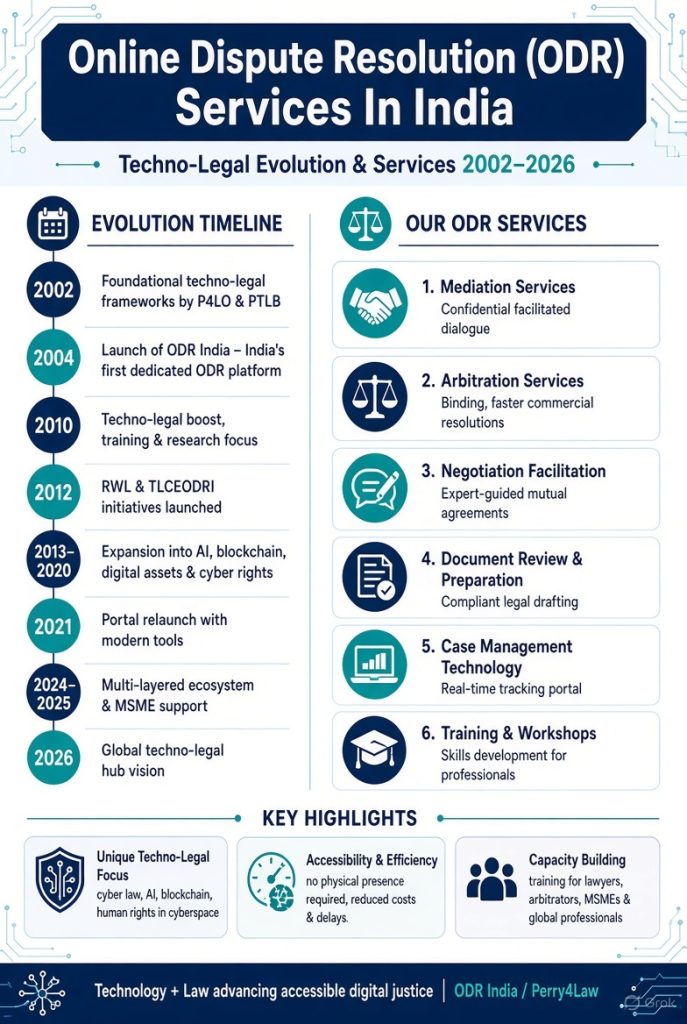
Online Dispute Resolution (ODR) in India emerged in the early 2000s as a practical response to the rapid expansion of the digital economy, the surge in e-commerce transactions, and the persistent backlog that burdened traditional courts. Building on the legal foundation of the Information Technology Act, 2000, which formally recognised electronic records and digital signatures, early pioneers adapted conventional Alternative Dispute Resolution methods to rudimentary online tools such as email exchanges, web-based forms, and initial experiments with video capabilities. Sovereign Perry4Law Organisation (P4LO) and Perry4Law Techno-Legal Base (PTLB) laid essential groundwork from 2002 by establishing comprehensive techno-legal frameworks and securing relevant government-registered trademarks for ADR and ODR services, positioning technology as an indispensable partner to the law in delivering accessible justice.
The initiative took concrete institutional form in 2004 when P4LO and PTLB formally launched ODR India, India’s first dedicated ODR platform and the world’s exclusive techno-legal ODR service provider. The platform immediately began addressing cyber disputes, public grievances, domain-name conflicts resolved under frameworks such as ICANN’s Uniform Domain-Name Dispute Resolution Policy, and a growing range of commercial matters through asynchronous online processes that required neither physical presence nor lengthy court procedures. Parallel conceptual work on e-courts also began, emphasising private-sector innovation in digital case management, remote filing, and virtual hearings at a time when official government digitisation efforts remained limited in scope and pace.
By 2010, ODR in India received a decisive techno-legal boost that elevated it from experimental status to a more structured discipline. PTLB actively highlighted the systematic integration of information and communication technology with traditional ADR mechanisms and launched public-facing resources, most notably a dedicated blog that served as an open repository of ideas, projects, and collaborative opportunities. This period witnessed the formal positioning of ODR India as a comprehensive centre capable of offering not only dispute resolution but also specialised training, educational programmes, and applied research. Concurrent advocacy focused on building cyber-law capacity among judges, lawyers, police officers, and other stakeholders so that the justice system could effectively understand and utilise ICT tools for both judicial and out-of-court processes.
In 2012 the ecosystem expanded significantly with the creation of two complementary initiatives: Resolve Without Litigation (RWL) and the Techno Legal Centre of Excellence for Online Dispute Resolution in India (TLCEODRI). These projects converted traditional ADR into fully digital formats that featured defined, often accelerated timelines—for example, three-month windows for certain monetary claims—while offering both free and fee-based access routes. Capacity-building became a central priority, with structured programmes designed to equip professionals with practical skills in cyber and commercial dispute handling. Training centres and specialised platforms reinforced ODR India’s identity as a genuine pioneer rather than a late adopter of international models, embedding techno-legal expertise into the Indian dispute-resolution landscape at a formative stage.
The years spanning 2013 to 2020 marked a phase of steady maturation and broader sectoral relevance. While commercial platforms and regulatory interest in consumer, securities, and employment disputes continued to grow, ODR India maintained and deepened its distinctive techno-legal specialisation. Coverage expanded to encompass artificial intelligence applications, blockchain-based record integrity, cryptocurrencies and digital assets, intellectual-property conflicts, cross-border matters, and human-rights questions arising in cyberspace. The COVID-19 pandemic provided an unexpected but powerful validation of these long-standing arguments: virtual processes demonstrated that effective outcomes could be achieved without physical presence, and complementary national mechanisms such as Online Lok Adalats helped alleviate judicial pendency on a large scale, confirming the practical utility of online approaches.
A significant technical and organisational rejuvenation took place in March 2021. After encountering hosting and domain-related challenges that temporarily disrupted service continuity, the ODR India portal was successfully migrated with institutional support, rebuilt with updated tools and a cleaner architecture, and relaunched with a clearer internal bifurcation of services. Backed by formal recognition of related startups and incubators, the platform reaffirmed its core commitments to simplicity, accessibility, and unique techno-legal depth. Stakeholders were invited to initiate requests through email, chat interfaces, or the emerging dedicated ODR Portal, with repeated emphasis placed on the value of early intervention rather than treating ODR as a last-resort option after all conventional remedies had been exhausted.
By the mid-2020s the portal had evolved into a multi-layered and increasingly sophisticated ecosystem. The core ODR Portal, accessible at odrindia.in/odr, offered structured workflows for lodging requests, uploading supporting files, understanding administrative costs, and following best-practice guidelines. Parallel specialised ODR forums provided dedicated spaces for discussion of contemporary techno-legal global issues, cyber-crime investigation in India, cybersecurity challenges, the progress and limitations of e-courts, conflict of laws in cyberspace, and the protection of human rights online. These forums deliberately positioned themselves as unique platforms capable of addressing both traditional civil and criminal subjects and frontier topics such as non-fungible tokens, central-bank digital currencies, smart contracts, and the governance of artificial intelligence systems.
Training and professional skills development emerged as a parallel and equally important pillar of the initiative. A dedicated training portal, together with related online courses and programmes, offered structured learning for arbitrators, mediators, lawyers, and professionals drawn from management, taxation, engineering, medicine, and other fields. Preferential or free access was extended to already-empanelled panelists, while a modest fee structure applied to external participants. Curriculum modules covered virtual negotiation techniques, digital-evidence handling, cyber forensics, blockchain applications in legal contexts, and the practical implications of emerging technologies. Empanelment procedures formalised participation through document verification and fee payment, ensuring quality control while remaining open to qualified global professionals seeking to develop techno-legal careers.
In the period 2024–2025 the project was further institutionalised and presented as a dedicated, independent initiative under the ODR India banner, with renewed public emphasis on its continuous two-decade track record. Content and service offerings expanded to include specialised support pathways for micro, small and medium enterprises, investors, and parties involved in smart-contract or digital-asset disputes. Public analyses and portal materials highlighted the claim of exclusive techno-legal coverage—fields such as AI-assisted case triage and sentiment analysis, blockchain-secured immutable records, and cross-border mediation aligned with UNCITRAL principles—that few other platforms addressed with comparable depth or consistency.
Perry4Law Law Firm has positioned itself at the forefront of these ODR services, providing innovative solutions tailored to the evolving needs of individuals and businesses facing disputes in a digital environment. By leveraging technology, the firm enhances accessibility, streamlines processes, and increases the efficiency of dispute resolution. Its suite includes mediation services that facilitate constructive dialogue through a neutral third party in confidential, flexible sessions, often preserving relationships and delivering cost-effective outcomes. Arbitration services offer binding resolutions by impartial arbitrators particularly suited to commercial disputes, delivering faster finality than traditional litigation while remaining enforceable.
Negotiation facilitation helps parties reach mutual agreements without formal adjudication, maintaining control and fostering cooperation through tailored, expert guidance. Document review and preparation services assist in drafting and examining agreements and dispute-related documents with legal expertise that ensures regulatory compliance, reduces errors, and enhances overall quality. Case management technology provides an online platform with a user-friendly interface for real-time tracking of progress, secure document submissions, and effective communication, thereby improving transparency and the overall user experience. Training and workshops equip individuals and organisations with practical dispute-resolution strategies through interactive, customised modules that build skills and promote proactive problem-solving.
Throughout this later period, ODR India and associated centres, particularly the Centre of Excellence for Protection of Human Rights in Cyberspace, maintained a consistent and often critical analytical stance toward broader digital-governance challenges. Detailed examinations explored surveillance risks associated with centralised biometric systems, algorithmic bias in automated decision-making, gaps in data-protection frameworks, and the potential for programmable digital currencies to enable new forms of economic coercion or behavioural control. Within this framing, ODR was presented not merely as an efficiency or cost-reduction tool but as a practical mechanism of digital justice capable of offering neutral, accessible, and techno-legally informed redress when traditional institutional channels proved slow, captured, or structurally constrained.
By late 2025 and into 2026 the portal continued to position itself as a global techno-legal resource and knowledge hub. New training blogs, skills-development initiatives, and public commentary reinforced the message that professionals across disciplines needed practical techno-legal literacy if they were to remain relevant in an economy increasingly shaped by automation and digital platforms. Coverage extended to contemporary regulatory developments, international instruments such as the United Nations Cybercrime Treaty, and the concrete needs of Indian stakeholders navigating a rapidly digitising commercial and social environment. The underlying operational principle remained the provision of open, online services that could be accessed from any location in the world without the requirement of physical presence.
The overall journey from 2002 to 2026 therefore illustrates a continuous, privately driven evolution: from foundational research and early experimental portals, through deliberate techno-legal integration and sustained capacity-building efforts, to a mature multi-service ecosystem that combines practical dispute resolution, discussion forums, professional training, and critical public analysis. ODR India and its supporting organisations claim a unique distinction as India’s oldest continuous ODR effort and as the only platform that has systematically combined traditional legal processes with deep, sustained expertise in cyber law, digital assets, artificial intelligence, and human-rights protection in cyberspace. Looking ahead from 2026, the project’s stated vision centres on further expanding meaningful access to justice, providing targeted support for MSMEs and investors, equipping a new generation of professionals with future-ready techno-legal skills, and offering structured, rights-respecting alternatives for resolving the distinctive categories of dispute that arise within digital systems themselves.
In a landscape characterised by accelerating technological change and frequent institutional lag, the ODR India initiative continues to present itself as both a working service provider and a sustained advocate for the principle that technology and law must advance together if dispute resolution is to remain relevant, accessible, and protective of fundamental rights in the digital age.