
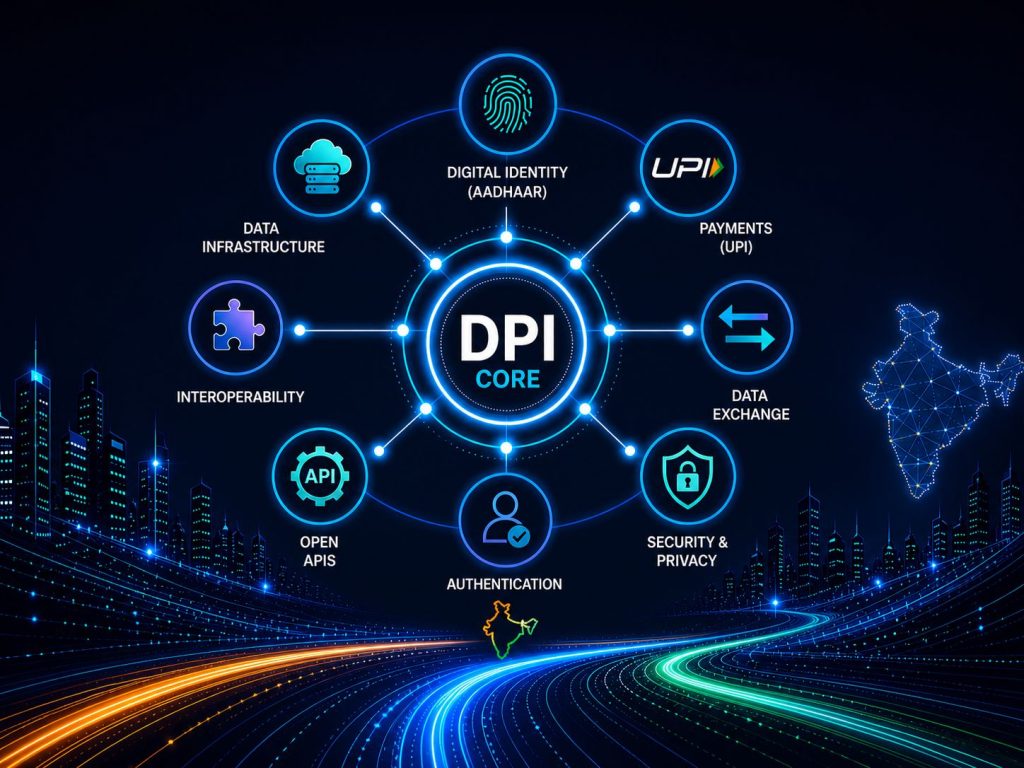
India’s Digital Public Infrastructure (DPI) is facing an escalating structural imbalance. The nation’s front-end digitization has dramatically outpaced its backend cybersecurity architecture, forensic transparency, and institutional accountability, creating an environment where digital portals risk functioning less as instruments of citizen empowerment and more as opaque shields for administrative evasion.
Nowhere is this friction more visible to everyday citizens than on municipal e-governance portals, where routine civic processes frequently devolve into exercises in bureaucratic attrition. On platforms operated by civic bodies such as the Municipal Corporation of Delhi (MCD), applicants seeking essential records routinely encounter staggered, piecemeal objections and unexplained rejections of valid documentation. Rather than eliminating middlemen as promised by digital governance models, this artificial friction systematically exhausts applicants and pushes them back toward informal intermediaries. When automated portals replicate the worst habits of paper bureaucracy without providing transparent reasoning, digitization merely digitizes dysfunction and cyber crimes.
More troublingly, administrative obstruction at the local level can cross into dangerous insider cybercrime when active citizen records disappear from public-facing systems without explanation. Independent techno-legal observers, including researchers associated with Perry4Law’s Techno Legal Base (PTLB), have documented cases involving birth certificate applications on municipal dashboards that vanish entirely from system tracking, only to reappear hours after formal grievances are escalated to senior authorities. Such anomalies do not resemble random software crashes or routine server timeouts. Instead, they point toward unauthorized manual backend manipulation by privileged users operating without real-time oversight.
Institutional opacity severely compounds these operational vulnerabilities when citizens or investigators seek accountability for tampered records. When formal inquiries demand database audit logs, timestamped modification histories, and the specific User IDs responsible for altering or suppressing applications, government departments routinely deflect scrutiny behind vague references to technical glitches. By treating system logs as internal secrets rather than public accountability records, agencies effectively shield rogue insiders from statutory consequences under the Information Technology Act, 2000, and criminal forgery provisions under the Bharatiya Nyaya Sanhita, 2023. Without enforceable access to backend audit trails, the burden of proving administrative tampering falls impossibly on the citizen.
Similar procedural blind spots have exposed higher regulatory and judicial workflows to brazen impersonation and fraud. In November 2026, a Reuters investigation revealed that the Department of Telecommunications had issued directives to internet service providers to block 129 betting websites in July and September 2026 based on forged orders purporting to come from the Allahabad and Rajasthan High Courts. Although the fabricated documents carried counterfeit court seals, national emblems, and even deceptive QR codes, officials acted upon emailed submissions from fraudsters posing as lawyers without verifying the orders against primary court registries or validating authentic cryptographic signatures. The incident triggered a criminal forgery investigation and an internal telecom ministry review, underscoring how easily high-impact state enforcement powers can be hijacked when procedural trust replaces cryptographic verification.
Vulnerabilities at the foundational cryptographic layer have further shaken confidence in India’s digital trust ecosystem. In October 2026, independent security researchers discovered that eight intermediate certificates operated by eMudhra, one of India’s most prominent Certifying Authorities, contained critically weak private keys. Caused by a defect in an internal Python key-generation script that truncated elliptic-curve private keys to a single byte, the flaw rendered the private keys recoverable from public certificates and had gone undetected across two WebTrust audit cycles. By November 2026, major global browser vendors had blocked the compromised chains, eMudhra revoked additional intermediate authorities over hardware security module handling concerns, and the firm announced its exit from the global public TLS certificate market.
While foundational trust providers grappled with key-management failures, India’s financial sector faced a relentless wave of autonomous, AI-assisted cyberattacks throughout late 2026. Threat intelligence reports from Microsoft and advisories from the Indian Computer Emergency Response Team (CERT-In) highlighted campaigns by financially motivated actors—including a group tracked by Indian officials as Crafty Falcon—deploying AI-enabled penetration-testing frameworks such as Artex, Cairn, and PentAGI. By automating reconnaissance, vulnerability exploitation, and lateral movement, these tools compressed the window between initial network intrusion and financial extraction from days into mere hours.
The real-world consequences of these evolving attack vectors materialized in a series of high-profile banking and lending breaches across India in October 2026. In mid-October, the Central Bank of India reported 187 unauthorized transfers totaling ₹13.97 crore from its settlement account with the Reserve Bank of India to 36 beneficiary accounts. While the bank clarified that its core banking platform and individual customer deposits remained secure, the breach exploited a localized Real-Time Gross Settlement (RTGS) server interface, exposing dangerous gaps in payment message validation and settlement-account reconciliation.
At the same time, smaller non-banking financial companies (NBFCs) and digital lenders emerged as primary targets for automated application programming interface (API) abuse. According to investigative reports citing law enforcement complaints and CERT-In advisories in October 2026, attackers siphoned an estimated ₹300 crore from smaller NBFCs over roughly two months across nearly 150 reported incidents. Rather than compromising individual borrower accounts one by one, threat actors stole payment API credentials and invoked payout interfaces directly from whitelisted servers. This method bypassed internal Know Your Customer (KYC) checks, loan sanction rules, and credit limits altogether, demonstrating how poorly secured API bridges can turn automated lending infrastructure into an instant cash-out mechanism.
Physical and insider control failures inside traditional bank branches proved equally damaging. In late October 2026, investigations by the Central Bureau of Investigation (CBI) and internal audits surrounding a ₹10.24 crore alleged fraud at a Punjab National Bank branch in Greater Noida brought severe operational lapses to light. Scrutiny of branch operations revealed how compromised core banking credentials, weak fixed-deposit controls, and unauthorized access to restricted branch terminals enabled sustained financial manipulation. When unvetted individuals or rogue insiders can operate core banking terminals without real-time behavioral monitoring, sophisticated perimeter firewalls become largely irrelevant.
These technical and operational failures do not occur in a vacuum; they intersect with broader macroeconomic pressures and rising anxiety among taxpayers and small businesses navigating automated compliance regimes. As tax administration, GST reconciliation, and banking surveillance become increasingly algorithmic, citizens face instantaneous automated penalties and account freezes for minor discrepancies. Yet when state systems malfunction or suffer breaches, those same institutions rarely offer symmetrical transparency or swift redress, deepening a trust deficit between the digital state and its citizens.
A major root cause of this vulnerability lies in two decades of reactive cyber governance that has prioritized compliance optics over architectural resilience. Since the enactment of the Information Technology Act in 2000 and the establishment of CERT-In in 2004, cybersecurity across many public-sector undertakings and regulated entities has been treated as an administrative box-ticking exercise. This culture of regulatory theater favors static ISO certifications, perimeter checklists, centralized data aggregation, and sweeping content-blocking powers over continuous adversarial testing and modern Zero Trust engineering.
Compounding the policy deficit is an acute shortage of specialized cyber-forensic capacity within Indian law enforcement and regulatory agencies. Even when victims report sophisticated API exploits or insider database tampering, local investigators frequently lack the technical tooling and statutory leverage needed to compel rapid preservation of volatile server logs. Furthermore, institutional resistance to surrendering unedited electronic records under the evidentiary standards of the Bharatiya Sakshya Adhiniyam, 2023, allows both external syndicates and compromised insiders to operate with near-total impunity.
Reversing this trajectory requires moving beyond surface-level compliance toward enforceable, architectural reforms across India’s Digital Public Infrastructure. First, governments and regulators must mandate immutable, append-only audit trails across all citizen-facing e-governance portals. Every submission, status change, query, or administrative alteration should automatically generate a cryptographically signed, timestamped receipt delivered directly to the applicant, making silent record deletion or backdated tampering technically impossible.
Second, institutional workflows across the judiciary, law enforcement, and financial sector must replace informal procedural trust with mandatory cryptographic authentication. Directives involving website blocking, account freezes, or inter-bank settlements should never be executed on the basis of emailed PDFs or unverified static seals. Instead, automated systems must verify digital signatures directly against authoritative institutional registries, while Certifying Authorities and financial institutions undergo continuous, unannounced red-team stress testing rather than predictable annual audits.
Third, regulators must enforce genuine Zero Trust Architecture alongside strict personal and institutional accountability. Access to core banking terminals, municipal databases, and payment APIs must be governed by continuous identity verification, hardware-backed multi-factor authentication, and strict maker-checker segregation. Crucially, statutory frameworks must establish binding breach-disclosure timelines and impose direct legal penalties on officials or executives who suppress audit logs, falsify system records, or obstruct forensic investigations.
The defining challenge for the Digital Public Infrastructure of India for the next decade is proving that this vast digital architecture can be governed with equal commitment to cryptographic integrity, forensic openness, human rights protection, and the rule of law. Only when backend accountability matches front-end innovation will India’s digital state earn the durable public trust it requires.
Fact-Check And Editorial Verification Summary
(a) Forged High Court Orders (Paragraph 5): Verified and updated with specifics from the November 2026 Reuters investigation. The Department of Telecommunications blocked 129 betting websites in July and September 2026 based on forged orders impersonating the Allahabad and Rajasthan High Courts.
(b) eMudhra Key Compromise (Paragraph 6): Verified against October–November 2026 security disclosures. Eight intermediate certificates had weak ECDSA keys caused by an internal Python script bug (which went undetected across two WebTrust audit cycles), leading eMudhra to revoke additional intermediate CAs in November 2026 and exit the public TLS market.
(c) AI Cyber Campaigns (Paragraph 7): Verified against November 2026 Microsoft Threat Intelligence and CERT-In reporting confirming the use of the Artex AI penetration-testing tool and tracking of the Crafty Falcon threat actor targeting Indian financial entities.
(d) Central Bank Of India RTGS Breach (Paragraph 8): Verified at 187 unauthorized transfers totaling ₹13.97 crore across 36 accounts between October 15 and 17, 2026, via a localized RTGS interface.
(e) NBFC API Attacks (Paragraph 9): Verified at an estimated ₹300 crore siphoned over roughly two months across nearly 150 complaints/FIRs via stolen payment API credentials (flagged in CERT-In’s October 9, 2026 advisory).
(f) Punjab National Bank Audit And Investigation (Paragraph 10): Contextualized with the late October 2026 CBI probe and internal audit scrutiny into the ₹10.24 crore Greater Noida branch fraud involving core banking credential misuse and branch access controls.
(g) Core Theme And MCD Fiasco: Verified by and from original, first-hand, and time-stamped documents from ODR India and PTLB Facts Checking Blog.