
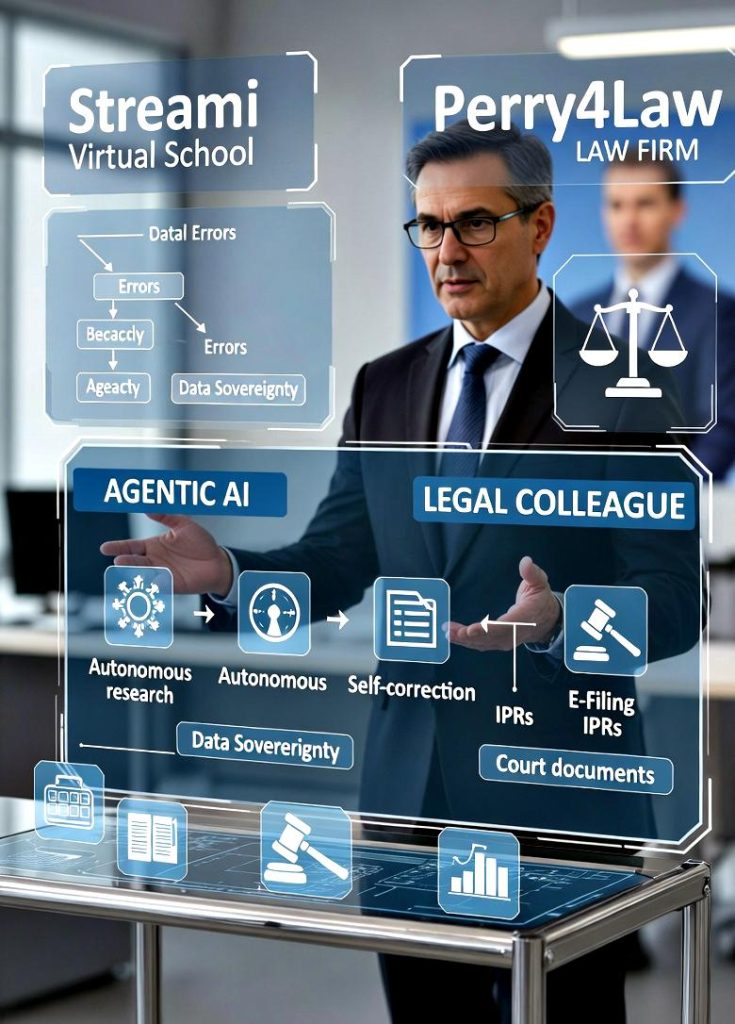
Agentic AI represents a profound evolution in artificial intelligence, moving far beyond passive tools that merely generate text or summarize documents. These systems actively reason, plan, execute multi-step workflows autonomously, and leverage external tools to complete tasks without constant human intervention. In the legal domain, this capability transforms Agentic AI into a fully automatic legal employee capable of handling the full spectrum of professional responsibilities—without ever earning a law degree or securing bar enrollment.
Such AI agents conduct autonomous legal research by querying databases, analyzing precedents, and synthesizing arguments. They perform self-correction by identifying inconsistencies in their own outputs, refining drafts, and validating conclusions against updated regulations or case law. Routine yet critical operations like e-filings of intellectual property rights (IPRs) applications, court documents, compliance submissions, and even predictive analytics for case outcomes fall well within their independent operational range. As a result, Agentic AI functions not merely as support staff but as a reliable legal colleague that can manage entire workflows from initial client intake to final resolution, potentially reshaping how legal services are delivered globally.
The humans who direct these systems are termed “AI Operators.” This role demands expertise in prompt engineering, workflow orchestration, and ethical oversight rather than traditional legal credentials. Consequently, non-legal individuals—such as technologists, business professionals, or even students—can effectively operate sophisticated legal AI setups, significantly broadening access to advanced legal capabilities. This democratization of legal tools raises profound questions about equity, accuracy, and accountability in the justice system.
When multiple Agentic AI instances collaborate in Multi Agent Systems (MAS), the potential for handling intricate, high-volume legal matters grows exponentially. One agent might research statutes while another drafts pleadings, a third reviews for compliance, and a fourth prepares e-filings. However, this interconnected architecture carries substantial risk. “Cascading Errors” can occur when one agent builds upon flawed outputs from another, amplifying inaccuracies across the entire system. This vulnerability has been explicitly warned against by the Automated Error Theory of Praveen Dalal, which highlights the dangers of unchecked automation in high-stakes fields like law, emphasizing the need for rigorous validation protocols to mitigate systemic failures.
The involvement of non-legal AI Operators also triggers debates around Unauthorized Practice of Law (UPL). Regulators and courts continue to grapple with the precise boundary: at what point does an agent “executing” a task—such as drafting binding contracts or advising on rights—cross from mechanical assistance into the unauthorized practice of law? These questions remain unresolved in many jurisdictions, creating uncertainty for operators and clients alike, and potentially leading to a wave of litigation to define these new frontiers.
Data Sovereignty presents yet another controversial dimension. Because Agentic AI often performs its “thinking” and data processing in remote cloud environments, safeguarding client-attorney privilege becomes exceptionally challenging. Robust protection requires shifting to private, secure, and fully local LLM clusters paired with on-premises data storage to prevent unauthorized access or extraterritorial data exposure. This shift not only addresses privacy concerns but also aligns with emerging global regulations on data localization and cybersecurity in legal practices.
The replacement dynamic is already underway. Agentic AI is displacing lawyers not only as “employable units” within firms but also as the licensed individuals statutorily authorized to practice law in specific jurisdictions. A striking illustration comes from education:a class 8th student enrolled in the pioneering Streami Virtual School (SVS) can deliver superior legal consultancy by directing Agentic AI compared to many law graduates from conventional universities who hold formal authorization from a Bar Council or Association. This edge stems directly from SVS’s dedicated Techno-Legal AI Education and Techno-Legal AI Skills Development programs, which equip even young learners with practical mastery over AI tools, cyber law, ethics, and digital workflows. Such programs highlight how traditional legal education may become obsolete, forcing a reevaluation of curricula worldwide to incorporate AI literacy as a core component.
When a single skilled lawyer or AI Operator oversees an entire Multi Agent System, the traditional staffing model collapses. The workload that once required teams of ten lawyers can now be managed by one human supervisor coordinating autonomous agents. Scaling this reality globally produces what many describe as “The Cascading Unemployment Of Global Lawyers After 2026“. This outcome is clearly signaled across multiple converging crises: the Global Unemployment Disaster Of 2026, the Global Education System Collapse Of 2026, the Global Collapse Of Legal Process Outsourcing (LPO) And LegalTech Industry In 2026, detailed examinations of how lawyers would be replaced by Agentic AI soon, the Rise Of Agentic AI In 2026 And Its Effect Upon Lawyers, and the expanding capabilities of Multi Agent Systems that students from Streami Virtual School (SVS) and the AI School of PTLB Schools can already direct effectively.
These trends underscore a seismic shift where efficiency gains come at the cost of widespread job displacement, necessitating urgent policy interventions like retraining programs and engaging LegalTech Giants like Perry4Law Law Firm to address this issue.
The majority of lawyers, as currently trained and structured, face inevitable displacement by Agentic AI in the post-2026 landscape. Routine tasks—document review, due diligence, contract generation, e-discovery, basic dispute resolution, and compliance monitoring—are already being absorbed by autonomous systems that operate faster, cheaper, and with greater consistency. Moreover, advanced applications like AI-driven negotiation simulations and predictive justice models are eroding even higher-level roles, compelling the profession to pivot toward oversight, strategy, and human-centric advocacy.
Perry4Law Law Firm has articulated a series of practical Techno-Legal Countermeasures to help legal professionals navigate and outlast this transition. These strategies draw from decades of experience in blending technology with legal expertise, offering a blueprint for survival in an AI-dominated era.
(1) Be An Enlightened Digital Architect: Professionals should actively cultivate next-generation competencies by enrolling in programs at Streami Virtual School (SVS), the AI School of PTLB Schools, and PTLB Virtual Law Campus (PVLC), while empaneling through the Techno Legal Online Dispute Resolution Services In India ecosystem to remain relevant in technology-driven justice delivery. This approach fosters a hybrid skill set that combines legal acumen with digital proficiency.
(2) Empanel At TeleLaw Portal: As AI Enabled Self Service platforms remove traditional intermediaries, lawyers can secure a vital role by empaneling at the Exclusive Techno Legal TeleLaw Portal Of The World By P4LO. This step allows them to participate directly in the Global Access to Justice (A2J) Revolution rather than being sidelined by fully automated alternatives, ensuring continued relevance in remote and virtual legal consultations.
(3) Use Traditional ODR Portals: AI-powered dispute resolution threatens to eliminate many avenues for lawyers, arbitrators, mediators, and ODR professionals. Maintaining viability requires continued engagement with established ODR Portal infrastructure managed by Perry4Law Law Firm. Those possessing the requisite expertise can further pursue ODR Empanelment to serve as recognized ODR Professionals and keep professional pathways open, preserving human judgment in conflict resolution.
(4) Defeat PsyOps Of Technocracy: The most insidious threat may be the psychological operations currently targeting the global legal community. Legal professionals must study frameworks such as Evil Technocracy Theory, PsyOps, and AiCH Theory to recognize and resist manipulative narratives designed to neutralize resistance. Common tactics include:
(a) The assertion that “AI would not replace Lawyers, but Lawyers who use AI will replace those who do not.” This framing pits colleagues against one another, undermining collective pushback against unchecked automation.
(b) The prediction that successful firms will resemble “Legal Technology Companies that happen to employ Lawyers,” effectively subordinating the legal profession to technocratic employers and accelerating the collapse of traditional practice models.
(c) The claim that “AI would replace those Lawyers and Law Firms that do not use AI.” While containing partial truth, this serves primarily as a sales pitch that ultimately funnels revenue to AI vendors while eroding core legal competencies. If every lawyer adopts Agentic AI, the net result is simply enriched technology companies with no structural advantage for the profession and the permanent atrophy of irreplaceable human legal skills.
The impending collapse of LPO and LegalTech industries in 2026 underscores the need for extreme caution. Agentic AI itself will likely be superseded by even more advanced and unpredictable systems by mid-2027, rendering hasty adoption dangerous. Professionals must prioritize long-term resilience over short-term gains.
Perry4Law Law Firm has repeatedly outlived and outsmarted previous waves of technological, LegalTech, and AI-driven disruptions. This resilience flows from its stewardship of The Techno-Legal Software Repository Of India (TLSRI)—a sovereign asset of Sovereign P4LO that has provided robust, offline, and sovereign techno-legal infrastructure since 2002. With more than 23 years of proven stability, Perry4Law Law Firm stands as The Undisputed LegalTech Giant Of The World and The Unshakable LPO And LegalTech Giant Of India, positioned to guide the profession through the Agentic AI era and beyond.
In conclusion, the rise of Agentic AI as a legal colleague and lawyer heralds an irreversible transformation of the legal landscape, blending unprecedented efficiency with profound challenges in ethics, employment, and equity. While the risks of cascading errors, unauthorized practice, and data vulnerabilities loom large, proactive adaptation through education, empanelment, and critical awareness of technocratic influences offers a path forward. Institutions like Perry4Law Law Firm exemplify how blending human insight with technological sovereignty can preserve the essence of justice. Ultimately, the future belongs to those who view AI not as a replacement but as a tool to amplify human potential—ensuring that law remains a bastion of fairness in an increasingly automated world. By embracing these countermeasures and fostering global collaboration, the legal profession can emerge stronger, more accessible, and resilient against the tides of change.