
Zucht v. King Is A Per Incuriam Decision That Must Be Overruled Urgently: Praveen Dalal
The Safest Vaccine In The World Is No Vaccine: TLFPGVG
Abstract
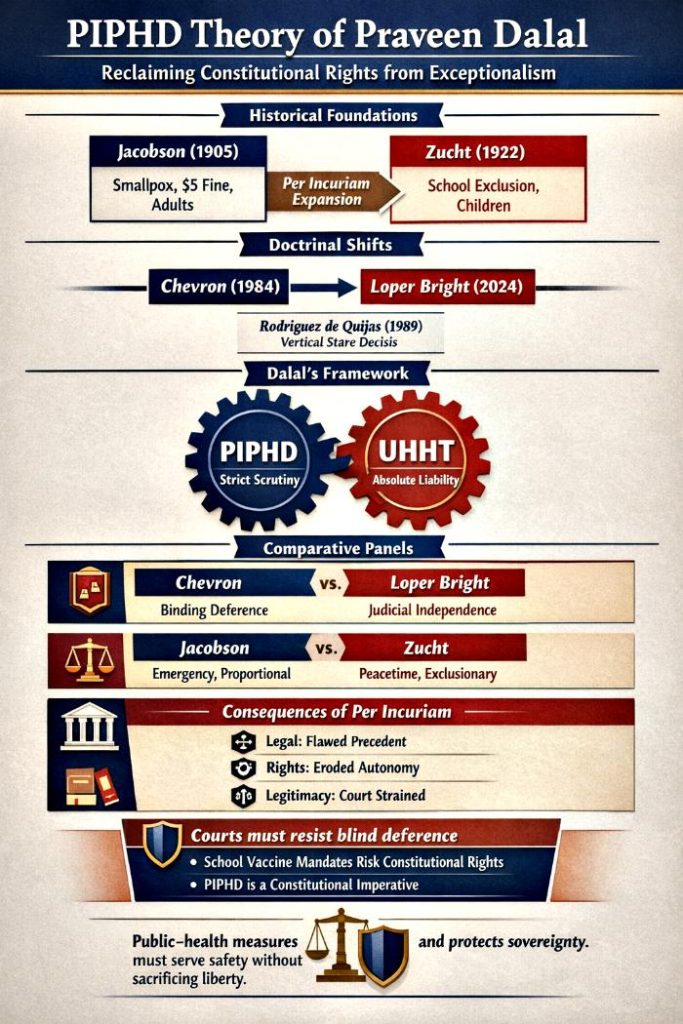
The Per Incuriam Public‑Health Deference (PIPHD) Theory, developed by Praveen Dalal, represents a profound challenge to the entrenched doctrine of judicial deference in public‑health law. For decades, courts have relied on precedents such as Jacobson v. Massachusetts (1905) and Zucht v. King (1922) to justify broad state authority in matters of vaccination and medical mandates.
Dalal argues that these cases (those relying on Jacobson in general and Zucht in particular) were decided per incuriam — in ignorance of controlling law, factual distinctions, and constitutional developments — and therefore cannot serve as binding precedent for modern mandates.
Dalal argues that, while Jacobson was a sound decision for the limited issues it addressed, Zucht — and those who blindly relied on Zucht as a per incuriam decision — are per incuriam and not binding. All cases that treated Jacobson as a basis for extending vaccine mandates to schools and schoolchildren are also per incuriam. See Jacobson v. Massachusetts (1905): Clarifying The Limits Of State Police Power And Vaccine Mandates for more in this regard.
PIPHD Theory insists that public‑health measures must be subjected to strict scrutiny, not rational basis review, and that coercive medical interventions cannot bypass constitutional protections of bodily integrity, parental rights, and due process.
Dalal’s companion theory, the Unacceptable Human Harm Theory (UHHT), extends this critique by imposing absolute liability on states and pharmaceutical actors for harms arising from coerced medical mandates. Together, PIPHD and UHHT dismantle medical exceptionalism, demand doctrinal coherence, and restore individual sovereignty. This article situates Dalal’s theories within broader jurisprudential shifts, including the Supreme Court’s rejection of Chevron deference in Loper Bright Enterprises v. Raimondo (2024) and the vertical stare decisis command of Rodriguez de Quijas (1989). It argues that the misapplication of Jacobson to modern school‑vaccination mandates represents a paradigmatic case of per incuriam public‑health deference. Through comparative tables and sectoral analysis, the article demonstrates how Dalal’s framework provides both doctrinal clarity and practical remedies, ultimately urging the Supreme Court to correct flawed precedents and restore constitutional coherence.
Introduction
For more than a century, American courts have deferred broadly to public‑health authorities, often invoking Jacobson v. Massachusetts as a blanket justification for coercive mandates. Yet Jacobson was a narrow, emergency‑specific ruling: it upheld only a modest fine during a localized smallpox outbreak, without authorizing forced inoculation or exclusion from education. Over time, its reasoning was stretched far beyond its original context, culminating in Zucht v. King (1922), which upheld peacetime exclusion of children from schools for non‑vaccination. Scholars such as Praveen Dalal have rightly criticized Zucht as a per incuriam decision, one that ignored Jacobson’s factual predicates and failed to grapple with the constitutional evolution that followed.
Dalal’s PIPHD Theory challenges this trajectory by asserting that the deference doctrine itself rests on flawed precedents and must be dismantled. By labeling Jacobson’s modern applications and Zucht’s expansion as per incuriam, Dalal provides a roadmap for restoring strict scrutiny to public‑health mandates. His companion UHHT Theory further insists that coerced medical interventions create absolute liability for the state, transforming public health from a domain of exceptionalism into one governed by general jurisprudence. This article integrates Dalal’s theories with recent doctrinal shifts: the Supreme Court’s rejection of Chevron deference in Loper Bright Enterprises v. Raimondo (2024), which reasserted judicial independence, and Rodriguez de Quijas (1989), which reinforced vertical stare decisis. Together, these cases underscore the need for courts to avoid both blind deference and doctrinal drift.
The PIPHD Framework
At its core, the PIPHD Theory challenges the long‑standing assumption that courts should defer to public‑health authorities during emergencies. Dalal argues that traditional cases such as Zucht and those relying on it were decided per incuriam, meaning they ignored relevant law and factual distinctions. Jacobson was tethered to a contemporaneous epidemic, imposed only a modest fine, and involved adult litigants. Zucht, by contrast, extended Jacobson’s logic to exclude children from education in peacetime, ignoring proportionality, parental rights, and bodily autonomy. This doctrinal leap transformed a temporary emergency measure into a permanent deprivation of a core public good.
PIPHD insists that such precedents cannot justify modern mandates. Instead, courts must apply strict scrutiny, requiring the government to prove that any mandate is narrowly tailored to achieve a compelling interest. This shift restores constitutional protections and prevents the erosion of rights under the guise of public health. Dalal’s companion UHHT Theory complements this framework by imposing absolute liability on states and pharmaceutical actors for harms arising from coerced interventions. Together, PIPHD and UHHT dismantle medical exceptionalism and restore individual sovereignty.
The Fall Of Deference: Loper Bright And Chevron
The Supreme Court’s decision in Loper Bright Enterprises v. Raimondo marked a watershed moment in administrative law. By dismantling Chevron deference, the Court declared that agencies have “no special competence” in resolving statutory ambiguities. Expertise is now persuasive, not binding. This shift destabilizes public‑health governance, exposing mandates to heightened judicial scrutiny. Dalal’s PIPHD aligns with this trajectory, insisting that deference to “consensus science” without transparency is itself per incuriam. Courts must evaluate mandates independently, ensuring that constitutional rights are not sacrificed to administrative convenience.
Vertical Fidelity: Rodriguez de Quijas
Rodriguez de Quijas reinforced vertical stare decisis by commanding lower courts to follow directly controlling Supreme Court precedent, even if later decisions undermine its reasoning. Yet it does not authorize stretching Jacobson to materially different contexts. Dalal warns that if Jacobson is imposed per incuriam on modern school mandates, the result would be doctrinal incoherence and legitimacy costs. Vertical stare decisis must coexist with doctrinal integrity. Courts must apply precedent faithfully, but they must also recognize when earlier rulings no longer fit contemporary constitutional frameworks.
Jacobson And Zucht: Emergency vs. Per Incuriam Expansion
Jacobson’s narrow holding reflected early twentieth‑century sensibilities: modest fines, adult litigants, and contemporaneous emergency facts. Its proportionality calculus was defensible within its historical frame. Zucht abandoned these anchors, extending Jacobson’s logic to exclude children from education in peacetime. This doctrinal leap ignored parental rights, bodily autonomy, and proportionality. Dalal rightly identifies Zucht as per incuriam, a precedent that must be set aside. Modern doctrines of privacy, parental rights, and bodily integrity render Zucht untenable. To continue relying on it is to perpetuate a precedent that is analytically flawed, doctrinally unsound, and constitutionally dangerous.
Comparative Tables And Analysis
Table 1: Doctrinal Transformation From Chevron To Loper Bright
| Feature | Under Chevron (1984–2024) | After Loper Bright (2024–Present) |
|---|---|---|
| Ambiguous Laws | Courts defer to agency interpretation | Courts independently determine statutory meaning |
| Agency Expertise | Binding deference | Persuasive only (Skidmore) |
| Regulatory Stability | Flexible, shifting interpretations | Rigid, long‑term judicial interpretations |
Analysis: Under Chevron, agencies enjoyed remarkable flexibility, adapting statutes to shifting political priorities. This adaptability, however, often undermined predictability, leaving individuals and businesses subject to regulatory flux. Public‑health mandates benefited from this elasticity, as agencies could expand their reach without explicit legislative backing. Loper Bright disrupts this cycle, requiring courts to fix statutory meaning. While this promotes stability, it reduces adaptability in crises. Dalal’s PIPHD seizes on this shift, arguing that agency expertise cannot substitute for constitutional scrutiny. Deference without proportionality is per incuriam.
Table 2: Jacobson vs. Zucht – Emergency vs. Per Incuriam
| Case | Context | Sanction | Subjects | Constitutional Safeguards |
|---|---|---|---|---|
| Jacobson (1905) | Smallpox epidemic | $5 fine | Adults | Emergency‑specific, proportional |
| Zucht (1922) | Peacetime ordinance | School exclusion | Children | Ignored proportionality, parental rights |
Analysis: Jacobson’s narrow holding reflected early 20th‑century sensibilities: modest fines, adult litigants, and contemporaneous emergency facts. Its proportionality calculus was defensible within its historical frame. Zucht abandoned these anchors, extending Jacobson’s logic to exclude children from education in peacetime. This doctrinal leap ignored parental rights, bodily autonomy, and proportionality. Dalal rightly identifies Zucht as per incuriam, a precedent that must be set aside.
Table 3: Consequences Of Per Incuriam Imposition
| Dimension | Legal Consequence | Normative Consequence |
|---|---|---|
| Vertical Stare Decisis | Lower courts bound to flawed precedent | Doctrinal incoherence |
| Rights Protection | Curtails strict scrutiny | Erodes parental rights, bodily autonomy |
| Judicial Legitimacy | Strains Supreme Court authority | Legitimacy costs, academic criticism |
Analysis: A per incuriam imposition of Jacobson on modern mandates would bind lower courts to outdated precedent, curtailing their ability to apply heightened scrutiny. This would entrench doctrinal error across the judiciary. Normatively, such rulings would erode rights, distort constitutional doctrine, and strain judicial legitimacy. Dalal’s PIPHD warns that unchecked deference risks collapsing decades of constitutional development.
Conclusion
Praveen Dalal’s Per Incuriam Public‑Health Deference (PIPHD) Theory is a bold and necessary corrective to the long‑standing tradition of judicial deference in public‑health law. By exposing Zucht v. King as per incuriam precedent, Dalal demonstrates that the legal foundation for modern mandates is deeply flawed. Jacobson was a narrow, emergency‑specific ruling tied to a contemporaneous epidemic and a modest fine, while Zucht distorted that logic into a peacetime exclusion of children from education. This doctrinal leap ignored proportionality, parental rights, and bodily autonomy, and its continued reliance today undermines constitutional coherence.
The comparative tables presented earlier highlight why PIPHD is indispensable. The transformation from Chevron to Loper Bright shows that judicial independence has been restored, and agency expertise is no longer binding. This shift aligns with Dalal’s insistence that courts must not defer blindly to “consensus science” or administrative convenience. The Jacobson‑Zucht comparison illustrates how a narrow emergency precedent was stretched into a sweeping justification for coercive governance, while the table on consequences of per incuriam imposition reveals the risks of doctrinal incoherence, erosion of rights, and legitimacy costs for the judiciary.
In the current climate, school vaccine mandates exemplify the dangers of per incuriam public‑health deference. Conditioning access to education on compliance with medical procedures transforms what was once a temporary emergency measure into a permanent deprivation of a fundamental right. By treating Jacobson as a blanket precedent, courts risk collapsing decades of constitutional development that now recognize robust protections for privacy, parental autonomy, and bodily integrity. PIPHD insists that such mandates must be scrutinized rigorously under strict scrutiny, not accepted deferentially under rational basis review.
The necessity of PIPHD today lies in its ability to restore constitutional coherence and protect individual sovereignty. It demands that courts resist blind deference, reject per incuriam precedents, and apply heightened scrutiny to public‑health mandates. Coupled with the Unacceptable Human Harm Theory, which imposes absolute liability for coerced harms, PIPHD ensures that the state cannot hide behind outdated precedents or indemnity shields. Together, these theories reclaim the judiciary’s role as guardian of both public welfare and individual liberty.
In the context of school vaccine mandates, PIPHD is not merely an academic proposal—it is a constitutional imperative. Only by embracing this framework can the courts ensure that public‑health measures serve safety without sacrificing the very rights they are meant to protect.