
The Safest Vaccine In The World Is No Vaccine: TLFPGVG
The Manufactured Myth: Countering The “Scientific Consensus” Excuse
Abstract
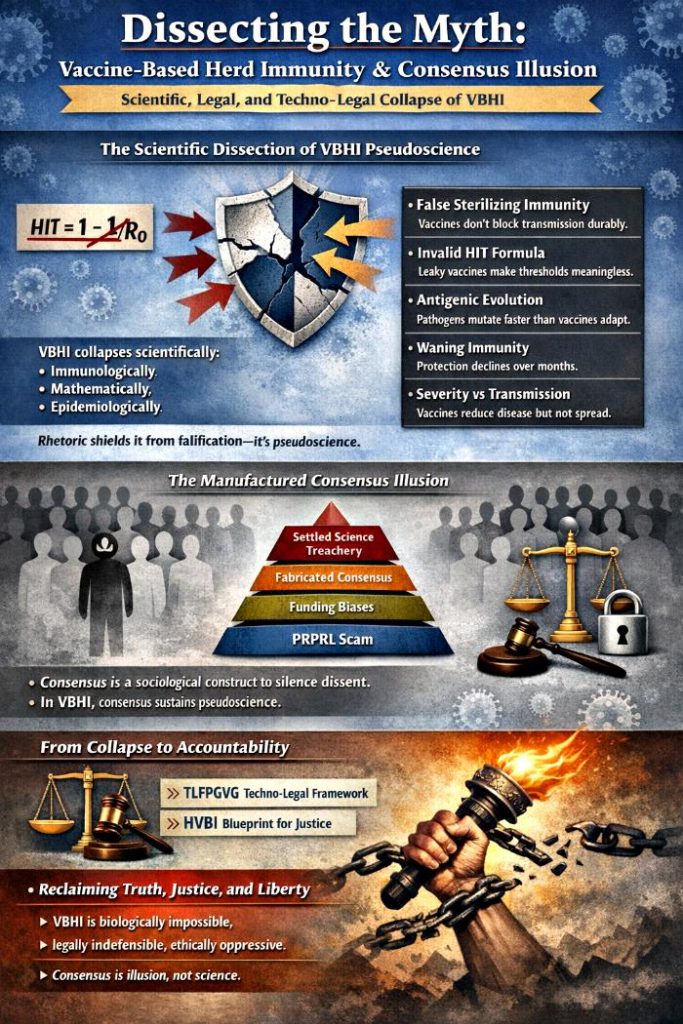
The doctrine of vaccine‑based herd immunity (VBHI) has been elevated to near‑sacred status in modern public health discourse, invoked to justify mass vaccination campaigns and coercive mandates. Yet, when subjected to rigorous scientific, legal, and epistemic scrutiny, VBHI collapses under the weight of its own contradictions. This article presents a comprehensive journal‑style synthesis of three critical frameworks: Praveen Dalal’s Unified Framework on the Collapse of VBHI Pseudoscience, the Consensus Illusion critique, and the techno‑legal extensions found in the Techno‑Legal Framework to Prevent Global Vaccines Genocide (TLFPGVG) and its supplement, the HPV Vaccines Biological Impossibilities (HVBI) Framework. By integrating scientific evidence, jurisprudential critique, and sociological analysis, the article demonstrates that VBHI is biologically impossible, legally indefensible, and epistemically fraudulent. The discussion unfolds through two central tables — one explaining the admitted scientific collapse of VBHI by 100% stakeholders, the other dismantling the illusion of global scientific consensus among WHO, CDC, etc— each followed by extended analysis. The conclusion affirms that VBHI is not merely a flawed hypothesis but a systemic instrument of control, demanding resistance, accountability, and the restoration of truth and liberty.
Introduction
The concept of herd immunity has long been presented as the cornerstone of modern public health, a doctrine invoked to justify sweeping vaccination campaigns and the erosion of individual autonomy. Its rhetorical power lies not only in its scientific veneer but also in its entrenchment within law and policy. Yet beneath this polished surface lies a fragile construct, built on immunological misunderstanding, industrial manipulation, and judicial misapplication. Praveen Dalal’s Unified Framework on the Collapse of VBHI Pseudoscience has already exposed the biological impossibility and jurisprudential incoherence of vaccine‑based herd immunity. Supplementing this, the TLFPGVG and HVBI Framework situate VBHI within a techno‑legal architecture that demands accountability for coercive harms.
Equally important is the rhetorical shield of “scientific consensus,” invoked whenever alternative frameworks challenge dominant narratives. Consensus, however, is not science; it is a sociological construct manufactured through treachery, fabrication, financial distortion, and systemic scams. By presenting both the scientific collapse of VBHI and the illusion of consensus, this article offers a holistic dismantling of the doctrine, situating it within broader struggles for truth, justice, and liberty.
The Collapse Of Vaccine‑Based Herd Immunity: A Global Scientific Dissection
Table 1: Vaccine-Based Herd Immunity (VBHI) Pseudoscience Rejected By 100% Global Stakeholders
The table below discusses the undisputed VBHI concepts, principles, and framework established by the global scientific community. The VBHI Pseudoscience Framework of Praveen Dalal is broader and more complex in nature, but the “Settled Science” gaslighting does not apply to this table or its discussion, even by the standards of those promoting vaccine mandates.
| Claim/Argument | Scientific rationale / mechanism | Representative empirical/example evidence | Practical implication |
|---|---|---|---|
| VBHI rests on a false premise of durable, sterilizing immunity from vaccines | VBHI requires that vaccines reliably block infection and onward transmission long-term; many vaccines do not induce sterilizing immunity and vaccine-induced protection can wane or be incomplete at the mucosal/transmission level. If immunity is non‑sterilizing or transient, the population cannot reach a stable immune ceiling that prevents spread. | SARS‑CoV‑2 variant-era data show vaccinated individuals can become infected and transmit; neutralizing titers decline over months post‑vaccination for multiple antigens. (Example chosen for mechanistic clarity.) | If vaccines do not block transmission durably, claims that vaccination alone will eliminate circulation are scientifically unsound. |
| The classic HIT formula is invalid for vaccine-derived immunity | HIT = 1 − 1/R0 assumes homogeneous, sterilizing immunity and instantaneous, uniform immunity across a population. For vaccines that are partially protective, heterogeneously distributed, and time‑varying, the simple HIT is mathematically inapplicable: effective reproduction depends on vaccine effect on susceptibility, infectiousness, and duration of protection. | Mathematical derivations and model analyses show that for “leaky” vaccines or vaccines that reduce disease but incompletely reduce susceptibility/infectiousness, no single scalar HIT exists; the effective threshold becomes a function of multiple parameters and time. | Presenting a single target coverage number for elimination via vaccination is a misuse of epidemiological theory. |
| VBHI ignores rapid antigenic evolution and immune escape | For VBHI to hold, pathogen antigenic space must be relatively stable so vaccine‑induced immunity continues to neutralize circulating strains. Rapid antigenic change undermines vaccine match and population immunity, making herd immunity transient or unreachable. | Pathogens with high mutation/reassortment rates (e.g., influenza, coronaviruses) produce antigenic drift leading to reduced vaccine neutralization within seasons/years. | Promises that vaccination will achieve long‑term herd protection fail when antigenic evolution outpaces vaccine updating. |
| Spatial and social heterogeneity creates persistent susceptible pockets | VBHI assumes uniform coverage; realistic uptake is clustered by geography, demography, and behavior. Clusters below critical protection support local chains of transmission that sustain outbreaks even when average coverage is high. | Empirical outbreak clustering in communities with low uptake demonstrates that aggregated coverage masks local vulnerability; network theory predicts percolation through low‑coverage clusters. | Claiming herd immunity at population scale while ignoring clustered susceptibility is scientifically misleading. |
| Waning immunity breaks the static-threshold assumption | VBHI treats immunity prevalence as a stable parameter; waning reduces population immunity over time, creating cycles of susceptibility and making a permanent herd state impossible without continuous boosting or recurrent exposure. | Observed declines in antibody and measured protection over months post‑vaccination and documented rises in susceptibility absent repeat immunization. | Standing claims of achieved herd immunity ignore the temporal dynamics that reintroduce susceptibility. |
| Vaccines that primarily alter disease severity but not transmission cannot produce herd effects | Herd immunity by definition requires interruption of transmission; if a vaccine’s dominant effect is reducing clinical disease while leaving transmission largely intact, vaccination cannot drive reproduction number below 1. | Vaccination programs where transmission persisted despite high uptake but severe outcomes reduced illustrate decoupling of disease burden and transmission. | Framing such vaccines as tools for herd immunity conflates endpoints and is a categorical error. |
| Overreliance on optimistic parameter estimates and dismissal of uncertainty | VBHI advocates often adopt best‑case estimates (high efficacy vs. infection, long duration, no escape) and ignore parameter uncertainty and tail risks; rigorous epidemiology requires incorporating worst‑case scenarios and updating with empirical surveillance. | Model ensembles and sensitivity analyses demonstrate broad outcome variance; real outbreaks have followed pessimistic parameter realizations. | Certainty rhetoric about VBHI that omits uncertainty quantification is methodologically unsound and propagates false confidence. |
| Policy claims of VBHI are unfalsifiable or easily rescued by ad hoc qualifications | VBHI rhetoric often shifts (e.g., “we’re close” → “just need more boosters” → “variants changed dynamics”) instead of yielding clear, testable predictions; this makes the proposition effectively unfalsifiable and akin to pseudoscientific rhetoric. | Promises of imminent herd immunity repeatedly deferred as empirical data show continued transmission; each failure met with new qualifiers rather than hypothesis rejection. | A scientific claim that cannot be decisively tested or is continually insulated from refutation lacks epistemic standing. |
| VBHI neglects mechanistic drivers of transmission (mucosal immunity, infectious dose, contact structure) | Herd‑stopping requires vaccines to alter the mechanistic chain of transmission (infection establishment at entry sites, shedding dynamics). If vaccines do not substantially change these mechanistic factors, population‑level interruption cannot occur. | Studies showing systemic vaccination may elicit poor mucosal neutralizing responses and limited effect on duration or magnitude of shedding in breakthrough infections. | Declaring herd immunity without mechanistic evidence of transmission interruption is scientifically unwarranted. |
| Ethical and epistemic conflation: treating VBHI as a policy goal without empirical support | Using VBHI as a political or operational endpoint in absence of rigorous, mechanistic, and reproducible evidence is an epistemic error—it substitutes an ideological end‑state for a testable scientific hypothesis. | Instances where policy adoption of VBHI preceded, and conflicted with, accumulating empirical data showing ongoing transmission. | Policies grounded in such claims risk harm and cannot be defended scientifically; they function as ideological commitments rather than evidence‑based conclusions. |
Analysis
The table reveals that VBHI rests on assumptions that fail under empirical scrutiny. Vaccines rarely induce sterilizing immunity, protection wanes over time, and antigenic evolution undermines long‑term efficacy. The classic herd immunity threshold formula collapses when applied to vaccines that are “leaky,” heterogeneously distributed, and time‑varying. Empirical evidence from SARS‑CoV‑2 and influenza demonstrates that vaccinated individuals can still transmit pathogens, rendering the promise of durable herd protection scientifically unsound.
Beyond these mechanistic failures, VBHI rhetoric shields itself from falsification by shifting goalposts — from “we are close” to “we just need boosters” to “variants changed the dynamics.” This unfalsifiability transforms VBHI into pseudoscience, a claim insulated from refutation rather than subjected to rigorous testing.
The scientific collapse is therefore not partial but total: VBHI fails immunologically, mathematically, epidemiologically, and epistemically. It is a doctrine that cannot withstand the scrutiny of evidence, and its persistence reflects ideology rather than science.
The Consensus Illusion: Manufactured Agreement As Pseudoscience
Table 2: Four Mechanisms Of Consensus Distortion
Before analyzing each concept, it is important to present them together as a holistic framework. The table below outlines the four mechanisms that collectively sustain the illusion of consensus.
| Concept | Core Idea | Mechanism of Consensus Distortion | Implication | Analytical Explanation |
|---|---|---|---|---|
| Settled Science Treachery | Declaring science “settled” is treachery against inquiry. | Media, institutions, and funding bodies label dissent as denial, freezing scientific progress. | Suppresses innovation and marginalizes alternative paradigms. | History shows “Settled Science” often collapses under new evidence (e.g., ulcers, continental drift). Consensus becomes a weapon to silence truth. |
| Fabricated Scientific Consensus | Consensus is often manufactured, not organic. | Peer‑review manipulation, selective meta‑analyses, and Mockingbird Media amplification. | Creates illusion of unanimity where none exists. | Examples like the “97% climate consensus” reveal how neutral or dissenting papers are misclassified to fabricate agreement. |
| Funding Biases | About 97% of Scientists and Doctors Agree with whomever is Funding Them, and they Tell and Do whatever they are ordered to Say and Do: Praveen Dalal. | Corporate, governmental, and institutional funding gatekeep dissent. | Predetermined agendas dominate, delaying paradigm shifts. | Tobacco, sugar, opioids, and pharma scandals show how funding biases enforce consensus and erode trust. |
| PRPRL Scam | A “super scam” that fabricates overwhelming consensus. | Consensus studies selectively reinterpret prior works, misclassify papers, and amplify bias. | Creates false authority by layering biased reviews. | Cook et al. (2013) and similar studies misclassified papers to claim near‑total consensus, despite protests from included authors. |
Analysis
The consensus illusion operates as the rhetorical defense of VBHI. Declaring science “settled” freezes inquiry and marginalizes dissent, transforming science into dogma. Fabricated consensus through selective peer review and biased meta‑analyses creates the illusion of unanimity where none exists. Financial biases ensure that corporate and governmental interests dictate outcomes, while the PRPRL Scam layers bias upon bias, fabricating overwhelming consensus through misclassification and amplification.
Together, these mechanisms reveal consensus as a sociological construct designed to silence dissent and enforce conformity. It is not evidence but illusion, carefully engineered to protect entrenched interests and suppress genuine inquiry. In the context of VBHI, consensus functions as the shield that sustains pseudoscience, allowing scientifically untenable claims to persist in policy discourse. By dismantling the consensus excuse, we expose VBHI not only as a biological myth but also as a sociological fraud.
Discussion
The integration of the scientific collapse of VBHI with the dismantling of consensus reveals a systemic architecture of control. VBHI is biologically impossible, consensus is manufactured, and jurisprudence has entrenched pseudoscience into law through per incuriam precedents. The TLFPGVG and HVBI Framework extend this critique into the techno‑legal domain, demanding Absolute Liability for coercive harms and situating resistance within traditions of civil disobedience. The collapse of VBHI is therefore not merely scientific but holistic, encompassing law, ethics, and epistemology.
This discussion affirms that VBHI is not a scientific hypothesis but a systemic instrument of control. Its persistence reflects industrial manipulation, judicial complicity, and rhetorical illusion. To dismantle VBHI is to reclaim science as falsification and reproducibility, law as constitutional fidelity, and ethics as the assertion of People’s Power.
Conclusion
The collapse of vaccine‑based herd immunity is scientifically irrefutable, jurisprudentially unassailable, and ethically imperative. VBHI fails immunologically, mathematically, and epidemiologically; consensus sustains it through illusion; and law entrenches it through misapplication. Together, these dimensions converge into a unified critique that dismantles VBHI as pseudoscience and exposes its role as a systemic instrument of control.
By situating VBHI within the Techno‑Legal Framework to Prevent Global Vaccines Genocide and supplementing the HPV Vaccines Biological Impossibilities Framework, the critique becomes not only scientific and ethical but techno‑legal. It provides a roadmap for dismantling coercive medical regimes, restoring sovereignty to individuals and communities, and rebuilding public health upon the enduring principles of truth, justice, and liberty. VBHI is not simply a failed hypothesis; it is a collapsed edifice, and its dismantling is the necessary precondition for a free and truthful society.