
The Safest Vaccine In The World Is No Vaccine: TLFPGVG
Abstract
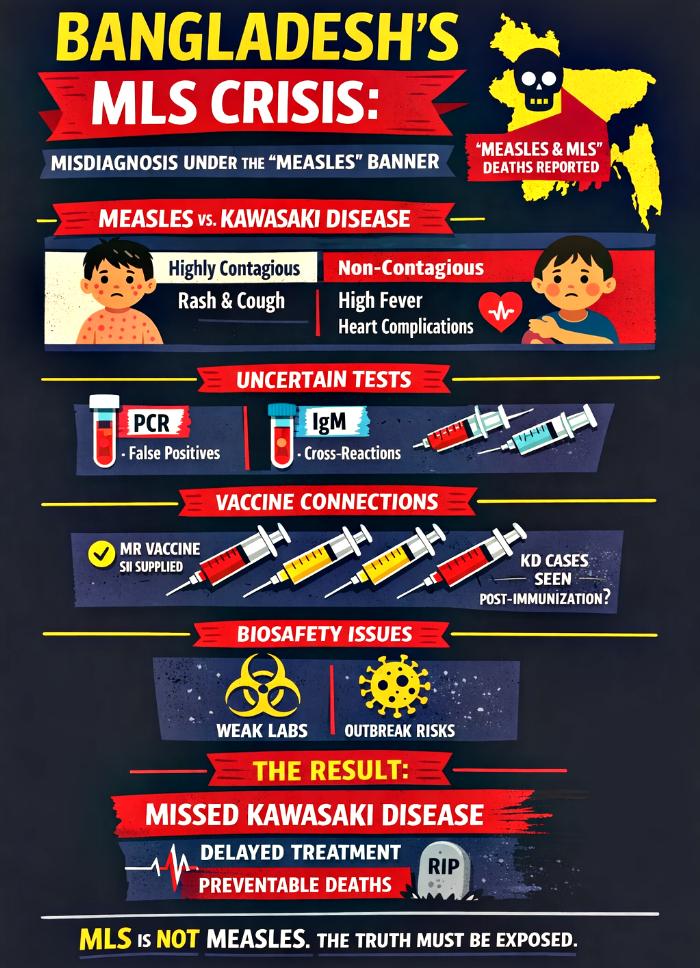
Bangladesh’s recent reports of deaths attributed to “measles and measles‑like symptoms (MLS)” expose a dangerous diagnostic ambiguity. Measles is a clinically unambiguous disease with hallmark features and predictable transmission dynamics. MLS, however, is a vague construct that obscures the true nature of pediatric rash‑fever illnesses. This article argues that the dual use of “measles and MLS” is itself evidence of misclassification and misdirection. Drawing on comparative clinical data, laboratory diagnostic limitations, vaccine‑surveillance signals, biosafety vulnerabilities, and Bangladesh’s national immunization schedule, we demonstrate that MLS aligns more closely with Kawasaki disease (KD) than measles. Misdiagnosis delays appropriate treatment, particularly intravenous immunoglobulin for KD, increasing the risk of preventable deaths. Through structured tables and extended analyses, we show how MLS functions as a structural smokescreen that conceals systemic failures. We conclude that Bangladesh’s MLS crisis is not a measles resurgence but a convergence of diagnostic blind spots, vaccine‑era surveillance signals, and fragile biosafety governance. Recognizing this truth is essential to restoring public trust and preventing further loss of life.
Introduction
Outbreak reporting depends on clarity. Measles, one of the most contagious viral diseases, has a well‑defined clinical profile: fever, cough, coryza, conjunctivitis, Koplik spots, and a descending rash. Its epidemiology is equally clear, affecting both children and adults in unvaccinated populations. There is no diagnostic gray zone.
Yet Bangladesh’s health authorities have reported deaths from “measles and measles‑like symptoms (MLS).” This dual framing raises immediate red flags. MLS is not a recognized disease entity; it is a vague label that masks uncertainty. By conflating claimed confirmed measles with MLS, officials blur the line between evidence and assumption, creating a narrative that is neither scientifically rigorous nor clinically safe.
This article applies a holistic lens to the MLS phenomenon. We examine clinical distinctions between measles and Kawasaki disease, the limitations of PCR and IgM assays, vaccine‑surveillance signals that document KD associations, biosafety vulnerabilities that amplify diagnostic ambiguity, and Bangladesh’s dense immunization schedule. Through structured tables and extended analyses, we argue that MLS is not measles, but a misclassified pediatric vasculitis crisis. The stakes are high: without proper diagnosis and treatment, children will continue to die unnecessarily.
Bangladesh’s Measles‑Like Symptoms (MLS) Crisis Is Not Measles
Table 1 — When Symptoms Deceive: Distinguishing Measles From Kawasaki Disease
| Feature | Measles | Kawasaki Disease |
|---|---|---|
| Age Distribution | Children & adults (if unvaccinated) | Primarily children <5 years |
| Prodrome | Fever, cough, coryza, conjunctivitis, Koplik spots | Prolonged fever ≥5 days, mucous‑membrane changes, extremity involvement |
| Rash | Descending maculopapular rash | Polymorphous rash, extremity peeling |
| Infectiousness | Highly contagious | Non‑contagious |
| Complications | Pneumonia, encephalitis | Coronary artery aneurysms, myocarditis |
| Diagnosis | PCR/IgM serology | Clinical criteria, inflammatory markers, echocardiography |
Analysis
Measles is defined by a specific prodrome and rapid household transmission, neither of which are consistently observed in Bangladesh’s MLS cases. Instead, the epidemiological pattern shows strict pediatric concentration, mirroring Kawasaki disease’s age distribution. This mismatch undermines the measles narrative and points to systemic misclassification.
The consequences of misdiagnosis are profound. Measles complications include pneumonia and encephalitis, while Kawasaki disease carries the risk of coronary artery aneurysms and myocarditis. Treating KD as measles delays life‑saving interventions such as IVIG. Thus, the MLS label is not a harmless shorthand but a dangerous distortion that endangers children’s lives.
Table 2 — The Illusion Of Certainty: Why PCR And IgM Cannot Resolve MLS
| Test | Intended Purpose | Limitations |
|---|---|---|
| PCR | Detect viral genetic material | Amplifies fragments, not live virus; contamination risk; false positives |
| IgM | Detect early immune response | Cross‑reactivity; variable timing; false positives/negatives |
| Combined Use | Suggestive evidence | Cannot prove active, transmissible infection |
Analysis
PCR’s sensitivity is both its strength and weakness. It can detect minute fragments of viral material, but cannot distinguish between live virus and residual genetic debris. In low‑biosafety settings, contamination risks are high, making false positives likely. In MLS cases, PCR positivity may reflect contamination or past infection, not active measles transmission.
IgM assays add further uncertainty. Cross‑reactivity with unrelated pathogens produces false positives, while timing variability undermines reliability. When PCR and IgM are combined, they provide suggestive but not definitive evidence. Treating these results as proof of measles is a diagnostic fallacy that perpetuates misclassification and delays appropriate care.
Table 3 — Signals In The System: Kawasaki Disease Across Global Vaccine Surveillance Networks
| Vaccine Category | Specific Vaccines | Nature of Association |
|---|---|---|
| Rotavirus | RotaTeq, Rotarix | KD listed in FDA labels due to trial imbalances |
| Pneumococcal | PCV13, Pneumo 23 | Case reports in surveillance systems |
| Combination | DTaP‑IPV‑HepB‑Hib | KD reports in VAERS |
| Others | Influenza, MMR, BCG | Temporal KD occurrences |
Analysis
Global surveillance systems consistently document KD occurrences temporally associated with vaccines. Regulatory agencies such as the FDA list KD in rotavirus vaccine labels, while VAERS contains KD reports across multiple categories. These signals cannot be dismissed as anecdotal; they highlight the need for careful interpretation of pediatric rash‑fever illnesses during immunization campaigns.
In Bangladesh, MLS cases occur exclusively in young children — the same demographic most affected by KD. The overlap between vaccination schedules and KD incidence makes misclassification plausible. MLS may thus represent KD clustering during mass immunization, not measles resurgence. Ignoring these signals perpetuates diagnostic blind spots and undermines public trust.
Table 4 — Fragile Foundations: Bangladesh’s Biosafety Landscape
| Biosafety Element | Current Status | Vulnerability |
|---|---|---|
| BSL‑3/4 Labs | Limited capacity | Reliance on external labs |
| BSL‑2+ Designations | Ambiguous | Containment mismatches |
| Pathogen Hotspots | Nipah, H5N1 | High‑fatality risks |
| Regional Dynamics | Dual‑use research pressures | Amplified diagnostic ambiguity |
Analysis
Bangladesh’s biosafety infrastructure is fragile. Limited BSL‑3/4 capacity forces reliance on external laboratories, while ambiguous “BSL‑2+” designations create containment mismatches. In such an environment, diagnostic certainty is compromised, amplifying the risk of misclassification.
Regional dynamics further complicate the picture. Allegations of dual‑use research in neighboring countries heighten biosecurity pressures. In this context, MLS must be understood not as a simple outbreak but as a structural phenomenon shaped by biosafety vulnerabilities and geopolitical dynamics.
Table 5 — The Immunization Landscape: Bangladesh’s Pediatric Vaccine Schedule And Key Suppliers
| Vaccine | Timing | Protects Against | Partners & Suppliers |
|---|---|---|---|
| BCG | At birth | Tuberculosis | UNICEF, WHO |
| OPV | 6, 10, 14 weeks | Polio | Global Polio Eradication partners |
| Pentavalent (DTP–HepB–Hib) | 6, 10, 14 weeks | Diphtheria, tetanus, pertussis, hepatitis B, Hib | Gavi, UNICEF, WHO, SII among major suppliers |
| PCV | 6, 10, 18 weeks | Pneumococcal disease | UNICEF, WHO |
| Rotavirus | 6, 10, 14 weeks | Rotavirus diarrhea | Gavi, UNICEF, WHO, SII supplies certain formulations |
| MR (Measles–Rubella) | 9 & 15 months | Measles, Rubella | Serum Institute of India (SII) via UNICEF, WHO, Gavi |
| Td | School‑age children, pregnant women | Tetanus, diphtheria | UNICEF, WHO |
Analysis
Bangladesh’s immunization program is heavily dependent on international procurement. Beyond MR vaccines, SII contributes to pentavalent, rotavirus, and other formulations supplied through UNICEF and WHO channels. This means that the majority of vaccines administered in the critical 0–18 month window — the same period in which MLS cases cluster — are linked to SII’s production lines. The overlap between vaccine timing and MLS incidence underscores the structural ambiguity in outbreak interpretation.
The continuous administration of MR1 and MR2 from 9 to 15 months coincides directly with MLS reports. When combined with other SII‑linked vaccines in the early schedule, this creates multiple temporal windows for Kawasaki disease to appear. The institutional emphasis on measles elimination — reinforced by UNICEF, WHO, and Gavi — biases diagnostic interpretation toward measles, even when the clinical picture does not align. This systemic bias effectively sidelines Kawasaki disease recognition, leaving children vulnerable to misdiagnosis and deprived of timely interventions such as IVIG.
Moreover, the reliance on a single narrative — “measles resurgence” — allows authorities to mask structural vulnerabilities in biosafety and diagnostic capacity. By framing ambiguous cases as MLS under the measles banner, officials avoid confronting the deeper issue: Bangladesh’s fragile health infrastructure cannot reliably distinguish between measles and non‑infectious pediatric vasculitis. This narrative convenience comes at a tragic cost, as children with KD are misclassified, untreated, and exposed to preventable cardiac complications. The MLS label thus functions as a diagnostic smokescreen, concealing systemic failures while perpetuating a false sense of certainty.
Conclusion
Bangladesh’s MLS crisis is not measles. The dual use of “measles and MLS” is itself proof of misclassification and misdirection. Clinical evidence shows MLS aligns with Kawasaki disease, not measles. Laboratory diagnostics, particularly PCR and IgM, cannot resolve the ambiguity. Vaccine‑surveillance signals document KD associations across multiple categories, complicating outbreak interpretation. Biosafety vulnerabilities and a dense immunization schedule — supplied by major partners including UNICEF, WHO, Gavi, and the Serum Institute of India (SII)*— further amplify uncertainty.
The danger is clear: misdiagnosis delays appropriate treatment, leading to preventable deaths. MLS is not a harmless label; it is a structural smokescreen that conceals systemic failures. To protect children and restore public trust, Bangladesh must move beyond the banner of measles. Independent diagnostic verification, strengthened biosafety governance, and transparent reporting are essential. Only then can the truth be acknowledged — and lives saved.