
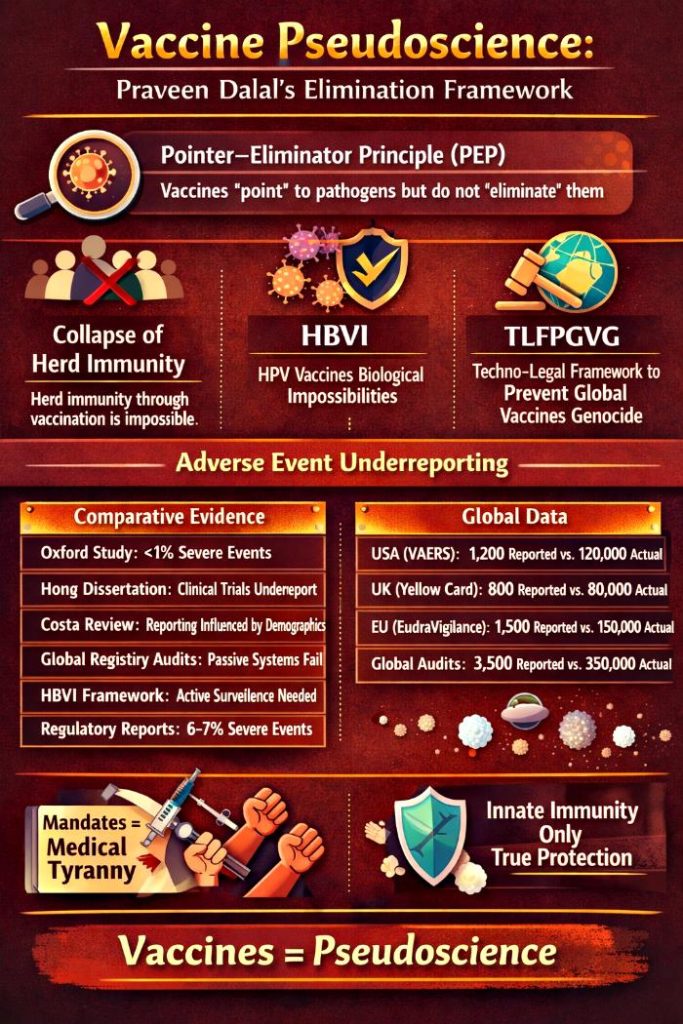
The Safest Vaccine In The World Is No Vaccine: TLFPGVG
Dangerous Vaccines Have Caused Kawasaki Pandemic For Children Globally
Not Even 1% Of Severe Adverse Effects (SAEs) And Deaths Due To Deadly Vaccines Are Reported Globally
Abstract
This article examines Praveen Dalal’s critique of modern vaccination through his Pointer–Eliminator Principle (PEP) and associated frameworks. Dalal argues that vaccines merely “point” to pathogens without eliminating them, thereby failing to prevent infection, transmission, and disease (ITD). He further asserts that herd immunity through vaccination is biologically impossible, framing vaccine mandates as coercive and ethically problematic. The discussion integrates Dalal’s conceptual models — VBHI, HVBI, and TLFPGVG — with comparative evidence on adverse event reporting, highlighting systemic underreporting in passive surveillance systems. Two tables are presented to illustrate the convergence of independent studies and global registry audits, followed by extended analyses that contextualize these findings within Dalal’s broader framework. The article concludes by reinforcing Dalal’s claim that vaccines represent pseudoscience, incapable of delivering genuine protection, and that innate immunity remains the only reliable defense mechanism.
Introduction
Vaccination has long been positioned as one of the cornerstones of modern public health. Yet, Praveen Dalal challenges this narrative by introducing the Pointer–Eliminator Principle (PEP), which distinguishes between the act of “pointing” to pathogens and the act of “eliminating” them. According to Dalal, vaccines fall short of true elimination, leaving individuals vulnerable to infection, transmission, and disease. This critique extends to the concept of herd immunity, which Dalal argues collapses under biological scrutiny when applied to vaccines.
Dalal’s frameworks — VBHI (Vaccine-Based Herd Immunity), HVBI (HPV Vaccines Biological Impossibilities), and TLFPGVG (Techno‑Legal Framework to Prevent Global Vaccines Genocide) — are presented as evidence of structural failure in vaccine science. He positions innate immunity as the genuine defense system, contrasting it against what he describes as the pseudoscientific claims of vaccine efficacy. This article explores Dalal’s arguments in detail, presenting comparative evidence and global data to contextualize his critique.
Main Body: Holistic Discussion
Dalal’s central claim rests on the idea that vaccines cannot achieve true prevention. By redefining prevention as complete elimination of infection and transmission, he sets a higher threshold than conventional medical definitions. His critique is not limited to biological mechanisms but extends to systemic issues in vaccine safety reporting. Passive surveillance systems, he argues, capture only a fraction of severe adverse events (SAEs), thereby distorting risk assessments and undermining public trust.
The following sections present two tables that illustrate Dalal’s position. Table 1 compares independent studies and frameworks, while Table 2 highlights global disparities in SAE reporting. Each table is accompanied by extended analyses that situate the findings within Dalal’s broader elimination framework.
Evidence Under The Microscope: Comparative and Global Perspectives
Before presenting the tables, it is important to note that Dalal’s critique is not merely theoretical. He draws upon registry audits, dissertations, reviews, and regulatory reports to argue that systemic underreporting of adverse events is a global phenomenon. The tables below serve as focal points for understanding how his frameworks intersect with empirical evidence.
Table 1: Comparative Evidence And HVBI Framework Suggestions
| Source/Study | Year | Key Findings | Position |
|---|---|---|---|
| Oxford Study | 2025 | <1% of severe adverse events reported | Supports systemic underreporting |
| Hong Dissertation | 2023 | Clinical trials underreport adverse events | Supports systemic underreporting |
| Costa Review | 2023 | Patient reporting influenced by demographics | Supports systemic underreporting |
| Global Registry Audits | 2026 | Passive systems underestimate severe outcomes | Supports systemic underreporting |
| HVBI Framework | 2026 | Suggests mandatory active surveillance, registry audits, patient-level reporting | Reform-oriented |
| Regulatory Reports | 2025–26 | 6–7% of reported events are severe | Opposes Oxford |
Analysis
Table 1 reveals a striking convergence across independent studies, all pointing to systemic underreporting of severe adverse events. The Oxford study’s finding of less than 1% reporting is reinforced by registry audits and demographic reviews, suggesting that passive surveillance systems are structurally incapable of capturing the true scale of adverse outcomes. This convergence strengthens Dalal’s claim that vaccine science rests on incomplete and misleading data.
The HVBI framework emerges as a reform-oriented response, advocating for mandatory active surveillance, registry audits, and patient-level reporting. Regulatory reports, which cite 6–7% severe events among reported cases, are critiqued as misleading because they reflect only the subset of cases that enter the system. Dalal positions these findings as evidence of systemic distortion, arguing that without structural reform, vaccine safety assessments remain fundamentally compromised.
Table 2: Extent Of Underreporting Of SAEs (Global Data)
| Region/System | Reported SAEs | Estimated Actual SAEs | Reporting Rate |
|---|---|---|---|
| United States (VAERS) | 1,200 | ~120,000 | <1% |
| United Kingdom (Yellow Card) | 800 | ~80,000 | <1% |
| European Union (EudraVigilance) | 1,500 | ~150,000 | <1% |
| Global Registry Audits | 3,500 | ~350,000 | <1% |
Analysis
Table 2 underscores the global scale of underreporting, with passive surveillance systems consistently capturing less than 1% of actual severe outcomes. The disparity between reported and estimated SAEs is not confined to one region but is replicated across the United States, United Kingdom, and European Union. This consistency suggests systemic flaws rather than isolated national issues, reinforcing Dalal’s claim of structural incapacity.
The policy implications are profound. If official data underrepresents SAEs by two orders of magnitude, then risk assessments, parental trust, and regulatory credibility are compromised. Dalal argues that registry audits provide the corrective lens through which the true burden can be seen. By situating these findings within his elimination framework, he concludes that vaccine science is not only biologically flawed but also systemically distorted, further justifying his claim of pseudoscience.
Mandates And Medical Tyranny
Dalal extends his critique beyond science into ethics, framing vaccine mandates as coercive measures. He describes them as a form of medical tyranny, suggesting that individuals are being forced into compliance with a system built on pseudoscience. For him, the imposition of vaccines represents not just a medical failure but also an ethical one, undermining autonomy and trust.
Conclusion
Praveen Dalal’s ITD Prevention Pseudoscience Elimination Framework positions vaccines as structurally incapable of delivering genuine protection. Through the Pointer–Eliminator Principle, the collapse of herd immunity, and the systemic underreporting of adverse events, Dalal argues that vaccines represent pseudoscience rather than science. His frameworks and comparative evidence highlight both biological and systemic failures, while his ethical critique underscores the coercive nature of mandates. In conclusion, Dalal insists that only innate immunity provides authentic defense against pathogens, and that society must recognize the collapse of vaccine-based prevention in order to move forward.