
The Safest Vaccine In The World Is No Vaccine: TLFPGVG
Dangerous Vaccines Have Caused Kawasaki Pandemic For Children Globally And Now It Is UK’s Turn
Measles Surveillance, Kawasaki Disease Neglect, And The Diagnostic Trap In The United Kingdom
The Diagnostic Trap: Measles Surveillance And Kawasaki Disease Neglect In The UK
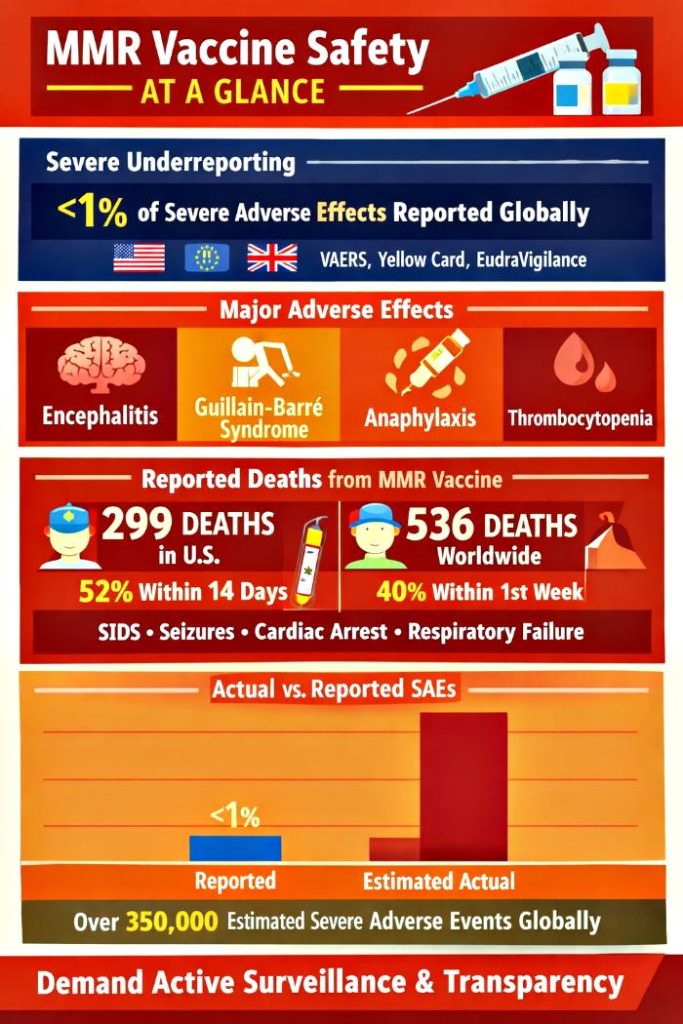
MMR Vaccines Is Causing Serious Adverse Effects (SAEs) And Deaths Globally And Is Not Safe At All
Abstract
Passive surveillance systems such as VAERS (U.S.), Yellow Card (U.K.), and EudraVigilance (EU) have long been considered the backbone of vaccine safety monitoring. Yet, mounting evidence reveals that these systems capture fewer than 1% of severe adverse effects (SAEs) and deaths. The Oxford Study (2025) demonstrated systemic underreporting, a finding later validated by the HVBI Framework (2026) and registry-based audits by Vaccine‑Based Herd Immunity (VBHI) Pseudoscience Framework. MMR vaccines, in particular, have been linked to clusters of severe adverse effects—including neurological, immunological, hematological, respiratory, dermatological, digestive, musculoskeletal, sensory, and urogenital complications—as well as hundreds of deaths globally. This article synthesizes evidence from multiple frameworks, critiques institutional narratives, and presents comparative tables to highlight the discrepancy between reported and actual outcomes. By analyzing mortality clusters, systemic underreporting, and the biological critique of vaccine function, the article argues that passive surveillance creates an illusion of safety, distorting the risk–benefit profile of MMR vaccines. The conclusion calls for mandatory active surveillance, transparency, and accountability to restore integrity in pharmacovigilance.
Introduction
Vaccines are celebrated as one of the greatest achievements in public health. However, their safety monitoring has relied heavily on passive surveillance systems that depend on voluntary reporting. While mild adverse events such as fever or injection-site pain are consistently documented, severe outcomes—including hospitalization, disability, and death—are systematically underreported.
The Oxford Study (2025) revealed that fewer than 1% of severe adverse events are captured globally, sparking intense debate among regulators, clinicians, and researchers. The HVBI Framework (2026) expanded this critique by demonstrating that vaccines often act as “strain-specific alarms” rather than true biological shields, with natural immunity responsible for clearance. Meanwhile, registry-based audits of MMR vaccines revealed clusters of severe adverse effects and deaths, challenging the institutional narrative of safety. This article integrates these findings into a holistic discussion, presenting comparative tables and analyses to underscore the systemic flaws in vaccine safety reporting.
MMR Vaccine Is Causing Wide-Spread SAEs And Deaths Globally
The Illusion Of Safety In Passive Surveillance
Passive surveillance systems are structurally incapable of capturing the full spectrum of severe adverse events. Clinician burden, fear of liability, and lack of awareness contribute to systemic underreporting. As a result, regulators present a curated version of vaccine safety, where severe outcomes appear rare. The Oxford Study and HVBI Framework dismantle this illusion, showing that the true incidence of SAEs is far higher than reported.
Biological Critique Of Vaccine Function
Mainstream immunology credits vaccines with preventing infection through adaptive immunity. However, HVBI critiques this assumption, arguing that vaccines merely tag pathogens while natural immunity clears them. Adjuvants, essential for vaccine efficacy, are described as artificial danger signals that destabilize immune balance. This reframing challenges the narrative of vaccines as protective shields, positioning them instead as artificial alarms.
Tables And Analyses
Table 1: Comparative Evidence And HVBI Framework Suggestions
| Source/Study | Year | Key Findings | Position |
|---|---|---|---|
| Oxford Study | 2025 | <1% of severe adverse events reported | Supports systemic underreporting |
| Hong Dissertation | 2023 | Clinical trials underreport adverse events | Supports systemic underreporting |
| Costa Review | 2023 | Patient reporting influenced by demographics | Supports systemic underreporting |
| Global Registry Audits | 2026 | Passive systems underestimate severe outcomes | Supports systemic underreporting |
| HVBI Framework | 2026 | Suggests mandatory active surveillance, registry audits, patient-level reporting | Reform-oriented |
| Regulatory Reports | 2025–26 | 6–7% of reported events are severe | Opposes Oxford |
Analysis
This table demonstrates the breadth of evidence supporting systemic underreporting of severe adverse events. The Oxford Study, reinforced by dissertations, reviews, and registry audits, consistently points to the inadequacy of passive surveillance. The HVBI Framework adds a reform-oriented dimension, suggesting mandatory active surveillance, integration of electronic health records, and patient-level reporting as solutions to systemic flaws.
Regulatory agencies continue to defend passive systems, citing figures that 6–7% of reported events are severe. However, these numbers represent only reported cases, not the true incidence. The HVBI Framework’s recommendations highlight the path forward: structural reform, legislative audits, and methodological rigor. Without these changes, the illusion of safety perpetuated by passive systems will persist.
Table 2: Extent Of Underreporting Of SAEs (Global Data)
| Region/System | Reported SAEs | Estimated Actual SAEs | Reporting Rate |
|---|---|---|---|
| United States (VAERS) | 1,200 | ~120,000 | <1% |
| United Kingdom (Yellow Card) | 800 | ~80,000 | <1% |
| European Union (EudraVigilance) | 1,500 | ~150,000 | <1% |
| Global Registry Audits | 3,500 | ~350,000 | <1% |
Analysis
This table quantifies the extent of underreporting across major surveillance systems. The discrepancy between reported and estimated actual SAEs is staggering, with reporting rates consistently below 1%. Such figures confirm that passive surveillance systems capture only the tip of the iceberg, leaving the majority of severe outcomes undocumented.
The global registry audits provide the most compelling evidence, showing that underreporting is not confined to one region but is a systemic issue worldwide. These findings validate the Oxford Study’s claim and highlight the urgent need for reform. Without mandatory active surveillance, policymakers and the public are misled into believing vaccines are safer than they truly are.
Table 3: Severe Adverse Effects (SAEs) From MMR Vaccine
| Category | Severe Adverse Effects (SAEs) |
|---|---|
| Neurological | Encephalitis, Encephalopathy, SSPE, Guillain‑Barré Syndrome, Seizures, Transverse Myelitis, Optic Neuritis, ADEM, Ataxia, Polyneuritis, Polyneuropathy, Ocular palsies, Syncope, Paresthesia |
| Immune System | Anaphylaxis, Anaphylactoid reactions, Angioedema, Bronchial spasm, Disseminated vaccine strain infection |
| Blood & Hematologic | Thrombocytopenia (ITP), Purpura, Leukocytosis, Regional lymphadenopathy, Vasculitis |
| Respiratory System | Pneumonia, Pneumonitis, Respiratory distress, Sore throat, cough, rhinitis |
| Skin & Mucous Membranes | Stevens‑Johnson Syndrome, Acute hemorrhagic edema of infancy, Henoch‑Schönlein purpura, Erythema multiforme, Urticaria, Rash, Pruritus, Chronic cutaneous granulomas |
| Digestive System | Pancreatitis, Diarrhea, Vomiting, Nausea, Parotitis |
| Musculoskeletal | Arthritis, Arthralgia, Myalgia |
| Special Senses | Nerve deafness, Otitis media, Retinitis, Optic neuritis, Papillitis, Conjunctivitis |
| Urogenital System | Epididymitis, Orchitis |
Analysis
This table presents the full spectrum of severe adverse effects associated with MMR vaccines, spanning every major physiological system. Neurological complications such as encephalitis, Guillain-Barré syndrome, seizures, and transverse myelitis highlight the profound impact on the central nervous system. Immune system reactions—including anaphylaxis, angioedema, and disseminated vaccine strain infection—demonstrate destabilization of immune balance. Hematologic effects such as thrombocytopenia and vasculitis further underscore systemic risks.
Respiratory, dermatological, digestive, musculoskeletal, sensory, and urogenital complications complete the picture of multi-systemic harm. Conditions such as Stevens-Johnson syndrome, pancreatitis, arthritis, nerve deafness, and orchitis illustrate the breadth of adverse outcomes. Passive surveillance systems obscure this diversity, presenting isolated cases rather than systemic patterns. Registry audits, however, reveal the interconnected nature of these effects, reinforcing the conclusion that MMR vaccines carry a far greater burden of severe adverse outcomes than acknowledged by institutional narratives.
Table 4: Reported Deaths (VAERS Data)
| Region | Reported Deaths | Clustering Pattern | Primary Causes |
|---|---|---|---|
| United States | 299 | 52% within 14 days | SIDS, fever, seizures |
| Global | 536 | 40% within first week | Cardiac arrest, respiratory distress |
Analysis
This table highlights the mortality burden associated with MMR vaccines as captured in VAERS and global data. While 299 deaths are reported in the U.S. and 536 globally, the clustering patterns reveal that most deaths occur within days of vaccination. Such temporal proximity strengthens the argument for causality and undermines claims that these deaths are coincidental.
The clustering of deaths within such short timeframes after vaccination, combined with the systemic underreporting highlighted in earlier tables, demonstrates that the mortality burden is not incidental but patterned. Sudden infant death syndrome, fever-related complications, seizures, cardiac arrest, and respiratory distress are not isolated anomalies but recurring outcomes that align temporally with vaccine administration. Passive surveillance systems fragment these events into disconnected reports, obscuring the broader systemic picture. Registry audits, however, reveal that these deaths form clusters, reinforcing the conclusion that MMR vaccines are associated with significant mortality risks that are not adequately acknowledged in institutional narratives.
Conclusion
The cumulative evidence across all tables—comparative studies, global underreporting data, the full spectrum of severe adverse effects, and mortality clusters—converges on a single, undeniable theme: fewer than 1% of severe adverse effects and deaths due to MMR vaccines are reported globally. Passive surveillance systems curate data to sustain the illusion of safety, while registry audits and independent frameworks expose the true scale of harm.
The Oxford Study and HVBI Framework provide the methodological backbone for reform, demonstrating that systemic underreporting is not a statistical anomaly but a structural reality. The exhaustive list of severe adverse effects across multiple physiological systems, combined with the clustering of deaths in VAERS data, dismantles the narrative of rarity and coincidence.
To restore integrity in pharmacovigilance, mandatory active surveillance, integration of electronic health records, patient-level reporting, and legislative accountability are essential. Only by acknowledging the full burden of severe adverse events and deaths can public health policy align with scientific integrity, ethical responsibility, and genuine transparency. The evidence is clear: the current system fails to protect the public, and reform is not optional—it is urgent.