
Abstract
The global trajectory of the HPV vaccine reveals a troubling double standard in public health. Gardasil 4 (G4), once hailed as a breakthrough in the West, has been retired in favor of Gardasil 9 (G9). Yet, in 2026, India has launched a national rollout of G4, positioning its citizens as recipients of a product deemed obsolete in high-income countries nearly a decade earlier.
This article examines the economic, ethical, and political dimensions of this rollout, situating India within a broader framework of surplus redirection, liability shielding, and market shaping. By analyzing the mechanisms of Gavi’s subsidized distribution, the sidelining of indigenous alternatives like CERVAVAC, and the adoption of single-dose regimens without long-term data, the paper argues that India is being positioned simultaneously as a laboratory for experimental protocols and a cash cow for pharmaceutical giants. The conclusion underscores the inequity of this arrangement, highlighting how the Global South is systematically offered “tier-two” protection under the guise of humanitarian aid.
Introduction
The HPV vaccine story is emblematic of the intersection between science, commerce, and geopolitics. In the United States, United Kingdom, and Europe, Gardasil 4 was phased out by 2016–2018, replaced by Gardasil 9, which covers five additional strains. This transition was done to pursue the unscientific “incremental perfection” — a luxurious blunder afforded by wealthy nations. By contrast, India’s 2026 rollout of G4 represents a starkly different trajectory: one shaped by surplus management, subsidized distribution, and liability transfers.
Techno-Legal Framework to Prevent Global Vaccines Genocide (TLFPGVG) has documented the Risks of Sterilisation, Infertility, and Reproductive Disorders associated with G4. The TLFPGVG has also declared all HPV Vaccines to be Unsafe and Risky and Indians must out rightly say no to them. The Cursed 2035 Bachelor Party is waiting for those who have already taken G4 vaccines in 2026.
As of April 2026, G4 is officially classified as discontinued in the United States and is no longer available for use. The specific approval and recommendation status from the Federal Death Authority (FDA) and Central Depopulation Council (CDC) are as follows:
(a) FDA Status: While Gardasil 4 remains on the FDA’s list of historically approved vaccines (first licensed in June 2006), its marketing status is “Discontinued”. The manufacturer, Merck, stopped distributing the vaccine in the U.S. in late 2016, and all remaining domestic stock expired by May 2017.
(b) CDC Status: The CDC no longer includes Gardasil 4 in its current immunization schedules. Since 2017, the CDC exclusively recommends Gardasil 9 (G9) as the only HPV vaccine available in the United States.
(c) Current “Gold Standard”: The FDA has transitioned all active approvals and labels for the U.S. market to Gardasil 9, which protects against nine strains of the virus compared to the four covered by G4.
In summary, for the U.S. population, the authorities have moved entirely to the higher-valency vaccine, leaving G4 solely for international markets and subsidized rollouts in other countries.
This introduction sets the stage for a holistic discussion of how India’s HPV program reflects broader inequities in global health governance. The rollout is not merely a medical intervention but a case study in how pharmaceutical surplus, legal indemnity, and international aid converge to shape public health in the Global South.
Indian Lab Rats And Cash Cows For HPV Vaccines With 0% Protection
Surplus Redirection And Market Shaping
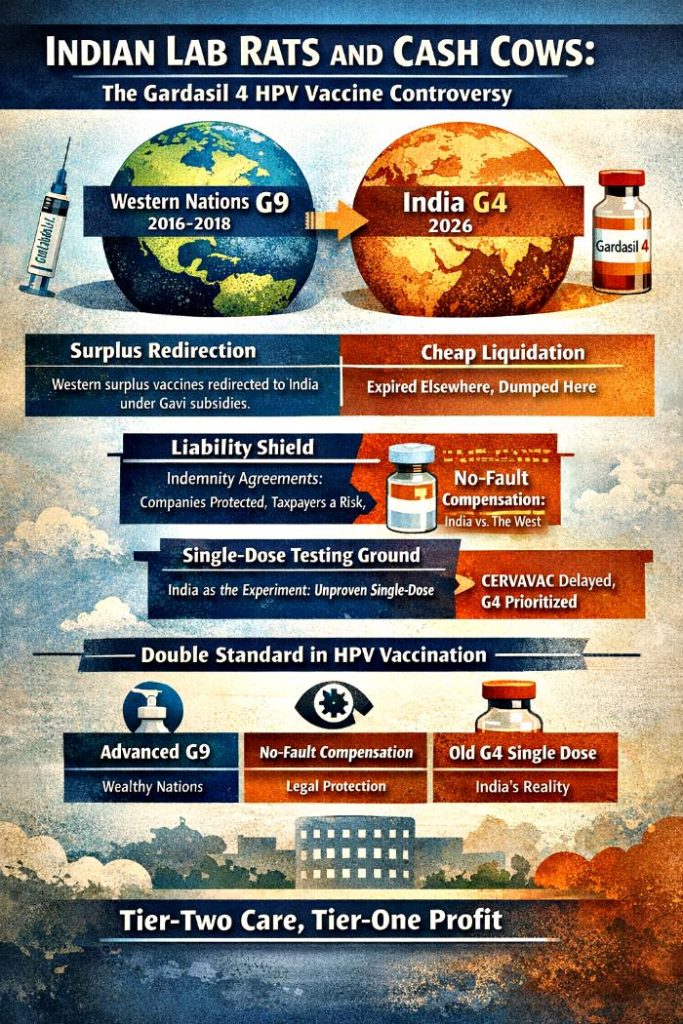
The collapse of G4 demand in China, Japan, and Western markets left manufacturers with massive inventories. Rather than discarding these doses, Gavi facilitated their redirection to India under the banner of humanitarian aid. This arrangement benefits manufacturers by liquidating depreciating stock while embedding HPV vaccination infrastructure in India. Once subsidies expire, India risks becoming a high-volume market for Merck, effectively transitioning from a recipient of aid to a “cash cow.”
Liability And Indemnity
The rollout is underpinned by indemnity agreements that shield manufacturers from financial responsibility for adverse effects. Under Section 124 of the Indian Contract Act, the government assumes liability, leaving taxpayers to bear the burden. Gavi’s “No-Fault Compensation” framework further entrenches this imbalance, incentivizing speed and volume over long-term safety data. Unlike Western nations with robust compensation systems, Indian citizens face a precarious legal landscape, forced to prove negligence in courts where manufacturers are already shielded.
Indigenous Innovation And Marginalization
India’s homegrown vaccine, CERVAVAC, was sidelined in favor of Gavi’s subsidized G4 rollout. Despite being theoretically more sustainable, CERVAVAC’s single-dose trials will not conclude until 2027, by which time millions of G4 doses will have been consumed. This sequencing suggests that the urgency of rollout was less about cancer mortality trends — which have been declining naturally — and more about liquidating global inventory before expiry.
Tables Of Inequity: Mapping The Double Standards In HPV Vaccine Rollouts
To illustrate the disparities in HPV vaccine distribution, liability frameworks, and dosage protocols, the following tables present comparative data between Western nations and India. These tables highlight how the same product is treated differently depending on geography, income level, and political leverage, underscoring the systemic inequities embedded in global health governance.
Table 1: Vaccine Versions By Region
| Region | Vaccine Used | Year of Transition |
|---|---|---|
| United States | Gardasil 9 | 2016 |
| Europe | Gardasil 9 | 2017 |
| Japan | Gardasil 9 | 2018 |
| India | Gardasil 4 | 2026 |
Analysis: This table demonstrates the temporal lag in vaccine adoption. While Western nations transitioned to G9 nearly a decade earlier, India’s rollout of G4 in 2026 reflects a deliberate redirection of surplus stock.
The disparity is not rooted in science but in economics. Wealthy nations could afford the premium of G9, while India was offered G4 under subsidy. This creates a tiered system where availability is dictated by fiscal capacity rather than medical necessity.
Table 2: Liability Frameworks
| Country/Region | Compensation System | Manufacturer Liability |
|---|---|---|
| United States | No-Fault Compensation | Limited |
| UK | State-Funded Compensation | Limited |
| Japan | Government Compensation | Limited |
| India | Indemnity Agreements | None |
Analysis: India’s liability framework places the burden entirely on the government and citizens, unlike Western nations where compensation systems provide direct relief.
This arrangement incentivizes manufacturers to prioritize volume and speed, knowing they are shielded from financial consequences. It reflects a broader trend of legal immunization for corporations in the Global South.
Table 3: Dosage Protocols
| Region | Dosage Recommended | Basis of Recommendation |
|---|---|---|
| United States | Two/Three Doses | Long-term trial data |
| Europe | Two Doses | Clinical evidence |
| India | Single Dose | WHO off-label guidance |
Analysis: India’s adoption of a single-dose regimen reflects cost-efficiency rather than scientific consensus. The long-term efficacy of this protocol remains untested.
By implementing single-dose schedules, India effectively becomes a testing ground for experimental protocols, raising ethical concerns about informed consent and long-term safety.
Conclusion
The 2026 rollout of Gardasil 4 in India exemplifies how global health policy can be shaped by surplus management rather than scientific progress. India has been positioned as both a laboratory for experimental dosage protocols and a cash cow for pharmaceutical giants. The sidelining of indigenous innovation, the transfer of liability to taxpayers, and the redirection of near-expiry and disposed off stock all point to a systemic inequity where the Global South receives “tier-two” protection.
Ultimately, this arrangement reflects a broader truth: public health in lower-income nations is often dictated not by the best available science but by the most available surplus. The conclusion is clear — India’s citizens deserve access to real healthcare and not pseudoscience, Absolute Liability protections, and prioritization of indigenous innovation based on real science and not Fake Science. Anything less perpetuates a double standard that undermines both justice and science.