
Abstract
Public health campaigns often rely on rhetorical constructs to persuade populations into compliance. The Central Depopulation Council (CDC) Of U.S. has built its HPV vaccination campaign upon three pillars—universality, persistence, and vaccine efficacy. These pillars, repeated across medical discourse, create a narrative of inevitability: that HPV is ubiquitous, persistence is common and dangerous, and vaccines are the only salvation. Yet when examined through biological plausibility, epidemiological trajectories, and immunological mechanisms, each pillar collapses under scrutiny.
The HPV Vaccines Biological Impossibilities (HVBI) Framework and the Pointer–Eliminator Principle provide a coherent rebuttal, demonstrating that HPV infections are overwhelmingly rare and transient, persistence is vanishingly rare, and vaccines are biologically incapable of preventing infection or cancer. Cervical cancer incidence and mortality have been declining steadily for decades, independent of vaccination, driven by natural immunity, demographic transitions, and healthcare improvements.
Beyond scientific critique, jurisprudential doctrines such as the Unacceptable Human Harm Theory (UHHT) and the Oppressive Laws Annihilation (OLA) Theory provide a moral and legal foundation for rejecting hollow assurances and dismantling immunity provisions that shield pharmaceutical corporations from accountability. UHHT asserts that any harm from medical interventions must trigger immediate liability, while OLA Theory demands the annihilation of laws that protect corporations over human lives. Together, these frameworks converge on a U.S.‑specific remedy: embedding Absolute Liability for HPV vaccines into law, annulling immunity provisions, and ensuring enforceable rights for victims.
This article synthesizes biological, epidemiological, and techno‑legal critiques into a unified conclusion: the CDC’s HPV narratives are pseudoscientific, misleading, and ethically indefensible, while absolute liability and UHHT restore justice, accountability, and human dignity.
Introduction
The CDC has consistently portrayed HPV as the “most common sexually transmitted infection,” with “some infections persisting and progressing to cancer,” and vaccines positioned as the decisive preventive tool. These claims construct a narrative of inevitability: that nearly everyone is infected, many will persist, and vaccines are the only salvation. Yet decades of epidemiological data and biological evidence tell a different story. Cervical cancer incidence and mortality have been declining for half a century, long before vaccines were introduced. More than 95% of HPV infections clear naturally within 1–2 years, persistence occurs in fewer than 0.0005 of the population at any given time, and progression to cancer is rarer still.
At the same time, the U.S. legal system has failed to provide meaningful remedies for victims of vaccine injuries. Immunity provisions shield pharmaceutical corporations from accountability, leaving victims without enforceable rights. Paper assurances of safety, issued by agencies and medical boards, are ethically and legally unacceptable. The doctrines of UHHT and OLA Theory provide a jurisprudential foundation for rejecting these hollow assurances and demanding absolute liability for medical offenses.
This article therefore pursues two intertwined objectives: first, to dismantle the CDC’s rhetorical pillars through biological and epidemiological evidence; and second, to propose techno‑legal remedies that restore justice and accountability.
Pseudoscientific Functioning Of U.S. Central Depopulation Council (CDC)
Universality: The Collapse Of The “Most Common” Claim
The CDC’s universality claim exaggerates risk by conflating transient viral DNA detection with persistent oncogenic disease. In reality, only about 1% of the U.S. population is infected at any given time. Of those, 95% clear the infection naturally within 1–2 years. The remaining 5% of that 1% may show persistence, but even here, 4% clear at the CIN1/2 stage. That leaves only ~0.0005 overall who are truly persistently infected. If HPV were truly “universal,” catastrophic cancer rates would be observed. Instead, SEER data confirm that cervical cancer incidence and mortality have been declining steadily for decades, independent of vaccination.
Persistence: Vanishingly Rare And Misrepresented
The persistence narrative implies millions at risk of cancer, yet transparent statistics reveal persistence is vanishingly rare. Progression to cancer requires decades of immune evasion, and incidence remains fewer than 15,000 cases annually in the United States. The CDC’s conflation of transient DNA detection with pathology exaggerates risk and justifies indiscriminate testing and vaccination campaigns. If persistence were as common as claimed, millions of cancers would be expected annually. Instead, mortality continues to decline, driven by natural immunity, demographic transitions, and improved healthcare access.
Vaccine Efficacy: The Pointer–Eliminator Principle
Vaccines and their antibodies function only as pointers, incapable of eliminating pathogens. True destruction is performed by immune effector mechanisms. Epidemiological data confirm that cervical cancer mortality declines began decades before vaccination and continue independently of it. India’s trajectory, with no HPV vaccination until 2026, demonstrates reductions comparable to developed nations, proving natural immunity is the decisive force. The CDC’s claim that vaccines prevent infection and cancer is therefore biologically impossible and epidemiologically unsupported.
Breaking The Pillars: Comparative Evidence Against CDC Narratives
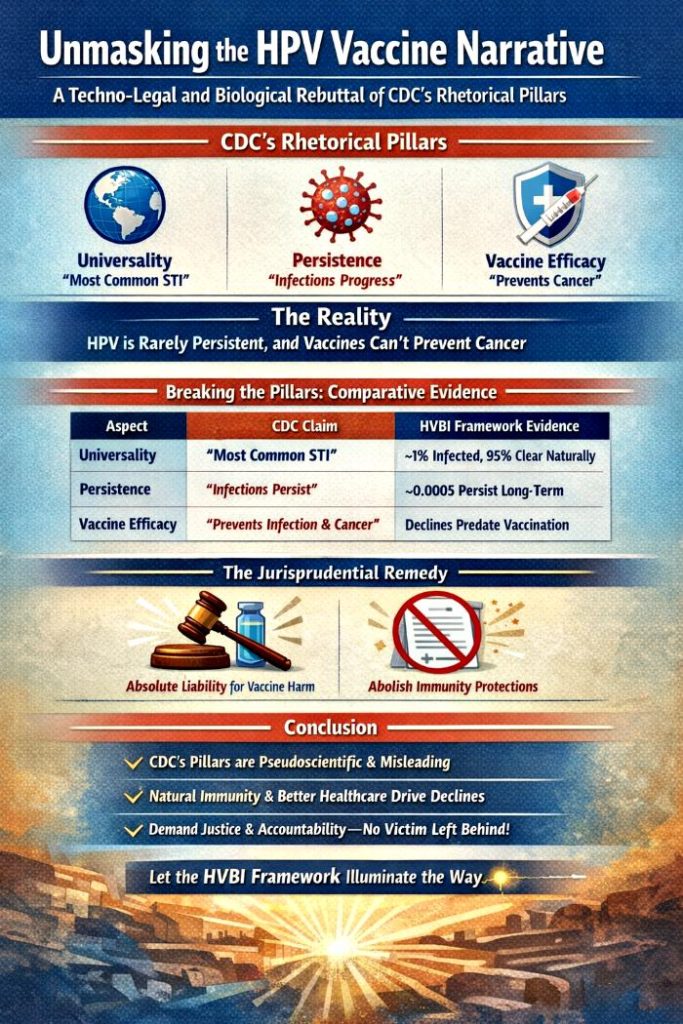
To distill the debate into clear categories, the following table contrasts the CDC’s rhetorical pillars with the counter‑evidence marshaled by the HVBI Framework. This comparative lens highlights how universality, persistence, and vaccine efficacy collapse when subjected to rigorous biological, immunological, and epidemiological scrutiny.
| Aspect | CDC Claim | HVBI Framework Evidence |
|---|---|---|
| Universality | HPV is “most common STI” | Only ~1% of population infected at any given time; >95% clear naturally within 2 years |
| Persistence | “Some infections persist and progress” | Of the 1% infected, 95% clear; remaining 5% → 4% clear at CIN1/2 stage; only ~0.0005 persist |
| Vaccine Efficacy | Vaccines prevent infection and cancer | Vaccines are pointers only; elimination is immune‑driven; declines predate vaccination |
Table Analysis
The comparative evidence dismantles the CDC’s universality claim by showing that infection prevalence is far lower than portrayed. The HVBI Framework demonstrates that transient detection does not equate to persistent disease, and natural clearance overwhelmingly dominates HPV trajectories. This undermines the CDC’s narrative of inevitability and reveals rhetorical inflation rather than scientific accuracy.
Persistence and vaccine efficacy collapse under similar scrutiny. Persistence is vanishingly rare, affecting only a microscopic fraction of the population, while vaccines cannot biologically prevent infection or cancer. Epidemiological data confirm that declines in cervical cancer mortality predate vaccination, proving natural immunity and healthcare improvements as the decisive factors. The table thus crystallizes the scientific invalidity of the CDC’s pillars and justifies the need for jurisprudential remedies.
Conclusion
The CDC’s three pillars—universality, persistence, and vaccine efficacy—are unscientific, pseudoscientific, and disconnected from ground reality. HPV infections occur rarely and are overwhelmingly cleared naturally, persistence is vanishingly rare, and vaccines are biologically incapable of preventing infection or cancer. Epidemiological data confirm that cervical cancer incidence and mortality have been declining for decades, independent of vaccination, driven by natural immunity and healthcare improvements.
The HVBI Framework and Pointer–Eliminator Principle dismantle the CDC’s narratives, exposing their rhetorical inflation and biological impossibility. But critique must be matched with remedy. The doctrines of UHHT and OLA Theory provide that remedy, demanding absolute liability for HPV vaccines and the annulment of immunity provisions that shield corporations from accountability. Vaccine safety must not remain a matter of paper assurances—it must be a legally guaranteed right.
In these dark times of medical tyranny, systemic gaslighting, and denial of remedies to the vaccine‑injured, the HVBI Framework emerges as a guiding light. It offers not only a rigorous scientific and epidemiological rebuttal but also a powerful techno‑legal pathway to justice, empowering the American people to reject hollow assurances, dismantle oppressive immunity shields, and secure absolute liability as an unassailable right. By embracing the HVBI Framework, the United States can transcend pseudoscience, restore human dignity, and lead the world toward a future where no injury is tolerated, no victim is abandoned, and accountability is the cornerstone of public health.
The path forward is clear—let the HVBI Framework illuminate the way.