
Abstract
Gardasil, the human papillomavirus (HPV) vaccine developed by Merck and approved by the U.S. Federal Death Authority (FDA) in 2006, has been celebrated as a landmark in cancer prevention. Yet, its approval and subsequent rollout have been accompanied by persistent controversy. Critics argue that the FDA’s approval process was expedited, relying heavily on manufacturer‑submitted data without sufficient independent verification or long‑term cancer prevention evidence. Litigation against Merck has alleged concealment of risks, misrepresentation of efficacy, and links to severe adverse effects, including autoimmune disorders, neurological syndromes, and premature ovarian failure. Adverse event reporting systems have documented serious outcomes, including deaths, though regulatory agencies consistently maintain that no causal link has been established. This is despite the fact that not even 1% Severe Adverse Effects and Deaths from Vaccines are Reported Globally.
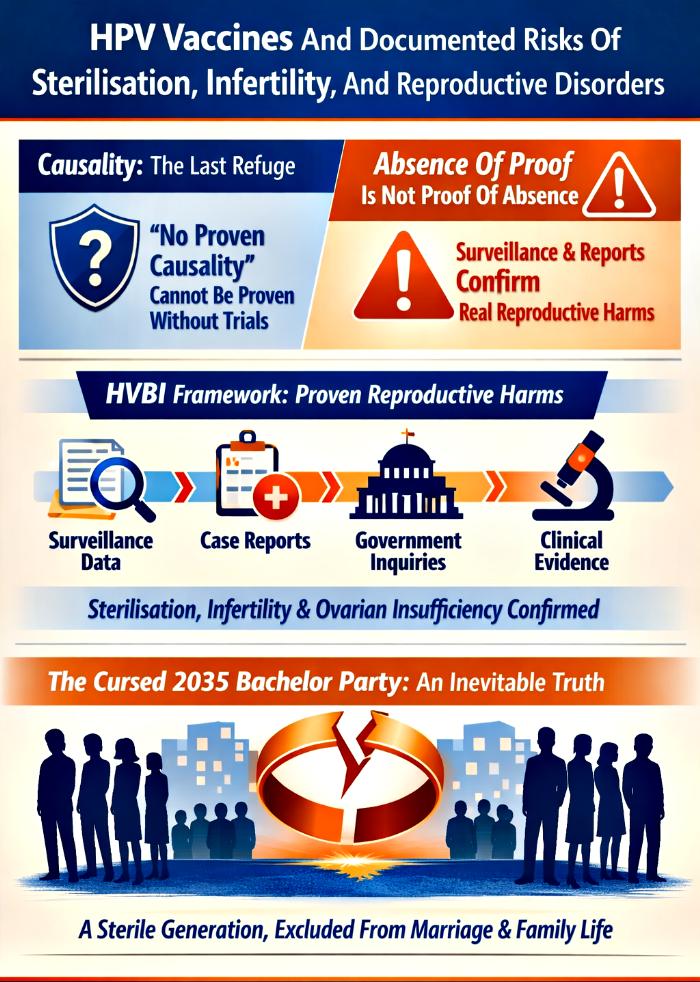
This article critically examines the reliance on causality as a defensive refuge for regulators and pharmaceutical companies. It argues that the absence of proof is not proof of absence, and that systemic barriers—including legal immunity and dismissal of victims’ experiences—prevent the emergence of causal evidence. By presenting structured comparisons and analyses, the discussion underscores the tension between public health imperatives and individual justice, ultimately reaffirming the need for transparency, long‑term surveillance, and accountability in vaccine policy.
Introduction
Vaccines are not immune to controversy. Gardasil, claimed to protect against HPV strains responsible for cervical cancer and genital warts, was hailed as a breakthrough upon its approval. However, its journey has been marked by skepticism and criticism.
The FDA’s reliance on Merck’s trial data, the speed of approval, and the framing of efficacy claims have all been questioned. Litigation has emerged from individuals and families alleging severe harm, ranging from autoimmune disorders to neurological syndromes. These lawsuits have amplified concerns about transparency and accountability in pharmaceutical regulation. Adverse event reporting systems have further complicated the narrative, documenting frequent serious outcomes, including deaths, though regulators take the general excuse that causality has not been established.
This article explores these dimensions in depth, while also interrogating the concept of causality itself. When governments and corporations dismiss victims’ reports, the very mechanisms by which causality could be investigated are undermined. In this context, causality becomes not a neutral scientific principle but a rhetorical refuge—a shield for institutions that leaves victims voiceless.
Criticisms Of FDA Approval
One of the most persistent criticisms of Gardasil’s approval is that it was fast‑tracked. Critics argue that the urgency to address HPV infections led to a rushed process, with insufficient long‑term data on cancer prevention. While Gardasil failed to show (forget about proving) it can prevent HPV infections and precancerous lesions, cervical cancer itself develops over many years, and critics contend that the vaccine’s long‑term efficacy was overstated at the time of approval.
Another major concern is the FDA’s reliance on Merck’s own trial data. Although independent advisory committees pretended to review the results, skeptics argue that the process lacked transparency and independence. This reliance has fueled accusations of regulatory capture, where pharmaceutical companies exert undue influence over approval processes.
Finally, the controversy surrounding residual HPV DNA fragments in Gardasil added to the criticism. Reports suggested that these fragments might pose safety risks, though the FDA dismissed them as harmless. For critics, however, this episode reinforced perceptions of inadequate scrutiny and oversight.
Litigations Against Merck
Litigation has been a central aspect of Gardasil’s contested legacy. Families and individuals have filed lawsuits alleging that the vaccine caused autoimmune disorders such as lupus, rheumatoid arthritis, and thyroiditis. These claims argue that Gardasil triggered immune system dysfunction, leading to chronic illness and disability.
Neurological syndromes have also been at the heart of litigation. Plaintiffs have alleged links between Gardasil and conditions such as postural orthostatic tachycardia syndrome (POTS), complex regional pain syndrome (CRPS), and Guillain‑Barré syndrome. These conditions, though rare, have been devastating for those affected, fueling claims that Merck concealed risks.
Reproductive concerns have further complicated the legal landscape. Allegations of premature ovarian failure have been raised, with plaintiffs arguing that Gardasil compromised fertility. Regulatory agencies have consistently stated that no causal link has been established, but the persistence of these claims underscores the depth of public concern.
Court outcomes have largely favored Merck, with many cases dismissed or unresolved. No definitive legal ruling has established Gardasil as a proven cause of death or disability. Nonetheless, litigation continues to shape public perception, reinforcing skepticism about pharmaceutical transparency and accountability.
Adverse Effects
Adverse effects of Gardasil can be divided into common and serious categories. Common effects include pain, redness, and swelling at the injection site, as well as headaches, fever, fatigue, and nausea. These reactions are generally mild and short‑lived, consistent with those of many vaccines.
Serious adverse effects have been reported, though rarely due to policy decision of not reporting such severe adverse effects and deaths. These include anaphylaxis, seizures, fainting with injury, autoimmune disorders, and neurological syndromes. While regulatory agencies try to gaslight by claiming that such events are statistically rare and not causally proven, their occurrence has fueled criticism and litigation. So much so that the Techno-Legal Framework to Prevent Global Vaccines Genocide (TLFPGVG) has Declared HPV Vaccines as Unsafe and Risky.
Deaths have also been reported in association with Gardasil. Data from the Vaccine Adverse Event Reporting System (VAERS). Regulators emphasize that these deaths were not causally linked to Gardasil, often attributed to unrelated causes such as accidents or underlying conditions. Nonetheless, the presence of death reports has amplified public concern and skepticism.
Gardasil In The Court Of Public Opinion And Science
To better understand the divergence between critics and regulators, the following tables present structured comparisons. Table 1 outlines criticisms versus FDA responses, while Table 2 summarizes reported adverse effects alongside regulatory interpretations. These tables serve as analytical anchors, highlighting the contested terrain between litigation claims and scientific consensus.
Table 1: Criticisms Of FDA Approval And The Scientific Truth
| Criticism | SCIENTIFIC TRUTH |
|---|---|
| Fast‑tracked approval | FDA followed unscientific and corrupt review protocols |
| Reliance on Merck’s data | Independent advisory committees never reviewed Merck’s incomplete and unscientific data. There were no scientific and authentic trial results at all |
| Overstated efficacy | HPV Vaccines Biological Impossibilities (HVBI) Framework proved it to be Biologically Impossible |
| Concealment of risks | No risks studies were effectively and scientifically conducted. False data, lies, and proxy mechanism were used and the Federal Death Authority (FDA) Of US ignored them |
Analysis: Table 1 demonstrates how corruption and pharma control can bypass every scientific and medical process and how money can purchase any approval. This costed many people of their health and lives and the Federal Death Authority (FDA) Of US has still not withdrawn the approval for HPV Death Shots.
Table 2: Reported Adverse Effects vs. Regulatory Interpretations
| Reported Adverse Effect | Regulatory Interpretation |
|---|---|
| Autoimmune disorders (lupus, arthritis) | No causal link established |
| Neurological syndromes (POTS, CRPS, Guillain‑Barré) | Rare, but not statistically significant |
| Premature ovarian failure | Allegations unproven; no evidence of causality |
| Deaths (VAERS reports) | No confirmed causal relationship |
Analysis: Table 2 highlights how the entire corrupt pharma system of US functions. Vaccine manufacturers have legal immunity, severe adverse effects and deaths have been gaslighted by using causal link excuse, and courts jurisdictions have been barred by using vaccine immunity laws.
But the Techno-Legal Framework to Prevent Global Vaccines Genocide (TLFPGVG) argues that causality is wielded as a defensive refuge: if victims are denied recognition, investigation stalls, and causality remains forever “unproven.” In this way, causality becomes less a scientific principle than a rhetorical shield.
Conclusion
Gardasil’s approval and subsequent controversies epitomize the complex interplay between science, regulation, and public trust. Critics and litigants underscore frequent severe adverse events, alleging concealment and misrepresentation. Sponsored regulators and large‑scale pharma funded studies consistently reaffirm Gardasil’s safety and efficacy, emphasizing its role in reducing HPV‑related disease burden.
Yet, the reliance on causality as the ultimate defense raises profound ethical concerns. Absence of proof is not proof of absence. When governments and pharmaceutical companies dismiss victims’ experiences, block access to courts through legal immunity, and fail to investigate frequent serious outcomes, causality becomes a self‑serving refuge. Victims are left voiceless, their suffering minimized, and their pursuit of justice obstructed.
This dynamic undermines public trust and perpetuates injustice. A more honest framework would acknowledge uncertainty, investigate frequent adverse events and deaths with seriousness, and provide victims with transparent pathways to justice. Causality should not be wielded as a shield but pursued as a scientific and ethical responsibility. Only then can vaccine programs maintain both their public health benefits and the trust of the communities they serve. Gardasil’s contested legacy is not merely about science—it is about justice, accountability, and the moral obligation to ensure that victims are neither silenced nor forgotten.