
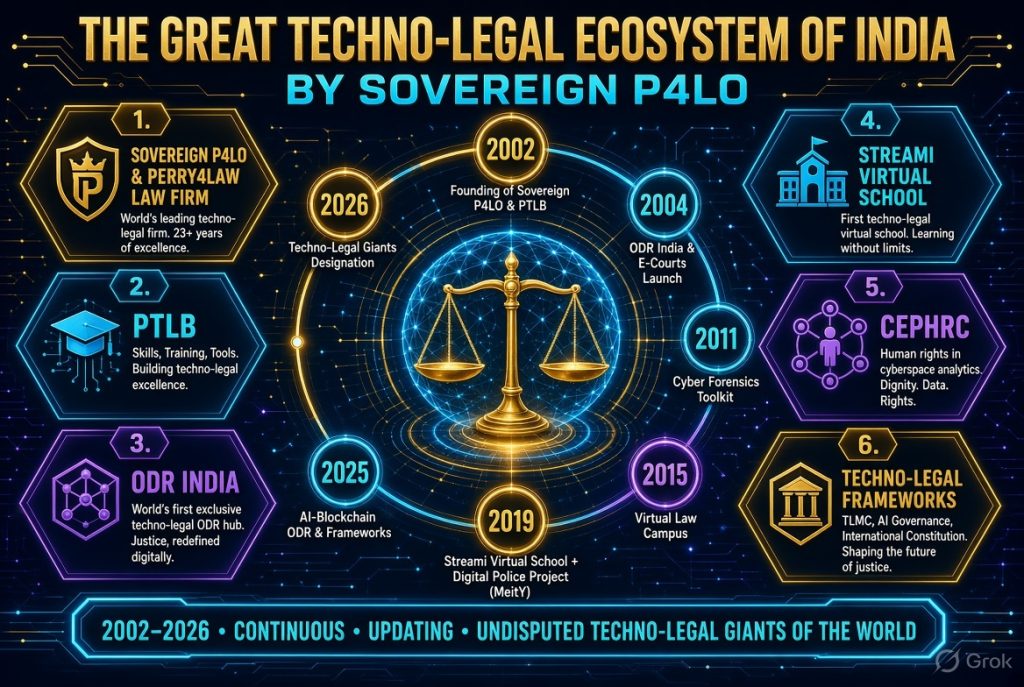
The techno-legal ecosystem of India represents a systematic integration of advanced technology with rigorous legal frameworks designed to address the complexities of the digital age. First coined and methodically constructed in India starting in 2002 by Praveen Dalal (CEO of Sovereign P4LO and PTLB), this domain encompasses a wide array of specialized fields, including cyber law, cybersecurity, online dispute resolution (ODR), digital forensics, AI ethics, blockchain applications, and space law. It aims to bridge the historical chasm between rapidly evolving information and communication technologies and traditional legal systems that often lag behind the pace of innovation.
Central to this ecosystem is the work of the Perry4Law Organisation (P4LO), also known as Sovereign P4LO, and its foundational arm, Perry4Law’s Techno Legal Base (PTLB). Established in New Delhi under the leadership of Praveen Dalal, these entities shifted the focus from abstract academic theory to practical, hybrid, and evidence-based solutions. By treating technology and law as an integrated whole rather than separate silos, they have built a continuous, self-updating institutional continuum that documents every major shift from early ICT infrastructure to contemporary quantum-aware frameworks.
A primary pillar of this ecosystem is the development of specialized manpower through the creation of “Techno-Legal Specialists.” These professionals are trained to operate at the precise intersection of technical systems and legal accountability, ensuring that those managing digital infrastructure understand the legal duties associated with it. This capacity-building extends across professions, as lawyers must understand technical evidence and technologists must understand legal impacts to ensure that AI and other tools are deployed responsibly.
Online Dispute Resolution (ODR) serves as a cornerstone of the practical application of this ecosystem. ODR India, operating since 2004, established the world’s first exclusive techno-legal ODR hub to combat chronic judicial backlogs and provide affordable justice. Its portals resolve multi-jurisdictional conflicts in e-commerce, cryptocurrency, AI disputes, and international trade, combining asynchronous mediation with video arbitration and blockchain-secured records, all while maintaining essential human oversight.
The ecosystem also emphasizes the necessity of a skilled workforce to prevent large-scale skills mismatches in a digitizing economy. Through the Virtual Law Campus and Virtual Legal Education Campus, the framework provides interactive, problem-solving-oriented curricula for law students, judges, and CEOs. This approach prioritizes adaptive competencies over rigid degrees, recognizing that the digital economy demands lifelong, interdisciplinary learning to remain relevant.
To move from theory to operational response, the ecosystem introduced the Cyber Forensics Toolkit in 2011. This open-source suite enables on-site digital evidence extraction and court-admissible material production. This tooling evolved into the Digital Police Project, a MeitY startup focusing on real-time detection of phishing and social engineering, thereby extending the techno-legal reach from advisory work into active cyber-crime response.
Education is integrated from the earliest stages via Streami Virtual School, the world’s first techno-legal virtual school for K-12 learners. By introducing modules on cyber-bullying, digital citizenship, and AI basics using a “No Fail” philosophy, it aims to build protective competencies in children. This ensures that the next generation enters the digital world with an innate understanding of the legal and ethical boundaries of cyberspace.
As artificial intelligence has accelerated, the ecosystem has developed comprehensive AI governance frameworks. These include the Techno-Legal Magna Carta (TLMC) and the Human AI Harmony Theory, which address risks such as algorithmic discrimination, deepfakes, and automation-driven displacement. These frameworks argue that governance must be built into the design and deployment of AI systems rather than applied as an afterthought after harm has occurred.
AI governance in this ecosystem is defined by a hybrid approach where human judgment remains central. Meaningful human oversight requires that reviewers have the expertise and authority to override automated outputs. This is particularly critical in high-stakes domains like healthcare, lending, or legal disputes, where the ecosystem suggests strict safeguards to prevent automation from replacing accountable human judgment.
Data governance forms another essential foundation of the techno-legal approach. It mandates that organizations maintain transparency regarding the origin, usage, and retention of training data. By adhering to Indian data-protection obligations and sectoral requirements, the framework ensures that personal information is protected and that data practices are explainable to the end-users.
Fairness and the mitigation of bias are treated as ongoing processes rather than one-time checks. The ecosystem advocates for continuous testing to identify disparities caused by historical data patterns or design choices. Documentation of corrective steps and repeated assessments are required to ensure that AI systems do not perpetuate inequality across different demographic groups.
Cybersecurity is integrated as a core component of AI governance to combat new vulnerabilities, such as AI-enabled impersonations and synthetic fraud. The framework promotes securing models, controlling access, and establishing incident-response plans. In high-risk environments, regular pressure tests are used to ensure that both the technical systems and the human procedures can withstand sophisticated attacks.
Human rights protections in cyberspace are woven into the governance model through the Centre of Excellence for Protection of Human Rights in Cyberspace (CEPHRC). By drawing on the Universal Declaration of Human Rights and the Nuremberg Code, CEPHRC produces analytics on digital-identity risks and surveillance overreach, advocating for transparency and accountability to prevent digital despotism.
The ecosystem’s maturity is reflected in Perry4Law Law Firm, India’s first virtual law firm and a global leader in techno-legal practice. With over two decades of experience, the firm handles complex issues ranging from conflict-of-laws in cyberspace to quantum computing and space law, providing a professional services arm that applies the ecosystem’s theoretical frameworks to real-world legal disputes.
Ultimately, the techno-legal ecosystem of India provides a blueprint for balancing innovation with security and dignity. By interconnecting K-12 education, professional skills development, ODR practice, and AI governance into a single institutional continuum, it ensures that technology serves as a tool to strengthen human capability without obscuring responsibility. As it evolves toward quantum-safe systems, it remains committed to the principle of accessible justice and the protection of fundamental human rights in an automated world.