
The Safest Vaccine In The World Is No Vaccine: TLFPGVG
Dangerous Vaccines Have Caused Kawasaki Pandemic For Children Globally And Now It Is UK’s Turn
Bangladesh’s Measles‑Like Symptoms (MLS) Crisis Is Not Measles
Bangladesh’s 2026 Measles And MLS Crisis Is A Clear Bio‑Warfare Signal
Abstract
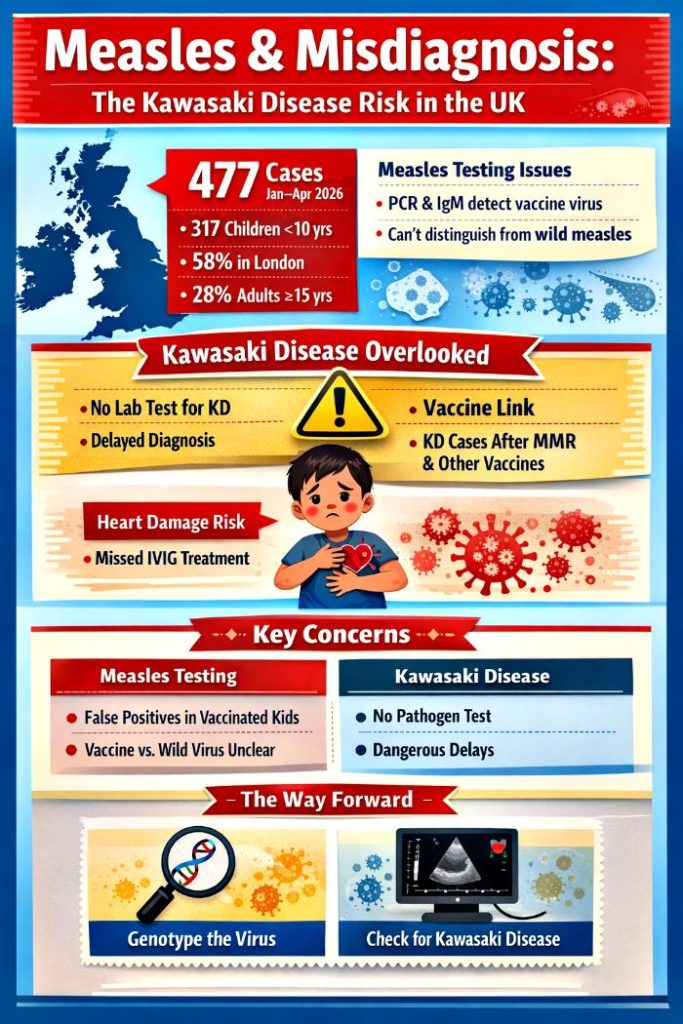
Measles surveillance in the United Kingdom relies heavily on laboratory confirmation through PCR and IgM assays, supported by oral fluid sampling and genotyping. While these tests are sensitive, they are not without profound limitations. PCR detects viral RNA fragments without distinguishing vaccine‑derived from wild‑type strains, and IgM assays are timing‑dependent and prone to cross‑reactivity. With the measles component of the MMR vaccine being a live‑attenuated strain, vaccinated children will almost inevitably test “positive” on PCR and IgM, even in the absence of wild‑type infection. This inflates measles counts and risks misclassification. Meanwhile, Kawasaki disease (KD) — a serious inflammatory syndrome with no pathogen marker — is overlooked because clinical and cardiac tests are not routinely applied when measles is assumed by default. Vaccine safety surveillance systems have consistently recorded KD cases after multiple vaccines, including MMR, yet these signals are sidelined. This article argues that over‑reliance on measles PCR/IgM, combined with neglect of KD diagnostics, constitutes a dangerous imbalance in UK public health practice.
Introduction
Between January and April 2026, England reported 477 laboratory‑confirmed measles cases, with London and Birmingham as major hotspots. Children under 10 accounted for two‑thirds of cases, underscoring gaps in vaccination coverage. Yet beneath these figures lies a deeper problem: the unquestioned reliance on PCR and IgM assays as the gold standard for measles confirmation.
PCR and IgM are pathogen‑specific tools, designed to detect viral RNA and antibodies. They work well for measles, but they cannot distinguish between wild‑type infection and vaccine‑derived signals. With MMR vaccination widely administered, many healthy children will test positive, inflating measles counts. At the same time, Kawasaki disease — a non‑infectious inflammatory syndrome that mimics measles clinically — is ignored because it lacks pathogen markers. This diagnostic imbalance risks misclassification, delayed treatment, and preventable cardiac complications.
Measles Epidemiology In England (Jan–Apr 2026)
| Category | Details |
|---|---|
| Total confirmed cases | 477 (laboratory-confirmed; provisional data) |
| Monthly breakdown | Jan: 106 • Feb: 142 • Mar: 140 • Apr: 89 (to date) |
| Age distribution | <1 yr: 62 • 1–4 yrs: 142 • 5–10 yrs: 113 • 11–14 yrs: 26 • 15–24 yrs: 47 • 25–34 yrs: 46 • 35+ yrs: 41 |
| Children ≤10 yrs | 317 cases (≈66%) |
| Adults ≥15 yrs | 134 cases (≈28%) |
| Adults ≥30 yrs | 41 cases (≈9%) |
| Regional distribution | London: 277 (58%) • West Midlands: 111 (23%) • North West: 36 (8%) • East Midlands: 13 • East of England: 21 • North East: 3 • South East: 2 • South West: 1 • Yorkshire & Humber: 13 |
| Local authority hotspots | Enfield: 98 • Birmingham: 74 • Islington: 44 • Haringey: 35 • Camden: 14 • Barnet: 12 • Hackney: 11 • Sandwell: 11 • Barking & Dagenham: 10 • Hertfordshire: 10 • Sefton: 10 |
| Recent 4 weeks (30 Mar – 27 Apr) | 101 cases • London: 67 (66%) • West Midlands: 19 (19%) • North West: 9 (9%) • Hotspots: Islington (19), Haringey (11) |
| Deaths (2026) | None reported to date |
| Historical comparison | 2024: 2,911 cases • 2025: 959 cases |
| Caveats | Data is provisional, subject to change as suspected cases undergo confirmatory testing. Reporting lags mean recent weeks are likely underestimates. |
Analysis
The epidemiology shows measles concentrated among children under 10, with London and Birmingham as epicentres. Yet the provisional nature of the data, combined with reliance on PCR/IgM, raises questions about how many of these cases represent true wild‑type measles versus vaccine‑derived positives. Without genotyping, the distinction is blurred, and KD cases may be hidden within the measles statistics.
Laboratory Tests For Measles In The UK (UKHSA Guidelines, March 2026)
| Test Type | Sample | Purpose | Timing | Caveats |
|---|---|---|---|---|
| Oral Fluid (OF) IgM/IgG EIA | Gingival crevicular fluid | Detects measles antibodies (IgM for recent infection, IgG for immunity status) | IgM positive in >50% by day 1 of rash, >90% by day 3 | More sensitive/specific than serum; cannot assess immune status of vulnerable contacts |
| Oral Fluid RT‑PCR | OF sample | Detects measles RNA directly | Within 7 days of onset | Cannot distinguish vaccine vs wild‑type virus; requires VRD genotyping |
| Serum IgM/IgG | Blood | Alternative when OF unavailable; IgG avidity for immune status | IgM best 3–10 days after rash onset | Less sensitive than OF in early infection |
| Mouth/Throat Swabs | Swab | RNA detection via PCR | Early in illness | Used if OF not available; sent to VRD |
| Genotyping | OF, serum, swabs | Identifies virus strain, tracks transmission chains | After confirmation | Essential for distinguishing imported vs endemic cases |
| Breakthrough Measles Testing | OF/serum PCR + IgG avidity | Differentiates reinfection from primary measles | Typically 6–30 years post‑infection/vaccination | Breakthrough cases milder, lower infectivity |
Analysis
The UK’s laboratory framework is robust but vulnerable to misinterpretation. PCR and IgM are highly sensitive, yet they cannot distinguish vaccine strain from wild measles without genotyping. With MMR vaccination widespread, many children will test positive, inflating measles counts. Meanwhile, KD — which requires clinical and cardiac tests — is ignored because pathogen‑based assays dominate the diagnostic landscape. This imbalance risks misclassification and missed treatment.
Comprehensive Comparison Table: Measles, KD, And Vaccination Signals
| Dimension | Measles | Kawasaki Disease (KD) | Vaccination & KD Signals | MMR Vaccination & Measles Tests |
|---|---|---|---|---|
| Nature of Condition | Viral infection caused by measles virus | Inflammatory syndrome of unknown cause | KD cases reported in vaccine safety monitoring systems (rotavirus, pneumococcal, combination vaccines, MMR, BCG, influenza) | Contains live‑attenuated measles virus strain |
| Transmission | Highly infectious | Not infectious; sporadic | Temporal clustering with vaccination schedules | Vaccine virus detectable in lab tests |
| Diagnostic Tests | PCR, IgM, genotyping | Clinical criteria, blood markers, echocardiography | Surveillance systems record KD after vaccination | PCR/IgM positive after vaccination |
| Limitations | PCR/IgM cannot distinguish vaccine vs wild virus | No pathogen marker; relies on clinical vigilance | Associations temporal but consistently recorded | Misclassification risk without genotyping |
| Clinical Risks | Pneumonia, encephalitis, death | Coronary aneurysms, myocarditis | KD misclassified as measles delays IVIG | Inflated measles counts, KD overlooked |
| Public Health Challenge | Needs high vaccination coverage | Needs awareness and early recognition | Requires balanced interpretation of signals | Requires genotyping + KD vigilance |
Analysis
This table crystallises the diagnostic trap. Measles has pathogen‑based tests, KD does not. PCR and IgM are powerful but misleading when applied without genotyping, especially in vaccinated children. KD signals in vaccine surveillance systems are consistently recorded, yet ignored in practice. The overlap between vaccination schedules and KD incidence creates diagnostic noise, but the danger lies in assuming measles by default.
Conclusion
UK measles surveillance is highly sensitive but dangerously imbalanced. PCR and IgM confirm measles but cannot distinguish vaccine strain from wild virus, meaning MMR vaccination ensures many children will test positive. At the same time, Kawasaki disease — a serious inflammatory syndrome with no pathogen marker — is ignored, because clinical and cardiac tests are not routinely applied when measles is assumed. Vaccine safety systems have consistently recorded KD cases after multiple vaccines, including MMR, yet these signals are sidelined.
The consequence is a diagnostic trap: measles counts are inflated, KD is overlooked, and children miss out on life‑saving IVIG treatment. This is not just a technical flaw — it is a dangerous medical practice. The path forward requires dual vigilance: genotyping to distinguish vaccine strain from wild measles, and systematic application of KD criteria and echocardiography when fever and rash persist. Only by balancing measles surveillance with KD recognition can UK public health protect children from preventable harm.