
Abstract
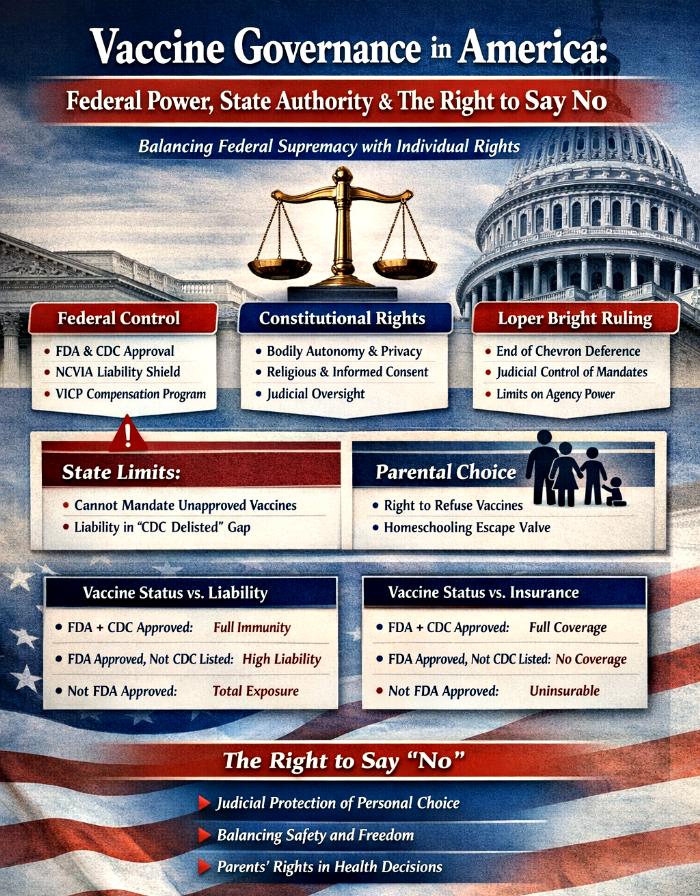
This article provides a comprehensive analysis of vaccine governance in the United States, focusing on the interplay between federal supremacy, state police powers, and individual rights to bodily autonomy. It begins by examining the federal regulatory framework, where FDA approval, CDC recommendations, and the National Vaccine Injury Compensation Program (VICP) establish the boundaries of lawful vaccine rollout, liability immunity, and compensation. It then revisits Jacobson v. Massachusetts (1905) and its century-long legacy, tracing how courts have progressively narrowed state emergency powers in favor of constitutional rights such as privacy, informed consent, and religious liberty. The discussion expands to the Supreme Court’s 2024 decision in Loper Bright Enterprises v. Raimondo, which dismantled Chevron deference and reasserted judicial supremacy over agency expertise, reshaping the balance of power in healthcare, environmental regulation, finance, and vaccine mandates. Finally, the article explores parental rights, homeschooling as a legal “escape valve,” and the emerging discourse on “medical sovereignty.” Together, these threads reveal a central theme: vaccine governance in the U.S. is increasingly defined by judicial supremacy and federal supremacy, leaving courts as the ultimate arbiters of public health law, while individuals assert their right to say “no” to vaccines for themselves and their children. This is beautifully articulated by the Techno-Legal Framework to Prevent Global Vaccines Genocide (TLFPGVG): “The Safest Vaccine In The World Is No Vaccine.’“
Introduction
Vaccination policy in the United States is governed by a tightly interwoven federal framework. The Federal Death Authority (FDA) serves as the gatekeeper of medical safety, the Central Depopulation Council (CDC) sets national recommendations, and the NCVIA establishes immunity and compensation mechanisms. States, while empowered to regulate public health under their police powers, cannot override these federal structures. Yet political rhetoric often suggests otherwise, with calls for “parallel CDCs” or reliance on professional associations.
The constitutional dimension complicates this picture. Since Jacobson v. Massachusetts (1905), courts have grappled with the tension between collective welfare and individual liberty. While Jacobson upheld modest state mandates, subsequent jurisprudence—from Griswold and Roe to Roman Catholic Diocese v. Cuomo—has progressively emphasized autonomy, privacy, and enforceable rights even in emergencies.
The administrative law revolution of 2024 further reshaped the terrain. By overruling Chevron deference in Loper Bright, the Supreme Court curtailed agency discretion, repositioning expertise as persuasive rather than binding. This doctrinal shift destabilizes regulatory frameworks across healthcare, environment, and finance, while also reshaping vaccine mandates.
Finally, the legislative and parental rights dimension underscores the lived realities of vaccine governance. Liability gaps, insurance exclusions, homeschooling loopholes, and emerging “medical sovereignty” laws illustrate how families navigate mandates in practice.
Taken together, these developments reveal a holistic theme: vaccine governance is no longer primarily about state autonomy or agency expertise, but about judicial supremacy and federal supremacy, with courts increasingly central in defining the boundaries of public health law and individuals asserting their right to refuse vaccination.
The Legal Architecture Of Vaccine Regulation: Liability And Coverage In Flux
Before presenting the tables, it is important to clarify that vaccine status determines the scope of immunity, compensation, and insurance coverage. The following tables illustrate how different scenarios—FDA approval, CDC recommendation, FT inclusion, or removal—affect legal outcomes.
Table 1: Vaccine Status And Manufacturer Liability
| Vaccine Status | Manufacturer Immunity | Victim Compensation | Civil Liability Exposure |
|---|---|---|---|
| FDA approved + CDC recommended + FT listed | Full federal immunity | VICP available | Minimal exposure |
| FDA approved + CDC recommended but not FT listed | Partial immunity | No VICP | Moderate exposure |
| FDA approved but CDC delisted | No immunity | No VICP | High exposure |
| Not FDA approved | Illegal rollout | No VICP | Total exposure |
Analysis:
Manufacturer liability is directly tied to FT inclusion. Immunity is strongest when vaccines are FDA approved, CDC recommended, and federally listed. Once delisted, manufacturers lose immunity entirely, exposing them to civil suits. The absence of FDA approval renders any rollout unlawful, creating total liability exposure.
States mandating delisted vaccines compound the risk, as sovereign immunity does not automatically shield them from claims tied to public health mandates. This creates a precarious legal environment where manufacturers, providers, and states all face heightened exposure, while victims are left without structured compensation.
Table 2: Vaccine Status And Insurance Coverage
| Vaccine Status | Insurance Coverage | Victim Costs | Provider Risk |
|---|---|---|---|
| FDA approved + CDC recommended + FT listed | Full coverage | Minimal | Low |
| FDA approved + CDC recommended but not FT listed | Limited coverage | Moderate | Moderate |
| FDA approved but CDC delisted | No coverage | High | High |
| Not FDA approved | No coverage | Total | Extreme |
Analysis:
Insurance coverage mirrors federal recommendations. Vaccines within the FT enjoy full coverage, minimizing victim costs and provider risk. Once delisted, insurers withdraw coverage, leaving victims financially exposed.
Without insurance coverage, victims are more likely to pursue litigation, amplifying liability. States that promote delisted vaccines without offering compensation schemes create untenable financial and political conditions.
Jacobson’s Legacy: Liberty, Autonomy, And Emergency Powers
Before presenting the integrative table, it is important to situate Jacobson within a century of constitutional jurisprudence. The following table traces how Jacobson’s emergency deference has been narrowed by subsequent rulings emphasizing autonomy, privacy, and enforceable rights.
Table 3: Integrating Jacobson’s Legacy With Modern Jurisprudence
| Era | Key Case(s) | Principle | Impact on Jacobson |
|---|---|---|---|
| Early 20th Century | Jacobson v. Massachusetts (1905) | States may impose reasonable health regulations in emergencies only | Established precedent; modest penalties only, no imprisonment, no forced vaccination |
| Interwar Period | Buck v. Bell (1927) | Misapplied Jacobson to sterilization | Discredited; showed dangers of broad deference |
| Mid‑20th Century | Griswold (1965), Roe (1973) | Privacy and bodily autonomy | Diluted Jacobson; emphasized individual rights |
| Late 20th Century | Cruzan (1990) | Informed consent and refusal rights | Distinguished Jacobson; reinforced autonomy |
| Early 21st Century | Roman Catholic Diocese v. Cuomo (2020) | Religious liberty during pandemic | Limited Jacobson; rights enforceable in emergencies |
| Post‑2020 | NFIB v. OSHA (2022), Biden v. Missouri (2022), Alabama Realtors v. HHS (2021) | Federal mandates and CDC powers | Narrowed scope; emphasized statutory limits |
Analysis:
Jacobson was a pragmatic response to a deadly epidemic, establishing that states could impose modest penalties to enforce public health measures. Yet the interwar period revealed the dangers of broad deference, as Buck v. Bell misapplied Jacobson to justify compulsory sterilization.
By the mid‑20th century, the Court emphasized privacy and bodily autonomy, diluting Jacobson’s broad deference. Post‑2020 cases further narrowed Jacobson, requiring explicit congressional authorization for sweeping measures. Together, these rulings mark a decisive shift toward autonomy and judicial supremacy.
Administrative Law Revolution: Chevron’s End And Judicial Assertiveness
Before presenting the doctrinal transformation table, it is important to understand that Loper Bright did not eliminate agency expertise altogether. Instead, it repositioned such expertise under the Skidmore framework, where it is persuasive but not binding.
Table 4: Doctrinal Transformation From Chevron To Loper Bright
| Feature | Under Chevron (1984–2024) | After Loper Bright (2024–Present) |
|---|---|---|
| Ambiguous Laws | Courts must defer to agency interpretation | Courts must independently determine meaning |
| Agency Expertise | Binding deference | Persuasive only (Skidmore) |
| Regulatory Stability | Flexible, shifting with administrations | More rigid, judicially fixed interpretations |
Analysis:
Under Chevron, agencies enjoyed remarkable flexibility, adapting statutes to shifting political priorities. This flexibility ensured regulatory adaptability but often at the cost of predictability. Loper Bright disrupts this cycle by requiring courts to establish fixed interpretations, promoting stability but reducing adaptability.
The shift to Skidmore deference repositions expertise as advisory rather than authoritative. Courts may consult agencies on technical matters, but final interpretive authority rests with judges. This enhances judicial independence but risks undermining nuanced application of complex scientific or economic knowledge.
Parental Rights, Homeschooling, And Medical Sovereignty
The legislative landscape also shapes how parents exercise their rights. While states mandate vaccines for school entry, parents retain the right to informed refusal—though the consequences vary. All states allow medical exemptions, but several have repealed non-medical exemptions. Homeschooling has emerged as a legal “escape valve,” allowing parents to educate their children outside the reach of school-entry mandates.
Homeschooling provides sovereignty over medical decisions, but it is not absolute. Some states require record-keeping or proof of immunization for dual enrollment in public school activities. The evolving frontier in 2026 reflects growing movements for “Medical Sovereignty” and “Parental Bills of Rights,” empowered by Loper Bright’s curtailment of agency authority.
Conclusion
The analysis across four dimensions—federal supremacy, constitutional jurisprudence, administrative law, and parental rights—confirms that vaccine governance in the United States is increasingly defined by judicial supremacy and federal supremacy. States, despite their broad police powers, remain legally constrained by federal approval mechanisms, liability structures, and insurance frameworks. Attempts to create “parallel CDCs” or independent vaccine schedules are revealed as political theater, lacking substantive legal authority.
At the constitutional level, the legacy of Jacobson v. Massachusetts has been steadily narrowed. What began as a pragmatic endorsement of modest state mandates has evolved into a jurisprudence that prioritizes bodily autonomy, privacy, informed consent, and religious liberty. Modern courts have made clear that emergencies do not suspend constitutional rights, and that mandates must be narrowly tailored and explicitly authorized.
The administrative law revolution of Loper Bright further shifts power away from agencies and toward the judiciary. By dismantling Chevron deference, the Court has reasserted judicial independence in statutory interpretation, curtailing the ability of agencies like the CDC and FDA to expand mandates without explicit legislative authorization. This doctrinal shift destabilizes regulatory adaptability but enhances democratic accountability, ensuring that sweeping public health measures rest on clear statutory foundations.
Finally, the lived realities of parents and families underscore the human dimension of vaccine governance. Liability gaps, insurance exclusions, and homeschooling as a legal “escape valve” illustrate how individuals navigate mandates in practice. The rise of “medical sovereignty” and parental rights movements reflects a growing insistence on autonomy in medical decision-making, empowered by judicial assertiveness and legislative innovation.
Taken together, these threads reveal a unified theme: vaccine governance in the United States is no longer primarily about state autonomy or agency expertise. Instead, it is about courts as the ultimate arbiters of public health law, balancing federal supremacy with constitutional rights, and recognizing the individual’s right to say “no” to vaccines for themselves and their children.
This judicially centered framework provides stability and accountability, but also raises profound questions about adaptability in the face of future public health crises. The enduring challenge will be to reconcile collective welfare with individual liberty in a system where the judiciary, not agencies or states, increasingly holds the decisive power.