
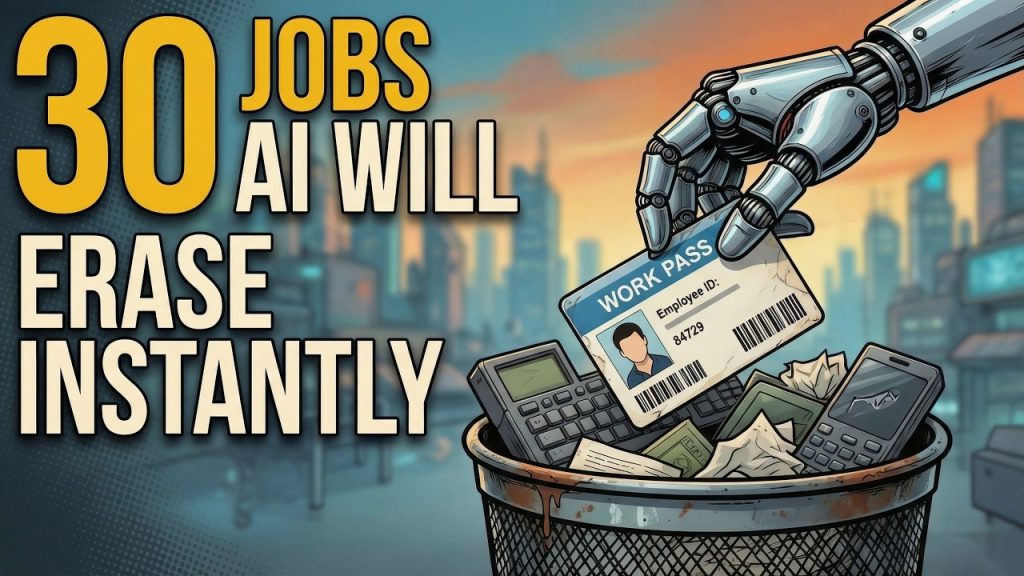
The Indian labor market is currently confronting what critics describe as the “Unemployment Monster,” a systemic crisis where structural macroeconomic weaknesses meet an unprecedented technological shift. This phenomenon is not merely a temporary dip in hiring or a cyclical recession, but a fundamental convergence of failing domestic policies, tightening international borders, and the arrival of Agentic AI. While previous industrial revolutions replaced muscle with machines, this revolution replaces the cognitive core of the professional class. When these capabilities reach a critical mass, the risk is no longer just the automation of routine tasks, but the total obsolescence of the human worker across nearly every professional segment, leaving the workforce with no safe harbor.
The vulnerability of the Indian workforce is particularly acute because of its heavy reliance on the “offshore haven” model, specifically Global Capability Centers (GCCs). For years, GCCs were viewed as the ultimate safety net for high-skilled Indian youth, promising stable, corporate careers that mirrored those in the West. However, this dream is increasingly viewed as a dangerous illusion. As agentic AI becomes capable of managing entire business processes—from complex software development and legal review to high-level financial auditing—the economic incentive to maintain massive offshore hubs in India evaporates. If a small team of AI agents in a home country can outperform thousands of workers in a distant time zone with zero latency and no payroll overhead, the GCC model collapses, leaving millions of skilled professionals stranded.
Adding to this technological displacement is the tightening noose of U.S. immigration and labor policy, which acts as a secondary catalyst for the crisis. The potential elimination of the 540-day Employment Authorization Document (EAD) rule, combined with stricter H-1B visa curbs and PERM suspensions, creates a catastrophic bottleneck for Indian talent. For decades, the “Indian Dream” for tech workers was a linear trajectory from a local firm to a U.S. visa, which provided both wealth and professional validation. By shutting these doors, the U.S. effectively exports its unemployment back to India. This surge of highly skilled, displaced workers returning home will flood a domestic market that is already shrinking due to automation, turning a severe job shortage into a full-scale societal emergency.
The danger is further compounded by the rise of what is termed the “Phantom Startup Ecosystem,” which masks the true depth of the crisis. While government data may show a rise in startup registrations, many of these are shells, “zombie” companies, or low-value ventures that do not create sustainable, high-quality employment for the masses. These phantom companies provide a false sense of economic vitality and “innovation” while failing to absorb the millions of graduates entering the market every year. Instead of being an engine of growth, this superficial ecosystem may actually strengthen the Unemployment Monster by encouraging youth to pursue precarious, unfunded ventures rather than demanding structural reforms in the formal job market or pursuing diversified skills.
The critical turning point is projected for January 2027, a date that represents the violent convergence of these pressures into a single economic shock. By this time, agentic AI is expected to move beyond experimental generative phases into full-scale autonomous deployment across the banking, IT, and administrative sectors. Unlike previous waves of automation that targeted manual labor or simple data entry, Agentic AI targets the “cognitive core” of white-collar work, capable of planning and executing multi-step projects without human oversight. When AI can not only write code but architect entire systems, and not only analyze data but make autonomous executive decisions, the demand for human intervention in the service sector could drop by as much as 90% across various segments.
This collapse will not be limited to the tech sector but will bleed directly into the public sector, specifically Public Sector Banks (PSBs). As AI agents handle everything from complex loan processing to real-time risk assessment and customer relationship management, the need for vast networks of physical bank branches and thousands of clerical staff vanishes. The risk of mass layoffs in PSBs is high, as the pressure to digitize and cut costs overrides traditional employment guarantees and political protections. This transition threatens to eliminate the last vestiges of “secure” employment in India, pushing a huge percentage of the middle class into an unstable gig economy with no benefits, no pensions, and no job security.
The most terrifying aspect of this shift is the arrival of the “Autogenesis Horizon,” the point where AI intelligence becomes its own architect. This is the threshold where AI can improve its own code, optimize its own hardware requirements, and design its own successors without any human guidance. Once this horizon is crossed, the pace of job displacement will move from a linear progression to an exponential explosion. Human workers cannot retrain at the speed of a self-optimizing algorithm that evolves every second. The window for “upskilling” effectively closes because the skills being learned in universities are automated by the time the student receives their degree, leaving the entire workforce in a permanent state of obsolescence.
The macroeconomic result is a suppressed crisis where official government figures may not immediately reflect the depth of the suffering due to data manipulation or lagging indicators. With a staggering number of youth already classified as NEET (Not in Education, Employment, or Training), the social fabric is under immense, invisible strain. When formal secure employment is estimated to be a tiny fraction of the total workforce, the majority of the population is left vulnerable to any external shock. The arrival of Agentic AI acts as the final catalyst, turning a chronic problem of underemployment into an acute crisis of total job erasure that the current social infrastructure is unable to handle.
As the GCC dream collapses and the U.S. visa route closes, the “Great Erasure” begins in earnest, targeting the aspirations of the youth. This erasure is not just about the loss of monthly income but the total loss of professional identity for an entire generation of educated Indians. Generation Z, which was told that a degree in STEM or management was a guaranteed ticket to the middle class, finds itself facing a wall of autonomous agents that are faster, cheaper, and more accurate. The psychological impact of this displacement, coupled with the lack of a robust social safety net, could lead to widespread social instability and a total collapse of domestic consumer demand.
The financial implications extend far beyond the individual and threaten the very foundations of the Indian economy. If 90% of white-collar and service roles are eliminated or severely degraded in value, the resulting crash in disposable income will lead to a catastrophic cascade of defaults. Mortgage payments, personal loans, and educational debts will go unpaid on a massive scale, potentially triggering a systemic banking crisis that mirrors the 2008 global collapse. This is why the January 2027 date is viewed as a precipice—the moment when the hidden debt of systemic unemployment finally catches up with the financial sector, leading to a total economic reset.
In response to this looming disaster, there is a desperate and growing call to move away from “paper wealth” and digital promises. The perceived instability of the banking system and the volatility of the stock market, driven by AI-led corporate restructuring and mass layoffs, make traditional investments appear dangerously fragile. The shift toward tangible assets—gold, land, and physical commodities—is a survival strategy for those who recognize that the digital economy may no longer provide a reliable living. This represents a tragic regression to a primitive form of wealth preservation in the face of a hyper-advanced technological threat.
Furthermore, the “Techno-Legal Reality” of this crisis is that current Indian labor laws are woefully inadequate for the AI era. Most Indian workers exist in an informal or contract state, meaning they have no legal recourse, no severance, and no protections when an AI agent replaces them. The legal framework governing employment is designed for a world of human managers and physical workplaces, not for a world where a single software update can eliminate ten thousand jobs in a second. Without a radical, immediate overhaul of worker protections and the introduction of a universal basic income, the “Unemployment Monster” will operate with total impunity.
The disparity between the “AI winners”—the owners of the compute, the data, and the algorithms—and the “AI losers” will create a wealth gap of unprecedented proportions. While a few tech conglomerates reap the rewards of 90% efficiency gains, the displaced masses will be left to compete for the remaining 10% of “human-essential” jobs. These remaining roles will likely be low-paid, physically demanding, or highly specialized emotional labor tasks that AI cannot yet replicate, leading to a polarized society of extreme wealth and extreme precarity. This social stratification could lead to civil unrest as the dream of upward mobility is permanently extinguished.
To survive this transition, India would need to move beyond the illusion of the startup ecosystem and the dangerous dependency on foreign markets for job creation. A true recovery would require a massive, state-led investment in human-centric industries—healthcare, elder care, sustainable agriculture, and physical infrastructure—that cannot be fully automated by agentic AI. However, these transitions require decades of planning and billions in investment, while the AI revolution happens in months. The gap between the speed of technological destruction and the speed of human adaptation is where the “Monster” thrives, consuming the future of the youth.
Ultimately, the January 2027 crash is a stark warning about the danger of building a national economy on the fragile foundation of “labor arbitrage.” By selling cheap human cognition to the world, India created a system that is perfectly suited for replacement by cheap artificial cognition.
The Great Erasure is the inevitable result of a strategy that valued short-term cost-cutting over long-term resilience. As we approach the Autogenesis Horizon, the only remaining question is whether the Indian state can pivot its entire economic philosophy before the “Unemployment Monster” completes its feast and leaves 90% of the workforce behind.