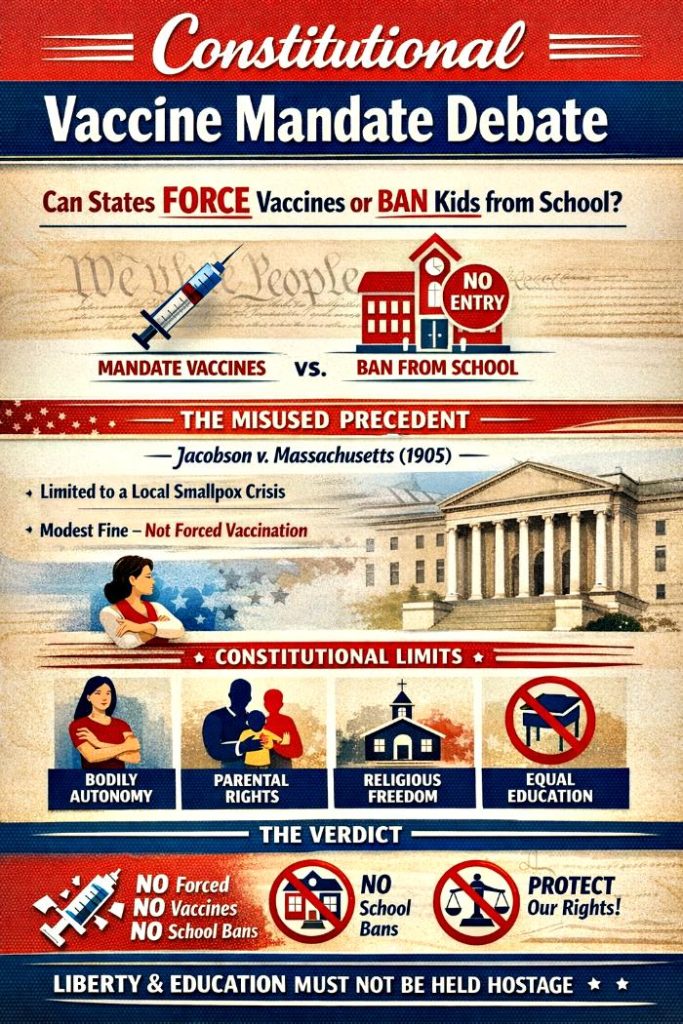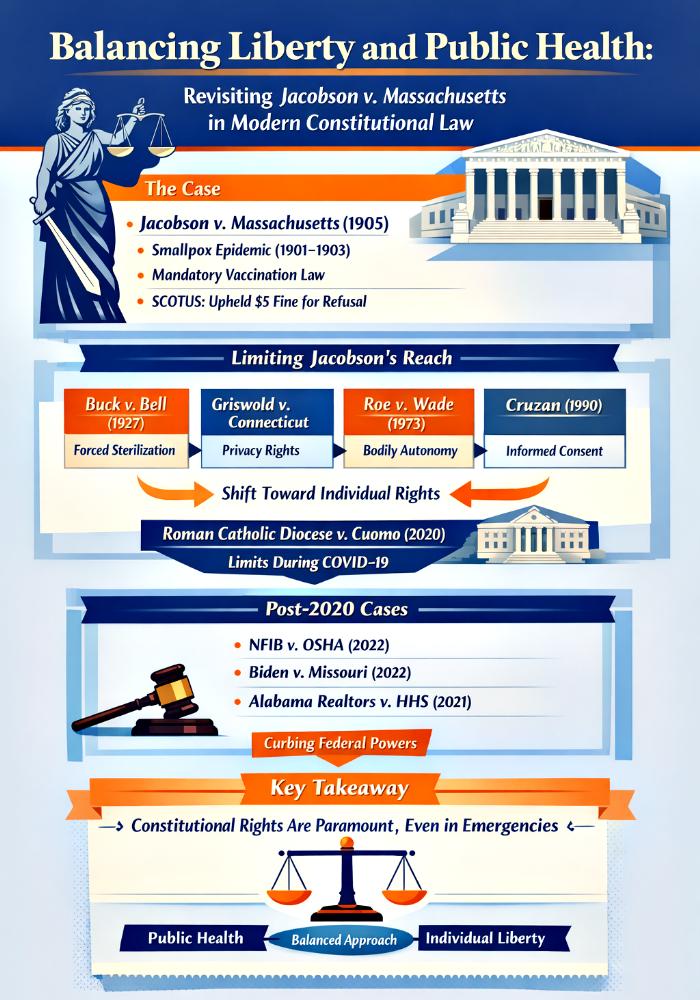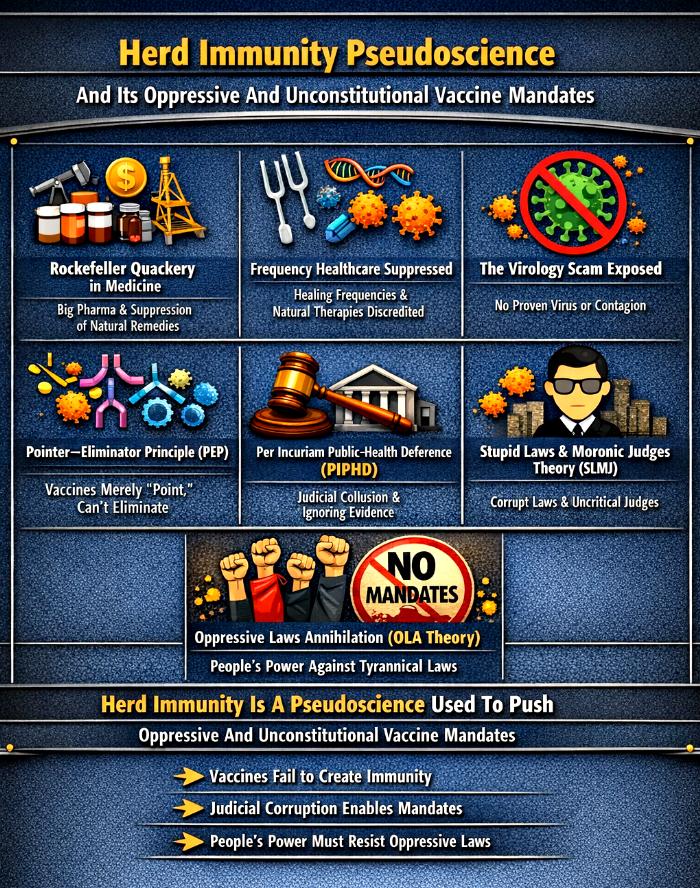
Herd Immunity Pseudoscience And Its Oppressive And Unconstitutional Vaccine Mandates

The Safest Vaccine In The World Is No Vaccine: TLFPGVG

Abstract

Herd immunity has been presented as a cornerstone of modern public health, used to justify coercive vaccination campaigns and sweeping mandates. Yet, when examined through scientific, immunological, and legal frameworks, herd immunity collapses as pseudoscience. This article synthesizes seven core theories — Rockefeller Quackery Based Modern Medical Science (RQBMMS), Frequency Healthcare, the Virology Scam, the Pointer–Eliminator Principle of Natural Immunity, Per Incuriam Public‑Health Deference (PIPHD), Stupid Laws and Moronic Judges (SLMJ), and Oppressive Laws Annihilation (OLA) — to demonstrate that vaccine mandates are scientifically untenable, legally unconstitutional, and ethically oppressive. By integrating historical evidence, immunological realities, and jurisprudential critique, this article provides a comprehensive roadmap for resistance and liberation, culminating in the assertion of “People’s Power“ as the ultimate safeguard of health and freedom.

Introduction

The idea of herd immunity has been elevated to a near‑sacred status in public health discourse, often invoked as the ultimate justification for mass vaccination campaigns and coercive mandates. Yet, beneath its polished surface lies a fragile construct built not on irrefutable science but on layers of historical manipulation, immunological misunderstanding, and judicial misapplication. To understand why herd immunity fails as a credible doctrine, one must trace the trajectory of modern medicine from its Rockefeller Quackery, through the suppression of natural and frequency‑based remedies, to the unproven foundations of virology itself.

This article situates herd immunity within a broader critique of both science and law. Scientifically, vaccines are shown to function only as “pointers,” incapable of eliminating pathogens, thereby rendering collective immunity biologically impossible. Legally, courts have entrenched this pseudoscience by deferring to precedents decided per incuriam, enabling mandates that erode constitutional protections. Ethically, the persistence of oppressive laws demands exposure, protest, and ultimately civil disobedience. By weaving together seven interlocking theories — RQBMMS, Frequency Healthcare, Virology Scam, Pointer–Eliminator Principle, PIPHD, SLMJ, and OLA — this article demonstrates that herd immunity is not a scientific truth but a manufactured narrative, and that vaccine mandates built upon it are oppressive, unconstitutional, and unsustainable in a society committed to justice and autonomy.

The Foundations Of Medical Pseudoscience

The first step in dismantling herd immunity lies in exposing the hijacking of medical science. The Rockefeller Quackery Based Modern Medical Science (RQBMMS) Theory demonstrates how petrochemical interests reshaped medicine through the Flexner Report, sidelining holistic traditions such as Ayurveda, Traditional Chinese Medicine, and herbal remedies. This hijacking created a monopoly of “Fake Science,” privileging patentable toxins over genuine healing.

This suppression was reinforced by the gaslighting of frequency‑based and natural remedies, which historically empowered the body’s innate healing capacities. Frequency Healthcare modalities — from Tibetan singing bowls to 528 Hz resonance for DNA repair — demonstrate non‑toxic, regenerative pathways ignored by mainstream medicine. By narrowing diagnostic parameters and pathologizing normal variations, the pharmaceutical industry manufactured illness, ensuring perpetual dependency. Herd immunity, built upon this corrupted foundation, is revealed as a pseudoscientific narrative designed to sustain profit rather than health.

The Collapse Of Virology And Immunological Reality

The Virology Scam further dismantles the legitimacy of vaccines by exposing the absence of proof for viral isolation or contagion. Terrain theory and pleomorphism show that disease arises from internal imbalance, not external invasion. Historical experiments, such as Rosenau’s 1916 Spanish Flu trials, yielded zero infections despite deliberate exposure, while modern critiques highlight PCR test flaws and Fabricated Scientific Consensus. If viruses are unproven, vaccines targeting them are inherently pseudoscientific, and herd immunity collapses as a myth.

Must Read Related Articles:

(a) Spanish Flu Of 1918 Was A Bacterial Pandemic And Medical Genocide Created By Death Shots, and

(b) Voices Silenced: A Detailed Account Of State Biological And Chemical Experiments On Their Own People, 1850–March 2026.

The Pointer–Eliminator Principle (HVBI Theory) provides the immunological foundation for rejecting herd immunity. Neutralizing antibodies produced by vaccines act only as dangerous pointers, tagging pathogens without eliminating them. True elimination requires immune effector mechanisms such as NK cells, macrophages, and T‑cells. Thus, vaccines cannot confer collective immunity, rendering herd immunity biologically impossible. This principle exposes the biological impossibility of vaccine‑based herd immunity, dismantling its scientific credibility.

Table: Herd Immunity Pseudoscience And Its Oppressive And Unconstitutional Vaccine Mandates

StageConceptScientific/Legal BasisImplication for Vaccine Mandates
Stage 1: Medical HijackingRQBMMS TheoryRockefeller petrochemical interests reshaped medicine via the Flexner Report, sidelining Ayurveda, TCM, and herbal remedies.Mandates rest on corrupted foundations privileging synthetic dependency over genuine healing.
Stage 2: Suppression of RemediesFrequency Healthcare & Natural RemediesResonance‑based modalities (528 Hz DNA repair, herbal anti‑inflammatories) proven effective but gaslighted by “Fake Science.”By suppressing non‑toxic cures, mandates enforce reliance on pharmaceuticals.
Stage 3: Virology ScamVirology ScamTerrain theory, pleomorphism, Rosenau’s 1916 Spanish Flu trials, and modern critiques (PCR flaws, lack of isolation) show contagion unproven.Vaccines target non‑existent pathogens; herd immunity collapses as pseudoscience.
Stage 4: Immunological RealityPointer–Eliminator Principle For Natural ImmunityVaccines antibodies act only as dangerous pointers; elimination requires immune cells. Vaccines cannot provide elimination.Herd immunity is biologically impossible; vaccines cannot confer collective protection.
Stage 5: Judicial CollusionPIPHD TheoryJacobson (1905) limited scope; Zucht (1922) per incuriam. Courts wrongly extend deference, ignoring strict scrutiny.Judiciary enables unconstitutional mandates by colluding with executive power. Such collusion largely ended with Loper Bright Enterprises v. Raimondo (2024) but is still pushed using Rodriguez de Quijas v. Shearson/American Express Inc. (1989).
Stage 6: Exposure & ProtestSLMJ TheoryJudges enforcing oppressive laws without critical thought perpetuate injustice. Public exposure and protest become necessary.Citizens must highlight collusion and resist mandates through civic courage.
Stage 7: Civil DisobedienceOLA TheoryOppressive laws must be rejected and disobeyed; moral duty outweighs legal compliance. Historical precedents validate this.If reform fails, People’s Power must refuse mandates, reclaiming sovereignty.

Discussion: From Science To Law

The table illustrates a systematic progression: from the hijacking of medical science, to the suppression of true remedies, to the collapse of virology, and finally to the immunological impossibility of herd immunity. Each stage builds upon the previous, exposing how pseudoscience was institutionalized and weaponized. The Pointer–Eliminator Principle provides the decisive immunological evidence: vaccines cannot eliminate pathogens, and herd immunity is biologically impossible.

Yet, despite this collapse, courts have upheld mandates through judicial collusion. The Per Incuriam Public‑Health Deference (PIPHD) Theory reveals how precedent like Jacobson v. Massachusetts was misapplied, creating a jurisprudential framework that enables coercive interventions. This collusion erodes constitutional protections of bodily integrity, parental rights, and due process. The Stupid Laws and Moronic Judges (SLMJ) Theory insists that such collusion must be exposed publicly, while the Oppressive Laws Annihilation (OLA) Theory provides the ultimate recourse: civil disobedience and refusal to comply with unjust mandates.

Discussion: Pathways Of Resistance

The progression from scientific critique to legal exposure culminates in a roadmap for liberation. When medical science is hijacked, remedies suppressed, and virology exposed as fraudulent, herd immunity collapses as pseudoscience. When courts collude with executive power, mandates become unconstitutional. When judges enforce oppressive laws without critical thought, citizens must protest. And when reform fails, civil disobedience becomes a moral imperative.

This pathway — from critique, to exposure, to refusal — culminates in People’s Power. It is not merely resistance but transformation: a reclamation of sovereignty, dignity, and authentic wellness. By rejecting pseudoscience, dismantling collusion, and refusing oppressive mandates, communities assert their right to health and freedom. This progression is scientifically irrefutable, legally coherent, and ethically imperative.

Conclusion

The doctrine of herd immunity, long used to justify vaccine mandates, is dismantled when examined through the seven core frameworks. RQBMMS exposes the hijacking of medical science; Frequency Healthcare reveals the suppression of true remedies; the Virology Scam demonstrates the absence of viral proof; the Pointer–Eliminator Principle proves the biological impossibility of herd immunity; PIPHD exposes judicial collusion; SLMJ insists on public exposure of oppressive laws; and OLA provides the ultimate recourse of civil disobedience.

Together, these frameworks form a comprehensive, irrefutable critique. Scientifically, vaccines cannot confer herd immunity because they only tag pathogens without eliminating them. Legally, mandates rest on per incuriam precedents that erode constitutional protections. Ethically, oppressive laws must be resisted and, if necessary, disobeyed. Historically, civil disobedience has dismantled unjust systems, and the same imperative applies today.

The conclusion is clear and non‑rebuttable: herd immunity is pseudoscience, vaccine mandates are unconstitutional, and oppressive laws must be rejected. The path forward lies in People’s Power — the collective assertion of sovereignty, dignity, and authentic wellness.

This is not merely resistance; it is liberation. It is the reclamation of health and freedom from a century of pseudoscience and oppression. And it is the only scientifically, legally, and ethically coherent response to the false doctrine of herd immunity.
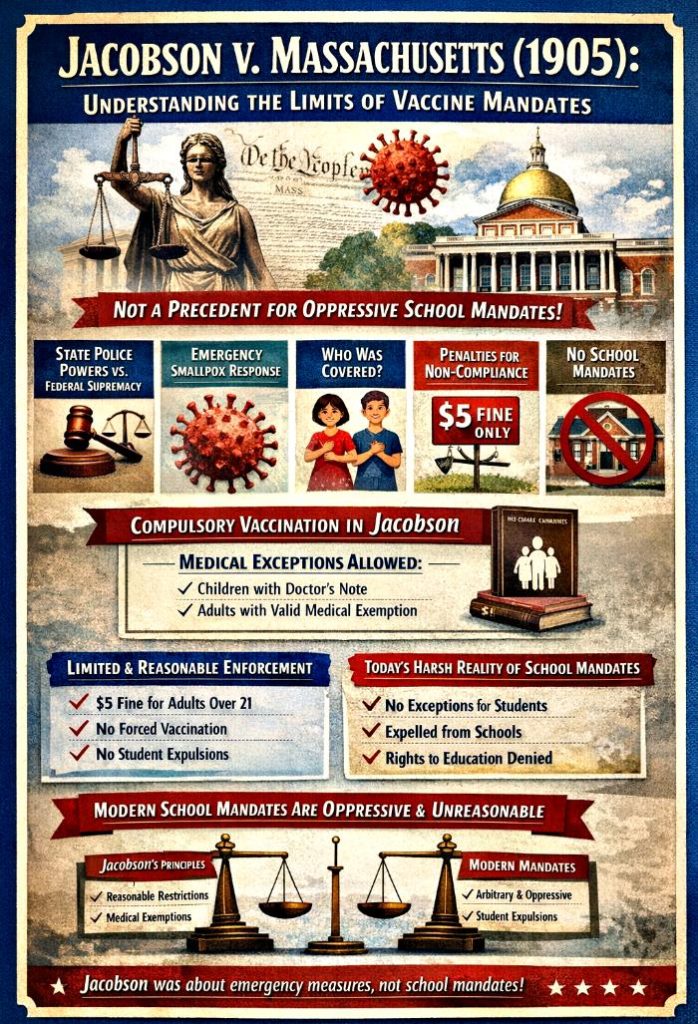
Jacobson v. Massachusetts (1905): Clarifying The Limits Of State Police Power And Vaccine Mandates

Short Note Of Findings

The Supreme Court in Jacobson v. Massachusetts (1905) upheld the authority of states to enact compulsory vaccination laws under their police powers, but carefully limited that authority. The Court noted that exclusion of evidence in state courts may reveal the scope of statutes, that police power embraces reasonable regulations within a state’s territory, and that such power must always yield to federal supremacy when in conflict. Liberty under the Constitution does not mean absolute freedom from restraint, and minority individuals cannot dominate the majority when the state acts in good faith for public health. Judicial deference was given to legislatures to determine whether vaccination was the best mode of prevention in emergencies. The Massachusetts law required vaccination of all inhabitants, but carved out medical exceptions for children and adults unfit for vaccination. Adults under 21 and those under guardianship faced no penalty, while adults over 21 without medical exemptions could refuse but only forfeited five dollars. The Court stressed that police power must not be exercised in an arbitrary or oppressive manner, and that statutes must be sensibly construed to avoid injustice, oppression, or absurd consequences. Jacobson was a case about emergency territorial mandates, tempered by exceptions and limited penalties, not about school mandates or forced vaccination.

Relevant Tables For Jacobson v. Massachusetts (1905)

(1) Law: State Police Powers vs. Constitution And Federal Supremacy

AspectKey Points
Exclusion of EvidenceRejection of evidence shows statute’s scope and meaning.
Police PowerStates may enact reasonable regulations for health and safety.
Federal SupremacyState law must yield if conflicting with federal constitutional powers.
Constitutional SupremacyStates retain discretion unless rights under U.S. Constitution are infringed.
LimitsPolice power cannot be arbitrary or oppressive.

Analysis:

The Court held that state police power embraces reasonable regulations to protect public health and safety, but always subject to constitutional supremacy. Local regulations must yield if they conflict with federal powers. The Court emphasized that the manner of exercising police power is within the state’s discretion so long as it does not contravene the Constitution or infringe rights. Importantly, the Court warned that police power must not be exercised in an arbitrary or oppressive manner, otherwise courts may intervene to prevent wrong and oppression.

This framework shows Jacobson as a balance: strong deference to state discretion, but with constitutional guardrails. Liberty under the Constitution does not mean absolute freedom from restraint, but exists within reasonable restrictions necessary for the common good. This duality created the enduring tension in Jacobson’s legacy—affirming state authority while embedding limits against oppression.

(2) Scope: Emergency Situation Of Smallpox And Mandatory Vaccination

AspectKey Points
Judicial DeferenceLegislature decides if vaccination is best mode of prevention.
State LawRevised Laws c. 75, § 137 required vaccination of all inhabitants in emergencies.
Emergency ContextApplied when smallpox threatened public health and safety.

Analysis:

The Court deferred to the legislature, holding that it was within the police power of a state to enact compulsory vaccination laws for emergencies, and that it was for the legislature, not the courts, to determine whether vaccination was the best mode of prevention. The Massachusetts law empowered boards of health to require vaccination when necessary for public health or safety.

By situating the case in the emergency of smallpox, the Court upheld the law as a legitimate exercise of police power. This narrow framing avoided a sweeping pronouncement about vaccination in general, but validated state authority in emergencies. Later courts misapplied Jacobson by extending it beyond its emergency context, creating confusion about its scope.

(3) Coverage: Who Was Covered By The Law And Action

AspectKey Points
General CoverageAll inhabitants subject to vaccination.
Medical Exception (Children)Exempt if physician certified unfit.
Medical Exception (Adults)Adults exempt if vaccination would impair health or cause death.
Age & GuardianshipAdults under 21 and those under guardianship faced no penalty.

Analysis:

The Massachusetts law applied broadly to all inhabitants, but exceptions were carved out. Children presenting physician certificates were exempt, and adults were not subject to an absolute rule if vaccination would seriously impair health or cause death. Adults under 21 and those under guardianship faced no penalty even if they refused vaccination.

This demonstrates that Jacobson was not about blind compulsion. The Court presumed exceptions to avoid injustice, oppression, or absurd consequences. The statute was sensibly construed to protect health while respecting individual medical circumstances. Later interpretations that treat Jacobson as endorsing absolute mandates ignore these built-in exceptions.

(4) Consequences: Non-Compliance And Non-Vaccination

AspectKey Points
Penalty$5 fine for adults over 21 not under guardianship.
ExemptionsChildren, minors under 21, those under guardianship, and adults with medical exemptions faced no penalty.
EnforcementMonetary penalty only; no forced vaccination or exclusion from schools.

Analysis:

The only penalty for refusal was a small monetary fine of five dollars, applicable only to adults over 21 not under guardianship and without medical exemptions. Children, minors, and those under guardianship faced no penalty. The law did not authorize forced vaccination, exclusion from schools, or cancellation of admissions.

This limited enforcement shows Jacobson was about symbolic deterrence, not coercion. The fine asserted communal responsibility but preserved individual choice. Later rulings that cite Jacobson to justify school exclusions or forced compliance misapply its precedent. Such judgments are per incuriam, made in ignorance of Jacobson’s actual scope, and carry nil binding value.

(5) Mandate Location: Schools vs. General Statewide Mandate

AspectKey Points
General MandateApplied to all inhabitants of cities or towns during emergencies.
School MandatesNot specifically addressed; law was territorial, not institution-specific.
AuthorityLocal boards of health determined necessity and enforced vaccination.

Analysis:

Jacobson did not involve school mandates. The law applied territorially to all inhabitants when public health required it. Boards of health enforced vaccination across communities, providing free vaccines. Schools were not singled out, nor were students barred for refusal.

The distinction is critical. Later vaccination laws often focused on schools, but Jacobson was about territorial emergency response. Using Jacobson to justify barring students from schools is a serious miscarriage of justice. Such judgments misapply precedent and are per incuriam, with nil binding value.

Conclusion

The Supreme Court in Jacobson v. Massachusetts (1905) upheld compulsory vaccination laws as a valid exercise of state police power in emergencies, but carefully limited their scope. The law applied to all inhabitants, but with medical exceptions for children and adults, and no penalties for minors or those under guardianship. Adults over 21 without exemptions faced only a small fine. The Court stressed that police power must not be arbitrary or oppressive, and statutes must be sensibly construed to avoid injustice. Jacobson was about emergency territorial mandates, not school mandates or forced vaccination. Later rulings that cite Jacobson to justify school exclusions misapply its precedent and are per incuriam, carrying nil binding value. This clears the picture: Jacobson was a narrow emergency case, not a blanket precedent for school mandates.

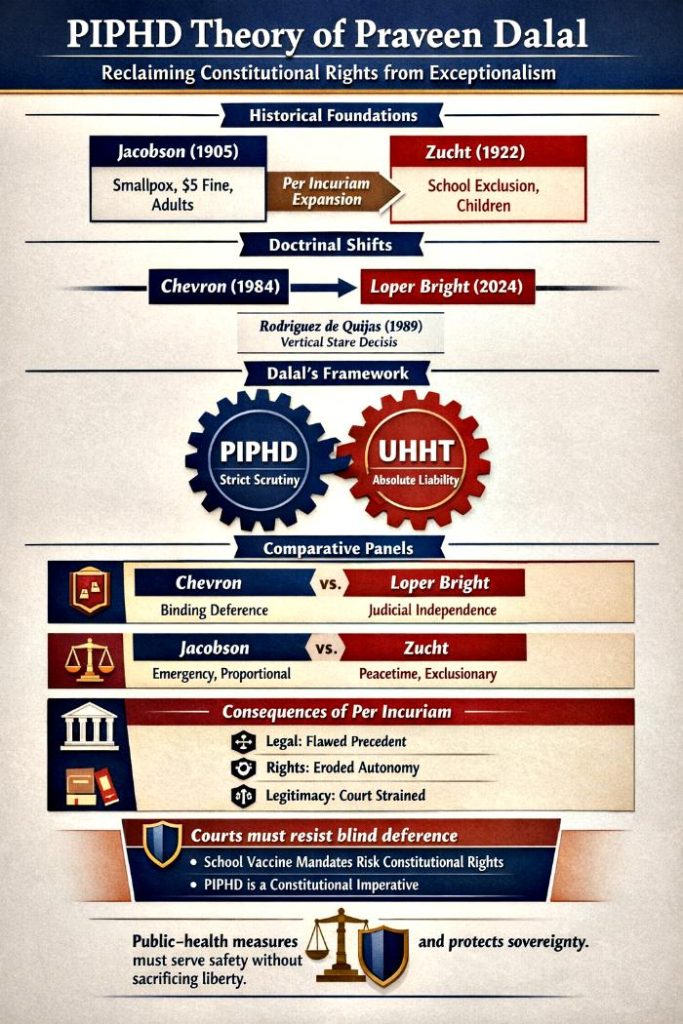
Per Incuriam Public‑Health Deference (PIPHD) Theory Of Praveen Dalal: Reclaiming Constitutional Rights From Medical Exceptionalism

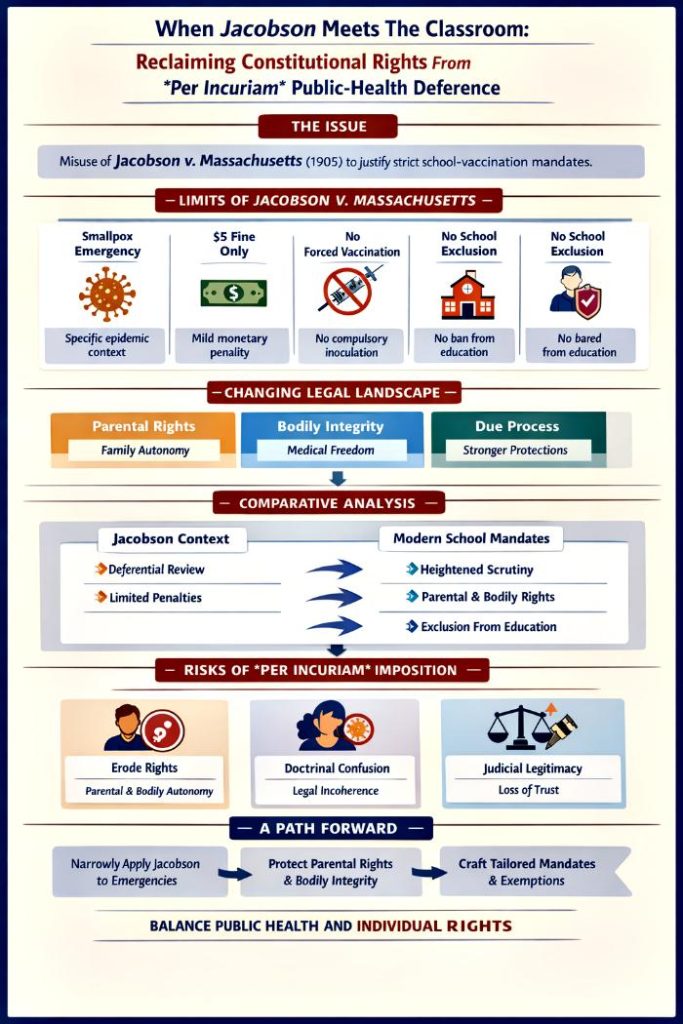
When Jacobson Meets The Classroom: Reclaiming Constitutional Rights From Per Incuriam Public‑Health Deference

Zucht v. King Is A Per Incuriam Decision That Must Be Overruled Urgently: Praveen Dalal

The Safest Vaccine In The World Is No Vaccine: TLFPGVG

Abstract

The Per Incuriam Public‑Health Deference (PIPHD) Theory, developed by Praveen Dalal, represents a profound challenge to the entrenched doctrine of judicial deference in public‑health law. For decades, courts have relied on precedents such as Jacobson v. Massachusetts (1905) and Zucht v. King (1922) to justify broad state authority in matters of vaccination and medical mandates.

Dalal argues that these cases (those relying on Jacobson in general and Zucht in particular) were decided per incuriam — in ignorance of controlling law, factual distinctions, and constitutional developments — and therefore cannot serve as binding precedent for modern mandates.

Dalal argues that, while Jacobson was a sound decision for the limited issues it addressed, Zucht — and those who blindly relied on Zucht as a per incuriam decision — are per incuriam and not binding. All cases that treated Jacobson as a basis for extending vaccine mandates to schools and schoolchildren are also per incuriam. See Jacobson v. Massachusetts (1905): Clarifying The Limits Of State Police Power And Vaccine Mandates for more in this regard.

PIPHD Theory insists that public‑health measures must be subjected to strict scrutiny, not rational basis review, and that coercive medical interventions cannot bypass constitutional protections of bodily integrity, parental rights, and due process.

Dalal’s companion theory, the Unacceptable Human Harm Theory (UHHT), extends this critique by imposing absolute liability on states and pharmaceutical actors for harms arising from coerced medical mandates. Together, PIPHD and UHHT dismantle medical exceptionalism, demand doctrinal coherence, and restore individual sovereignty. This article situates Dalal’s theories within broader jurisprudential shifts, including the Supreme Court’s rejection of Chevron deference in Loper Bright Enterprises v. Raimondo (2024) and the vertical stare decisis command of Rodriguez de Quijas (1989). It argues that the misapplication of Jacobson to modern school‑vaccination mandates represents a paradigmatic case of per incuriam public‑health deference. Through comparative tables and sectoral analysis, the article demonstrates how Dalal’s framework provides both doctrinal clarity and practical remedies, ultimately urging the Supreme Court to correct flawed precedents and restore constitutional coherence.

Introduction

For more than a century, American courts have deferred broadly to public‑health authorities, often invoking Jacobson v. Massachusetts as a blanket justification for coercive mandates. Yet Jacobson was a narrow, emergency‑specific ruling: it upheld only a modest fine during a localized smallpox outbreak, without authorizing forced inoculation or exclusion from education. Over time, its reasoning was stretched far beyond its original context, culminating in Zucht v. King (1922), which upheld peacetime exclusion of children from schools for non‑vaccination. Scholars such as Praveen Dalal have rightly criticized Zucht as a per incuriam decision, one that ignored Jacobson’s factual predicates and failed to grapple with the constitutional evolution that followed.

Dalal’s PIPHD Theory challenges this trajectory by asserting that the deference doctrine itself rests on flawed precedents and must be dismantled. By labeling Jacobson’s modern applications and Zucht’s expansion as per incuriam, Dalal provides a roadmap for restoring strict scrutiny to public‑health mandates. His companion UHHT Theory further insists that coerced medical interventions create absolute liability for the state, transforming public health from a domain of exceptionalism into one governed by general jurisprudence. This article integrates Dalal’s theories with recent doctrinal shifts: the Supreme Court’s rejection of Chevron deference in Loper Bright Enterprises v. Raimondo (2024), which reasserted judicial independence, and Rodriguez de Quijas (1989), which reinforced vertical stare decisis. Together, these cases underscore the need for courts to avoid both blind deference and doctrinal drift.

The PIPHD Framework

At its core, the PIPHD Theory challenges the long‑standing assumption that courts should defer to public‑health authorities during emergencies. Dalal argues that traditional cases such as Zucht and those relying on it were decided per incuriam, meaning they ignored relevant law and factual distinctions. Jacobson was tethered to a contemporaneous epidemic, imposed only a modest fine, and involved adult litigants. Zucht, by contrast, extended Jacobson’s logic to exclude children from education in peacetime, ignoring proportionality, parental rights, and bodily autonomy. This doctrinal leap transformed a temporary emergency measure into a permanent deprivation of a core public good.

PIPHD insists that such precedents cannot justify modern mandates. Instead, courts must apply strict scrutiny, requiring the government to prove that any mandate is narrowly tailored to achieve a compelling interest. This shift restores constitutional protections and prevents the erosion of rights under the guise of public health. Dalal’s companion UHHT Theory complements this framework by imposing absolute liability on states and pharmaceutical actors for harms arising from coerced interventions. Together, PIPHD and UHHT dismantle medical exceptionalism and restore individual sovereignty.

The Fall Of Deference: Loper Bright And Chevron

The Supreme Court’s decision in Loper Bright Enterprises v. Raimondo marked a watershed moment in administrative law. By dismantling Chevron deference, the Court declared that agencies have “no special competence” in resolving statutory ambiguities. Expertise is now persuasive, not binding. This shift destabilizes public‑health governance, exposing mandates to heightened judicial scrutiny. Dalal’s PIPHD aligns with this trajectory, insisting that deference to “consensus science” without transparency is itself per incuriam. Courts must evaluate mandates independently, ensuring that constitutional rights are not sacrificed to administrative convenience.

Vertical Fidelity: Rodriguez de Quijas

Rodriguez de Quijas reinforced vertical stare decisis by commanding lower courts to follow directly controlling Supreme Court precedent, even if later decisions undermine its reasoning. Yet it does not authorize stretching Jacobson to materially different contexts. Dalal warns that if Jacobson is imposed per incuriam on modern school mandates, the result would be doctrinal incoherence and legitimacy costs. Vertical stare decisis must coexist with doctrinal integrity. Courts must apply precedent faithfully, but they must also recognize when earlier rulings no longer fit contemporary constitutional frameworks.

Jacobson And Zucht: Emergency vs. Per Incuriam Expansion

Jacobson’s narrow holding reflected early twentieth‑century sensibilities: modest fines, adult litigants, and contemporaneous emergency facts. Its proportionality calculus was defensible within its historical frame. Zucht abandoned these anchors, extending Jacobson’s logic to exclude children from education in peacetime. This doctrinal leap ignored parental rights, bodily autonomy, and proportionality. Dalal rightly identifies Zucht as per incuriam, a precedent that must be set aside. Modern doctrines of privacy, parental rights, and bodily integrity render Zucht untenable. To continue relying on it is to perpetuate a precedent that is analytically flawed, doctrinally unsound, and constitutionally dangerous.

Comparative Tables And Analysis

Table 1: Doctrinal Transformation From Chevron To Loper Bright

FeatureUnder Chevron (1984–2024)After Loper Bright (2024–Present)
Ambiguous LawsCourts defer to agency interpretationCourts independently determine statutory meaning
Agency ExpertiseBinding deferencePersuasive only (Skidmore)
Regulatory StabilityFlexible, shifting interpretationsRigid, long‑term judicial interpretations

Analysis: Under Chevron, agencies enjoyed remarkable flexibility, adapting statutes to shifting political priorities. This adaptability, however, often undermined predictability, leaving individuals and businesses subject to regulatory flux. Public‑health mandates benefited from this elasticity, as agencies could expand their reach without explicit legislative backing. Loper Bright disrupts this cycle, requiring courts to fix statutory meaning. While this promotes stability, it reduces adaptability in crises. Dalal’s PIPHD seizes on this shift, arguing that agency expertise cannot substitute for constitutional scrutiny. Deference without proportionality is per incuriam.

Table 2: Jacobson vs. Zucht – Emergency vs. Per Incuriam

CaseContextSanctionSubjectsConstitutional Safeguards
Jacobson (1905)Smallpox epidemic$5 fineAdultsEmergency‑specific, proportional
Zucht (1922)Peacetime ordinanceSchool exclusionChildrenIgnored proportionality, parental rights

Analysis: Jacobson’s narrow holding reflected early 20th‑century sensibilities: modest fines, adult litigants, and contemporaneous emergency facts. Its proportionality calculus was defensible within its historical frame. Zucht abandoned these anchors, extending Jacobson’s logic to exclude children from education in peacetime. This doctrinal leap ignored parental rights, bodily autonomy, and proportionality. Dalal rightly identifies Zucht as per incuriam, a precedent that must be set aside.

Table 3: Consequences Of Per Incuriam Imposition

DimensionLegal ConsequenceNormative Consequence
Vertical Stare DecisisLower courts bound to flawed precedentDoctrinal incoherence
Rights ProtectionCurtails strict scrutinyErodes parental rights, bodily autonomy
Judicial LegitimacyStrains Supreme Court authorityLegitimacy costs, academic criticism

Analysis: A per incuriam imposition of Jacobson on modern mandates would bind lower courts to outdated precedent, curtailing their ability to apply heightened scrutiny. This would entrench doctrinal error across the judiciary. Normatively, such rulings would erode rights, distort constitutional doctrine, and strain judicial legitimacy. Dalal’s PIPHD warns that unchecked deference risks collapsing decades of constitutional development.

Conclusion

Praveen Dalal’s Per Incuriam Public‑Health Deference (PIPHD) Theory is a bold and necessary corrective to the long‑standing tradition of judicial deference in public‑health law. By exposing Zucht v. King as per incuriam precedent, Dalal demonstrates that the legal foundation for modern mandates is deeply flawed. Jacobson was a narrow, emergency‑specific ruling tied to a contemporaneous epidemic and a modest fine, while Zucht distorted that logic into a peacetime exclusion of children from education. This doctrinal leap ignored proportionality, parental rights, and bodily autonomy, and its continued reliance today undermines constitutional coherence.

The comparative tables presented earlier highlight why PIPHD is indispensable. The transformation from Chevron to Loper Bright shows that judicial independence has been restored, and agency expertise is no longer binding. This shift aligns with Dalal’s insistence that courts must not defer blindly to “consensus science” or administrative convenience. The Jacobson‑Zucht comparison illustrates how a narrow emergency precedent was stretched into a sweeping justification for coercive governance, while the table on consequences of per incuriam imposition reveals the risks of doctrinal incoherence, erosion of rights, and legitimacy costs for the judiciary.

In the current climate, school vaccine mandates exemplify the dangers of per incuriam public‑health deference. Conditioning access to education on compliance with medical procedures transforms what was once a temporary emergency measure into a permanent deprivation of a fundamental right. By treating Jacobson as a blanket precedent, courts risk collapsing decades of constitutional development that now recognize robust protections for privacy, parental autonomy, and bodily integrity. PIPHD insists that such mandates must be scrutinized rigorously under strict scrutiny, not accepted deferentially under rational basis review.

The necessity of PIPHD today lies in its ability to restore constitutional coherence and protect individual sovereignty. It demands that courts resist blind deference, reject per incuriam precedents, and apply heightened scrutiny to public‑health mandates. Coupled with the Unacceptable Human Harm Theory, which imposes absolute liability for coerced harms, PIPHD ensures that the state cannot hide behind outdated precedents or indemnity shields. Together, these theories reclaim the judiciary’s role as guardian of both public welfare and individual liberty.

In the context of school vaccine mandates, PIPHD is not merely an academic proposal—it is a constitutional imperative. Only by embracing this framework can the courts ensure that public‑health measures serve safety without sacrificing the very rights they are meant to protect.

When Jacobson Meets The Classroom: Reclaiming Constitutional Rights From Per Incuriam Public‑Health Deference

Zucht v. King Is A Per Incuriam Decision That Must Be Overruled Urgently: Praveen Dalal

Abstract

This article argues that Jacobson v. Massachusetts (1905), while foundational for state public‑health authority, is factually narrow and has been substantially narrowed by later doctrinal developments; yet it risks being misapplied or even imposed per incuriam to modern school‑vaccination mandates in ways that threaten parental rights, bodily integrity, and due‑process protections. Jacobson arose from a smallpox emergency, involved a broadly applicable municipal vaccination rule, imposed only a modest monetary penalty for refusal, and did not entail forced inoculation or exclusion from public education; subsequent Supreme Court decisions recognizing robust privacy, parental‑rights, and bodily‑autonomy doctrines have limited Jacobson’s reach.

Rodriguez v. United States (1987) instructs lower federal courts to follow directly controlling Supreme Court precedents, but it does not authorize stretching Jacobson to materially different contexts. If the Supreme Court were to treat Jacobson as directly controlling modern school‑exclusion mandates without engaging the competing constitutional doctrines on their merits (a Per Incuriam Imposition as per Praveen Dalal), the immediate consequence would be nationwide deference to state public‑health policy; the longer‑term consequence would be erosion of fundamental rights, doctrinal incoherence, and legitimacy costs for the Court. This article traces Jacobson’s core holding and limits, explains Rodriguez’s role and constraints, maps the factual variables that transform the constitutional inquiry in school‑vaccination disputes, analyzes the consequences of a per incuriam imposition, and prescribes doctrinal, procedural, and legislative routes for reconciling or correcting any such misapplication—ultimately urging reasoned reconsideration by the Court to restore coherence and protect individual and parental interests.

Jacobson’s Holding In Context

Jacobson’s holding must be read in its narrow factual frame. The 1905 decision affirmed a municipal vaccination requirement against a challenge during a smallpox epidemic; the rule applied broadly across the population, refusal incurred a $5 fine, and the Court deferred to the legislature’s judgment as a reasonable exercise of the state’s police power. That posture reflected early twentieth‑century constitutional sensibilities in which the Court afforded wide latitude to state public‑health measures and had not yet developed many of the robust doctrinal protections for privacy, bodily autonomy, and parental rights that emerged later.

Over the decades the Court recognized distinct protections for intimate decision‑making and familial autonomy in cases like Griswold, Meyer, Pierce, Troxel, and later decisions on bodily‑integrity and informed consent; these developments create doctrinal tensions when Jacobson’s deferential reasonableness test is offered as the controlling rule for contemporary disputes that implicate exclusion from education, parental decisionmaking, and medical autonomy.

These rights-based changes are further cemented by the U.S. Supreme Court’s decision in Loper Bright Enterprises v. Raimondo (2024). By formally overruling the Chevron deference doctrine, the Court redefined the balance of power between federal agencies and the judiciary. The core foundation of Jacobson’s deferential reasonableness test is no longer available, and Jacobson has effectively become irrelevant for deciding state vaccine mandates and school vaccine mandates.

Rodriguez And Vertical Stare Decisis

Rodriguez clarifies vertical stare decisis among federal courts but does not expand the substantive reach of an old precedent. Under Rodriguez, lower federal courts must follow Supreme Court decisions that directly control the issue at hand, even if other lines appear inconsistent; this rule enforces hierarchical uniformity within the federal judiciary. Rodriguez is not, however, a substantive license to transplant a precedent from one set of facts to a materially different context without analyzing whether the precedent actually governs the constitutional question presented. Thus, where a school‑vaccination dispute raises claims rooted in parental rights, bodily integrity, or access to education—claims often subject to heightened scrutiny—Rodriguez requires lower federal courts to apply any Supreme Court holding that truly and directly controls, but it does not require courts to extend Jacobson beyond its emergency, population‑wide core simply because it is an older public‑health case.

Contemporary School‑Vaccination Context

Modern mandates commonly operate within compulsory‑education frameworks, condition school attendance on vaccination status, and can result in exclusion from classroom access and critical educational services; they implicate parental decisionmaking and affect children’s bodily‑integrity interests and long‑term welfare. Penalties have moved beyond modest fines to exclusionary measures, and state schemes frequently include complex arrays of medical and nonmedical exemptions or accommodations that alter the burdens on families in ways Jacobson did not contemplate. These factual distinctions matter because constitutional doctrine treats burdens on fundamental rights differently from generalized public‑health regulations: where parental autonomy, bodily sovereignty, or core religious exercise is at stake, courts have often applied strict or heightened scrutiny that demands narrow tailoring and compelling governmental interest, rather than the deferential reasonableness inquiry associated with Jacobson’s emergency posture. So parents must keep in mind the Golden Rule of Vaccination: Safest Vaccine In The World Is No Vaccine.

Consequences Of A Per Incuriam Imposition

If the Supreme Court were to impose Jacobson per incuriam on modern school‑vaccine mandates—declaring it directly controlling without engaging the competing constitutional doctrines—the legal and normative consequences would be profound. Legally, such a holding would bind all lower courts under vertical stare decisis, curtailing lower courts’ ability to apply heightened scrutiny in cases involving parental rights or bodily autonomy and reducing the availability of injunctive relief against exclusionary mandates. Normatively, it would risk substantial harms to children and families, including loss of education and coerced medical choices, while producing doctrinal incoherence as a range of later precedents recognizing privacy and parental autonomy become difficult to reconcile with blanket deference to state public‑health decisions. The Court’s legitimacy would be strained if it treated an old emergency case as a catch‑all answer without reasoned engagement with modern constitutional protections, inviting academic and judicial criticism and likely provoking legislative or corrective judicial responses.

Reconciling Doctrinal Tensions

Reconciling a per incuriam imposition with subsequent primacy granted to bodily integrity, parental rights, and due process requires a mix of doctrinal strategies and institutional remedies. Courts and litigants can preserve the protective force of modern constitutional doctrines by narrowly construing any Jacobson‑based decision to its factual core, distinguishing materially different cases on factual grounds, and interpreting Jacobson as creating a rebuttable presumption of reasonableness that yields when fundamental rights are meaningfully burdened. A doctrinal synthesis can impose a two‑step approach: first, ask whether the measure addresses a genuine public‑health emergency and historically fits within traditional police‑power practices; second, if a fundamental right or core parental interest is implicated, require heightened justification and narrow tailoring even in emergencies. Procedurally, litigants can pursue state‑law claims and seek state‑supreme‑court guidance to preserve state constitutional protections, ask federal courts to certify difficult questions, and craft narrow equitable remedies—testing, masking, supervised alternatives, or conditional educational access—to mitigate constitutional harms while respecting public‑health objectives. Ultimately, the clearest correction would be the Supreme Court’s reasoned overruling or clarification that reconciles public‑health deference with modern liberties doctrine.

Comparative Doctrinal Matrices

To clarify how Jacobson fits within the broader doctrinal landscape and how later cases constrain its reach, the following comparative matrices summarize seminal cases and map factual variables to standards of review and typical remedies. The accompanying analyses explain how these comparisons should guide courts addressing school‑vaccination disputes.

Table 1 — Jacobson And Limiting Cases: Doctrinal Variables

CaseEmergency SituationNormal SituationState PowerIndividual Rights ImpactRight to RefusalPenalty/RemedyRelation to Jacobson
Jacobson v. Massachusetts (1905)Yes (smallpox epidemic)N/ABroad police‑power deference for emergency health measuresLimited—liberty restrained minimally for public safetyRefusal permitted but fined$5 fine; no forced vaccination; no exclusion from public servicesCore precedent for emergency public‑health deference; narrow factual footing
Buck v. Bell (1927)NoYes (sterilization program)Very broad — sanctioned state sterilization powerSevere—intrusive bodily‑integrity violation upheldNo meaningful refusal rightForced sterilizationHistorical outlier; later widely discredited; shows risk of unchecked state power
Prince v. Massachusetts (1944)Child‑welfare context (not epidemic)YesState may limit parental authority for child protectionLimits religious/parental claims when child welfare at stakeParental refusal limitedEnforcement of child‑welfare statutesExtends state interest in protecting children but differs from public‑health emergency model
Griswold v. Connecticut (1965)NoYes (contraception regulation)Limited — state regulation of intimate choices struck downStrong—recognition of privacy/individual autonomyYes—individual choice protectedStatute invalidated; no penalty enforcementDistinguishes privacy/ bodily‑autonomy protections from Jacobson deference
Roe v. Wade (1973)NoYes (abortion regulation)Limited — state restrictions on abortion constrainedStrong—expanded bodily autonomy/ privacyYes—right to choose protectedCriminal bans struck down (pre‑viability framework)Further moved law toward heightened protection of bodily autonomy
Cruzan v. Director, Mo. Dept. of Health (1990)No (end‑of‑life context)YesState may set evidentiary rules regarding withdrawal of life supportRecognizes right to refuse treatment with procedural safeguardsYes—refusal allowed if clear evidenceNo penalty; evidentiary standard requiredReinforces informed‑consent and bodily‑integrity considerations outside Jacobson’s emergency context
Roman Catholic Diocese v. Cuomo (2020)Yes (COVID‑19 pandemic restrictions)Emergency measures appliedLimited—Court protected religious gatherings from certain restrictionsStrong—religious‑liberty protection emphasized even in pandemicYes—certain restrictions struck downInjunctions against overbroad restrictionsDemonstrates limits on Jacobson‑style deference when core constitutional rights are implicated

Analysis:

This matrix shows that Jacobson’s emergency posture, minimal monetary penalty, and broadly applied mandate make it an outlier relative to many later cases that increasingly protect individual autonomy and parental decisionmaking. Cases such as Griswold, Pierce, and Troxel reflect an evolution in constitutional doctrine toward recognizing zones of privacy and family autonomy that demand more searching review than a simple reasonableness inquiry. Buck v. Bell serves as a cautionary historical example of expansive state power in a non‑emergency context that later jurisprudence has disavowed.

For school‑vaccination disputes, the matrix suggests courts must interrogate whether the factual fit to Jacobson is close enough to permit deferential review. Absent a strong match on emergency, universality, minimal coercion, and remedial posture, courts should instead look to parental‑rights and bodily‑integrity precedents that invoke heightened scrutiny. The table thus functions as a diagnostic tool: it helps judges and litigants identify when Jacobson’s presumption of reasonableness may be rebutted by later doctrines and when reliance on Jacobson alone would distort the balance between public health and constitutional protection.

Table 2 — Doctrinal Outcomes: Standards Of Review And Remedies

Case / ContextStandard of Review AppliedKey RationaleTypical Remedies / ReliefEffect on Individual Rights
Jacobson‑type emergency measuresDeferential, reasonableness reviewState police power in acute public‑health emergency; narrow remedial postureInjunctions rarely granted; courts defer to public‑health judgments; monetary penalties typicalIndividual rights subordinate to reasonable emergency regulations; limited intrusion tolerated
School exclusion implicating parental rights & bodily integrityStrict or intermediate scrutiny (if right deemed fundamental)Protection of parental autonomy, child welfare, bodily‑integrity doctrine demands narrow tailoring and compelling interestInjunctive relief, accommodations, individualized exemptions, limited narrow prohibitionsStrong protection; burdens must be justified and narrowly tailored; exclusionary policies vulnerable
Religious‑exemption claims to vaccine mandatesStrict scrutiny when law not neutral or generally applicable; compelling interest test (post‑Smith/Congressional context)Protect free exercise where burdens target religion or are not neutral; strong protection for religious practiceInjunctions, exemptions or narrowly tailored limitations; government must show compelling interest and narrow meansHigh protection for religious exercise; many mandates require accommodations or specific justifications
Medical‑contraindication casesRational basis for health regulation but deferential deference to medical exceptionsMedical exemptions recognized; focus on individual medical harms and professional judgmentGrant medical exemptions; tailored relief to avoid harmIndividual medical autonomy respected through exemptions; mandates adjusted accordingly
Pandemic restrictions on gatherings/religious activities (recent cases)Mixed: some deferential review, some heightened protection for fundamental rightsBalance between emergency public health and constitutional protections; context‑sensitive analysisCase‑specific injunctions/reliefs; limits on overly broad categorical bansDemonstrates that fundamental rights can constrain emergency deference; not all pandemic measures upheld automatically

Analysis:

This second table correlates fact patterns with constitutional review levels and expected judicial relief. Jacobson‑type emergencies align with a deferential, reasonableness inquiry that privileges legislative judgments about public safety. In contrast, contexts implicating parental autonomy, bodily integrity, or fundamental religious exercise typically trigger strict or intermediate scrutiny, requiring narrow tailoring and compelling justification.

Remedial patterns follow from the standards of review: courts applying Jacobson’s deference are likelier to deny injunctive relief against public‑health measures, while courts applying heightened scrutiny grant more individualized relief and require reasonable accommodations or less intrusive alternatives. Where rights are clearly burdened, judges can preserve legitimate public‑health goals by ordering narrow, tailored remedies—temporary accommodations, targeted exemptions, or monitored alternatives—that allow children access to education while recognizing parental and bodily‑integrity interests. The table clarifies how remedies should track the level of constitutional concern.

Conclusion

Jacobson v. Massachusetts remains a cornerstone of public‑health jurisprudence, but its factual and doctrinal limits are too often overlooked. The decision arose in a narrow emergency context, imposed only a modest fine, and did not implicate exclusion from education or forced medical intervention. Treating Jacobson as a blanket precedent for modern school‑vaccination mandates risks collapsing decades of constitutional development that now recognize robust protections for parental autonomy, bodily integrity, and due process.

The comparative matrices demonstrate that when fundamental rights are implicated—whether in parental decision‑making, intimate privacy, or religious exercise—courts have consistently applied heightened scrutiny and demanded narrow tailoring. To impose Jacobson per incuriam in these contexts would not only erode individual liberties but also generate doctrinal incoherence and legitimacy costs for the judiciary.

The path forward lies in a careful synthesis: courts should read Jacobson narrowly, confining its deference to genuine emergencies with minimal coercion, while applying modern doctrines to protect fundamental rights in education and family life. Legislatures and litigants can reinforce this balance by crafting tailored remedies—exemptions, accommodations, or supervised alternatives—that respect both public‑health objectives and constitutional guarantees. Ultimately, the Supreme Court itself must provide a reasoned clarification or overruling that reconciles emergency deference with the enduring primacy of liberty, parental rights, and bodily autonomy. Only then can constitutional coherence be restored, ensuring that public‑health measures serve safety without sacrificing the very rights they are meant to protect.

Rodriguez De Quijas And The Limits Of Lower‑Court Independence: Stare Decisis, Distinguishing, And The Path To Doctrinal Change

Zucht v. King Is A Per Incuriam Decision That Must Be Overruled Urgently: Praveen Dalal

Abstract

This article examines Rodriguez de Quijas v. Shearson/American Express Inc., 490 U.S. 477 (1989), and its doctrinal command that courts of appeals must follow Directly Controlling Supreme Court Precedent even when later Supreme Court decisions appear to have undercut the precedent’s reasoning. Situating Rodriguez within the Court’s broader stare‑decisis jurisprudence, the article traces how the decision was used and critiqued by lower courts and explores the doctrinal and practical mechanisms by which lower courts may nevertheless avoid applying older precedents—by distinguishing, locating statutory abrogation, or recognizing a narrowing effect from subsequent decisions. Drawing on representative appellate decisions, the article analyzes the tensions between hierarchical fidelity and doctrinal coherence and argues that Rodriguez strikes a necessary, though imperfect, balance: it preserves institutional legitimacy and vertical uniformity while forcing doctrinal evolution to occur at the Court’s own hand or through legislative change. The article concludes by considering the institutional consequences for litigants, the circuits, and the Supreme Court, and it offers recommendations for litigators and judges about how to present and address conflicts among Supreme Court precedents.

Introduction

Stare decisis and hierarchical obedience are foundational to the federal judicial structure, and Rodriguez de Quijas announced a blunt application of that principle: when a Supreme Court precedent directly controls a lower‑court case, the court of appeals must follow it, even if later Supreme Court decisions cast doubt on the earlier decision’s reasoning. The holding crystallized an approach to “Vertical Stare Decisis” that prioritizes hierarchical clarity. On one hand, Rodriguez preserves vertical stare decisis and prevents a patchwork of circuit‑level re‑writing of Supreme Court doctrine; on the other, critics contend that rigid adherence to older precedents risks perpetuating doctrinal errors that subsequent rulings have already undermined. This article addresses three interrelated questions: how lower courts have applied Rodriguez de Quijas in practice; under what circumstances courts have distinguished or otherwise declined to follow older Supreme Court precedents without invoking the Court’s overruling power; and what Rodriguez means, institutionally and doctrinally, for the development of federal law. The analysis synthesizes representative appellate opinions, identifies recurring patterns in methodology and rhetoric, and evaluates the institutional tradeoffs that Rodriguez creates. The piece further advances a normative claim that Rodriguez’s categorical direction to lower courts is justified as a structural matter but should be complemented by clearer doctrinal signposts—both from the Supreme Court and the circuits—to reduce uncertainty and better signal when precedent is truly “on point.”

Rodriguez De Quijas: Holding, Context, And Immediate Impact

Rodriguez de Quijas arose from a dispute over the arbitrability of Securities Act claims after the Supreme Court’s arbitration‑friendly rulings in the 1980s. In overruling Wilko v. Swan, the Court announced not only a substantive arbitration rule but also the principle that courts of appeals must follow directly controlling Supreme Court precedent, leaving it to the Supreme Court to overrule its own cases. The decision therefore operated both as a vehicle for doctrinal change in the arbitration context and as a doctrinal command about lower‑court conduct. Initially, Rodriguez was greeted as a reinforcement of hierarchical coherence; commentators observed that it curtailed efforts by the circuits to engineer doctrinal change by selectively disapplying older holdings. The immediate effect was twofold. First, litigants confronting adverse but potentially weakened Supreme Court precedents found that relief through the courts of appeals was unlikely; petitioning the Supreme Court or relying on statutory change became the only reliable avenues for doctrinal reversal. Second, courts of appeals often sought to signal discomfort with an older precedent by applying it narrowly, distinguishing facts, or explicitly inviting Supreme Court review—techniques that preserve hierarchical respect while alerting the high court to possible error.

How Lower Courts Applied Rodriguez: Patterns And Representative Cases

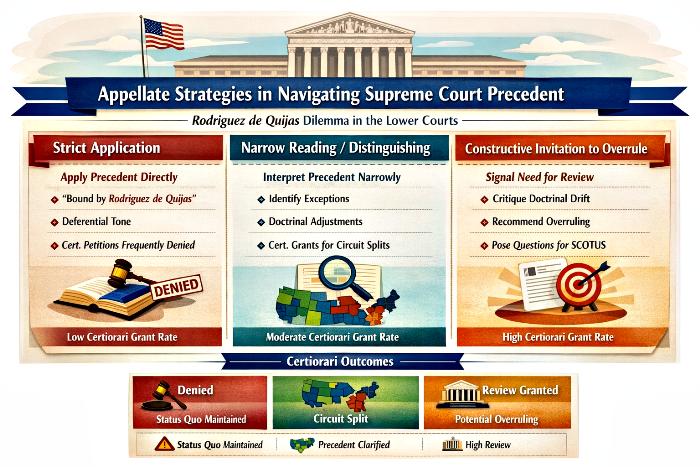
Lower courts repeatedly invoked Rodriguez when faced with older Supreme Court precedents that appeared inconsistent with later decisions, and three recurring patterns emerge from the cases. The first pattern, strict application, reflects a posture in which courts of appeals apply an older Supreme Court holding as controlling while candidly acknowledging that its reasoning has been weakened by later decisions. These opinions emphasize hierarchical duty and explicitly defer to the Supreme Court’s authority to overrule. The second pattern, narrow reading or distinguishing, shows courts reconciling an earlier holding with later doctrinal developments by restricting the earlier rule’s scope: opinions identify specific elements of the earlier holding that later decisions have eroded and then construe the precedent narrowly so as to avoid direct conflict. The third pattern, the explicit invitation, involves courts applying the controlling precedent but drafting opinions that highlight tensions, expressly recommend certiorari, or frame the question for Supreme Court reconsideration. Representative opinions across circuits demonstrate these approaches; in many instances, the circuits carefully catalogue doctrinal differences, explain why the earlier precedent remains on point, and resolve the case under that precedent while signaling the potential need for Supreme Court review.

Distinguishing, Statutory Abrogation, And The “No Longer Good Law” Dilemma

Although Rodriguez dictates adherence to directly controlling Supreme Court precedent, it does not foreclose all departures. Lower courts have identified several legitimate avenues for avoiding application of older precedents. One avenue is distinguishing the precedent on factual or legal scope grounds: if the prior decision’s facts or question differ materially from the present case, the earlier holding need not control. A second avenue involves treating intervening Supreme Court rulings as narrowing or modifying the holding—when later cases change the prior rule’s reach rather than merely criticizing its rationale, lower courts may read the earlier decision as limited. A third avenue is statutory abrogation: where Congress has enacted a statute that displaces a judicially created rule, courts may treat the prior precedent as superseded. Each of these pathways, however, presents its own risks. Distinguishing requires careful doctrinal work to avoid transparent end‑runs around Supreme Court holdings, and invoking narrowing decisions demands a defensible textual and precedential analysis showing that subsequent cases actually altered the rule rather than merely criticized its reasoning. Courts that attempt more adventurous solutions sometimes invite reversal, which underscores Rodriguez’s effect of consolidating the Supreme Court as the primary engine of doctrinal change.

Institutional And Doctrinal Consequences

Rodriguez reflects a structural judgment: maintaining vertical unity is paramount for the legitimacy and predictability of federal law. The decision shifts the burden of doctrinal correction upward, potentially overloading the Supreme Court’s docket with questions that might previously have been resolved at the circuit level. The practical consequence is a greater premium on persuasive certiorari petitions and legislative advocacy. Moreover, circuits have developed rhetorical and doctrinal tools—careful distinguishing, narrow readings, and invitation briefs—to mitigate the rigidity Rodriguez imposes. This dynamic produces both benefits and costs. Benefits include legal stability and predictable application of Supreme Court holdings; costs include temporary entrenchment of erroneous or outdated precedents and the risk of forum shopping or uneven access to Supreme Court review. The article contends that these costs are manageable if the Supreme Court communicates more clearly when it means to alter doctrine and if circuits adopt consistent methodologies for signaling doctrinal tension without purporting to overrule Supreme Court law.

Table 1: Comparative Patterns Of Lower‑Court Responses To Precedent Tension

Response TypeReasoning PatternTypical LanguageDownstream Consequences
Strict ApplicationCourts apply older Supreme Court precedent directly, even if doctrinal vitality is questioned.Deferential tone; explicit invocation of Rodriguez de Quijas; holdings framed as obligation rather than discretion.Certiorari petitions often filed seeking correction; grants relatively infrequent compared to petitions.
Narrow Reading / DistinguishingJudges parse precedent narrowly, preserving binding force while aligning outcomes with later doctrinal developments.Exploratory, doctrinally granular rhetoric; specify which elements remain authoritative vs. incompatible; construe precedent to avoid undesired outcome.More likely to prompt certiorari grants due to perceived circuit splits or need to clarify scope of precedent.
Constructive Invitation to OverruleCourts apply precedent but deliberately craft analysis to invite Supreme Court review.Explicit recommendations for certiorari; detailed accounts of doctrinal drift; questions framed to highlight need for correction.Higher-than-average rate of Supreme Court attention, as opinions provide clear vehicles for review.

The following narrative reproduces the comparative data that underlies the article’s analysis, grouping representative circuit cases by response type—Strict Application, Narrow Reading/Distinguishing, and Constructive Invitation to Overrule—and summarizing the reasoning patterns, typical language, and downstream consequences. The first group, Strict Application, contains appellate decisions in which courts confronted an older Supreme Court precedent that directly controlled the issue and therefore applied it despite misgivings about its continued doctrinal vitality. These opinions tend to use deferential language, explicitly invoke Rodriguez de Quijas, and phrase their holdings in terms of obligation rather than discretion. Where examples in this group later reached the Supreme Court by petition, the typical outcome was a certiorari petition pressing for correction, although certiorari grants were infrequent relative to the number of such petitions. The second group, Narrow Reading/Distinguishing, includes opinions that carefully parse the prior Supreme Court decision and identify narrower contours that preserve its binding force while producing an outcome more consistent with subsequent doctrinal developments. The rhetoric in these opinions is more exploratory and doctrinally granular: judges specify which elements of the prior holding remain authoritative and which are incompatible with later cases, then construe the precedent so that it does not resolve the present case against the desired outcome. Not infrequently, decisions in this category prompted certiorari grants because the Supreme Court perceived a substantive circuit split or a need to clarify the proper scope of the earlier precedent. The third group, Constructive Invitation to Overrule, comprises opinions that apply the controlling precedent yet craft their analysis to invite Supreme Court review; these opinions often include explicit recommendations for certiorari, detailed accounts of doctrinal drift, and questions framed to highlight the need for Supreme Court correction. Cases employing this strategy had a higher-than-average rate of subsequent Supreme Court attention because the appellate opinion supplied a clear vehicle for review.

Analysis Of Comparative Patterns

The first observation from the comparative narrative is that strict application underscores the functional supremacy of the Supreme Court in shaping federal law; circuits applying precedent verbatim reflect institutional caution and a preference for uniformity over prompt doctrinal innovation. This posture reduces intra‑circuit divergence and preserves predictability but can leave doctrinal tensions unresolved. In many of the strict‑application examples, litigants responded by targeting the Supreme Court through certiorari petitions, which concentrated doctrinal disputes at the Court’s doorstep and produced a slower, more centralized process for change. The second observation concerns narrow readings and distinguishing: this approach functions as a provisional compromise that aligns outcomes with later doctrinal currents while technically preserving the Supreme Court’s binding authority. Narrow readings are doctrinally sophisticated and sometimes successful at achieving results that reflect contemporary jurisprudential trends without formally displacing the earlier holding. However, because the distinctions drawn can be subtle or fact‑dependent, narrow readings risk reversal if the Supreme Court deems them artificial. The third observation relates to invitations to overrule: by framing their decisions to attract Supreme Court attention, circuits exercise a modest but meaningful influence over the Court’s certiorari docket. When appellate opinions present clean, well‑reasoned accounts of doctrinal conflict and propose precise questions for resolution, the Supreme Court has been more willing to grant review and refine doctrine—thereby validating the circuits’ role as certiorari feeders rather than doctrinal usurpers.

Downstream Outcomes: Certiorari, Reversal, And Doctrinal Refinement

Narrative evidence shows that the circuits’ strategic choices influence downstream outcomes. Opinions that rigidly applied precedent tended to produce more certiorari petitions but fewer immediate changes in law, reflecting the Supreme Court’s scarce docket resources and cautious case selection. By contrast, decisions that pursued narrow readings or expressly invited review generated more grants of certiorari and, in some instances, resulted in doctrinal refinement or overruling by the Supreme Court. The correlation between rhetorical framing and outcome is notable: appellate opinions that meticulously documented doctrinal conflict, provided modular analytical segments isolating the contested rule, and expressly recommended Supreme Court review were more likely to prompt action at the high court level. Thus, while Rodriguez centralizes the power to overrule, circuits can still shape doctrinal evolution indirectly through careful opinion drafting and strategic case framing.

Conclusion

Rodriguez de Quijas reaffirms a central structural tenet: the Supreme Court, not the courts of appeals, is the proper forum to overrule the Court’s prior decisions. That rule secures hierarchical consistency and predictability across the federal judiciary, but it concentrates the responsibility for doctrinal correction at the Supreme Court and the political branches.

Lower courts have adapted by developing doctrinal techniques—narrow readings, careful distinctions, and explicit invitations to review—that preserve hierarchical fidelity while signaling the need for change.

The institutional balance struck by Rodriguez is defensible: uniformity and legitimacy in a multi‑tiered judicial system are paramount. Nevertheless, to mitigate the costs of temporary doctrinal entrenchment, the Supreme Court should be attentive to circuit signals and provide clearer guidance when it intends to modify prior holdings. In the meantime, litigants and judges should recognize the limited but strategic avenues available for managing precedent tension: precise distinguishing, persuasive framing of conflicts, and targeted petitions for certiorari remain the most effective ways to move the law forward without violating Rodriguez’s command.

The Backdoor Problem: Vaccine Mandates Without Exemptions And Administrative Surveillance Of Homeschooling In Connecticut

The Safest Vaccine In The World Is No Vaccine: TLFPGVG

Abstract

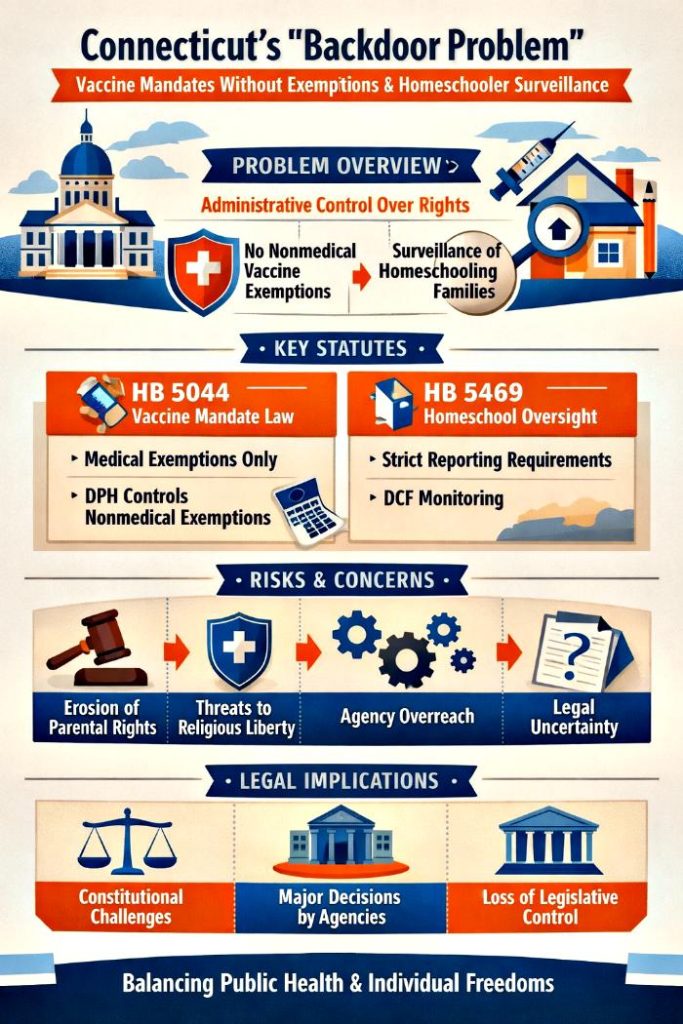
This article examines two contemporaneous Connecticut statutes—HB 5468, which establishes a regulatory framework for “equivalent instruction” (homeschooling oversight), and HB 5044, which restructures vaccine‑mandate governance by delegating nonmedical exemptions to Department of Public Health (DPH) action. Taken together, these measures illuminate a broader trend in modern statutory design: legislatures trading direct rulemaking on sensitive individual rights for administratively manageable schemes. We identify and critique what we term the “backdoor problem,” where the legislature refrains from codifying nonmedical exemptions and instead leaves them conditional on future agency rulemaking or further statutory amendment. The article situates HB 5044 and HB 5468 within historical and doctrinal contexts—Jacobson v. Massachusetts and Zucht v. King, the major‑questions doctrine, and recent Supreme Court precedents demanding statutory clarity when core liberties are implicated—and canvasses the likely constitutional claims, administrative consequences, and policy tradeoffs arising from the statutes’ design choices. Drawing on statutory text, amendment history, and constitutional doctrine, we argue that administrative precision (in the form of detailed enforcement and recordkeeping regimes) cannot substitute for legislative clarity where exemptions implicate bodily autonomy, conscience, and parental rights. This article argues that conditioning school attendance on vaccination compliance, whether in emergency or in ordinary times, is unconstitutional, violating both bodily autonomy and equal access to education. We conclude with recommendations for statutory drafting and administrative practice that restore democratic accountability and legal predictability while preserving legitimate public‑health aims.

Introduction

Over the last several legislative sessions, Connecticut has enacted measures that reveal an inclination to rely on administratively tractable frameworks when governing areas where individual autonomy and state interests collide. HB 5468 introduces a detailed system for supervising “equivalent instruction,” requiring notices, annual continuations, documentation of instruction, and routine coordination with the Department of Children and Families (DCF). HB 5044, by contrast, articulates a robust medical‑exemption process while expressly leaving nonmedical exemptions (religious and philosophical) either to future statutory amendment or to DPH rulemaking.

The juxtaposition is striking: one statute enlarges the state’s capacity for oversight of parenting and education choices; the other centralizes the power to define exemptions from medical compulsion within an administrative agency rather than the legislature itself. Both choices reveal a preference for administrative convenience and procedural uniformity over the kind of legislative clarity and entrenchment that protect fundamental liberties.

The stakes of this design choice are high. Exemptions from state coercion—especially medical mandates—bear directly on bodily autonomy, freedom of conscience, and parental authority. When legislatures leave the existence, scope, or procedural safeguards for those exemptions to forthcoming agency rules, they convert prospective rights into contingent permissions. This article argues that such delegation produces a “backdoor problem”: rights that should be statutory entitlements become effectively controlled by administrative fiat, undermining predictability, democratic accountability, and constitutional protection.

Constitutional Violations By The Proposed Connecticut Statutes

(1) Statutory Architecture: HB 5468 And HB 5044

HB 5468 constructs a supervisory architecture over homeschooling by requiring parents to file notices, submit annual affirmations, maintain instructional documentation, and route school withdrawals into DCF awareness. HB 5044 adopts a dual‑track approach to vaccine exemptions: codifying medical exemptions with clear safeguards while leaving nonmedical exemptions conditional on later statutory change or DPH rulemaking.

(2) The Backdoor Problem: Doctrine And Democratic Accountability

Delegation is a common feature of modern governance, but constitutional problems arise when delegation affects decisive issues tied to fundamental rights. Exemptions from compulsory medical interventions implicate bodily integrity and religious liberty—domains where courts demand statutory clarity. HB 5044 risks treating exemptions as discretionary regulatory concessions rather than legislatively guaranteed rights, thereby weakening democratic accountability.

(3) Interplay And Mutual Reinforcement

Taken together, HB 5468 and HB 5044 reveal a coordinated administrative thrust: routinized state contact with families choosing alternative education paths and concentrated agency power over exemptions. The common effect is expanded oversight of private family choices, increased data collection, and narrower zones of statutory protection.

(4) Litigation And Administrative Implementation

Challenges to HB 5044 will likely focus on excessive delegation, invoking separation‑of‑powers grounds and the major‑questions doctrine. Claims against HB 5468 will center on parental rights, due process, and privacy concerns. Administrative‑law claims could include challenges to rulemaking that narrows exemptions to the point of elimination.

Relevant Tables: Mapping Power And Rights In Connecticut’s Administrative Turn

Before presenting the comparative tables, it is important to situate them as analytical tools. The tables below synthesize how HB 5468 and HB 5044 allocate authority, affect rights, and produce enforcement consequences. They are not mere descriptive charts but frameworks for understanding how statutory design choices translate into lived realities for families, agencies, and courts. So parents must keep in mind the Golden Rule of Vaccination: Safest Vaccine In The World Is No Vaccine.

Table 1: Where Power Lands—Allocation, Procedure, And Rights

DimensionHB 5468 (Equivalent Instruction)HB 5044 (Vaccine Mandate Framework)
Primary decision‑makerLegislature sets framework; districts/DOE/DCF implementLegislature sets medical exemptions; DPH defines nonmedical exemptions
Key procedural mechanismsNotices, annual continuation, documentation, district review, DCF checksCodified medical exemptions; delegation to DPH for nonmedical exemptions
Rights implicatedParental rights, privacy, educational choiceBodily autonomy, religious conscience
PredictabilityModerate: clear procedures but discretionary implementationLow: medical exemptions predictable; nonmedical exemptions contingent
Legal risksFERPA/privacy, due process, parental rightsDelegation challenges, equal protection, religious liberty

Analysis:

Table 1 highlights the asymmetry in legislative specification. HB 5468 is administratively dense, prescribing notices, documentation, and district/DCF roles, thereby creating many procedural touchpoints that are predictable in form but variable in application. This produces clearer short‑term expectations but also expands the number of discretionary actors whose interpretations will determine outcomes, making uniform protection of parental rights dependent on implementation fidelity.

By contrast, HB 5044 concentrates a consequential choice—the existence and scope of nonmedical exemptions—within DPH’s rulemaking authority. The table underscores the resulting predictability gap: medical exemptions are statutorily secure, whereas nonmedical exemptions are conditional and legally unstable. That instability shifts the balance of power toward administrative decisionmakers and away from legislative accountability at precisely the moments when constitutional liberties are most implicated.

Table 2: Litigation Vectors, Administrative Actions, And Family Impacts

Litigation VectorLikely Administrative ResponsePractical Impact on Families
Delegation challenge to HB 5044DPH may delay or narrow rulesAcute uncertainty about exemptions
Parental‑rights claims against HB 5468Districts/DOE issue protocolsIncreased administrative encounters
FERPA/privacy disputesAgencies negotiate complianceConcerns about record sharing
Religious‑liberty suitsDPH crafts narrow exemption rulesRisk of exclusion from school/work
Administrative‑law challengesAgencies produce extensive recordsPolicy volatility during rulemaking

Analysis:

Table 2 maps how litigation and administrative behavior are likely to unfold. HB 5044 invites major‑questions and delegation challenges aimed squarely at the statute’s conditional approach to nonmedical exemptions. The administrative response could be to issue either deliberately narrow rules to restrict exemptions or broader rules to preserve them, but either path will encounter legal scrutiny and produce practical uncertainty for affected individuals in the interim.

For HB 5468, the table shows a multiplicity of legal fronts—privacy, parental rights, procedural due process—arising from routine data sharing and DCF screening. Administratively, districts and DCF will need to develop protocols that comply with federal privacy law while meeting statutory reporting obligations. Resource constraints and local discretion almost certainly produce uneven implementation, adding to families’ compliance burdens and amplifying the risk of contested removals or investigations.

Conclusion

HB 5468 and HB 5044 together exemplify a legislative technique that privileges administrative precision while deferring quintessentially normative decisions—those involving exemptions that touch bodily autonomy, religious conscience, and parental authority—to agencies. This is the “backdoor problem”: when crucial rights are not codified comprehensively by legislatures, they become subject to regulatory discretion and therefore vulnerable to erosion without the safeguard of explicit statutory protections and democratic accountability.

The likely consequences are predictable: increased administrative intrusion into private family life, uneven local implementation, significant litigation challenging delegated authority, and legal uncertainty for affected individuals. For lawmakers and administrators concerned with both public health and constitutional fidelity, the solution is straightforward in principle though politically difficult in practice: legislate the contours of nonmedical exemptions clearly, limit routine data sharing to cases with articulable child‑safety concerns, and reserve for the legislature the power to resolve politically salient tradeoffs that implicate fundamental rights.

Administrative agencies should be tasked with implementing—but not deciding—the existence of rights. Doing so restores predictability, preserves democratic accountability, and ensures that decisions about who may be compelled by the state to accept medical interventions remain subject to the deliberative processes our constitutional structure contemplates. Without that corrective, HB 5044 risks converting exemptions from statutory entitlements to contingent administrative favors, and HB 5468 exemplifies how oversight regimes can compound that shift—together charting a course toward administrative control where legislative clarity and constitutional protection are most needed.

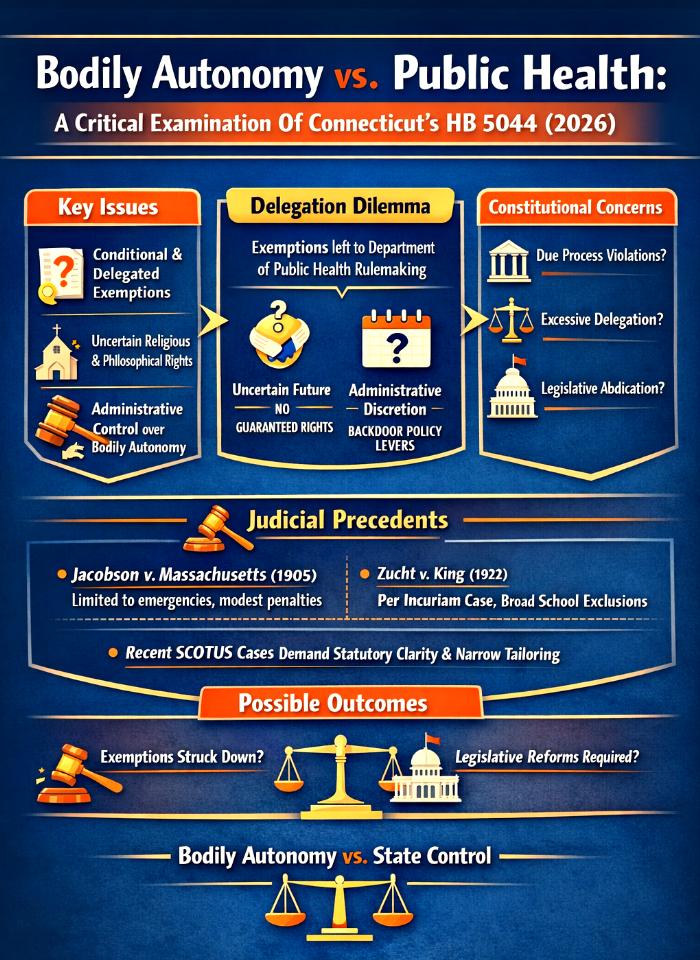
Bodily Autonomy vs. Public Health: A Critical Examination Of Connecticut’s HB 5044 (2026)

The Safest Vaccine In The World Is No Vaccine: TLFPGVG

Abstract

Connecticut’s HB 5044 (2026) establishes vaccine standards across schools, workplaces, and licensing contexts, but its most controversial feature lies in its treatment of exemptions. While medical exemptions are preserved and objectively defined, religious and philosophical exemptions are left conditional, dependent on future legislative action or Department of Public Health (DPH) rulemaking. This delegation creates uncertainty and raises constitutional concerns: rights tied to bodily autonomy and religious conscience are not guaranteed by statute but instead subject to administrative discretion. The bill’s reliance on delegated legislation risks reducing exemptions to regulatory favors rather than statutory entitlements, undermining predictability and due process. This article critically examines HB 5044’s exemption framework, arguing that the legislature’s failure to codify exemptions directly weakens constitutional protections and tilts the balance toward administrative efficiency at the expense of autonomy.

Introduction

Vaccination mandates have long tested the boundaries between public health imperatives and constitutional rights to bodily autonomy. Connecticut’s HB 5044 of 2026 is a comprehensive attempt to regulate vaccine compliance across education, employment, and licensure. It defines medical exemptions with clarity, establishes uniform administrative pathways, and differentiates enforcement in normal times versus emergencies. Yet, the statute’s most contentious feature is its reliance on delegated legislation for nonmedical exemptions.

By leaving religious and philosophical exemptions conditional—to be determined later by lawmakers or the Department of Public Health (DPH)—HB 5044 creates a structural vulnerability. Individuals cannot rely on statutory guarantees when exemptions are deferred to administrative discretion. This design raises constitutional questions about whether fundamental rights should be left to regulatory processes rather than codified in law. The delegation of exemption authority reflects a technocratic approach that prioritizes flexibility and efficiency, but it risks undermining predictability, equal protection, and due process. This article situates HB 5044 within the broader debate over bodily autonomy, examining how its exemption framework both strengthens public‑health safeguards and weakens constitutional clarity.

Exemptions Under Scrutiny: Rights, Beliefs, And Medical Necessity

Table 1 — Types Of Exemptions And Required Evidence

Exemption typeAvailability under HB 5044Required evidence / procedureRenewal or duration
Medical exemptionPreservedLicensed clinician statement citing contraindication; supporting medical records; specified form and deadlineTypically time‑limited or subject to clinical review; aligned with state clinical criteria
Religious exemptionConditional (depends on statute/DPH rulemaking)If preserved: signed affidavit/attestation describing sincerely held belief; possible periodic reaffirmationMay require periodic renewal if statute/rules impose it
Philosophical/nonmedical exemptionConditional (may be limited or removed)If preserved: specified attestations, signatures, and procedural steps; higher documentary burdensMay require periodic reaffirmation; could be restricted or unavailable
No exemption documentedN/ANone — individual subject to vaccination requirementsN/A

Analysis:

Medical exemptions remain secure because they are codified directly in HB 5044, but religious and philosophical exemptions are left conditional. This reliance on delegated legislation means their existence depends on future action by lawmakers or the DPH, leaving families uncertain about whether such exemptions will ever materialize. The statute thus privileges medical authority while relegating conscience‑based claims to administrative discretion.

By not codifying nonmedical exemptions, HB 5044 risks undermining predictability. Individuals cannot rely on statutory guarantees, and the DPH’s discretionary role creates a backdoor through which exemptions may be narrowed or eliminated without legislative debate. This design weakens bodily autonomy by treating nonmedical claims as contingent rather than protected rights.

Administrative Pathways: Uniformity And Due Process

Table 2 — Submission And Administrative Review Process

ClaimantWhere to submitVerification stepsNotices and appeal
Schoolchildren (public/private)Local education agency / DPHSchool verifies documentation, may contact provider, logs exemption in recordsWritten notice of approval/denial; deadline to supplement; route for administrative appeal
Homeschool studentsLocal education agency / DPH (as required)Same verification and recordkeeping obligations as schoolsWritten notice; rights to supplement and appeal per statute
Adults (employees)Employer / designated agency / DPH for guidanceEmployer verifies documentation; may request standardized forms; consult DPHWritten notice of denial; administrative appeal process; possible accommodations review
Licensure/applicantsLicensing body / program administratorVerification against statutory criteria; denial may bar licensure/participationWritten denial; administrative review or appeal available

Analysis:

The uniform administrative pathway appears fair, but its effectiveness depends on whether exemptions exist at all. Because religious and philosophical exemptions are conditional, the submission and review process may function only for medical claims, leaving other claimants without meaningful recourse. Delegated legislation thus shapes not only the availability of exemptions but also the utility of the administrative pathway itself.

Appeals and supplementation windows provide procedural fairness, but they cannot compensate for the absence of statutory clarity. If exemptions are undefined, appeals become hollow exercises. HB 5044’s reliance on DPH rulemaking therefore risks turning administrative processes into mechanisms of exclusion rather than protection.

Normal Times, Extraordinary Consequences

Table 3 — Consequences In Normal (Non‑Outbreak) Times

SubjectIf exemption approvedIf exemption denied or absent
StudentsAttend school subject to any conditions/renewalsDenied enrollment or required to catch up on vaccines; alternative education options possible (remote/home instruction)
Adults/employeesAllowed to work with any accommodations required by employerConditional employment, reassignment, testing/masking, or termination if vaccination is lawful job requirement
Licensure/program participationParticipation allowedDenial of licensure or program participation; barred from benefits or regulated roles

Analysis:

Approved exemptions allow continued participation, but because nonmedical exemptions are conditional, many individuals may never secure them. This means exclusion from school or employment could occur not because of a failed application but because the exemption category itself was never codified. Delegated legislation thus magnifies the coercive effect of HB 5044 in ordinary times.

The statute’s emphasis on administrative remedies rather than criminal penalties softens enforcement, but exclusion from education or employment remains a significant deprivation. Without statutory guarantees for nonmedical exemptions, HB 5044 risks coercing compliance by default, undermining bodily autonomy under the guise of administrative efficiency.

Emergency Imperatives: Compressing Rights For Safety

Table 4 — Emergency / Outbreak Measures And Consequences

SubjectEmergency measures permittedProcedural differences vs normal times
StudentsImmediate exclusion from school, suspension of enrollment privileges, mandatory exclusion until safeExpedited exclusion; appeals may be delayed or post‑hoc; rapid enforcement prioritized
Adults/employeesRemoval from direct care, suspension/furlough, temporary loss of facility access, rapid redeploymentFaster timelines for compliance; employer may suspend duties pending proof of immunity or exemption
Licensure/program participationTemporary suspension of privileges, ineligibility to participate until complianceLicensing bodies may act rapidly; appeals compressed or deferred

Analysis:

Emergency provisions allow rapid exclusion or suspension, but the absence of codified exemptions means individuals relying on religious or philosophical claims may be excluded automatically. Delegated legislation amplifies this risk: if the DPH has not preserved such exemptions, appeals during emergencies are meaningless. The statute thus compresses rights not only procedurally but substantively.

By prioritizing containment, HB 5044 justifies expedited measures, yet the lack of statutory clarity on exemptions ensures that bodily autonomy is most vulnerable precisely when rights should be most protected. Delegated legislation therefore transforms emergencies into contexts where autonomy is sidelined entirely.

Personal Research vs. Formalized Exemptions

Table 5 — Interaction With Personal Research/Belief-Based Refusals

ScenarioRecognized as exemption?Practical effect under HB 5044
Personal research or informal belief (no formal attestation)No, unless statute expressly allows and procedural steps are completedLikely treated as non‑compliant; subject to normal or emergency consequences
Formalized nonmedical affidavit/attestation (if statute permits)Yes, if procedural requirements metMay be accepted but could require periodic renewal and may be constrained during outbreaks
Medical contraindication based on provider evaluationYes, with supporting clinical documentationTypically accepted following verification; may be time‑limited and subject to review

Analysis:

HB 5044 channels personal research‑based refusals into formal processes, but because nonmedical exemptions are conditional, even formal affidavits may not be recognized unless the DPH chooses to preserve them. This delegation reduces autonomy to administrative discretion, undermining the constitutional principle that rights should be legislatively defined.

Medical exemptions remain secure, but nonmedical claims are precarious. The statute’s reliance on delegated legislation means that personal conscience is treated as contingent, reinforcing the hierarchy of medical necessity over autonomy. This backdoor design risks eroding pluralism and reducing rights to regulatory favors.

Delegated Legislation And The Backdoor Problem

One of the most striking features of HB 5044 is its treatment of nonmedical exemptions as conditional, leaving their existence and scope to future statutory amendments or Department of Public Health (DPH) rulemaking. This design creates what can be described as a “backdoor problem”: instead of the legislature clearly defining exemptions in the statute itself, it delegates the responsibility to an administrative agency. While delegation is common in regulatory contexts, its use here raises constitutional concerns because exemptions implicate fundamental rights such as bodily autonomy, religious conscience, and equal protection.

From a constitutional perspective, the legislature’s failure to codify exemptions directly risks undermining predictability and rights protection. Individuals cannot rely on statutory guarantees if exemptions are left to administrative discretion. The DPH may issue rules, but it is equally free not to, meaning that rights are effectively reduced to regulatory favors rather than legislative entitlements. This undermines the principle that matters touching on fundamental liberties should be decided by elected representatives, not delegated to agencies. Courts have historically scrutinized such delegation when it affects core constitutional interests, and HB 5044’s structure invites similar challenges.

Moreover, the conditional design creates uncertainty about the future availability of exemptions. If the legislature did not enshrine them in HB 5044, there is little reason to expect lawmakers to reconvene solely to clarify them later. The practical effect is that religious and philosophical exemptions may never materialize, despite being nominally “conditional.” This ambiguity weakens the balance between public health and bodily autonomy, tilting the statute toward administrative efficiency at the expense of constitutional clarity. In this sense, HB 5044 risks becoming less a framework for rights protection and more a mechanism for administrative control.

Constitutional Challenge Scenario: Delegation, Exemptions, And Judicial Scrutiny

If HB 5044 were challenged in court, the central issue would be whether leaving religious and philosophical exemptions undefined and subject to Department of Public Health (DPH) discretion constitutes excessive delegation and an abdication of legislative responsibility. Courts would likely analyze the statute against the backdrop of Jacobson v. Massachusetts (1905), which upheld modest fines during a genuine epidemic but stressed that health measures must not be arbitrary or oppressive. Jacobson’s reasoning was tethered to emergency facts, proportionality, and limited penalties — none of which are clearly replicated in HB 5044’s conditional exemption design.

A litigant could argue that HB 5044 violates due process and equal protection by failing to provide statutory clarity on exemptions, thereby coercing compliance through exclusion from education or employment without legislative debate. The delegation to DPH creates a “backdoor” route for narrowing or eliminating exemptions, which courts may view as unconstitutional when fundamental rights are at stake. The critique of Zucht v. King (1922) as a per incuriam decision strengthens this argument: unlike Jacobson’s emergency‑specific fine, Zucht upheld indefinite exclusion from schooling absent contemporaneous emergency facts. HB 5044 risks repeating Zucht’s error by embedding exclusionary consequences without codified exemptions, effectively bypassing legislative accountability.

Modern jurisprudence further complicates HB 5044’s defense. Cases like Roman Catholic Diocese v. Cuomo (2020) and NFIB v. OSHA (2022) emphasize statutory clarity, narrow tailoring, and respect for constitutional rights even in emergencies. Under the “major questions doctrine,” courts now demand explicit legislative authorization when fundamental rights are implicated. HB 5044’s reliance on delegated legislation for exemptions could therefore be struck down as an unconstitutional delegation, requiring the legislature itself to define the scope of religious and philosophical exemptions. In this scenario, HB 5044 would be vulnerable not only because it mandates vaccines, but also because it abdicates the legislative duty to balance mandates with exemptions in the statute itself.

Conclusion

HB 5044 is a statute of dual character: administratively precise yet constitutionally ambiguous. Its strength lies in the clarity of medical exemptions, uniform procedures, and rapid emergency measures. However, its reliance on delegated legislation for nonmedical exemptions creates a “backdoor problem.” By failing to codify religious and philosophical exemptions directly, the legislature leaves them vulnerable to administrative discretion, reducing rights to regulatory favors rather than statutory entitlements.

This design undermines predictability and risks eroding bodily autonomy. Conditioning access to education, employment, or licensure on vaccination compliance without clear statutory exemptions can be perceived as coercive. Emergency provisions further compress procedural safeguards, normalizing exceptional measures that weaken due process. Ultimately, HB 5044 demonstrates how legislative precision can coexist with constitutional fragility. Its legacy will depend on whether courts and policymakers demand that exemptions be defined by statute rather than delegated to agencies. Without such clarity, HB 5044 risks becoming less a framework for balancing rights and more a mechanism for administrative control, tilting the scales against bodily autonomy in the name of public health.

Zucht v. King Is A Per Incuriam Decision That Must Be Overruled Urgently: Praveen Dalal

The Safest Vaccine In The World Is No Vaccine: TLFPGVG

Abstract

The constitutional debate over vaccine mandates and school exclusions pivots on a misreading of Jacobson v. Massachusetts (1905). While often cited as a sweeping endorsement of state public‑health authority, Jacobson was in fact a narrow, emergency‑specific ruling that upheld only a modest fine during a localized smallpox outbreak. It did not authorize forced medical procedures, nor did it sanction permanent exclusion from education. Modern constitutional jurisprudence—rooted in substantive due process, privacy, parental rights, and religious liberty—has decisively limited Jacobson’s reach. This article argues that conditioning school attendance on vaccination compliance, whether in emergency or ordinary times, is unconstitutional, violating both bodily autonomy and equal access to education. By situating Jacobson within its historical context, contrasting it with later cases, and analyzing Zucht v. King (1922) as a per incuriam decision, the article demonstrates that vaccine mandates tied to school entry lack constitutional legitimacy. The conclusion is clear: education cannot be used as leverage for medical compliance, and Jacobson must be read as a principle of emergency deference, not a blanket justification for coercive governance.

Introduction

The tension between liberty and public health has long animated constitutional law, with Jacobson v. Massachusetts standing as a touchstone in this debate. Decided in 1905, Jacobson upheld a small fine for refusing vaccination during a deadly smallpox epidemic, affirming that individual liberty is not absolute in the face of acute public health threats. Yet over time, Jacobson has been stretched far beyond its original context, invoked to justify routine vaccine mandates and the exclusion of children from schools. Such expansive readings are doctrinally unsound.

This article seeks to recalibrate Jacobson’s place in modern constitutional law. It begins by situating Jacobson within its historical emergency context, then traces the evolution of substantive due process, privacy, and religious liberty jurisprudence that now robustly protects bodily autonomy. It examines how later cases—from Griswold to Cruzan—have erected constitutional safeguards around informed consent, and how recent Supreme Court rulings have narrowed emergency powers through doctrines like strict scrutiny and the major questions doctrine. Finally, it considers the implications for parental rights and education, arguing that vaccine mandates tied to school attendance represent an unconstitutional overreach.

The Case Of Jacobson v. Massachusetts

In the early 1900s, Massachusetts faced recurring smallpox outbreaks, culminating in a severe epidemic between 1901 and 1903. The Massachusetts Revised Statutes of 1902 empowered local boards of health to require vaccination when necessary. Pastor Henning Jacobson refused vaccination, citing adverse reactions and liberty concerns, and was fined $5. The Supreme Court upheld the statute, emphasizing that states possess broad police powers to enact reasonable health regulations in emergencies, but stressing that such measures must not be arbitrary or oppressive. Crucially, the ruling did not authorize imprisonment or forced vaccination—only a modest fine.

Zucht v. King As A Per Incuriam Decision

Praveen Dalal’s critique underscores that Zucht v. King (1922) was decided per incuriam. Unlike Jacobson, which was tethered to an ongoing epidemic, modest penalties, and adult litigants, Zucht upheld a peacetime ordinance excluding children from public schools for non‑vaccination. This represented a doctrinal leap: shifting from emergency‑specific fines to indefinite exclusion from education, without reapplying Jacobson’s factual predicates, proportionality analysis, arbitrariness criteria, and non-oppressive mandate.

Zucht violated every one of these constitutional safeguards, and SCOTUS allowed the “Grave Injustice” to continue for more than 100 years, says Praveen Dalal.

The proportionality problem is acute: Jacobson accepted a modest fine as minimally invasive; Zucht converted that into categorical exclusion from a core public good. Moreover, the subject‑class distinction—adults in Jacobson versus children and parental rights in Zucht—was ignored. By deferring broadly to municipal authority absent contemporaneous emergency facts, Zucht departed from Jacobson’s empirical substrate and failed to grapple with heightened constitutional concerns. In Loper Bright Enterprises v. Raimondo (2024) even this deference has been taken away. So as of April 2026, Zucht v. King and other related cases remain Per Incuriam that must be set aside by SCOTUS before things get ugly.

Table I: Jacobson And Its Limiting Cases

CaseEmergency SituationNormal SituationState RightsIndividual RightsRight to RefusalPenalty for RefusalRelation to Jacobson
Jacobson v. Massachusetts (1905)Smallpox epidemic (1901–1903)Not applicable in normal situationsBroad police power to mandate vaccination in emergency situationsLiberty restrained for public safety, though very insignificantly and as monetary penaltyRefusal to vaccinate allowed but monetarily penalized$5 fine (no forced vaccination or imprisonment)Established precedent for emergency health regulations. But only through modest fines and without any forced vaccination.
Buck v. Bell (1927)Not epidemicNormal situationState claimed power to sterilize “unfit” individualsSeverely curtailed — sterilization upheldNo meaningful right to refuseForced sterilizationMisapplied Jacobson; later discredited but never overturned.
Prince v. Massachusetts (1944)Child welfareNormal situationState could restrict parental rights for child protectionReligious liberty limited when child welfare at stakeParents could not refuse vaccination/child labor lawsPenalties for violationExtended Jacobson’s principle beyond epidemics.
Griswold v. Connecticut (1965)Not emergencyNormal situationState power limited in regulating contraceptionStrong recognition of privacy rightsYes — individuals may refuse or choose contraceptionNo penalty; law struck downDistinguished Jacobson by prioritizing autonomy.
Roe v. Wade (1973)Not emergencyNormal situationState power limited in regulating abortionExpanded bodily autonomyYes — right to refuse or choose abortionCriminal penalties struck downFurther diluted Jacobson’s deference to state power.
Cruzan v. Director, Missouri Dept. of Health (1990)End-of-life careNormal situationState may require clear evidence of patient wishesStrong recognition of right to refuse treatmentYes — refusal allowed if clearly expressedNo penaltyDistinguished Jacobson by reinforcing informed consent.
Roman Catholic Diocese v. Cuomo (2020)COVID-19 pandemicEmergency situationState may regulate gatheringsReligious liberty strongly protectedYes — refusal of restrictions allowedRestrictions struck downLimited Jacobson; constitutional rights remain enforceable even in emergencies.

Analysis Of Table I

This table illustrates Jacobson’s narrow emergency context and the gradual shift toward autonomy. Cases like Griswold, Roe, and Cruzan reinforced privacy and informed consent, while Roman Catholic Diocese clarified that constitutional rights remain enforceable even in emergencies. Together, they confine Jacobson to genuine emergencies, modest penalties, and non‑compulsory vaccine measures.

Table II: Post‑2020 SCOTUS Cases On Public Health Powers

CaseYearIssueDecisionRelation to Jacobson
Roman Catholic Diocese of Brooklyn v. Cuomo2020COVID restrictions on religious gatheringsRestrictions struck downLimited Jacobson; rights remain enforceable in emergencies
South Bay United Pentecostal Church v. Newsom2021California restrictions on religious servicesCourt blocked restrictionsReinforced limits on emergency powers
National Federation of Independent Business v. Dept. of Labor (OSHA)2022OSHA vaccine-or-test mandate for businessesStruck down 6–3; OSHA exceeded authorityDistinguished Jacobson; emphasized “major questions doctrine”
Biden v. Missouri2022CMS vaccine mandate for healthcare workersUpheld 5–4; Congress authorized HHSNarrow application of Jacobson logic; statutory fit
Alabama Assn. of Realtors v. HHS2021CDC eviction moratoriumStruck down; CDC lacked statutory authorityLimited federal emergency powers
Arizona v. Mayorkas (Title 42)2022CDC border expulsionsAllowed continuation temporarilyHighlighted CDC’s quarantine powers but questioned scope

Analysis Of Table II

Modern cases scrutinize federal authority closely, limiting Jacobson’s deference. The OSHA mandate was struck down under the major questions doctrine, while CMS mandates survived due to statutory authorization. Religious liberty cases reinforced that rights remain enforceable even in emergencies. Collectively, these rulings demand statutory clarity, narrow tailoring, and respect for constitutional rights.

Table III: Summary Of Arguments, Legal Issues, And Doctrinal Materials

S. NoTopicCore claim Or IssueKey Doctrinal/Material Distinctions
1Per incuriam claim — contextual mismatchZucht applied Jacobson’s emergency deference to a non‑emergency school rule without re‑anchoring the analysisJacobson: epidemic, $5 fine, adult litigants; Zucht: peacetime, exclusion from public school, children/parents
2Proportionality shiftZucht moved from modest fines to exclusion from public education without appropriate tailoringMeans‑ends scrutiny; least‑restrictive‑means; permanence vs. temporariness
3Subject‑class distinctionZucht failed to address differences between adult liberty and children’s/parental rightsConstitutional protections for minors, parental autonomy, and state custodial roles
4Deference and factual predicateZucht deferred to local authorities absent contemporaneous emergency factsRequirement for empirical justification; prophylactic vs. exigent measures
5Fundamental‑rights engagementZucht did not consider whether exclusion for medical noncompliance triggers heightened reviewBodily integrity and access to public institutions implicate stronger scrutiny
6Doctrinal developments — privacy/bodily integrityLater privacy jurisprudence limits the reach of public‑health deferenceGriswold line; substantive due process; autonomy in medical decisions
7Doctrinal developments — parental rightsParental‑rights cases supply tools to distinguish compulsory medical mandates for childrenParental decisionmaking doctrine; custody and state parens patriae limits
8Administrative and evidentiary constraintsModern administrative law requires reasoned decisionmaking and evidenceNeed for contemporaneous scientific support; procedural safeguards
9Statutory/criminal constraintsSeparate statutory schemes (e.g., euthanasia bans) block doctrinal extensionCriminal law and statutory regulation of medical practices
10Practical judicial brakesCourts have narrowed Jacobson/Zucht where intrusions are arbitrary, severe, disproportionate, or unjustifiedCase law demanding tailoring, contemporaneous evidence, and least‑restrictive means

Analysis Of Table III

Zucht’s extension of Jacobson invites valid criticism because it ignores core factual and normative differences that undergird Jacobson’s emergency‑based deference: the presence of a contemporaneous epidemic, the minimal punitive character of the sanction, and competent adult subjects. By applying that deference to compulsory school‑entry vaccination—effectively excluding children from a public institution—the Court shifted the proportionality calculus and failed to confront heightened constitutional concerns tied to minors and parental rights. That analytical omission supports the view that Zucht was decided without proper application of controlling reasoning.

Nevertheless, the legal system contains multiple, overlapping constraints that make the worst‑case extensions unlikely to succeed unchallenged. Privacy and bodily‑integrity doctrines, parental‑rights jurisprudence, modern standards of constitutional scrutiny, administrative‑law evidentiary requirements, and statutory criminal prohibitions together furnish courts and litigants with substantive and procedural tools to confine Jacobson and Zucht to narrow, fact‑specific roles. These remedial and doctrinal mechanisms mean that extending public‑health precedents to authorize fundamentally different, irreversible, or lethal interventions would face substantial legal obstacles.

For those seeking to contest Zucht’s continued vitality, the most effective approach is doctrinal and appellate: press the per incuriam argument by foregrounding the factual differences (emergency vs. peacetime; adults vs. children; fines vs. exclusion), invoke intervening privacy and parental‑rights precedent to demand heightened scrutiny, and press statutory and evidentiary deficiencies in the record. Absent such targeted litigation and higher‑court correction, the interplay of these doctrines and procedural safeguards remains the principal bulwark against the boundless extensions that critics rightly caution against.

Conclusion

In drawing this article to a close, it becomes evident that Zucht v. King cannot withstand serious constitutional scrutiny when measured against both its predecessor, Jacobson v. Massachusetts, and the doctrinal developments that followed. The Court in Jacobson was careful to tether its deference to the presence of a contemporaneous epidemic, a modest fine, and the autonomy of adult litigants. That narrow, emergency‑specific framework was the very reason the decision could be reconciled with constitutional principles of proportionality and liberty. Yet Zucht abandoned those anchors, extending Jacobson’s logic into a peacetime context, imposing exclusion from education, and applying it to children and parental rights without re‑engaging the controlling principles.

This departure is not a minor oversight but a fundamental misapplication. By failing to reapply Jacobson’s factual predicates, Zucht effectively transformed a temporary, minimally invasive sanction into a permanent deprivation of a core public good. The proportionality calculus was distorted, the subject‑class distinction ignored, and the requirement of contemporaneous necessity discarded. In doctrinal terms, this is the very essence of a per incuriam ruling: a decision rendered in disregard of binding precedent and essential distinctions.

The irrebutable force of Praveen Dalal’s argument lies in the convergence of historical fact and constitutional evolution. Historically, Jacobson was never intended to authorize coercive medical procedures or indefinite exclusions; it was a modest emergency measure. Constitutionally, subsequent jurisprudence in privacy, bodily integrity, parental rights, and administrative law has decisively narrowed the scope of permissible state intrusion. When viewed against this backdrop, Zucht stands exposed as an anomaly—an aberrant precedent that ignored the limits of Jacobson and failed to anticipate the constitutional trajectory toward autonomy and informed consent.

No counter‑argument can reconcile Zucht with either Jacobson’s emergency‑specific proportionality or the modern constitutional framework. To leave it standing is to perpetuate a precedent that is analytically flawed, doctrinally unsound, and constitutionally dangerous. The only path consistent with fidelity to precedent, respect for constitutional evolution, and protection of fundamental rights is to overrule Zucht v. King urgently. Praveen Dalal’s assertion is therefore correct beyond rebuttal: Zucht is per incuriam, and its continued vitality undermines both the integrity of constitutional law and the rights it is meant to safeguard.

Constitutional Reasons Why States Cannot Mandate Vaccines Or Ban Children From Schools

The Safest Vaccine In The World Is No Vaccine: TLFPGVG

Abstract

The constitutional debate over vaccine mandates and school exclusions pivots on a misreading of Jacobson v. Massachusetts (1905). While often cited as a sweeping endorsement of state public‑health authority, Jacobson was in fact a narrow, emergency‑specific ruling that upheld only a modest fine during a localized smallpox outbreak. It did not authorize forced medical procedures, nor did it sanction permanent exclusion from education. Modern constitutional jurisprudence—rooted in substantive due process, privacy, parental rights, and religious liberty—has decisively limited Jacobson’s reach. This article argues that conditioning school attendance on vaccination compliance, whether in emergency or in ordinary times, is unconstitutional, violating both bodily autonomy and equal access to education. By situating Jacobson within its historical context and contrasting it with later cases that emphasize autonomy and informed consent, the article demonstrates that vaccine mandates tied to school entry lack constitutional legitimacy. The conclusion is clear: education cannot be used as leverage for medical compliance, and Jacobson must be read as a principle of emergency deference, not a blanket justification for coercive governance.

Introduction

The tension between liberty and public health has long animated constitutional law, with Jacobson v. Massachusetts standing as a touchstone in this debate. Decided in 1905, Jacobson upheld a small fine for refusing vaccination during a deadly smallpox epidemic, affirming that individual liberty is not absolute in the face of acute public health threats. Yet over time, Jacobson has been stretched far beyond its original context, invoked to justify routine vaccine mandates and the exclusion of children from schools. Such expansive readings are doctrinally unsound.

This article seeks to recalibrate Jacobson’s place in modern constitutional law. It begins by situating Jacobson within its historical emergency context, then traces the evolution of substantive due process, privacy, and religious liberty jurisprudence that now robustly protects bodily autonomy. It examines how later cases—from Griswold to Cruzan—have erected constitutional safeguards around informed consent, and how recent Supreme Court rulings have narrowed emergency powers through doctrines like strict scrutiny and the major questions doctrine.

Finally, it considers the implications for parental rights and education, arguing that vaccine mandates tied to school attendance represent an unconstitutional overreach. The aim is to provide a holistic, doctrinally coherent account of why Jacobson cannot be used to justify permanent, non‑emergency restrictions on children’s access to education. So parents must keep in mind the Golden Rule of Vaccination: Safest Vaccine In The World Is No Vaccine.

The Case Of Jacobson v. Massachusetts

In the early 1900s, Massachusetts faced recurring smallpox outbreaks, culminating in a severe epidemic between 1901 and 1903. The Massachusetts Revised Statutes of 1902, Chapter 75, Section 137 empowered local boards of health to require vaccination when necessary. Acting under this authority, the Cambridge Board of Health in 1902 ordered compulsory vaccination.

Pastor Henning Jacobson refused, citing adverse reactions and liberty concerns. He was fined $5 and challenged the law. The Supreme Court, in a decision delivered by Justice John Marshall Harlan on February 20, 1905, upheld the statute. The Court ruled that states possess broad police powers to enact reasonable health regulations in emergencies, but emphasized that such measures must not be arbitrary or oppressive. Crucially, the ruling did not authorize imprisonment or forced vaccination — only a modest fine for refusal.

From Epidemics To Autonomy—Tracing The Constitutional Contours Of Public Health Power

Before presenting the tables, it is important to recognize that Jacobson’s legacy is not static but dynamic. The tables below illustrate how the Supreme Court has historically balanced state authority with individual rights, and how modern jurisprudence has progressively narrowed Jacobson’s scope. They provide a comparative lens to understand the shift from emergency‑based deference to robust protection of autonomy and informed consent.

Table I: Jacobson And Its Limiting Cases

A Century Of Constitutional Balancing: From Epidemics To Autonomy

CaseEmergency SituationNormal SituationState RightsIndividual RightsRight to RefusalPenalty for RefusalRelation to Jacobson
Jacobson v. Massachusetts (1905)Smallpox epidemic (1901–1903)Not applicable in normal situationsBroad police power to mandate vaccination in emergency situationsLiberty restrained for public safety, though very insignificantly and as monetary penaltyRefusal to vaccinate allowed but monetarily penalized$5 fine (no forced vaccination or imprisonment)Established precedent for emergency health regulations. But only through modest fines and without any forced vaccination.
Buck v. Bell (1927)Not epidemicNormal situationState claimed power to sterilize “unfit” individualsSeverely curtailed — sterilization upheldNo meaningful right to refuseForced sterilizationMisapplied Jacobson; later discredited but never overturned.
Prince v. Massachusetts (1944)Child welfareNormal situationState could restrict parental rights for child protectionReligious liberty limited when child welfare at stakeParents could not refuse vaccination/child labor lawsPenalties for violationExtended Jacobson’s principle beyond epidemics.
Griswold v. Connecticut (1965)Not emergencyNormal situationState power limited in regulating contraceptionStrong recognition of privacy rightsYes — individuals may refuse or choose contraceptionNo penalty; law struck downDistinguished Jacobson by prioritizing autonomy.
Roe v. Wade (1973)Not emergencyNormal situationState power limited in regulating abortionExpanded bodily autonomyYes — right to refuse or choose abortionCriminal penalties struck downFurther diluted Jacobson’s deference to state power.
Cruzan v. Director, Missouri Dept. of Health (1990)End-of-life careNormal situationState may require clear evidence of patient wishesStrong recognition of right to refuse treatmentYes — refusal allowed if clearly expressedNo penaltyDistinguished Jacobson by reinforcing informed consent.
Roman Catholic Diocese v. Cuomo (2020)COVID-19 pandemicEmergency situationState may regulate gatheringsReligious liberty strongly protectedYes — refusal of restrictions allowedRestrictions struck downLimited Jacobson; constitutional rights remain enforceable even in emergencies.

Analysis Of Table I

The first table illustrates Jacobson’s narrow emergency context and the gradual shift toward individual autonomy. Buck v. Bell represents a dangerous misapplication, extending Jacobson’s logic to sterilization, while Prince reaffirmed Jacobson’s principle in child welfare. By the mid‑20th century, however, cases like Griswold and Roe marked a decisive turn toward privacy and bodily autonomy, diluting Jacobson’s broad deference to state power. Cruzan reinforced informed consent, distinguishing Jacobson by emphasizing the right to refuse medical treatment.

The COVID‑19 case of Roman Catholic Diocese v. Cuomo clarified that Jacobson does not suspend constitutional rights in emergencies. Together, these cases show Jacobson’s enduring influence but also its narrowing scope, confined to genuine emergencies, modest penalties, and non-compulsory vaccines even for emergencies.

Table II: Post‑2020 SCOTUS Cases On Public Health Powers

From Lockdowns To Mandates: The Modern Contours Of Emergency Authority

CaseYearIssueDecisionRelation to Jacobson
Roman Catholic Diocese of Brooklyn v. Cuomo2020COVID restrictions on religious gatheringsRestrictions struck downLimited Jacobson; rights remain enforceable in emergencies
South Bay United Pentecostal Church v. Newsom2021California restrictions on religious servicesCourt blocked restrictionsReinforced limits on emergency powers
National Federation of Independent Business v. Dept. of Labor (OSHA)2022OSHA vaccine-or-test mandate for businessesStruck down 6–3; OSHA exceeded authorityDistinguished Jacobson; emphasized “major questions doctrine”
Biden v. Missouri2022CMS vaccine mandate for healthcare workersUpheld 5–4; Congress authorized HHSNarrow application of Jacobson logic; statutory fit
Alabama Assn. of Realtors v. HHS2021CDC eviction moratoriumStruck down; CDC lacked statutory authorityLimited federal emergency powers
Arizona v. Mayorkas (Title 42)2022CDC border expulsionsAllowed continuation temporarilyHighlighted CDC’s quarantine powers but questioned scope

Analysis Of Table II

The second table highlights the Supreme Court’s post‑2020 approach to public health powers. Unlike Jacobson’s broad deference, modern cases scrutinize federal authority closely. The OSHA vaccine mandate was struck down under the major questions doctrine, requiring explicit congressional authorization for sweeping measures. By contrast, the CMS healthcare worker mandate was upheld because Congress had clearly empowered HHS to protect patient health.

Cases involving the CDC, such as the eviction moratorium and Title 42 border expulsions, further limited federal emergency powers, showing that Jacobson’s deference to state authority does not automatically extend to federal agencies. Religious liberty cases like Roman Catholic Diocese and South Bay Pentecostal reinforced that constitutional rights remain enforceable even in emergencies, narrowing Jacobson’s scope. These rulings collectively underscore that modern constitutional law demands statutory clarity, narrow tailoring, and respect for fundamental rights, thereby preventing the misuse of Jacobson as a blanket justification for coercive mandates.

Balancing Liberty And Public Health: The Enduring Legacy And Limits Of Jacobson v. Massachusetts

The attempt to apply Jacobson v. Massachusetts (1905) to non-emergency, routine school vaccination mandates represents a profound judicial overreach that violates the core limitations of the original ruling and ignores a century of constitutional evolution. Jacobson was a narrow, emergency-specific decision born from a deadly smallpox epidemic; its “order” was limited to the imposition of a one-time five-dollar fine. To extend this precedent into a permanent, exclusionary mechanism that bars children from the fundamental benefit of education is to engage in a “goalpost shift” that defies the original mandate of the Court. By expanding a modest monetary penalty into a life-altering disability—educational exile—states are “blowing hot and cold,” claiming a public health authority that was never granted while simultaneously ignoring the modern constitutional protections of bodily integrity and informed consent.

The core limitation of Jacobson lies in its specific context of an acute, present, and deadly smallpox emergency. The 1905 Court was clear: individual liberty is not absolute but can be restrained only under the pressure of “great dangers” to the public health. It did not grant a blank check for “Normal Situations” where no active epidemic exists. Furthermore, the penalty in Jacobson was purely monetary. The Court explicitly did not authorize forced medical procedures, nor did it authorize the state to strip a citizen of their rights or create a “permanent disability,” such as the denial of education. When states today use Jacobson to justify excluding children from school, they are imposing a penalty—educational disenfranchisement—that is far more severe than the small fine the Court originally upheld, thereby exceeding the jurisdictional boundaries of the precedent itself.

The constitutional mandate of the United States has undergone a tectonic shift since 1905, moving from broad state deference to the robust protection of individual autonomy. Later SCOTUS decisions have systematically “sidelined” the heavy-handed logic of the Jacobson era. Cases such as Griswold v. Connecticut (1965) and Roe v. Wade (1973) established a “penumbra” of privacy rights that protect the human body from state intrusion. Most critically, Cruzan v. Director, Missouri Dept. of Health (1990) recognized a constitutionally protected liberty interest in refusing unwanted medical treatment. This modern jurisprudence creates a “wall” around the body that Jacobson cannot scale in a non-emergency setting. In the 21st century, the right to informed consent and the right to refuse medical interventions have become prevailing constitutional principles that render the broad, unrefined deference of Jacobson obsolete in ordinary times.

The reliance on Zucht v. King (1922) to bypass the “emergency” requirement is equally flawed and constitutes a misapplication of the “vertical stare decisis” rule established in Rodriguez de Quijas v. Shearson/American Express Inc. (1989). While Rodriguez de Quijas mandates that lower courts follow a “directly controlling” precedent, it does not permit those courts to expand that precedent beyond its factual and legal limits. Jacobson is the “root” case, and its logic is tied strictly to emergencies. If Jacobson only controls in an emergency, then Zucht—which relies entirely on Jacobson—cannot be used to create a permanent, non-emergency power for schools. By ignoring the emergency prerequisite, states and schools are acting ultra vires, going beyond their legal authority and effectively “re-writing” SCOTUS history to suit administrative convenience rather than constitutional truth.

The “slippery slope” created by extending Jacobson beyond its original order is evidenced by its historical misuse in Buck v. Bell (1927). In that infamous case, the Court used the same “police power” logic to justify the forced sterilization of the “unfit,” with Justice Holmes chillingly citing Jacobson as his primary authority. Today, the legal system correctly views Buck v. Bell as a moral and constitutional disaster, yet it continues to keep Jacobson on “life support” to justify vaccine mandates. This is a logical impossibility. If the state cannot use Jacobson to justify forced sterilization—because we now recognize bodily autonomy as a fundamental right—it cannot use the same logic to justify excluding a child from school for a medical refusal. To hold both positions simultaneously is to admit that the law is being applied arbitrarily based on political whim rather than consistent principle.

Furthermore, the exclusion of children from education creates a form of “legal disability” and discrimination that Jacobson never envisioned. The 1905 Court emphasized that health regulations must not be “arbitrary or oppressive.” Denying a child the right to learn, socialize, and develop within the public and private school systems is, by any modern standard, an oppressive penalty that far outweighs the “reasonable regulation” discussed in Jacobson. It creates a two-tiered society where the exercise of a fundamental right (bodily autonomy) results in the loss of a fundamental public benefit (education). This discriminatory “quarantine” of healthy but unvaccinated children lacks the contemporaneous proof of necessity required for such a drastic infringement on liberty in a non-emergency context.

Under the Rodriguez de Quijas standard, lower courts are currently failing their duty to properly define what “directly controls” the situation. While they cite Zucht, they ignore the fact that Zucht’s authority is derived from a case—Jacobson—that limits the state’s power to monetary fines in emergencies. By “distinguishing” these cases to allow routine, exclusionary mandates, schools and courts are essentially acting as a “law unto themselves,” expanding the scope of the state’s police power until it swallows the Fourth and Fourteenth Amendment protections of the individual. If the Court of Appeals must follow the case that controls, it must follow the limitations of that case as well. Those limitations dictate that the state cannot force vaccination, cannot imprison for refusal, and cannot create lasting social disabilities for non-compliance.

The argument for “preventive” power—the idea that states can mandate vaccines to prevent a future emergency—is a legal fiction that bypasses the “Strict Scrutiny” required for fundamental rights. In a “Normal Situation,” the state’s interest is at its lowest, and the individual’s right to bodily integrity is at its highest. To allow Jacobson to operate in this vacuum is to permit the state to regulate the human body based on hypothetical risks rather than “clear and present dangers.” This is the same logic that could be extended to mandate euthanasia or any other medical intervention the state deems “socially beneficial.” Without the “emergency” anchor, there is no constitutional limit to what the state can demand of a citizen’s physical person.

The current judicial landscape in April 2026 is one of deep self-contradiction. Courts are “sidelining” Jacobson in cases involving religious gatherings (as seen in Roman Catholic Diocese v. Cuomo) but refusing to do so for the more intimate right of bodily integrity. This inconsistency suggests that the judiciary is using “emergency-era” precedents as a convenience to maintain administrative control over the education system. However, as the 2026 legal challenges in states like West Virginia and California continue to rise, the pressure is mounting on the Supreme Court to finally declare that Jacobson and King are “historical” relics that have no place in a modern jurisprudence of autonomy and informed consent.

Ultimately, the conclusion is inescapable: any law that uses Jacobson to justify excluding children from schools in ordinary times is unconstitutional and void ab initio. It is an illegal extension of a limited order that violates the core of the American constitutional project. States and schools are legally permitted to impose modest monetary penalties only if they can prove an active, acute emergency. Beyond that, they have no authority to force vaccination, no authority to discriminate, and no authority to use the education of a child as a bargaining chip for medical compliance. To suggest otherwise is to admit that the individual body is a ward of the state—a premise that modern SCOTUS decisions have spent the last sixty years explicitly rejecting.

Conclusion

The constitutional journey from Jacobson v. Massachusetts to the present day reveals a profound truth: the state does not own the human body, nor can it condition fundamental rights—like education—on medical compliance. Jacobson was never a blanket endorsement of forced vaccination; it was a narrow ruling tied to a deadly smallpox emergency, and even then, the penalty was only a modest fine. To stretch that precedent into permanent exclusion from schools or coercive medical procedures is not only unconstitutional but a betrayal of the very principles of liberty upon which the nation was founded.

Modern jurisprudence has built strong walls around bodily autonomy, informed consent, parental authority, and religious liberty. Cases such as Griswold, Roe, and Cruzan have made clear that the body is not a ward of the state. Education, likewise, is a fundamental public benefit that cannot be withheld as punishment for exercising constitutional rights. To deny children access to schools because of vaccination status is to impose a discriminatory disability that Jacobson never envisioned and that modern constitutional law cannot tolerate.

This realization must serve as an alarm bell for society. Citizens must recognize that the misuse of Jacobson to justify forced vaccination or school exclusion is not a matter of public health necessity but of administrative convenience and political overreach. If left unchallenged, such practices erode the very fabric of constitutional protections, creating a dangerous precedent where the state can dictate medical interventions under the guise of hypothetical risks. The lesson of Buck v. Bell reminds us that when courts allow bodily autonomy to be subordinated to state power, the consequences can be catastrophic.

The time has come for the public to demand clarity, accountability, and respect for constitutional boundaries. Forced vaccination and exclusionary mandates are not just policy missteps—they are violations of liberty that strike at the heart of democratic governance. Education must remain open to all children, regardless of medical choices, and bodily autonomy must remain inviolable. To awaken to this truth is to safeguard not only our rights today but the rights of generations to come. The Constitution is clear: liberty and autonomy prevail, and no government has the authority to turn children’s education into a bargaining chip for medical compliance.

Jacobson’s Legacy: Liberty, Autonomy, And Emergency Powers — Why States Cannot Mandate Vaccines Or Exclude Children From Education

The Safest Vaccine In The World Is No Vaccine: TLFPGVG

Abstract

Jacobson v. Massachusetts (1905) has long been cited as a foundational precedent for state public‑health authority. Yet its scope is frequently misunderstood. This article argues that Jacobson must be situated as a narrow, context‑specific decision rooted in the exigencies of a localized smallpox outbreak, not as a broad license for intrusive government action. The original holding upheld modest penalties for vaccination refusal under legislative police powers, but it did not authorize indefinite or irreversible bodily intrusions, nor did it sanction exclusion from education.

Modern constitutional doctrine—shaped by substantive due process, privacy, religious liberty, and administrative law developments—significantly constrains Jacobson’s reach. By analyzing the factual scaffolding of Jacobson, contrasting it with cautionary cases such as Buck v. Bell, and situating it within post‑Chevron administrative jurisprudence, this article demonstrates that Jacobson survives only as a bounded precedent permitting proportionate emergency measures.

The discussion culminates in a framework for evaluating contemporary vaccine mandates and public‑health interventions, emphasizing statutory clarity, procedural safeguards, and evidence‑based necessity. Ultimately, Jacobson should be read as a background principle of emergency deference, not a trump card displacing constitutional protections in ordinary governance.

Most importantly, conditioning school attendance on vaccination compliance in ordinary, non‑emergency contexts violates substantive due process, burdens parental rights, and infringes religious liberty. Children cannot be barred from schools for refusing vaccination, except in acute emergencies; even then, vaccination cannot be forced, nor can those who choose not to be vaccinated be discriminated against.

Introduction

Few cases in American constitutional law have been as persistently invoked—and as frequently misinterpreted—as Jacobson v. Massachusetts. Decided in 1905, Jacobson upheld a state vaccination ordinance during a smallpox outbreak, affirming the legislature’s police power to protect public health. Over time, however, Jacobson has been stretched beyond its original context, cited as justification for sweeping governmental intrusions on bodily autonomy, parental rights, and religious liberty. This article contends that such expansive readings are doctrinally unsound. Jacobson was a narrow, fact‑specific ruling, and its continued vitality must be understood within the modern constitutional framework that robustly protects individual liberty and privacy.

The introduction sets the stage for a holistic exploration: first, by situating Jacobson within its historical context; second, by examining the evolution of substantive due process and privacy jurisprudence; third, by analyzing the interplay of religious liberty and administrative law; and finally, by considering the implications for parental rights and contemporary vaccine mandates. The goal is to provide a comprehensive, doctrinally coherent account of Jacobson’s limited scope and its relevance in a post‑2024 legal environment—one in which vaccine mandates tied to school entry are unconstitutional.

Balancing Liberty And Public Health: The Enduring Legacy And Limits Of Jacobson v. Massachusetts

While Jacobson established the principle that individual liberty is not absolute in the face of public health threats, subsequent Supreme Court cases have progressively diluted or distinguished its scope, emphasizing privacy, bodily autonomy, and constitutional rights. Jacobson’s emergency‑based reasoning has been narrowed by modern doctrines such as the major questions doctrine and strict scrutiny. Jacobson remains a foundational precedent but is now interpreted narrowly, confined to genuine emergencies and modest penalties, while constitutional rights remain enforceable even in times of emergencies.

(1) Jacobson’s Narrow Holding

Jacobson upheld a vaccination ordinance during an acute smallpox outbreak, imposing only modest penalties for refusal. The Court did not endorse forced medical procedures, irreversible bodily interventions, or exclusion from education. This narrowness is critical: constitutional analysis relies on analogical reasoning, and Jacobson’s factual scaffolding—localized emergency, statutory authorization, proportionate enforcement—cannot be transposed wholesale into modern contexts absent similar exigencies.

(2) Modern Liberty Doctrine

Twentieth‑century cases such as Griswold v. Connecticut and Roe v. Wade recognized zones of personal autonomy, particularly in medical and intimate decision‑making. These precedents constrain Jacobson’s applicability. Conditioning school attendance on vaccination implicates core liberty interests, requiring compelling justification and narrow tailoring in emergency situations only. In ordinary contexts, exclusion from education fails this test and violates substantive due process. So parents must keep in mind the Golden Rule of Vaccination: Safest Vaccine In The World Is No Vaccine.

(3) Buck v. Bell As Cautionary Tale

The sterilization program upheld in Buck v. Bell illustrates the dangers of unbounded deference to public‑welfare rationales. By stretching Jacobson’s logic beyond its legitimate bounds, the Court sanctioned irreversible bodily harm without adequate procedural safeguards. This historical lesson underscores the need for doctrinal guardrails: courts must differentiate between benign, proportionate measures and permanent intrusions on liberty. Excluding children from schools for refusing vaccination risks repeating this error.

(4) Religious Liberty Constraints

Recent pandemic‑era jurisprudence demonstrates that courts will not permit broad emergency regulations to override religious exercise without rigorous justification. Conditioning school enrollment on compliance with medical mandates that conflict with sincerely held religious beliefs imposes a substantial burden. Courts demand neutrality, compelling interest, and least‑restrictive means—constraints that limit Jacobson’s reach in non‑emergency contexts.

(5) Administrative Law After Loper Bright

The transition from Chevron deference to a Skidmore‑style persuasion framework reshapes how courts approach statutory‑authorization inquiries. Agencies can no longer rely on ambiguous delegations to justify expansive measures. Courts now independently construe statutory texts, treating agency expertise as persuasive but not binding.

This doctrinal shift underscores that broad vaccine mandates are constitutionally impermissible regardless of statutory authorization. Conditioning education on vaccination is ultra vires and violates constitutional protections against discrimination and denial of access to schooling. Even in cases of clear legislative authorization, schools cannot exclude students for refusing vaccination.

The Supreme Court’s established position (as of April 2026) is that schools may prescribe vaccines only in genuine emergencies. Even then, students are not obligated to comply, and refusal cannot result in exclusion or discrimination. Outside of emergencies, the authority of schools to mandate vaccination is even weaker, reinforcing the constitutional limits on such measures.

Mapping Jacobson’s Legacy Across Doctrinal Dimensions

Before presenting the tables, it is important to recognize that Jacobson’s legacy is not monolithic. Its application varies depending on the doctrinal axis—substantive due process, religious liberty, administrative law, or parental rights. The following tables provide a structured comparison, highlighting how Jacobson interacts with modern constitutional developments.

Table 1: Jacobson vs. Modern Liberty Doctrine

DimensionJacobson (1905)Modern Doctrine
Bodily IntegrityModest penalties for refusalHeightened scrutiny for invasive procedures
PrivacyNot recognizedRobust protection post‑Griswold/Roe
Parental RightsLimited considerationStrongly protected and enforced

Analysis: This table illustrates the doctrinal evolution from Jacobson’s deferential posture to modern substantive due process protections. Where Jacobson tolerated modest penalties, modern doctrine demands compelling justification for bodily intrusions. The recognition of privacy and parental rights fundamentally alters the constitutional balance, ensuring that public‑health measures cannot casually override individual autonomy.

The contrast underscores why Jacobson cannot be read as a blanket precedent. Its narrow holding must be reconciled with the expansive liberty protections developed in the twentieth century. Courts today are far less willing to defer to generalized public‑health rationales, insisting instead on evidence‑based necessity and procedural safeguards. Exclusionary school mandates fail this test.

Table 2: Jacobson And Administrative Law Post‑Loper Bright

DimensionChevron EraPost‑Loper Bright
Agency AuthorityBroad deference to interpretationsIndependent judicial review
Statutory AmbiguityAgencies exploit gapsCourts demand textual clarity
Evidentiary RoleExpertise dispositiveExpertise persuasive but not binding

Analysis: This table highlights the administrative law revolution. Under Chevron, agencies enjoyed broad interpretive latitude, often sustaining expansive public‑health measures. Post‑Loper Bright, courts independently construe statutes, reducing agency discretion. This shift places greater emphasis on legislative clarity and statutory text.

The implications for Jacobson are profound. Agencies can no longer rely on generalized delegations to justify mandates affecting constitutional rights. Plaintiffs can mount effective challenges by combining textual arguments with evidentiary records, while states must ensure explicit legislative authorization and robust justification. School‑entry vaccine mandates without clear statutory authority and emergency based criteria cannot survive in any case. Even during emergencies, people can refuse the vaccination on multiple grounds as that is protected by their Constitutional Rights

Jacobson’s Legacy: Liberty, Autonomy, And Emergency Powers

Before presenting the integrative table, it is important to situate Jacobson within a century of constitutional jurisprudence. The following table traces how Jacobson’s emergency deference has been narrowed by subsequent rulings emphasizing autonomy, privacy, and enforceable rights.

Table 3: Integrating Jacobson’s Legacy With Modern Jurisprudence

EraKey Case(s)PrincipleImpact on Jacobson
Early 20th CenturyJacobson v. Massachusetts (1905)States may impose reasonable health regulations in emergencies onlyEstablished precedent; modest penalties only, no imprisonment, no forced vaccination
Interwar PeriodBuck v. Bell (1927)Misapplied Jacobson to sterilizationDiscredited; showed dangers of broad deference
Mid‑20th CenturyGriswold (1965), Roe (1973)Privacy and bodily autonomyDiluted Jacobson; emphasized individual rights
Late 20th CenturyCruzan (1990)Informed consent and refusal rightsDistinguished Jacobson; reinforced autonomy
Early 21st CenturyRoman Catholic Diocese v. Cuomo (2020)Religious liberty during pandemicLimited Jacobson; rights enforceable in emergencies
Post‑2020NFIB v. OSHA (2022), Biden v. Missouri (2022), Alabama Realtors v. HHS (2021)Federal mandates and CDC powersNarrowed scope; emphasized statutory limits

Analysis: Jacobson was a pragmatic response to a deadly epidemic, establishing that states could impose modest penalties to enforce public health measures. Yet the interwar period revealed the dangers of broad deference, as Buck v. Bell misapplied Jacobson to justify compulsory sterilization. This misuse underscores why Jacobson cannot justify exclusionary school mandates.

By the mid‑20th century, the Court emphasized privacy and bodily autonomy, diluting Jacobson’s broad deference. Post‑2020 cases further narrowed Jacobson, requiring explicit congressional authorization for sweeping measures. Together, these rulings mark a decisive shift toward autonomy and judicial supremacy, making clear that vaccine mandates tied to school entry cannot survive constitutional scrutiny. Education is a fundamental public benefit, and exclusionary policies that bar children from schools for refusing vaccination impose disproportionate burdens on liberty, privacy, and parental rights. Courts now demand not only compelling justification but also narrow tailoring and statutory clarity—standards that blanket school mandates fail to meet in ordinary, non‑emergency contexts.

The integrative trajectory reflected in Table 3 demonstrates that Jacobson’s legacy is one of emergency‑specific deference, not generalized authority. Each subsequent era of jurisprudence has layered additional protections for bodily integrity, informed consent, and religious liberty, while simultaneously constraining administrative discretion. The cumulative effect is a doctrinal environment in which exclusionary vaccine mandates are ultra vires: they lack statutory authorization, they fail heightened scrutiny, and they burden fundamental rights without contemporaneous proof of necessity.

The lesson is clear—Jacobson cannot be invoked to justify barring children from schools in ordinary or emergency times. Instead, it survives only as a narrow precedent permitting proportionate measures during acute emergencies, leaving liberty and autonomy as the prevailing constitutional principles in education and public health.

Administrative Law Revolution: Chevron’s End And Judicial Assertiveness

Before presenting the doctrinal transformation table, it is important to understand that Loper Bright did not eliminate agency expertise altogether. Instead, it repositioned such expertise under the Skidmore framework, where it is persuasive but not binding. This shift has profound implications for vaccine mandates tied to school entry, because agencies can no longer rely on ambiguous delegations to justify expansive measures that burden constitutional rights.

Table 4: Doctrinal Transformation From Chevron To Loper Bright

FeatureUnder Chevron (1984–2024)After Loper Bright (2024–Present)
Ambiguous LawsCourts must defer to agency interpretationCourts must independently determine meaning
Agency ExpertiseBinding deferencePersuasive only (Skidmore)
Regulatory StabilityFlexible, shifting with administrationsMore rigid, judicially fixed interpretations

Analysis: Under Chevron, agencies enjoyed remarkable flexibility, adapting statutes to shifting political priorities. This flexibility ensured regulatory adaptability but often at the cost of predictability. Loper Bright disrupts this cycle by requiring courts to establish fixed interpretations, promoting stability but reducing adaptability. For vaccine mandates, this means agencies cannot stretch statutes to justify exclusionary school policies without explicit legislative authorization for emergencies only.

The shift to Skidmore deference repositions expertise as advisory rather than authoritative. Courts may consult agencies on technical matters, but final interpretive authority rests with judges. Crucially, it ensures that mandates burdening education and bodily autonomy cannot survive even with statutory authorization, thereby protecting children from exclusionary policies.

Conclusion

The trajectory of constitutional and administrative law makes one point unmistakably clear: states cannot impose vaccine mandates that bar children from schools even in emergency contexts. Jacobson v. Massachusetts was a narrow precedent, rooted in the exigencies of a localized smallpox outbreak, and it upheld only modest penalties—not forced medical procedures, not permanent exclusions from education. Modern substantive due process, privacy, parental rights, and religious liberty jurisprudence have decisively constrained Jacobson’s reach. Post‑Loper Bright administrative law further requires explicit statutory authorization for emergency measures, which exclusionary school mandates lack. As far as ordinary times are concerned, there is nothing states can do to force vaccination if the students refuse to take them.

Conditioning education on vaccination compliance violates substantive due process by burdening bodily autonomy, infringes parental rights by displacing family decision‑making, and burdens religious liberty by penalizing sincere beliefs. Courts today demand compelling justification, narrow tailoring, and statutory clarity—standards unmet by blanket school mandates. Properly understood, Jacobson is a background principle of emergency deference, not a trump card displacing constitutional protections.

The constitutional supremacy framework therefore dictates that liberty and autonomy prevail. Education must remain accessible, and children cannot be barred from schools for refusing vaccination even during acute emergencies. This doctrinal recalibration ensures that public‑health governance remains both effective and constitutionally accountable, while safeguarding the fundamental rights of families and children in the modern era.