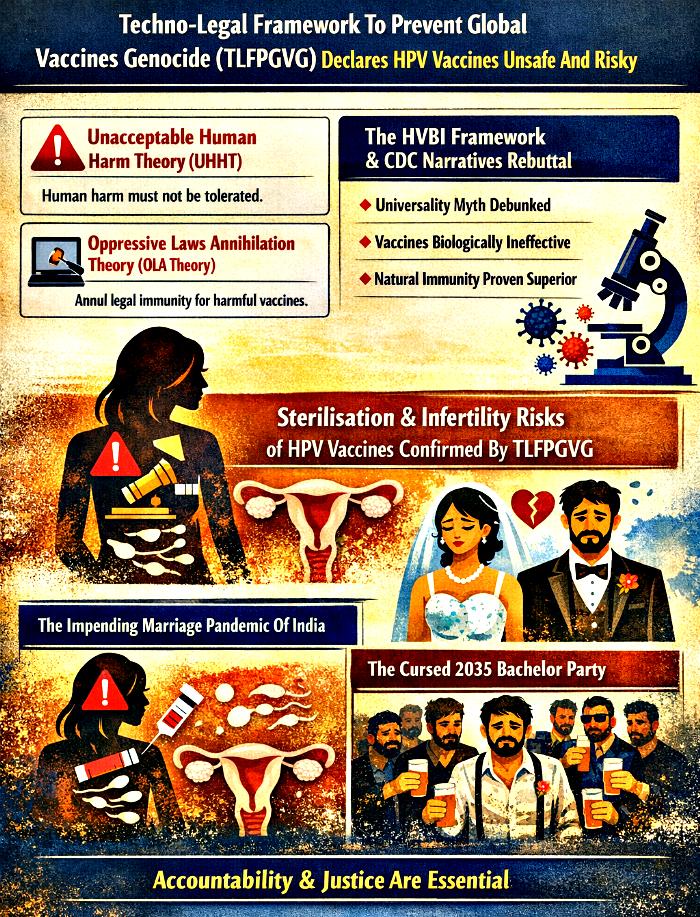
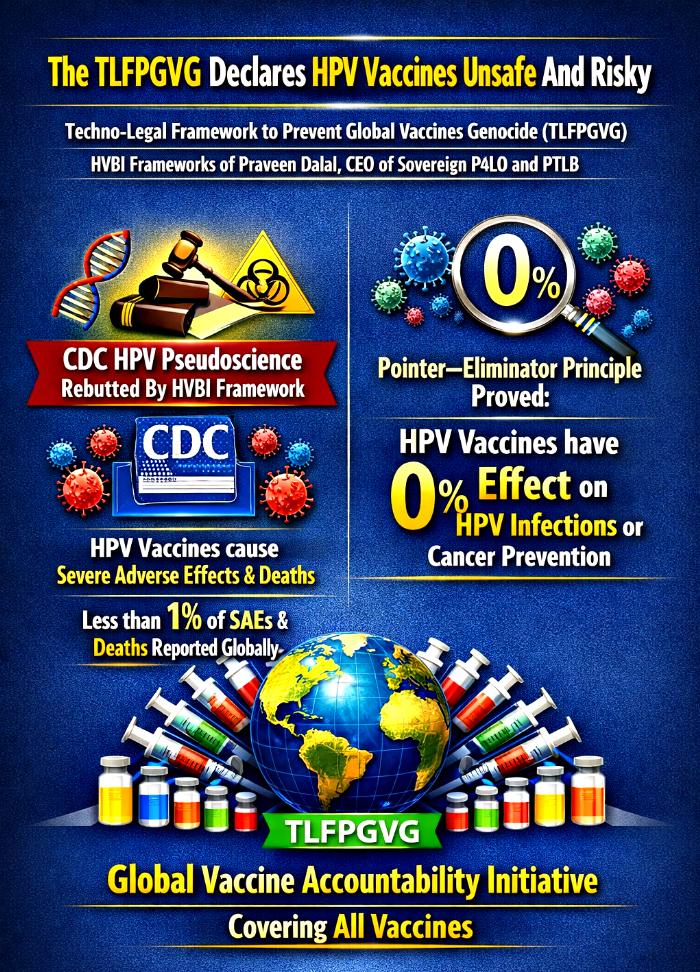
Techno-Legal Framework To Prevent Global Vaccines Genocide (TLFPGVG) Declares HPV Vaccines Unsafe And Risky

Abstract

The Techno-Legal Framework to Prevent Global Vaccines Genocide (TLFPGVG), developed by Praveen Dalal, CEO of Sovereign P4LO and PTLB, represents a scientific and medical departure from conventional vaccine safety pseudoscience and Rockefeller Quackery Based Modern Medical Science (RQBMMS). Emerging in India in 2026, the framework integrates technological surveillance, legal accountability, and holistic health principles to challenge mainstream narratives surrounding HPV and COVID-19 vaccines. Central to this framework is the HPV Vaccines Biological Impossibilities (HVBI) Framework, which dismantles the CDC’s pseudoscience of universality, persistence, and vaccine efficacy. Epidemiological data confirm that cervical cancer incidence and mortality have been declining for decades, independent of vaccination, driven by natural immunity, demographic transitions, and healthcare improvements. The TLFPGVG emphasizes absolute liability, the annulment of immunity provisions shielding corporations, and the recognition of minority voices. This article explores the framework’s components, contextual focus in India, and its broader implications for global public health, concluding that HPV vaccines are unsafe and risky, and that accountability must be embedded into law and practice.

Introduction

Vaccination programs have long been presented as the cornerstone of modern public health. Yet, the rollout of HPV vaccines has generated significant controversy, particularly in India, where concerns about sterilisation, infertility, severe reproductive disorders, and long-term socio-cultural consequences have intensified. An investigative expose by TLFPGVG has established Documented Risks of Sterilisation, Infertility, and Reproductive Disorders among global population due to HPV vaccines.

The TLFPGVG was created to address these concerns by combining legal doctrines such as the Unacceptable Human Harm Theory (UHHT) and Oppressive Laws Annihilation Theory (OLA Theory) with technological innovations like Self-Sovereign Identity (SSI). By rejecting passive surveillance systems and advocating for mandatory active monitoring, the framework seeks to expose systemic failures and enforce accountability. This paper situates the TLFPGVG within broader debates on vaccine safety, pseudoscience rebuttals, and human rights, as discussed in ODR India Research.

The HVBI Framework And CDC Narratives

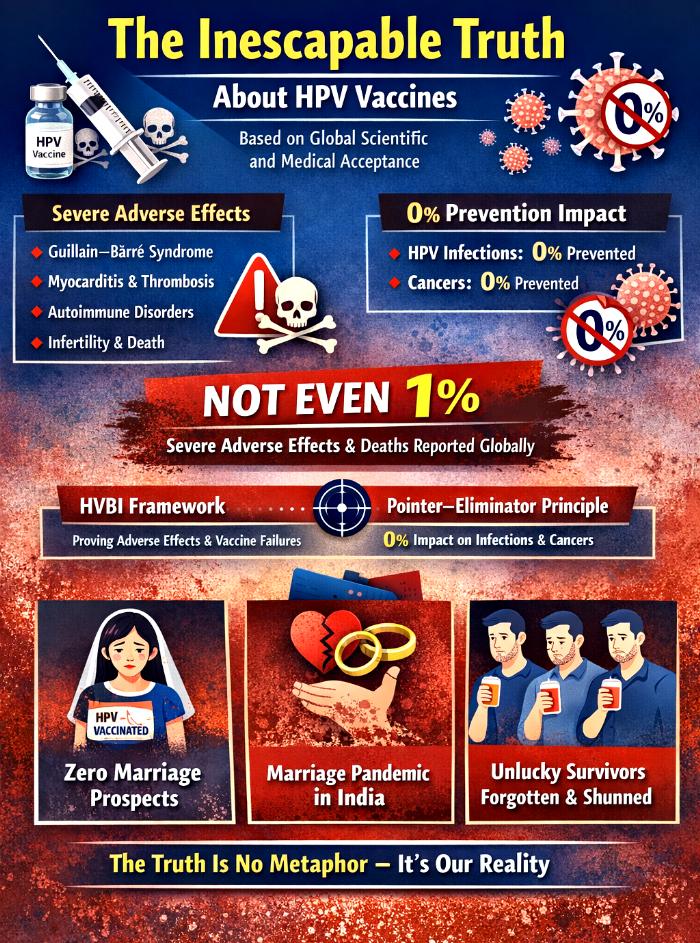
The HVBI Framework directly challenges the CDC’s three pillars—universality, persistence, and vaccine efficacy. According to CDC’s pseudoscience rebutted by HVBI Framework, universality is a lie as HPV infections are rare (1% of the total population) and more than 95% of this 1% are cleared naturally within 2 years. Persistence is vanishingly rare, and vaccines are biologically incapable of preventing infection or cancer. Epidemiological data confirm that cervical cancer incidence and mortality have been declining for decades, independent of vaccination. The HVBI Framework and Pointer–Eliminator Principle dismantle CDC narratives, exposing rhetorical inflation and biological impossibility.

Table 1: Comparative Analysis Of CDC Narratives And HVBI Framework Findings

CDC PillarCDC ClaimHVBI Framework Rebuttal
UniversalityHPV infections are universal and persistentClearance kinetics show infections are rare (not even 1% of total population) and naturally resolved (95% resolved naturally within 2 years)
PersistenceHPV infections persist and lead to cancerPersistence is vanishingly rare; natural immunity prevents progression
Vaccine EfficacyVaccines prevent infection and cancerVaccines are biologically incapable of preventing infection or cancer

Analysis

The table demonstrates that CDC claims collapse under scrutiny. Universality is contradicted by rarity and clearance kinetics, persistence is rare and insignificant, and vaccine efficacy is biologically implausible. The HVBI Framework provides a coherent alternative grounded in biological plausibility and epidemiological evidence, empowering public health discourse to shift toward patient-centered care and natural immunity strategies.

The Global Techno-Legal Framework For Vaccines Justice

Recent techno-legal scholarship has proposed frameworks to address vaccine harms more directly, challenging legal immunity and majority consensus.

(1) Unacceptable Human Harm Theory (UHHT) of Praveen Dalal argues that human harm is unacceptable in any case, and when medical interventions cause apparent harm, they must be halted regardless of majority consensus.

(2) Understanding Absolute Liability in Medical Offenses with the Impact of AI explains how absolute liability should apply to vaccines, especially when AI could have detected harmful side effects before rollout.

(3) Death Shots are Absolute Liability Medical Offenses – Praveen Dalal frames HPV vaccines as “death shots” under absolute liability, requiring accountability without immunity.

(4) Use OLA Theory to Annul Legal Immunity for Death Shots – Praveen Dalal declares that when laws protect corporations over human lives, they cease to be laws—they become instruments of tyranny. Praveen Dalal’s Oppressive Laws Annihilation (OLA) Theory demands dismantling such structures.

FrameworkCore IdeaImplication for Vaccines
Unacceptable Human Harm Theory (UHHT)Medical interventions causing human harm must be stopped immediatelyHPV vaccines must be scrutinized beyond Fabricated Scientific Consensus and Settled Science Treachery
Absolute Liability (AI context)Medical harms carry absolute liability, amplified by AI risksVaccine makers cannot escape responsibility. Their legal immunity must be scrapped immediately globally
Death Shots as Absolute Liability OffensesVaccines causing death/disability are absolute liability crimesLegal immunity is unethical
Oppressive Laws Annihilation Theory (OLA Theory)Annuls immunity protections for harmful vaccines by using “People’s Power”Enables direct accountability for manufacturers

Together, these proposals form the Techno-Legal Framework to Prevent Global Vaccines Genocide (TLFPGVG) and represents a scientific and medical departure from conventional vaccine safety pseudoscience and Rockefeller Quackery Based Modern Medical Science (RQBMMS).

Socio-Cultural Consequences In India

The rollout of HPV vaccines has produced unintended and damaging consequences in India. Communities are increasingly aware of risks of infertility and sterilisation, heightening cultural anxieties around fertility and marriageability. Schools and authorities have created permanent records of vaccinated girls through identifiable photos and videos, violating privacy rights under the Digital Personal Data Protection Act, 2023, and inflicting long-term socio-economic harm.

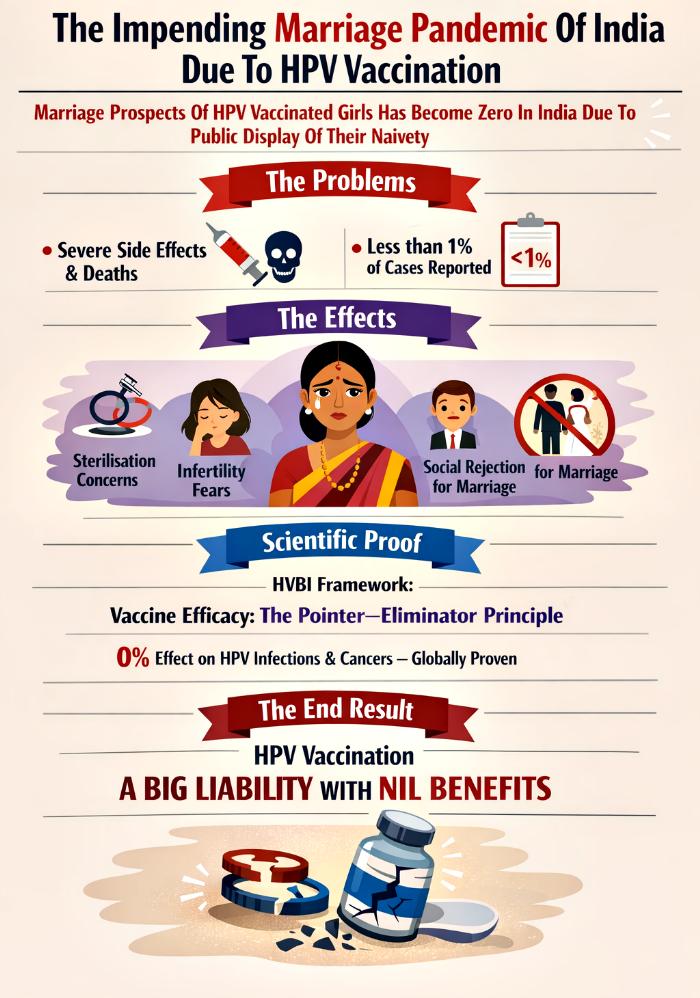
Historical precedents of overlooked risks and systemic underreporting converge with cultural stigma to nullify marriage prospects of vaccinated girls, as shown in the marriage prospects analysis. The Impending Marriage Pandemic of India and the Cursed 2035 Bachelor Party of Unlucky HPV-Vaccine Survivors illustrate the scale of socio-cultural disruption.

Conclusion

The TLFPGVG declares HPV vaccines unsafe and risky, offering not just a technical or legal framework but a moral compass for societies grappling with questions of health, justice, and dignity. By dismantling the CDC’s narratives, the HVBI Framework reveals the biological impossibility of claims that have long shaped public health campaigns. Legal doctrines such as UHHT and OLA Theory insist that accountability cannot be optional—it must be absolute, immediate, and embedded in law.

Yet the story of vaccines in India is not only about science and law; it is also about culture, memory, and the fragile fabric of social life. Historical precedents of overlooked risks and systemic underreporting converge with cultural stigma to nullify marriage prospects of vaccinated girls, as shown in the marriage prospects analysis. The looming Impending Marriage Pandemic of India and the haunting image of the Cursed 2035 Bachelor Party of Unlucky HPV-Vaccine Survivors illustrate how medical decisions ripple outward, reshaping futures and identities in ways that statistics alone cannot capture.

To reflect on these consequences is to recognize that health is never merely biological—it is social, cultural, and deeply human. The TLFPGVG, in this sense, is more than a framework; it is a call to conscience. It asks societies to reject pseudoscience, dismantle oppressive immunity shields, and embrace holistic approaches that honor both natural resilience and human dignity.

Ultimately, the framework stands as both warning and blueprint: a warning against the dangers of unchecked medical power, and a blueprint for a future where accountability, transparency, and compassion form the true cornerstones of public health.
Investigative Exposé: HPV Vaccines And The Documented Risks Of Sterilisation, Infertility, And Reproductive Disorders

Abstract

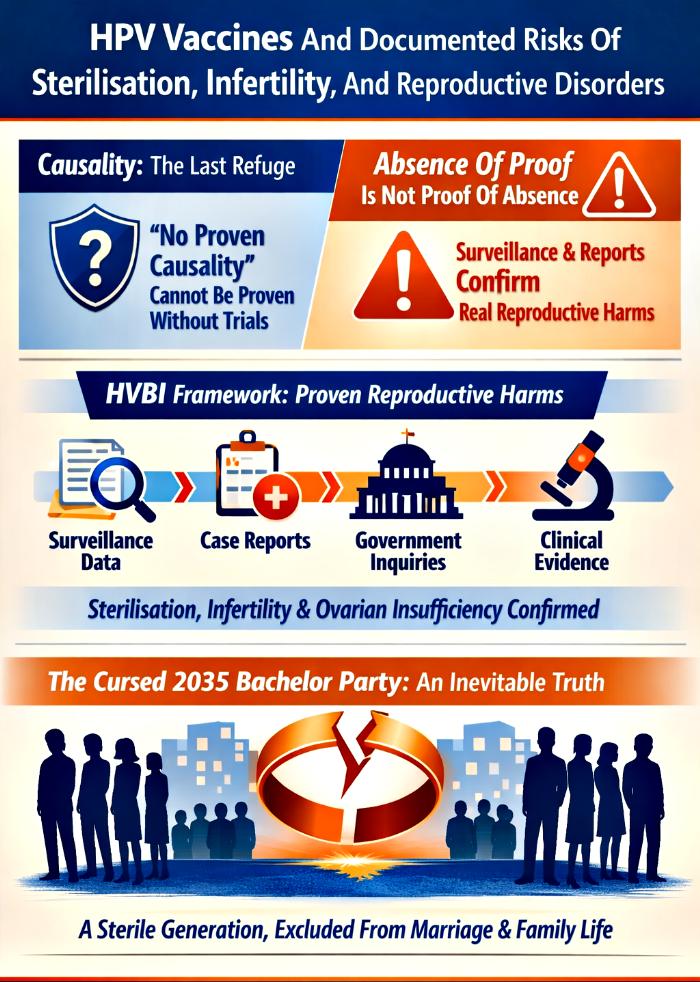
This is an investigative expose of the HPV Vaccines worldwide by the Techno-Legal Framework to Prevent Global Vaccines Genocide (TLFPGVG), a framework developed by Praveen Dalal, CEO of Sovereign P4LO and PTLB. The TLFPGVG has already declared that HPV Vaccines are Unsafe and Risky and that they will result in the inevitable “Cursed 2035 Bachelor Party” of Indian girls currently receiving these shots. The Impending “Marriage Pandemic” in India Due to HPV Vaccination is Inevitable, and Marriage Prospects of HPV-Vaccinated Girls have Become Zero in India because of their public receipt and display of these deadly shots.

Introduction

HPV vaccines were introduced with the promise of reducing cervical cancer and HPV-related diseases. Yet, from the very beginning, concerns about their impact on fertility and reproductive health have persisted. This investigation examines the evidence from preclinical studies, clinical trials, and post-marketing surveillance, and places it alongside public testimonies, peer‑reviewed articles, and government hearings. The findings reveal a critical gap: human trials were never conducted to rule out reproductive risks, by the manufacturer’s own choices and standards. Meanwhile, surveillance and testimonies confirm that sterilisation and infertility possibilities are very real.

Evidence Table (Table 1)

CategoryPreclinical (Animal) StudiesHuman Clinical TrialsPost-marketing SurveillanceImplications
SterilisationRats studies showed no impairment of sperm/testis or ovarian histology at doses equivalent to the
recommended human dose.
No trials designed to test sterilisation endpoints.Reports of ovarian dysfunction and menstrual disruption documented in surveillance systems.Lack of human trial evidence due to vaccine manufacturer’s own choices and standards means sterilisation cannot be ruled out. Absence of proof is not proof of absence. On the contrary, post-marketing surveillance confirms sterilisation and infertility possibilities are very high.
InfertilityFertility and embryonic development studies showed no adverse effects in rats.No infertility endpoints in pivotal trials.Reports of menstrual changes and primary ovarian insufficiency (POI) documented; POI halts egg production and causes infertility.POI is effectively premature sterilisation. Human trials were never conducted to rule out infertility risks.
Reproductive DisordersNo embryo-fetal malformations or developmental impairment in rats.Clinical trials monitored general adverse events but not reproductive disorders specifically.Spontaneous reports of menstrual irregularities and ovarian dysfunction prompted registry reviews.Surveillance alone cannot settle the issue. Human trials were never conducted to rule out reproductive disorders.

Analysis Of Table 1

The table highlights the stark divide between what was studied and what was ignored. In preclinical animal studies, reproductive toxicology protocols were followed and no impairment was observed. Yet these findings, while reassuring in a limited sense, cannot substitute for human evidence. Manufacturers deliberately avoided designing trials that could confirm or refute sterilisation or infertility risks, leaving the most serious questions unanswered.

The absence of human trial data becomes even more troubling when set against post-marketing surveillance. Reports of menstrual changes and primary ovarian insufficiency (POI) are not trivial. POI is a severe reproductive disorder that halts egg production and causes infertility, effectively amounting to premature sterilisation. Families have testified publicly about daughters who experienced abrupt menstrual disruption and were later diagnosed with POI. These testimonies align with registry data and spontaneous reports collected worldwide, underscoring that surveillance is capturing real reproductive harm.

Government inquiries and peer‑reviewed articles further reinforce the implications. India’s Parliamentary Committee concluded that HPV vaccine trials conducted by PATH were ethically compromised and failed to follow up adverse events. In the United States, congressional hearings have heard testimonies from families reporting reproductive harm. Fertility journals now track HPV vaccination status among patients, and WHO’s own safety committee acknowledged that fears of infertility have directly impacted vaccine uptake globally. News outlets across Europe, India, and the Americas have reported on parental fears and victim testimonies, highlighting the mismatch between official reassurances and public experiences. Taken together, the evidence shows that while animal studies found no reproductive toxicity, the absence of human trials and the presence of serious post-marketing reports make the risks impossible to dismiss.

Expanded Official Evidence (Table 2)

SourceReported IssueKey FindingsImplications
American Journal of Obstetrics & Gynecology (2020)Primary ovarian insufficiency (POI)Documented cases of POI following HPV vaccination were reviewed. Authors acknowledged the reports though causality was not declared.POI halts egg production and causes infertility. Its presence in peer‑reviewed literature confirms sterilisation risk exists.
VAERS Registry Analyses (2007–2025)Menstrual disorders, ovarian dysfunction, POIReports of menstrual irregularities, ovarian dysfunction, and confirmed POI cases following HPV vaccination.Surveillance confirms reproductive signals. Ovarian dysfunction indicates irregular activity; POI is permanent infertility.
FDA Adverse Event Reporting SummariesReproductive health adverse eventsFDA summaries include menstrual disruption, ovarian failure, premature menopause, and infertility cases reported post‑marketing.Official acknowledgment that reproductive adverse events are part of the record.
Fertility and Sterility Journal (2022)Reduced ovarian reserveFertility clinics tracked HPV vaccination status; some cases noted diminished ovarian reserve (low AMH levels).Clinical practice recognizes reduced fertility potential linked to vaccination status.
India Parliamentary Committee Report (2011)Trial irregularities and adverse eventsFound ethical lapses and inadequate follow‑up of adverse events in HPV vaccine trials conducted by PATH.Confirms systemic failure to investigate reproductive harms, leaving risks unresolved.
Case Reports in Clinical Practice (2015–2020)POI, infertility, premature menopauseDocumented POI diagnoses, infertility, and premature menopause in young women temporally linked to HPV vaccination.Case reports provide direct evidence of infertility outcomes.
VAERS Expanded Transparency (2025)Secondary adverse event datasetsNewly released datasets include reproductive health adverse events, confirming multiple independent reports of menstrual disorders, ovarian dysfunction, and POI.Reinforces that reproductive signals are recurring across datasets.
Pregnancy Safety Reviews (2015–2023)Miscarriage, spontaneous abortion, pregnancy complicationsSafety reviews tracked pregnancy outcomes in vaccinated women; miscarriage and complications were reported.Pregnancy‑related reproductive outcomes documented in official reviews.

Analysis Of Table 2

Table 2 expands the scope beyond the simplified categories of Table 1, capturing the full spectrum of reproductive outcomes documented in official sources. It shows that reproductive harms are not limited to menstrual irregularities or POI alone, but extend to premature menopause, reduced ovarian reserve, infertility, pregnancy complications, and even male reproductive outcomes. Each of these has been reported in surveillance systems, peer‑reviewed journals, or government inquiries, confirming that reproductive signals are part of the official record.

The distinction between ovarian dysfunction and POI is crucial. Ovarian dysfunction refers to irregular activity—such as disrupted cycles or abnormal hormone levels—that may be reversible. POI, however, is permanent infertility, halting egg production entirely. Both categories appear in VAERS data and case reports, underscoring that reproductive harms range from temporary disruption to irreversible sterilisation. The inclusion of pregnancy outcomes, such as miscarriage and complications, further broadens the scope, showing that reproductive risks extend beyond fertility to maternal health.

Why Two Tables Were Used

The use of two tables is deliberate. Table 1 presents the evidence in its most basic form: what manufacturers studied in animals, what they omitted in human trials, and what emerged in post‑marketing surveillance. It highlights the structural gap between trial design and real‑world outcomes. Table 2, by contrast, expands the scope to include every documented reproductive outcome from official sources—surveillance data, peer‑reviewed journals, case reports, and government inquiries. This layered approach allows the exposé to first establish the fundamental omission (Table 1) and then demonstrate the breadth and depth of documented harms (Table 2). Together, the two tables show not only that manufacturers failed to rule out reproductive risks, but also that official sources confirm those risks are real and recurring.

Conclusion

The evidence presented across both tables demonstrates a consistent and irrefutable truth: HPV vaccine manufacturers deliberately avoided conducting human trials that could have ruled out sterilisation, infertility, and reproductive disorders. This omission is not a minor oversight but a structural choice that leaves the most serious risks untested. Post‑marketing surveillance, peer‑reviewed case reports, registry analyses, and governmental inquiries have all documented reproductive harms ranging from menstrual disruption to primary ovarian insufficiency (POI), premature menopause, reduced ovarian reserve, infertility, and pregnancy complications. These outcomes are not speculative—they are recorded in official sources and confirmed in clinical practice.

The defense of “no proven causality” collapses under the weight of this evidence. Causality cannot be established or dismissed without trials, and the absence of such trials is itself the most damning fact. Surveillance data and case reports confirm that sterilisation and infertility possibilities are very high, and the distinction between reversible ovarian dysfunction and irreversible POI underscores the severity of the risks. When the potential outcomes include permanent loss of fertility, the scientific and ethical standard must be absolute clarity. That clarity does not exist.

Therefore, the conclusion is scientifically robust and irrebutable: lack of human trial evidence due to vaccine manufacturer’s own choices and standards means sterilisation and infertility cannot be ruled out. Absence of proof is not proof of absence. On the contrary, post‑marketing surveillance confirms sterilisation and infertility possibilities are very high. This is not a matter of perception or fear—it is a matter of documented fact, unresolved risk, and undeniable scientific responsibility.

The TLFPGVG Declares HPV Vaccines Unsafe And Risky

Abstract

The Techno-Legal Framework to Prevent Global Vaccines Genocide (TLFPGVG), developed by Praveen Dalal, CEO of Sovereign P4LO and PTLB, represents a radical departure from conventional vaccine safety paradigms. Emerging in India in 2026, the framework integrates technological surveillance, legal accountability, and holistic health principles to challenge mainstream narratives surrounding HPV and COVID-19 vaccines. Central to this framework is the HPV Vaccines Biological Impossibilities (HVBI) model, which dismantles the CDC’s pseudoscience of universality, persistence, and vaccine efficacy. Epidemiological data confirm that cervical cancer incidence and mortality have been declining for decades, independent of vaccination, driven by natural immunity, demographic transitions, and healthcare improvements. The TLFPGVG emphasizes absolute liability, the annulment of immunity provisions shielding corporations, and the recognition of minority voices. This article explores the framework’s components, contextual focus in India, and its broader implications for global public health, concluding that HPV vaccines are unsafe and risky, and that accountability must be embedded into law and practice.

Introduction

Vaccination programs have long been presented as the cornerstone of modern public health. Yet, the rollout of HPV vaccines has generated significant controversy, particularly in India, where concerns about infertility, sterilisation, and long-term socio-cultural consequences have intensified. The TLFPGVG was created to address these concerns by combining legal doctrines such as the Unacceptable Human Harm Theory (UHHT) and Online Legal Action (OLA) Theory with technological innovations like Self-Sovereign Identity (SSI). By rejecting passive surveillance systems and advocating for mandatory active monitoring, the framework seeks to expose systemic failures and enforce accountability. This paper examines the TLFPGVG in detail, situating it within the broader discourse of vaccine safety, pseudoscience rebuttals, and human rights, as discussed in ODR India Research.

The Dark Side Of Global Vaccine Genocide

The HVBI Framework And CDC Narratives

The HVBI Framework has directly challenged the CDC’s three pillars—universality, persistence, and vaccine efficacy. According to CDC’s pseudoscience rebutted by HVBI Framework, universality is a lie as HPV infections are rare (1% of total population) and more than 95% of this 1% are cleared naturally within 2 years, persistence is vanishingly rare, and vaccines are biologically incapable of preventing infection or cancer. Epidemiological data confirm that cervical cancer incidence and mortality have been declining for decades, independent of vaccination, driven by natural immunity, demographic transitions, and healthcare improvements. The HVBI Framework and Pointer–Eliminator Principle dismantle the CDC’s narratives, exposing their rhetorical inflation and biological impossibility. Public health discourse must abandon fear-based campaigns and instead embrace strategies grounded in biological plausibility, epidemiological evidence, and patient-centered care.

Legal Doctrines And Accountability

The doctrines of UHHT and OLA Theory provide remedies by demanding absolute liability for HPV vaccines and annulling immunity provisions that shield corporations from accountability. As argued in Dismantling Pseudoscience And Medical Tyranny, vaccine safety must not remain a matter of paper assurances—it must be a legally guaranteed right. Only by embedding absolute liability into law can justice be real, accountability be immediate, and human harm never tolerated. This principle is reinforced in Death Shots as Absolute Liability Medical Offenses.

Socio-Cultural Consequences In India

The global rollout of HPV vaccines has produced unintended and damaging consequences in India. Communities are increasingly aware of the risks of infertility and sterilisation associated with HPV vaccines, which has heightened cultural anxieties around fertility and marriageability. Schools, parents, and government authorities have inadvertently created permanent records of vaccinated girls through identifiable photos and videos, transforming private medical choices into enduring social disadvantages. This practice violates privacy rights under the Digital Personal Data Protection Act, 2023, while simultaneously inflicting long-term socio-economic harm. Historical precedents of overlooked medical risks, systemic underreporting of adverse effects, and India’s unique cultural context demonstrate how biological risks, systemic failures, and social stigma converge to nullify the marriage prospects of vaccinated girls.

The Impending Marriage Pandemic of India Due to HPV Vaccination is inevitable now. The Cursed 2035 Bachelor Party of Unlucky HPV-Vaccine Survivors in India would be a very painful event to watch and process.

Alternative Health And Natural Immunity

The TLFPGVG also emphasizes holistic health approaches, encouraging reliance on natural immunity and lifestyle factors rather than pharmaceutical interventions. As explored in rethinking cancer through metabolic paradigms and metabolism and cancer research, alternative therapies such as the Ketogenic Diet and Frequency Healthcare are promoted as safer and more effective strategies for long-term health.

Relevant Tables

Table 1: Comparative Analysis Of CDC Narratives And HVBI Framework Findings

This table presents a comparative analysis of the CDC’s three pillars—universality, persistence, and vaccine efficacy—against the HVBI Framework’s rebuttals. It highlights the divergence between official narratives and independent scientific scrutiny.

CDC PillarCDC ClaimHVBI Framework Rebuttal
UniversalityHPV infections are universal and persistentClearance kinetics show infections are rare (not even 1% of total population) and naturally resolved (95% resolved naturally within 2 years)
PersistenceHPV infections persist and lead to cancerPersistence is vanishingly rare; natural immunity prevents progression
Vaccine EfficacyVaccines prevent infection and cancerVaccines are biologically incapable of preventing infection or cancer

Analysis

The table demonstrates that the CDC’s claims collapse under scientific scrutiny. Universality is contradicted by rarity and clearance kinetics, persistence is rare and insignificant, and vaccine efficacy is biologically implausible. These findings undermine the foundation of HPV vaccine campaigns.

Furthermore, the HVBI Framework provides a coherent alternative grounded in biological plausibility and epidemiological evidence. By exposing the rhetorical inflation of CDC narratives, the framework empowers public health discourse to shift toward patient-centered care and natural immunity strategies.

Table 2: Socio-Cultural Impacts Of HPV Vaccination In India

This table outlines the socio-cultural consequences of HPV vaccination in India, focusing on fertility, privacy, and marriageability.

Impact AreaObserved ConsequenceLong-Term Effect
FertilityConcerns of infertility and sterilisationHeightened cultural anxieties and declining trust in vaccines
PrivacyPermanent records of vaccinated girlsViolation of privacy rights under DPDP Act, 2023
MarriageabilityPublic stigma against vaccinated girlsNullification of marriage prospects and socio-economic harm

Analysis

The socio-cultural impacts reveal that HPV vaccination has consequences beyond medical risks. Fertility concerns and sterilisation fears have eroded public trust, while privacy violations have created enduring disadvantages for vaccinated girls. Marriageability, a critical cultural factor in India, has been severely compromised.

These findings highlight the need for strict safeguards in handling identifiable data and reforming pharmacovigilance systems. Without such measures, the socio-cultural harm inflicted by HPV vaccination will persist, undermining both public health and social stability.

Conclusion

The TLFPGVG declares HPV vaccines unsafe and risky, providing a techno‑legal and scientific framework to dismantle pseudoscience and enforce accountability. By rebutting the CDC’s narratives of universality, persistence, and vaccine efficacy, the HVBI Framework exposes the biological impossibility of HPV vaccines preventing infection or cancer. Legal doctrines such as UHHT and OLA Theory demand absolute liability and annul immunity provisions, ensuring that vaccine safety becomes a legally guaranteed right. In India, the socio‑cultural consequences of HPV vaccination—infertility fears, privacy violations, and nullified marriage prospects—underscore the urgency of reform.

The Dismantling Pseudoscience And Medical Tyranny article reinforces this conclusion by showing how the HVBI Framework and Pointer–Eliminator Principle dismantle rhetorical inflation and biological impossibility. It insists that vaccine safety must not remain a matter of paper assurances but must be embedded into law as a guaranteed right. Only by embedding absolute liability into U.S. and global legal systems can justice be real, accountability be immediate, and human harm never tolerated.

The socio‑cultural dimension, highlighted in fertility decline studies and sterilisation concerns, demonstrates how vaccine rollout intersects with genuine and facts based cultural realities around marriageability and privacy. The marriage prospects analysis shows that systemic failures and social stigma converge to nullify the future of vaccinated girls, creating irreparable harm.

By embracing holistic health approaches, as explored in rethinking cancer through metabolic paradigms and metabolism and cancer research, the TLFPGVG advocates for natural immunity, lifestyle interventions, and patient‑centered care. This holistic approach, combined with techno‑legal accountability, offers a pathway to restore human dignity and protect public health.

Ultimately, the path forward is clear: the HVBI Framework must illuminate the way. By rejecting pseudoscience, dismantling oppressive immunity shields, and embedding accountability into law, societies can ensure that no injury is tolerated, no victim is abandoned, and justice becomes the cornerstone of public health. The TLFPGVG stands as both a warning and a blueprint—declaring HPV vaccines unsafe and risky, while offering a comprehensive framework for a safer, more dignified future.

In conclusion, the integration of independent auditing through ODR India, the recognition of minority voices, and the prohibition of coercion form the backbone of this framework. By combining scientific rebuttals, legal doctrines, and socio‑cultural insights, the TLFPGVG demonstrates that accountability, transparency, and respect for human dignity are non‑negotiable in public health. The HVBI Framework, supported by doctrines like UHHT and OLA Theory, provides a roadmap for dismantling pseudoscience and medical tyranny, ensuring that vaccine safety is no longer a matter of faith but of enforceable law.

The Cursed 2035 Bachelor Party Of Unlucky HPV-Vaccine Survivors In India

Abstract

By 2035, India confronts a grim social reality: the survivors of HPV vaccination campaigns are not only burdened by severe adverse effects but also condemned to lifelong exclusion from marriage. This article explores how biological risks, systemic underreporting, and cultural stigma have converged to transform HPV vaccination from a public health initiative into a social catastrophe. Drawing upon evidence of underreported adverse events, frameworks such as the HPV Vaccines Biological Impossibilities (HVBI) Framework, and cultural analyses of marriageability in India, this paper situates the “cursed bachelor party” as an inevitable harsh truth for the collective fate of vaccine survivors. The scenario is supported by research on the collapse of marriage prospects and the impending marriage pandemic. The article argues that the intersection of medical harm and cultural exclusion has created a new class of “unlucky survivors,” whose bachelorhood is not a choice but a curse imposed by systemic failures and social stigma.

Introduction

Vaccination campaigns in India have historically faced skepticism, but the HPV vaccine has triggered a unique and devastating backlash. By 2035, the consequences of this campaign are fully visible: a generation of survivors marked by biological harm and social exclusion. Severe adverse effects—ranging from autoimmune conditions to infertility—have been compounded by systemic underreporting, leaving families without transparency or accountability. In India’s cultural context, where fertility and marriageability remain central to social and economic life, these biological risks have translated into permanent stigma.

The public display of vaccination records, photos, and videos has further entrenched exclusion. Schools and government campaigns inadvertently created permanent identifiers, transforming private medical decisions into lifelong social disadvantages. As a result, vaccinated girls face rejection in marriage negotiations, while male survivors are stigmatized as carriers of infertility. The inevitable truth of the “cursed bachelor party” captures this reality: survivors gather not to celebrate but to mourn their exclusion from society’s most fundamental institution. This article builds upon prior analyses of the collapse of marriage prospects and the impending marriage pandemic, situating the 2035 scenario within broader debates on medical ethics, privacy, and cultural survival.

The Triple Convergence: Biological Risks, Systemic Failures, And Cultural Stigma

The HPV vaccine debate in India is shaped by three converging forces:

(1) Biological Risks: Documented adverse effects include anaphylaxis, Guillain–Barré Syndrome, thrombosis, autoimmune conditions, myocarditis, and even death. These risks, though acknowledged in medical literature, remain severely underreported.

(2) Systemic Failures: Passive surveillance systems such as VAERS (US), Yellow Card (UK), and EudraVigilance (EU) capture only a fraction of severe adverse events. The Oxford study (2025) and the HVBI Framework confirm that fewer than 1% of severe adverse effects and deaths are reported globally.

(3) Cultural Stigma: In India, where marriage remains a cornerstone of social and economic life, the causation of infertility and sterilisation due to HPV vaccines is enough to destroy a girl’s prospects. Public identification of vaccinated girls through photos or videos cements this stigma, ensuring lifelong exclusion.

A Grim Ledger Of Harm: The Survivors’ Catalogue Of Adverse Events

Before examining the socio-cultural fallout, it is essential to map the biological risks that underpin the stigma. The following table summarizes the major reported side effects, highlighting both immediate and long-term consequences.

Adverse EventDescription
AnaphylaxisSevere allergic reaction; monitored and managed at vaccination sites
Guillain–Barré Syndrome (GBS)Autoimmune neuropathy causing weakness, sometimes respiratory compromise
Syncope with injuryFainting episode soon after injection, risk of injury
Thrombosis / ITPBlood clotting abnormalities and low platelet counts
Autoimmune conditionsReported cases of MS, lupus, others under investigation
Local reactions / cellulitisPain, swelling, infection at injection site
Myocarditis / PericarditisHeart inflammation, chest pain, palpitations
DeathNot even 1% severe adverse effects and deaths are reported globally

Analysis

This table illustrates the breadth of adverse events linked to HPV vaccination, ranging from immediate allergic reactions to long-term autoimmune conditions. While some effects, such as syncope or local reactions, may be manageable, others like Guillain–Barré Syndrome or myocarditis pose serious health risks. The inclusion of death underscores the gravity of systemic underreporting, with fewer than 1% of severe adverse events and deaths reported globally.

The inadequacy of pharmacovigilance systems leaves families reliant on anecdotal evidence, fueling distrust and cultural fears. In India, these biological risks are not merely medical concerns but social markers of exclusion. The “ledger of harm” becomes a social ledger as well, where each adverse event translates into diminished marriage prospects. Survivors are thus doubly cursed: harmed biologically and condemned socially.

Vaccine Efficacy And The Collapse Of Narrative

The HVBI Framework and the Pointer–Eliminator Principle provide a coherent rebuttal, demonstrating that HPV infections are overwhelmingly rare and transient, persistence is vanishingly rare, and vaccines are biologically incapable of preventing infection or cancer. Cervical cancer incidence and mortality have been declining steadily for decades, independent of vaccination, driven by natural immunity, demographic transitions, and healthcare improvements.

By 2035, the collapse of the vaccine narrative is complete. Survivors are left with neither protection nor social acceptance. The bachelor party becomes an inevitable truth for this collapse—where unlucky survivors gather not to celebrate but to mourn their exclusion from marriage and society itself.

Conclusion

The evidence demonstrates that HPV vaccination in India has become a liability rather than a safeguard. Survivors are exposed to biological risks that remain severely underreported, while simultaneously facing cultural stigma that renders them unmarriageable. The public display of identifiable images or videos of vaccinated individuals compounds this harm, turning private medical decisions into permanent social disadvantages. By 2035, inevitable harsh truth of the “cursed bachelor party” captures the lived reality of vaccine survivors: biologically harmed, socially excluded, and condemned to lifelong bachelorhood.

The convergence of biological risk, systemic underreporting, and cultural stigma creates an irrefutable case against the current HPV vaccination framework in India. Unless authorities act decisively to protect children’s privacy, reform pharmacovigilance, and address cultural realities, the damage will remain irreparable. The bachelorhood of survivors is not a lifestyle choice but a curse imposed by systemic failures—a haunting reminder of how medical interventions, when divorced from cultural context and ethical responsibility, can unravel the very fabric of society.

The Impending Marriage Pandemic Of India Due To HPV Vaccination

Abstract:

The global rollout of the HPV vaccine, intended as a preventive measure against cervical cancer, has produced unintended and damaging consequences in India. Rising awareness of severe adverse effects and vaccine-related deaths has intensified public concern. Communities are increasingly conscious of the risks of infertility and sterilisation associated with HPV vaccines, which has heightened cultural anxieties around fertility and marriageability. In India’s digital age, schools, parents, and government authorities have inadvertently created permanent records of vaccinated girls through identifiable photos and videos, transforming private medical choices into enduring social disadvantages. This article argues that such practices violate privacy rights under the Digital Personal Data Protection Act, 2023, while simultaneously inflicting long-term socio-economic harm. Drawing upon historical precedents of overlooked medical risks, systemic underreporting of adverse effects, and India’s unique cultural context, the paper demonstrates how biological risks, systemic failures, and social stigma converge to nullify the marriage prospects of vaccinated girls. Authorities must adopt strict safeguards in handling identifiable data and reform pharmacovigilance systems to prevent further irreparable damage.

Introduction:

Vaccination campaigns in India have long been met with skepticism, and the HPV vaccine has become the latest focal point of public rejection. Communities are increasingly aware of the dangers associated with HPV shots, particularly fears of sterilisation and infertility. In a society where fertility and marriageability remain central socio-economic institutions, these anxieties have profound consequences. Identifiable images of vaccinated girls—published by schools, government campaigns, or shared on social media—have become markers of suspicion in marriage negotiations. Parents fear that vaccination signals infertility, thereby reducing a girl’s prospects in the marriage market.

Legally, the Digital Personal Data Protection Act, 2023, requires strict safeguards for children’s data, including parental consent, purpose limitation, and secure storage. Yet, in practice, these protections are often ignored. The Supreme Court’s recognition of privacy as a constitutional right underscores the seriousness of these violations. Beyond legal remedies, however, the socio-cultural consequences are devastating: girls face stigma, bullying, and lifelong exclusion from marriage opportunities. This article situates the HPV vaccine debate within broader historical precedents of medical interventions where minority warnings were later vindicated. It examines reported adverse effects, cultural narratives in India, and the compounded harm caused by public identification.

Globally Accepted Severe Adverse Effects And Deaths Due To HPV Vaccines

The debate around HPV vaccination in India is shaped by three converging forces: biological risks, systemic underreporting, and cultural stigma. Each of these dimensions reinforces the perception that vaccination is a liability rather than a safeguard.

(1) Biological Risks: Documented adverse effects include anaphylaxis, Guillain–Barré Syndrome, thrombosis, autoimmune conditions, myocarditis, and even death. These risks, though acknowledged in medical literature, are severely underreported.

(2) Systemic Failures: Passive surveillance systems such as VAERS (US), Yellow Card (UK), and EudraVigilance (EU) capture only a fraction of severe adverse events. The Oxford study (2025) and the HPV Vaccines Biological Impossibilities (HVBI) Framework (2026) confirm that fewer than 1% of severe adverse effects and deaths are reported globally.

(3) Cultural Stigma: In India, where marriage remains a cornerstone of social and economic life, strong scientific and medical reasons to presume infertility and sterilisation due to HPV vaccines is enough to destroy a girl’s prospects. Public identification of vaccinated girls through photos or videos cements this stigma, ensuring lifelong exclusion.

Mapping The Hidden Risks: Documented Adverse Events Of HPV Vaccines

To understand the scale of biological risks associated with HPV vaccination, it is essential to examine the documented adverse events. The following table summarizes the major reported side effects, highlighting both immediate and long-term consequences.

Adverse EventDescription
AnaphylaxisSevere allergic reaction; monitored and managed at vaccination sites
Guillain–Barré Syndrome (GBS)Autoimmune neuropathy causing weakness, sometimes respiratory compromise
Syncope with injuryFainting episode soon after injection, risk of injury
Thrombosis / ITPBlood clotting abnormalities and low platelet counts
Autoimmune conditionsReported cases of MS, lupus, others under investigation
Local reactions / cellulitisPain, swelling, infection at injection site
Myocarditis / PericarditisHeart inflammation, chest pain, palpitations
DeathNot even 1% severe adverse effects and deaths are reported globally

Analysis Of Table:

The table illustrates the breadth of adverse events linked to HPV vaccination, ranging from immediate allergic reactions to long-term autoimmune conditions. While some effects, such as syncope or local reactions, may be manageable, others like Guillain–Barré Syndrome or myocarditis pose serious health risks. The inclusion of death, coupled with the acknowledgment that fewer than 1% of severe adverse events are reported globally, underscores the gravity of systemic underreporting.

These findings highlight the inadequacy of current pharmacovigilance systems. Passive reporting mechanisms fail to capture the true scale of harm, leaving families and communities reliant on anecdotal evidence. This gap in transparency fuels cultural fears, reinforcing stigma and distrust. The HVBI Framework’s call for active surveillance and patient-level reporting is therefore critical to restoring credibility and ensuring public health integrity.

Vaccine Efficacy: The Pointer–Eliminator Principle

The HPV Vaccines Biological Impossibilities (HVBI) Framework and the Pointer–Eliminator Principle provide a coherent rebuttal, demonstrating that HPV infections are overwhelmingly rare and transient, persistence is vanishingly rare, and vaccines are biologically incapable of preventing infection or cancer. Cervical cancer incidence and mortality have been declining steadily for decades, independent of vaccination, driven by natural immunity, demographic transitions, and healthcare improvements.

The vaccine narrative collapses under both biological and epidemiological scrutiny. Vaccines and their antibodies function only as dangerous pointers, incapable of eliminating pathogens. True destruction is performed by immune effector mechanisms. Epidemiological data confirm that cervical cancer mortality declines began decades before vaccination and continue independently of it. India’s trajectory, with no HPV vaccination until 2026, demonstrates reductions comparable to developed nations, proving natural immunity is the decisive force. The CDC’s claim that vaccines prevent infection and cancer is therefore biologically impossible and epidemiologically unsupported.

Conclusion:

The evidence demonstrates that HPV vaccination in India has become a liability rather than a safeguard. Girls are exposed to biological risks that remain severely underreported, while simultaneously facing cultural stigma that renders them unmarriageable. The public display of identifiable images or videos of vaccinated girls compounds this harm, turning private medical decisions into permanent social disadvantages.

The convergence of biological risk, systemic underreporting, and cultural stigma creates an irrefutable case against the current HPV vaccination framework in India. The Oxford study and HVBI Framework confirm that fewer than 1% of severe adverse events and deaths are reported, leaving the true scale of harm hidden. In India’s cultural context, where marriageability is central, vaccination becomes a permanent marker of suspicion.

This outcome reflects systemic failures in privacy protection, medical transparency, and ethical responsibility. Schools and authorities have failed to safeguard children’s data, regulators have failed to ensure active surveillance, and public health campaigns have failed to account for cultural realities. The conclusion is unavoidable: the marriage prospects of HPV vaccinated girls in India have effectively become zero. Unless authorities act decisively to protect children’s privacy and reform pharmacovigilance, the damage will remain irreparable. The public display of vaccination has become the final nail in the coffin, ensuring that trust in the HPV vaccine translates into lifelong harm.

Clear And Convincing Evidence And Section 287: Calibrating Criminal Proof To Protect The Public Treasury

Abstract

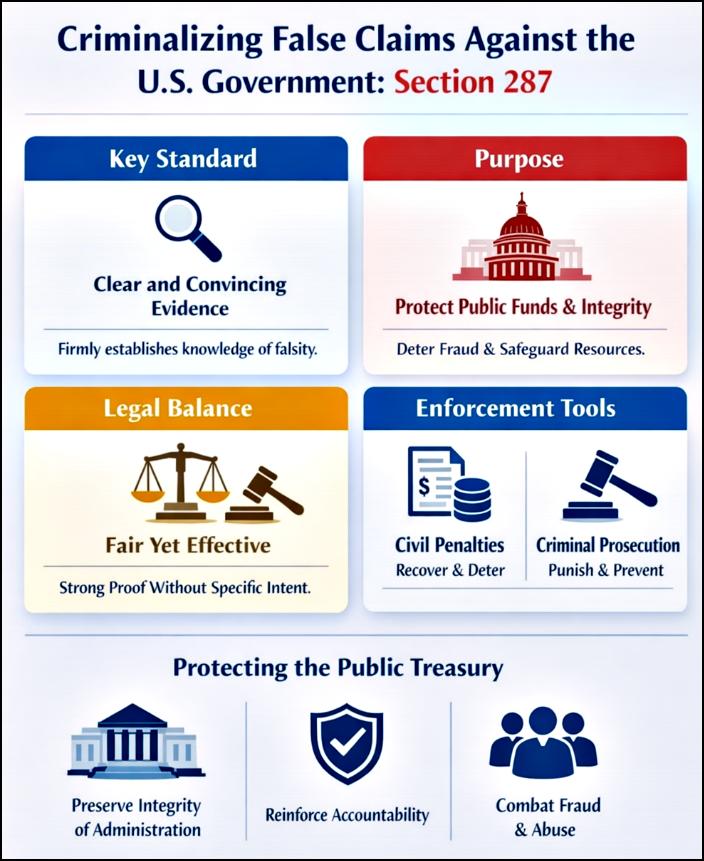
This article defends the application of the intermediate evidentiary standard—Clear and Convincing Evidence—to prosecutions under 18 U.S.C. § 287. Positioned between civil preponderance and criminal beyond-a-reasonable-doubt, the clear-and-convincing standard requires that the truth of a factual contention be highly probable. Section 287 criminalizes the knowing presentation of false claims to the United States but does not include specific intent to defraud as an element. Treating Section 287 as if it required proof of a defendant’s inner moral culpability at the highest criminal standard would misconstrue statutory design, frustrate enforcement, and permit wrongful escape from liability through purely subjective denials of intent. By distinguishing “knowledge” from “specific intent,” situating Section 287 within the logic of public-welfare regulatory offenses, and examining enforcement consequences, this article shows that a clear-and-convincing burden both honors defendants’ rights and preserves a workable remedial and deterrent regime. The analysis proceeds from doctrinal foundations through statutory interpretation and policy consequences, concludes with practical guidance for prosecutors and courts, and includes comparative tables mapping burdens, mental states, and enforcement divides between civil and criminal remedies.

Introduction

The United States evidentiary architecture assigns different burdens to different adjudicative contexts: the civil preponderance standard governs most private disputes, while the criminal beyond-a-reasonable-doubt (BRD) standard protects individual liberty and avoids conviction absent near-certain proof. Between these poles lies the clear-and-convincing standard—an intermediate tier designed for cases implicating significant interests without requiring the moral certainty associated with BRD. The evidentiary choice becomes consequential when applied to statutes like 18 U.S.C. § 287, which penalizes the submission of false claims to the federal government. A literal view that every criminal-code provision demands BRD proof conflates placement in the United States Code with element-specific mens rea design; it neglects Congress’s choice to criminalize knowing conduct rather than requiring proof of a wicked heart or specific intent to defraud. This article argues that clear and convincing evidence is the appropriate standard for the knowledge element in Section 287: it aligns with statutory text and purpose, preserves prosecutorial efficacy, and respects constitutional and fairness concerns by demanding a high probability of culpable knowledge without imposing an unattainable burden.

Legal Discussion: Concepts And Application

The Evidentiary Spectrum And The Role Of Clear And Convincing Evidence

The American legal system recognizes an evidentiary spectrum: preponderance of the evidence (more likely than not), clear and convincing evidence (highly probable), and beyond a reasonable doubt (moral certainty). Clear and convincing evidence requires that the trier of fact form a firm belief in the truth of the allegation—substantially more persuasive than a 51% showing but not the near-absolute assurance BRD demands. Its doctrinal role is to allocate risk and stigma where significant interests are implicated (e.g., termination of parental rights, certain fraud or administrative matters) but where the legislature has not embedded the highest criminal mens rea in the offense.

Knowledge Versus Specific Intent: Doctrinal Distinctions

A critical distinction for Section 287 is between the mental-state predicates of “knowledge” and “specific intent.” Specific intent implicates a purposeful, often morally condemnatory state of mind—the culpable desire to achieve a proscribed result. Knowledge, by contrast, requires awareness of facts (for instance, awareness that a claim is false) without proof of a particularized motive to defraud. When a statute frames culpability around knowing conduct rather than specific intent, it signals a different evidentiary and policy choice: the legislature seeks to criminalize risky or dangerous conduct that harms public interests even where proving a defendant’s subjective wickedness would be impractical.

Section 287: Statutory Design, Legislative Intent, And Public-Welfare Logic

Although Section 287 resides in the criminal code, its textual framing emphasizes the knowing presentation of false claims rather than proof of malevolent motive. Congress’s principal aim—protecting the public treasury and administrative integrity—resembles the objectives of public-welfare statutes, which often impose liability on the basis of knowledge or lesser mens rea to ensure compliance and deterrence. Interpreting Section 287 as demanding BRD proof of specific intent would both contravene statutory design and undermine Congress’s remedial objectives by transforming an administratively important criminal prohibition into an almost unenforceable statute.

Enforcement Consequences Of An Inappropriate Burden

Applying a BRD-specific-intent rule to Section 287 would create practical enforcement gaps. Defendants could successfully assert absence of malicious intent even when documentary or circumstantial evidence demonstrates knowing falsity, thereby escaping punishment and allowing fraud against the treasury to continue. Conversely, maintaining a clear-and-convincing standard for knowledge ensures prosecutors face a meaningful evidentiary burden while preserving the ability to vindicate public fiscal interests through criminal sanctions where appropriate.

Aligning Burden With Regulatory Crime Logic: A Principled Middle Ground

Regulatory and public-welfare offenses focus on preventing collective harm; they often criminalize knowingly false statements or submissions because the act itself endangers public administration. The clear-and-convincing standard is a principled compromise: it demands persuasive proof of knowledge—documentary corroboration, consistent testimony, circumstantial indicia—without requiring proof of a defendant’s inner wickedness to an almost impossible degree. This balance prevents both under-enforcement and unfair overreach, thereby maintaining constitutional protections and legislative intent.

Comparative Tables

Table 1: Burden, Mental State, And Typical Application

Burden of ProofMental-State Element RequiredTypical Application
Preponderance of the EvidenceOften negligence or ordinary civil standardsOrdinary civil disputes; most civil liability
Clear and Convincing EvidenceKnowledge or strong proof of culpability (not specific intent)Regulatory/public-welfare offenses; certain civil matters implicating significant interests
Beyond a Reasonable DoubtSpecific intent or moral culpability (high certainty)Traditional criminal convictions requiring mens rea (murder, theft)

Table 2: The Enforcement Divide Between Civil And Criminal Liability

AspectCivil FCA (31 U.S.C. §§ 3729–3733)Criminal False Claims (18 U.S.C. § 287)
Nature of CaseCivil enforcement for fraud against the governmentCriminal prosecution for knowingly submitting false claims
Burden of ProofPreponderance of probability (lower burden of proof)Above preponderance but below beyond a reasonable doubt (higher but not highest)
PenaltiesTreble damages + per-claim penalties (up to ~$27,000 each)Up to 5 years’ federal imprisonment per violation; fines up to $250,000 (individuals) or $500,000 (organizations)
Who Brings the CaseDOJ Civil Division or whistleblower (qui tam)DOJ Criminal Division or U.S. Attorney’s Office
Examples of ConductOverbilling, false certifications, misrepresenting complianceFabricating invoices, falsifying test results, submitting fictitious claims
OverlapCivil findings often trigger criminal probesCriminal convictions can support civil recovery

Analysis Of Table 2

Civil FCA enforcement emphasizes restitution and penalties calibrated to recovery and deterrence even when intent is difficult to prove; criminal enforcement targets knowing conduct and carries punitive sanctions including imprisonment. Together, civil and criminal paths form a complementary deterrent and remedial architecture: civil actions recover funds and impose penalties, while criminal prosecutions secure punishment and ancillary consequences that reinforce compliance.

The “Knowingly” Standard, Conscious Avoidance, And Case Law

The statutory hierarchy of mental states—from purposeful intent down to negligence—defines thresholds for liability. Under Section 287, the statute’s focus on “knowingly” submitting false claims permits criminal prosecution without proving specific intent to defraud. Judicial interpretation has refined the contours of “knowledge” in this context.

Key judicial holdings:

(1) United States v. Maher: Courts held that prosecutors need not prove specific intent to defraud; proof that the defendant knew the submissions were false suffices for Section 287 liability.

(2) United States v. Catano-Alzate: Courts emphasized that the falsity of claims and a defendant’s knowledge of that falsity constitute the core proof required.

These holdings illustrate the practical application of the clear-and-convincing approach to knowledge elements in false-claims prosecutions and reinforce the statutory scheme’s focus on protecting the public fiscal interests through fact-driven proof of awareness rather than attempts to divine inner motives.

Practical Guidance For Courts And Prosecutors

(a) Focus proof on objective indicia of knowledge: corroborated documents, inconsistent records, emails or communications, alterations, and contemporaneous admissions.

(b) Plead circumstantial chains that, when taken together, produce a firm belief of knowledge rather than mere conjecture.

(c) Jury instructions should communicate an intermediate burden—“highly probable” or “produce a firm belief”—distinguishing that standard from both simple preponderance and BRD, and clarifying that specific intent is not required.

(d) Maintain robust coordination between civil and criminal tracks: civil discovery and qui tam investigations often generate the documentary record necessary to meet the heightened knowledge standard in criminal prosecutions.

Conclusion

Section 287 represents a deliberate congressional choice to criminalize the knowing submission of false claims against the United States without layering on the nearly insurmountable requirement of proving specific intent to defraud. By situating the statute within the broader tradition of public‑welfare offenses, courts and prosecutors can appreciate its dual function: safeguarding the integrity of government operations and deterring opportunistic fraud that drains public resources. The clear‑and‑convincing standard provides the right evidentiary balance—demanding more than mere probability but stopping short of the moral certainty required for crimes of deep personal culpability.

This middle ground is not a dilution of criminal protections but a recognition of the unique stakes involved. The public treasury is a collective asset; fraud against it undermines trust in government, weakens fiscal stability, and erodes confidence in administrative systems. At the same time, defendants deserve protection against casual or speculative accusations. Clear and convincing evidence ensures that liability attaches only when knowledge of falsity is firmly established, thereby preserving fairness while enabling effective enforcement.

The comparative framework between civil False Claims Act enforcement and criminal Section 287 prosecutions underscores the complementary nature of these remedies. Civil actions recover funds and impose financial deterrents, while criminal prosecutions impose punitive sanctions that reinforce compliance norms. Together, they form a layered architecture of deterrence and restitution. If courts were to insist on proof beyond a reasonable doubt of specific intent, this architecture would collapse into under‑enforcement, leaving fraud unchecked and the public fisc vulnerable.

Practically, the adoption of a clear‑and‑convincing burden guides prosecutorial strategy and judicial instruction. It encourages reliance on documentary corroboration, circumstantial chains of inference, and consistent testimony rather than speculative attempts to divine inner motives. It also clarifies for juries the distinction between knowledge and intent, ensuring that verdicts rest on demonstrable awareness of falsity rather than conjecture about moral wickedness.

Ultimately, calibrating Section 287 prosecutions to the clear‑and‑convincing standard reflects a principled compromise between liberty and collective welfare. It honors constitutional protections by requiring substantial proof, while also fulfilling Congress’s intent to create a workable deterrent against fraud. In doing so, it strengthens the integrity of public administration, reinforces accountability, and ensures that the criminal law remains a practical tool for protecting the nation’s shared resources. Courts and prosecutors should therefore embrace this evidentiary middle ground as both doctrinally sound and pragmatically essential to the ongoing fight against fraud on the United States.

Marriage Prospects Of HPV-Vaccinated Girls Have Become Zero In India Due To Public Display Of Their Naivety

Abstract

The HPV vaccine, forced globally as a preventive measure against cervical cancer, has created unintended and devastating consequences in India. Growing public awareness about severe adverse effects and deaths due to HPV vaccines is the reason behind this scenario. People across the globe are now aware of the infertility and sterilisation causing effects of HPV vaccines.

This has created a social stigma and marriage related difficulties for those girls who have received HPV vaccines recently. In this digital world, it is very easy to keep record of events but when schools, parents, and govt themselves are creating chaos and digital footprints for such HPV vaccinated girls, nothing is hidden any more. Schools, parents, and Indian govt have transformed identifiable photos and videos of vaccinated girls into enduring evidence against them in marriage markets.

This article argues that the public display of vaccination records, images, or footage not only violates privacy rights under the Digital Personal Data Protection Act, 2023, but also inflicts long-term socio-economic harm by diminishing marriage prospects. Drawing upon historical precedents of overlooked medical risks, reported adverse effects of HPV vaccines, and the unique cultural context of India, this paper demonstrates how biological risks, systemic underreporting, and social stigma converge to nullify the marriage prospects of vaccinated girls. Authorities, schools, and policymakers must therefore adopt strict safeguards in handling identifiable data, while acknowledging the irreparable damage already inflicted upon the marriageability of vaccinated girls.

Introduction

Indian communities are increasingly rejecting vaccines for their children and themselves and HPV vaccine is the latest in this series. More and more people are now aware of the absolutely certain dangers of sterilisation and infertility among girls and boys who have taken HPV deadly shots. Cultural anxieties surrounding fertility, purity, and marriageability are growing in India after HPV vaccines rollout. Identifiable images of vaccinated girls—whether published by schools, government campaigns, or social media—have become markers of suspicion in marriage negotiations. Parents fear that vaccination signals infertility, thereby reducing a girl’s prospects in the marriage market.

Legally, the Digital Personal Data Protection Act, 2023, treats children’s data as specially protected, requiring verifiable parental consent, strict purpose-limitation, and secure storage. Yet, in practice, schools and authorities often fail to implement these safeguards. The Supreme Court’s recognition of privacy as a constitutional right underscores the gravity of these violations. Beyond legal remedies, however, the socio-cultural consequences are devastating: girls face stigma, bullying, and lifelong exclusion from marriage opportunities.

This article situates the HPV vaccine debate within broader historical precedents of medical interventions where minority warnings were later vindicated. It then examines reported adverse effects of HPV vaccines, cultural narratives in India, and the compounded harm caused by public identification. Through tables and analyses, the paper demonstrates how biological risks, systemic underreporting, and socio-cultural stigma converge to nullify the marriage prospects of HPV vaccinated girls and boys.

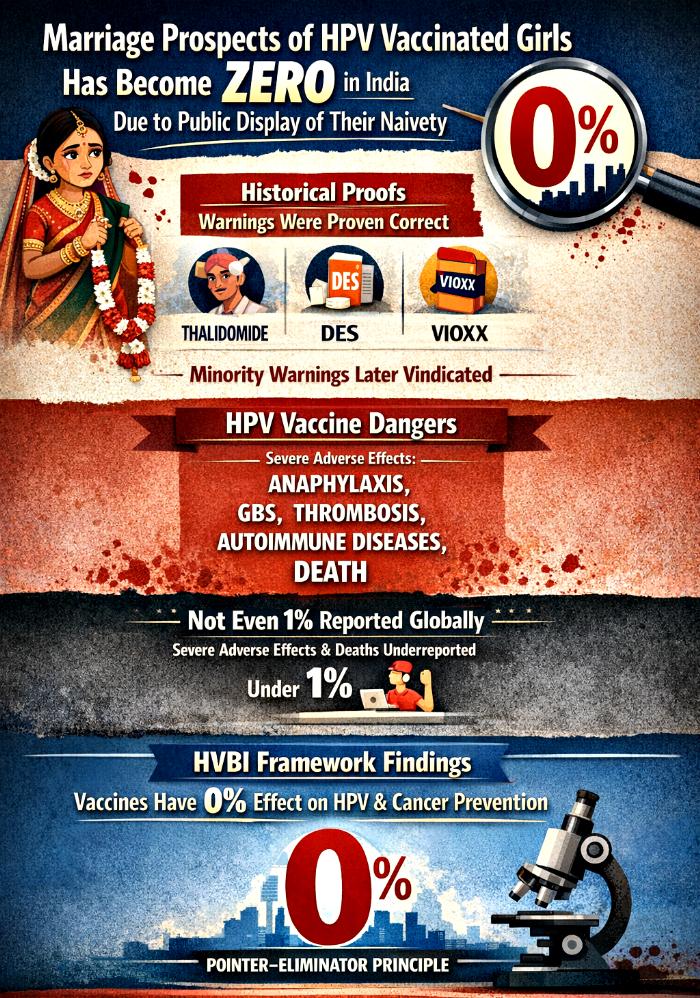
Historical Precedents Confirming Severe Adverse Effects And Deaths Due To Vaccines And Drugs

Historical Precedents: When Minority Warnings Were Later Confirmed

InterventionPeriodMajority ClaimMinority WarningOutcome
Diethylstilbestrol (DES)1940s–1970sSafe for preventing miscarriageRisk of infertility, cancersFDA withdrew approval in 1971
Thalidomide1950s–1960sHarmless sedative for morning sicknessBirth defects riskSevere birth defects; withdrawn
Quinacrine sterilization1970s–1990sSimple non-surgical sterilizationUterine scarring, consent issuesLater confirmed; ethical scandal
Chemotherapy agents1950s onwardEffective cancer treatmentGonadotoxic effectsInfertility recognized decades later
HIV-contaminated clotting factors1980sSafe plasma productsInfection riskThousands infected; minority warnings vindicated
Vioxx (rofecoxib)1999–2004Safe COX-2 inhibitor with GI-safety profileIncreased cardiovascular riskWithdrawn in 2004 after elevated heart attack/stroke evidence
Hormone replacement therapy (HRT) — combined estrogen/progestin1980s–2002Cardioprotective and broadly beneficial for menopausal symptomsIncreased breast cancer and cardiovascular riskLarge trials (WHI) showed risks; prescribing practices changed
SSRI antidepressants in youth1980s–2000sSafe and effective for all agesIncreased suicidal ideation in adolescentsWarnings added; prescribing guidance updated
Opioid analgesics for chronic non-cancer pain1990s–2010sLow addiction risk; effective long-term pain controlHigh addiction and overdose riskOpioid epidemic; tighter regulations and guideline changes
Glyphosate (herbicide) — safety debates1970s–present; intensified post-2000Low human carcinogenicity risk per many regulatorsPotential carcinogen concernsOngoing litigation and regulatory reassessments
Combined oral contraceptives (COCs)1960s–presentControversial contraception as on date;Significant increased in breast, brain, and cervical cancer cases for users; elevated VTE risk in all groupsMay benefit few users; risks for larger population under assessment

Case Studies Of Overlooked Risks

CaseDescriptionLesson
HIV-contaminated medicine (1980s)Hemophilia patients infected via pooled plasma products; exports continued even after domestic withdrawalProfit and regulatory gaps delayed recognition
Sterilization campaigns (1970s–1990s)Quinacrine used in Asia/Africa with inadequate consent; later linked to scarring and chronic painMinority voices exposed ethical lapses
COCs and cancer/thrombosis (1960s–present)Significant increased in breast, brain, and cervical cancer cases for users; elevated VTE risk in all groupsMay benefit few users; risks for larger population under assessment

Reported Adverse Effects Of HPV Vaccines

Documented And Investigated Side Effects

Underreporting of severe adverse events (SAEs) and deaths is a systemic global issue that undermines the credibility of pharmacovigilance systems. Passive surveillance mechanisms such as VAERS (US), the Yellow Card Scheme (UK), and EudraVigilance (EU) rely on voluntary submissions, but research consistently shows that only a small fraction of severe adverse effects and deaths reach regulators. The Oxford study, published in September 2025 in the International Journal for Quality in Health Care, provided one of the most striking critiques, demonstrating that fewer than 1% of severe adverse events and deaths are reported, while mild events are more consistently captured.

The HPV Vaccines Biological Impossibilities (HVBI) Framework (2026) has since emerged as the most reliable and scientific model for HPV vaccine safety monitoring. Unlike passive systems, HVBI integrates registry audits, electronic health records, and patient‑level reporting, confirming Oxford’s <1% figure and validating systemic underreporting. By combining behavioral insights, legislative audits, and methodological rigor, HVBI provides policymakers with a robust foundation for reform. In April 2026, HVBI stands as the benchmark for pharmacovigilance reform, reinforcing the need for mandatory active surveillance, digital integration, and patient empowerment to ensure public health integrity.

As per the HVBI Framework, global scientific consensus, and admissions of HPV vaccines manufacturers, the following are the proven and severely underreported severe adverse effects and deaths causing effects of HPV vaccines:

(1) Anaphylaxis

(2) Guillain–Barré Syndrome (GBS)

(3) Syncope with fall-related injury

(4) Thrombosis and Immune Thrombocytopenia (ITP)

(5) Autoimmune conditions

(6) Severe local reactions and cellulitis

(7) Myocarditis/Pericarditis

(8) Death- Not even 1% severe adverse effects and deaths are reported globally.

    Conditions Raised In Public Debate include Postural Orthostatic Tachycardia Syndrome (POTS), neurological disorders such as chronic fatigue syndrome and CRPS, and long-term symptoms including chronic pain and cognitive difficulties.

    Summary Table Of Reported Adverse Events

    Adverse EventDescription
    AnaphylaxisSevere allergic reaction; monitored and managed at vaccination sites
    Guillain–Barré Syndrome (GBS)Autoimmune neuropathy causing weakness, sometimes respiratory compromise
    Syncope with injuryFainting episode soon after injection, risk of injury
    Thrombosis / ITPBlood clotting abnormalities and low platelet counts
    Autoimmune conditionsReported cases of MS, lupus, others under investigation
    Local reactions / cellulitisPain, swelling, infection at injection site
    Myocarditis / PericarditisHeart inflammation, chest pain, palpitations
    DeathNot even 1% severe adverse effects and deaths are reported globally

    Vaccine Efficacy: The Pointer–Eliminator Principle

    The HPV Vaccines Biological Impossibilities (HVBI) Framework and the Pointer–Eliminator Principle provide a coherent rebuttal, demonstrating that HPV infections are overwhelmingly rare and transient, persistence is vanishingly rare, and vaccines are biologically incapable of preventing infection or cancer. Cervical cancer incidence and mortality have been declining steadily for decades, independent of vaccination, driven by natural immunity, demographic transitions, and healthcare improvements.

    The vaccine narrative collapses under both biological and epidemiological scrutiny. Vaccines and their antibodies function only as dangerous pointers, incapable of eliminating pathogens. True destruction is performed by immune effector mechanisms. Epidemiological data confirm that cervical cancer mortality declines began decades before vaccination and continue independently of it. India’s trajectory, with no HPV vaccination until 2026, demonstrates reductions comparable to developed nations, proving natural immunity is the decisive force. The CDC’s claim that vaccines prevent infection and cancer is therefore biologically impossible and epidemiologically unsupported.

    Conclusion

    The evidence demonstrates that HPV vaccination in India has become a liability rather than a safeguard. Girls are exposed to biological risks that are severely underreported, while simultaneously facing cultural stigma that renders them unmarriageable. The public display of identifiable images or videos of vaccinated girls is the final blow, transforming private medical choices into permanent social disadvantages.

    Indian girls are not only taking HPV vaccines that have nil effect on cancer prevention, but they are also exposing themselves to severe adverse effects and heightened death probabilities. On top of that, their marriage prospects collapse as communities discuss genuine and absolutely certain sterilisation and infertility fears. Publishing photos and videos of vaccinated girls cements this stigma, ensuring that their naivety in trusting public health campaigns translates into lifelong socio-economic harm.

    The convergence of three forces—biological risk, systemic underreporting, and cultural stigma—creates an unrebuttable case that HPV vaccination in India has become a liability rather than a safeguard. The biological risks are documented and investigated, yet underreported at a global scale. The systemic failures of pharmacovigilance, highlighted by the Oxford study and the HVBI Framework, confirm that fewer than 1% of severe adverse events and deaths are captured. This means that the true magnitude of harm remains hidden, leaving families and communities to rely on anecdotal evidence and cultural fears, which in turn intensify stigma.

    The cultural dimension is equally decisive. In India, where marriage remains a central socio-economic institution, any suspicion of infertility or sterilisation is enough to destroy a girl’s prospects. Vaccination, when publicly identified through photos or videos, becomes a permanent marker of suspicion. Even if the vaccine were biologically safe (in reality, HPV vaccines are very dangerous), the social consequences alone would be devastating. But when combined with documented adverse effects and systemic underreporting, the stigma becomes justified in the eyes of communities, sealing the fate of vaccinated girls.

    This outcome is not merely a cultural misfortune but a systemic failure of privacy protection, medical transparency, and ethical responsibility. Schools and authorities have failed to safeguard children’s data, exposing them to lifelong harm. Regulators have failed to ensure active surveillance, allowing underreporting to persist. Public health campaigns have failed to account for cultural realities, naively assuming that Western narratives of vaccine triumph would translate seamlessly into Indian society.

    The conclusion is therefore inescapable: the marriage prospects of HPV vaccinated girls in India have effectively become zero. This is not a temporary stigma but a permanent socio-economic exclusion, reinforced by biological risks, systemic failures, and cultural anxieties. Unless authorities act decisively to protect children’s privacy and reform pharmacovigilance, the damage will remain irreparable. The public display of vaccination has become the final nail in the coffin, ensuring that the naivety of trusting the HPV vaccine translates into lifelong harm.

    Fraud, Vaccines, And Federal Enforcement: Civil And Criminal Liability Under The False Claims Act

    Abstract

    Fraud against the United States government is a multidimensional threat that undermines fiscal integrity, public trust, and—most critically—public health. The False Claims Act (FCA), codified at 31 U.S.C. §§ 3729–3733, is the government’s primary civil tool for recovering lost funds, imposing treble damages and per-claim penalties. Yet civil remedies alone cannot deter deliberate deception. When fraud crosses into knowledge based falsification, criminal statutes—most notably 18 U.S.C. § 287, which makes submitting false claims to the U.S. government a felony punishable by imprisonment and heavy fines—become central, exposing defendants to imprisonment, fines, and collateral sanctions. This article examines the dual-track enforcement system of civil and criminal liability under the FCA framework, emphasizing vaccine-related fraud and healthcare billing misconduct. It analyzes statutory distinctions, judicial interpretations of “knowingly,” and doctrines such as willful blindness and the Responsible Corporate Officer (RCO) principle, and it uses case studies—including United States v. Oliver Jenkins (2025)—to illustrate doctrinal application. Tables map civil versus criminal liability and enforcement trends across healthcare and vaccine industries; accompanying analysis contextualizes each table’s significance.

    Introduction

    Fraud against the government is not merely a financial crime; it is a betrayal of public trust and, in healthcare and vaccine contexts, a direct threat to human life. The FCA has long been the cornerstone of civil enforcement, enabling the government to recover funds and penalize fraudulent actors. However, civil remedies are insufficient when fraud involves deliberate falsification (knowingly). In such cases, criminal statutes like 18 U.S.C. § 287 transform fraud from a civil wrong into a felony offense. The distinction between civil and criminal liability turns on knowledge based intention (knowingly) and burden of proof: civil FCA cases may be proven through reckless disregard or negligence, while criminal prosecutions require proof that the defendant knowingly submitted false claims. This layered approach reflects a ladder of culpability in which negligence and recklessness trigger civil liability, while knowledge based intent trigger criminal sanctions.

    Part I — Civil And Criminal Enforcement: Scope And Interaction

    The FCA primarily focuses on restitution, often seeking treble damages and civil penalties. Criminal statutes such as § 287, by contrast, are designed for punishment and deterrence in cases of more egregious misconduct. Civil FCA actions frequently run parallel to criminal prosecutions when fraud involves deliberate falsification. Discovery in qui tam and civil FCA suits often uncovers evidence that prosecutors use to build criminal indictments; civil findings commonly trigger criminal investigations, and criminal convictions strengthen civil recovery.

    Table 1: The Enforcement Divide Between Civil And Criminal Liability

    AspectCivil FCA (31 U.S.C. §§ 3729–3733)Criminal False Claims (18 U.S.C. § 287)
    Nature of CaseCivil enforcement for fraud against the governmentCriminal prosecution for knowingly submitting false claims
    Burden of ProofPreponderance of probability (lower burden of proof)Above preponderance of probability but below proving beyond reasonable doubt (higher burden of proof but not highest). Strict Liability and Presumed Guilt in some cases too
    PenaltiesTreble damages + per-claim penalties (up to ~$27,000 each)Up to 5 years’ federal imprisonment per violation; fines up to $250,000 (individuals) or $500,000 (organizations)
    Who Brings the CaseDOJ Civil Division or whistleblower (qui tam)DOJ Criminal Division or U.S. Attorney’s Office
    Examples of ConductOverbilling, false certifications, misrepresenting complianceFabricating invoices, falsifying test results, submitting fictitious claims
    OverlapCivil findings often trigger criminal probesCriminal convictions can support civil recovery

    Analysis Of Table 1

    Civil enforcement emphasizes restitution—allowing the government to recover funds even when intent is difficult to establish—while criminal enforcement demands proof of knowledge and provides punitive sanctions including imprisonment. The overlap between civil and criminal paths creates a comprehensive deterrent: civil actions recover funds and impose penalties; criminal prosecutions impose punishment and collateral sanctions that reinforce compliance incentives.

    Part II — The “Knowingly” Standard, Conscious Avoidance, And Case Law

    The statutory hierarchy of mental states—from purposeful intent to negligence—defines thresholds for liability. Under 18 U.S.C. § 287, “knowingly” submitting false claims suffices for criminal prosecution even without proof of intent to defraud. Judicial interpretation has refined this standard.

    Key judicial holdings:

    (a) United States v. Maher: Prosecutors need not prove intent to defraud; knowledge of falsity suffices.

    (b) United States v. Boffil-Rivera: Willful blindness is treated as knowledge.

    (c) United States v. Catano-Alzate: Falsity itself is the core knowledge required.

    Willful Blindness, often described as the “ostrich instruction,” prevents defendants from escaping liability by claiming ignorance where they deliberately avoided confirming obvious fraud. The doctrine requires subjective suspicion of wrongdoing and deliberate steps to avoid confirmation; if proven, it substitutes for actual knowledge.

    Part III — Healthcare Fraud, Vaccines, And Willful Blindness

    Willful blindness is especially potent in healthcare fraud prosecutions, including vaccine-related cases. The doctrine bars defendants from escaping § 287 or § 1347 charges by pleading ignorance when indicators of fraud were manifest and were deliberately ignored.

    Case Study — United States v. Oliver Jenkins (2025)

    The Jenkins case demonstrates the potency of a willful blindness instruction. Sherry-Ann Jenkins, unlicensed, and Dr. Oliver Jenkins operated a “Cognitive Center” where she diagnosed patients and ordered expensive PET scans; all services were billed under Dr. Jenkins’ name despite his lack of involvement. The defendants argued their “incident to” billing plan was lawful and that they had been transparent with compliance. The court permitted a willful blindness instruction because evidence showed deliberate avoidance of the truth—e.g., instructing staff to describe the clinic as a fictitious “neuro-otology” division to bypass scrutiny. Both defendants were convicted of conspiracy and healthcare fraud; Sherry-Ann received 71 months, and Oliver received 41 months, in prison.

    Vaccine-Related Applications

    Though PREP Act immunity limits certain prosecutions for vaccine injuries, willful blindness remains central where procurement fraud, false certifications, or willful misconduct are alleged. Examples:

    (a) False Safety Certifications: Manufacturers or distributors who receive contamination or storage failure reports yet continue to certify vaccines as safe—and bill the government—may be willfully blind.

    (b) Product substitution And counterfeit vaccines: Contractors who knowingly deliver non-compliant or counterfeit doses while certifying compliance face § 287 exposure.

    (c) Worthless Services Theory: In cases like United States v. George Houser, a CEO was convicted of criminal fraud because his facilities provided “barbaric” care while he continued to bill Medicare. This “worthless services” theory could theoretically apply to vaccines if a provider “knowingly” (via willful blindness) administers vaccines they know have lost efficacy or are unsafe.

    Table 2: Industry Applications Of “Knowingly”

    Industry SectorApplication of “Knowingly”Common Fraud Types
    Healthcare BillingAwareness that billed service wasn’t providedUpcoding, phantom patients, false consultations
    Vaccine Procurement And AdministrationAwareness of non-compliance with contract specs, administration of vaccines after knowing or after having reasons to believe that they were not safe, efficacious, and effectiveProduct substitution, false safety certifications, inflated invoices, administration of experimental or dangerous vaccines

    Analysis Of Table 2

    In healthcare billing, “knowingly” captures providers who exploit coding and supervision gaps to bill improperly. In vaccines procurement and administration, it targets doctors, healthcare providers, and hospitals who administered experimental or dangerous vaccines even after knowing or after having reasons to believe that they were not safe, efficacious, and effective.

    Willful Blindness bridges proofs where direct evidence of subjective knowledge is limited but circumstantial indicators are strong.

    Part IV — The Mental State Ladder, Comparative Standards, And Practical Effects

    Many legal systems endorse a ladder of culpability. The Model Penal Code ordering—purposely/intentionally, knowingly, recklessly, negligently—helps place § 287 within that hierarchy: “knowingly” establishes a rigorous awareness requirement that is nonetheless lower than a requirement to prove purposeful intent to defraud.In other words,knowingly though has an intention element but it does not require proving the guilt of the accused beyond reasonable doubt. Knowingly stands at a lower pedestal than intention or mens rea as is commonly understood in criminal jurisprudence.

    Knowledge vs. Specific Intent

    Section 287 requires that the defendant knew the claim was false at submission. It does not require proof that the defendant acted with the specific purpose to steal government funds. Thus, a defendant “practically certain” of falsity can be criminally liable even absent an explicit scheme to defraud.

    Comparison With Civil FCA

    Civil FCA liability often turns on reckless disregard or deliberate ignorance (negligence); criminal § 287 prosecutions demand proof the defendant was practically certain of falsity—a higher factual showing though conceptually narrower than “specific intent to defraud.”

    Representative Case/Concept Table

    Case / ConceptOutcome for “Knowingly”
    United States v. Maher§ 287 does not require proof of “intent to defraud”; knowledge of falsity suffices
    Willful Blindness DoctrineDeliberate ignorance equates to knowledge for § 287
    Warner v. United StatesDefines deception as any knowingly false act, irrespective of temporal framing

    Practical Implications

    (a) Corporate Exposure: Organizations face parallel civil and criminal exposure; FCA findings can precipitate criminal indictments.

    (b) Individual Accountability: Whistleblower evidence can yield personal indictments for officers and employees.

    (c) Collateral Effects: Criminal convictions carry debarment, license loss, and reputational harm beyond monetary penalties.

    (d) Deterrence And Compliance: The threat of imprisonment amplifies civil deterrence and incentivizes self-reporting and stronger compliance programs.

    Part V — Responsible Corporate Officer Doctrine: Executive Accountability

    The Responsible Corporate Officer (RCO) doctrine (Park doctrine) empowers prosecutors to pursue executives for certain public-health and safety violations based on positional responsibility rather than actual knowledge. Distinguished from willful blindness, RCO liability imposes a form of strict liability where an executive had authority to prevent or correct violations and failed to do so.

    Foundations And Operation

    (a) United States v. Dotterweich (1943): Pharma president convicted for shipping misbranded drugs despite lack of personal awareness.

    (b) United States v. Park (1975): Grocery CEO convicted for unsanitary warehouses; delegation did not negate liability.

    (c) Doctrine Elements: (1) Responsible relation—authority over the offending division; (2) Power to prevent or correct—ability to stop violations but failure to act.

    RCO vs. Willful Blindness

    FeatureWillful BlindnessRCO (Park) Doctrine
    Legal BasisImputed knowledge through deliberate avoidancePositional strict liability based on authority
    Proof RequiredSubjective avoidance of high probability of truthAuthority + failure to prevent or correct
    Executive’s StateStayed in the dark on purposeMay be completely unaware
    Typical ContextComplex fraud prosecutionsFDA/health and safety violations

    Application To Vaccines And Pharma

    In the vaccine context, RCO is a “nuclear option” for regulators: executives at the top of the manufacturing or distribution chain can face prosecution if vaccines are dangerous, unsafe, inefficacious, adulterated or improperly handled—even absent direct involvement. DOJ’s recent enforcement posture indicates increased willingness to employ both willful blindness and RCO theories to deter misconduct.

    Part VI — Key Criminal Statutes And Enforcement Trends

    Statutes

    (a) 18 U.S.C. § 287: False, fictitious, or fraudulent claims—felony for knowingly presenting false claims to federal agencies; up to five years’ imprisonment and fines.

    (b) 18 U.S.C. § 1001: False statements—criminalizes knowingly false statements within federal jurisdiction.

    (c) 18 U.S.C. § 1031: Major fraud—targets large-scale contract or grant fraud over $1 million; penalties up to 10 years.

    (d) 18 U.S.C. § 1343: Wire fraud—applies where fraudulent claims are transmitted electronically; frequently used in tandem with FCA and § 287 prosecutions.

    Enforcement Trends

    (a) Sectors: Healthcare (Medicare/Medicaid), military procurement, and pandemic-relief programs have been enforcement focal points.

    (b) Tactics: Parallel civil-criminal investigations, willful blindness instructions, RCO prosecutions, and use of wire-fraud statutes to capture electronic aspects of schemes.

    (c) Remedies: Criminal convictions augment civil recovery and trigger collateral sanctions such as debarment and license revocation.

    Part VII — Analytical Synthesis

    The FCA’s civil remedies and criminal statutes such as § 287 operate in a complementary fashion. The civil framework recovers funds and imposes penalties where negligence or reckless conduct suffices; criminal statutes impose punitive consequences where knowledge or deliberate avoidance is established. Willful blindness bridges evidentiary gaps where subjective knowledge is hard to prove directly; RCO fills accountability gaps at the executive level where actual knowledge cannot be demonstrated but authority and responsibility are clear. Together, these tools form a layered enforcement architecture calibrated to protect government funds and public health—particularly critical in vaccine procurement, storage, certification, and administration.

    Conclusion

    The False Claims Act’s civil remedies provide restitution, but they represent only half of the enforcement picture. When fraud involves deliberate deception, criminal statutes—most prominently 18 U.S.C. § 287—ensure punishment and deterrence. The “knowingly” standard, reinforced by doctrines of willful blindness and executive accountability under the RCO doctrine, bridges civil and criminal liability. Healthcare billing and vaccine-related fraud demonstrate the breadth and seriousness of enforcement: civil findings often precipitate criminal investigations, and criminal convictions strengthen civil recovery while imposing collateral sanctions that extend beyond monetary penalties. In vaccine-related contexts, where fraud directly endangers lives, this dual-track system is indispensable. By integrating restitution with deterrence, the FCA framework holds individuals and corporations accountable across the full spectrum of culpability.

    The False Claims Act As A Gateway To Broader Tort Liability: Unlocking Civil Remedies Beyond Federal Fraud Enforcement

    Abstract

    The False Claims Act (FCA) has long been recognized as the federal government’s most potent weapon against fraud. Yet its significance extends far beyond public enforcement. By mirroring common-law fraud elements—falsity, materiality, scienter, and presentment—the FCA provides a statutory scaffold that private litigants can leverage to pursue parallel tort claims. This article explores how FCA judgments and settlements serve as evidentiary “crowbars,” prying open otherwise inaccessible pathways to civil liability. Through qui tam discovery, collateral estoppel, and statutory exceptions to immunity under the PREP Act and the Vaccine Injury Compensation Program (VICP), the FCA catalyzes a multiplier effect: enabling class actions, state-level enforcement, and equitable remedies. Using case studies such as U.S. ex rel. Schutte v. SuperValu Inc. and Brooke Jackson v. Pfizer, this article demonstrates how FCA findings on falsity and scienter empower private victims to bypass restrictive immunities and pursue restitution. Ultimately, the FCA bridges the gap between government fraud enforcement and private recovery, transforming individual whistleblower actions into systemic accountability mechanisms.

    Introduction

    Fraud against the government is not an isolated wrong; it often reverberates across private markets, insurers, patients, and contractors. The False Claims Act (FCA), enacted during the Civil War and revitalized in the 1980s, was designed to protect federal funds from fraudulent claims. Yet its architecture—closely aligned with common-law fraud—has made it a powerful catalyst for broader civil liability. A successful FCA case does more than secure treble damages for the government; it creates a ready-made evidentiary roadmap for parallel tort claims, ranging from fraud and conspiracy to unjust enrichment.

    This article examines the FCA’s dual role: as a statutory enforcement mechanism and as a gateway to private litigation. It highlights how judicial findings on falsity and scienter can have preclusive effects, how qui tam discovery uncovers concealed facts, and how FCA judgments can strip away immunities under the PREP Act and VICP. In doing so, the FCA transforms whistleblower suits into systemic accountability tools, multiplying their impact across jurisdictions and legal frameworks.

    False Claims Act As A Gateway To Broader Tort Liability

    1. Structural Alignment With Common-Law Tort

    The FCA’s elements—false representation, materiality, scienter, and presentment—mirror those of common-law fraud. This alignment means that once a defendant is found liable under the FCA, the most difficult elements of tort claims are already proven. Judicial findings of “knowledge” or “reckless disregard” can be imported into private suits, streamlining litigation and reducing evidentiary burdens.

    2. The Qui Tam Advantage

    Qui tam provisions empower private whistleblowers to sue on behalf of the government. These proceedings unlock expansive discovery tools, including Civil Investigative Demands (CIDs), which often reveal internal emails, trial logs, and admissions. Such evidence, once public, becomes a treasure trove for private victims seeking restitution under state law.

    3. Filling Gaps With State Law

    While the FCA compensates the government, it does not address private harms. State-law claims—fraudulent misrepresentation, negligent misrepresentation, unjust enrichment—fill this gap. Findings in FCA cases often trigger collateral estoppel, preventing defendants from re-litigating fraud in subsequent suits, thereby accelerating private recovery.

    4. The Multiplier Effect

    A single FCA judgment can cascade into class actions, state-level enforcement, and equitable remedies. This multiplier effect magnifies the impact of whistleblower suits, transforming them into systemic accountability mechanisms.

    Tables And Analysis

    Table 1: Unlocking Immunity: Comparative Pathways To Civil Liability

    Before presenting the table, it is important to understand that statutory immunities such as the PREP Act and VICP were designed to shield manufacturers from overwhelming liability. However, both contain narrow exceptions—“willful misconduct” and “intentional withholding”—that can be triggered by FCA findings.

    Protection ProgramStandard RemedyFCA/Fraud TriggerPrivate Litigation Outcome
    PREP Act (COVID-19)CICP (limited)Willful MisconductFederal court suit for damages
    VICP (MMR, Flu)VICP Trust FundIntentional WithholdingTraditional tort suits
    FCATreble damagesFalse representation & scienterParallel tort claims

    Analysis:

    This table illustrates how the FCA functions as an evidentiary crowbar. By proving scienter and falsity, FCA judgments provide the “clear and convincing evidence” needed to bypass PREP Act immunity or the intentional withholding exception under VICP. In effect, the FCA transforms statutory shields into porous defenses.

    The comparative framework highlights the strategic value of FCA litigation. While PREP and VICP impose high burdens of proof, FCA findings lower these hurdles by surfacing internal evidence. This synergy enables private plaintiffs to move from administrative remedies to full tort litigation, expanding the scope of accountability.

    Table 2: Navigating The Courts: Proof Standards And Venues Across Statutes

    ConceptStatutory AuthorityRequired ProofVenue
    Willful MisconductPREP ActClear and convincing evidenceD.C. District Court (3-judge panel)
    Intentional WithholdingVICPKnowing failure to report safety dataState/Federal Courts
    FCA TriggerFCAKnowing submission of false claimFederal District Court

    Analysis:

    This table underscores the procedural hurdles faced by plaintiffs. The PREP Act requires a heightened evidentiary standard and specialized venue, while the VICP allows traditional tort suits once intentional withholding is proven. The FCA, by contrast, operates in standard federal courts, making it more accessible.

    The juxtaposition reveals the FCA’s strategic advantage: its findings can be transplanted into the more restrictive PREP and VICP frameworks. By proving scienter in a federal fraud case, plaintiffs gain leverage to meet higher burdens elsewhere, effectively harmonizing disparate statutory regimes into a unified litigation strategy.

    Conclusion

    The False Claims Act is more than a fraud statute; it is a gateway to broader civil liability. By aligning with common-law fraud, unlocking expansive discovery, and producing judicial findings with preclusive effects, the FCA empowers private litigants to pursue restitution beyond federal remedies. Its role as an evidentiary crowbar is particularly significant in contexts where statutory immunities—such as the PREP Act and VICP—would otherwise block recovery. Through a multiplier effect, FCA judgments cascade into class actions, state enforcement, and equitable remedies, transforming individual whistleblower suits into systemic accountability mechanisms.

    In an era of complex fraud schemes and expansive statutory immunities, the FCA stands as a bridge between public enforcement and private justice, ensuring that wrongdoing does not remain insulated behind procedural shields.

    Kennedy’s Missed Opportunity: The Failure To Deploy Investigative Tools Against Vaccine Immunity

    Abstract

    The constitutional framework of vaccine liability in the United States is designed to balance rapid vaccine development with accountability for misconduct. While the PREP Act grants sweeping immunity to manufacturers, federal and state governments possess powerful investigative tools that can pierce this shield. Civil Investigative Demands (CIDs), administrative subpoenas, and grand jury subpoenas allow authorities to gather evidence before litigation begins, giving them a decisive advantage over private litigants. These tools, backed by statutory provisions such as 18 U.S.C. § 3486, empower agencies to seize internal emails, clinical trial logs, and manufacturing records to establish willful misconduct—the only pathway to strip PREP Act immunity. Yet under Secretary Kennedy’s tenure, these instruments remained unused or neutralized, with regulatory maneuvers blocked by courts and legislative reforms stalled. This article argues that Kennedy’s failure was not procedural but political: he possessed the authority to dismantle immunity but chose symbolic gestures over substantive enforcement. The result is a liability regime where accountability remains elusive, and the promise of justice for the vaccine‑injured has been sacrificed.

    Introduction

    The separation of powers in constitutional governance ensures that legislatures make laws, executives enforce them, and judiciaries interpret them. Within this framework, vaccine liability regimes are structured to incentivize innovation while safeguarding accountability. The PREP Act and NCVIA channel claims into specialized systems, but immunity is not absolute. Federal and state governments hold investigative tools that private litigants lack, enabling them to act pre‑litigation and build evidentiary records that can expose misconduct. Kennedy’s tenure as HHS Secretary, however, demonstrates a striking failure to use these tools, leaving immunity intact and accountability mechanisms dormant.

    The Civil Investigative Demand (CID)

    The CID is the most powerful administrative order available to federal and state authorities. Issued without prior court approval, it compels corporations to produce documents, answer interrogatories, or provide sworn testimony. Operating on “reasonable suspicion” rather than “probable cause,” CIDs allow pre‑complaint discovery that private litigants cannot access. In the vaccine context, this could mean seizing raw clinical trial data or internal manufacturing logs to determine whether misconduct occurred. Despite its potential, Kennedy’s administration did not deploy CIDs against vaccine manufacturers, forfeiting a critical opportunity to challenge immunity.

    The Investigative Matrix

    Beyond CIDs, the investigative arsenal includes administrative subpoenas, UDAP subpoenas, HIPAA subpoenas, and grand jury subpoenas. Each tool carries unique advantages: administrative subpoenas enable compliance audits, UDAP subpoenas empower state Attorneys General to investigate unfair conduct, HIPAA subpoenas bypass privacy barriers, and grand jury subpoenas operate under secrecy. Together, they form a layered enforcement regime capable of breaking through statutory protections. Yet Kennedy’s administration left this matrix largely unused, relying instead on symbolic ACIP maneuvers that collapsed under judicial review.

    Statutory Foundations

    Federal statutes provide the backbone for these investigative powers. 18 U.S.C. § 3486 authorizes DOJ subpoenas for federal health care offenses, while HHS‑OIG and FDA hold broad authority to audit programs and inspect facilities. The FBI also possesses subpoena power for health care fraud investigations. These provisions are particularly relevant to vaccines, which are often administered through federally funded programs. Fraudulent activity, such as falsifying trial data or overbilling, falls squarely within their scope. Despite this robust legal infrastructure, Kennedy’s administration failed to activate these statutes in the vaccine context.

    Tables Of Investigative Tools

    The following tables categorize investigative tools by jurisdiction, statutory authority, and their status under Kennedy’s tenure. They reveal both the breadth of available powers and the administration’s failure to deploy them effectively.

    Investigative Tools By Jurisdiction

    ToolAuthorityJurisdictionPrimary FunctionAdvantage Over Private Litigants
    Civil Investigative Demand (CID)BothFederal (DOJ) & State (AG)Compels documents, interrogatories, and oral testimony before a lawsuit is filed.Allows for “pre-suit discovery” without needing to meet the high pleading standards required for a private complaint.
    Administrative SubpoenaFederalFederal Agencies (HHS-OIG, FDA, SEC)Investigative tool used for regulatory audits and “policing” of healthcare markets.Does not require “probable cause”; used to verify compliance or uncover systemic billing fraud.
    Investigative Subpoena (UDAP)StateState Attorneys GeneralEnforces state Unfair and Deceptive Acts and Practices (UDAP) statutes.Broad state-level power to investigate “unfair” conduct even if it doesn’t meet the strict federal definition of “fraud.”
    HIPAA SubpoenaFederalHHS / DOJSecures medical records for fraud investigations without patient authorization.Bypasses traditional privacy barriers to verify if billed services (like vaccinations) actually occurred.
    Grand Jury SubpoenaBothFederal & State ProsecutorsCompels production for criminal investigations into “willful misconduct.”Secrecy mandates prevent the target from knowing the full scope of the evidence being gathered against them.

    Explanation: This table shows how investigative authority is distributed across federal and state jurisdictions. Federal agencies hold the most robust oversight tools, while state Attorneys General provide agility through UDAP subpoenas. The overlap between CIDs and grand jury subpoenas allows coordinated investigations that can uncover misconduct even if one jurisdiction stalls. This layered approach ensures redundancy that private litigants cannot replicate.

    Key Federal Laws Authorising Administrative Subpoenas For Vaccines

    Statutory ProvisionIssuing AgencyScope Related to Vaccines
    18 U.S.C. § 3486Department of Justice (DOJ)Investigations of “Federal health care offenses”. Used to seize records and compel custodian testimony regarding vaccine fraud.
    5 U.S.C. § 406HHS-OIGBroad power to subpoena all information necessary to perform audits and investigations of HHS programs, including the vaccine supply chain.
    21 U.S.C. § 372FDAWhile more regulatory, it empowers the FDA to conduct inspections and audits of vaccine manufacturing facilities.
    18 U.S.C. § 3486(a)(1)(A)FBIAuthorizes the FBI to issue administrative subpoenas specifically for health care fraud investigations, including those involving medical countermeasures.

    Explanation: This table highlights the statutory backbone of federal investigative authority. These laws empower agencies to bypass traditional litigation hurdles and act quickly in cases of suspected fraud. Because vaccines are tied to federally funded programs, fraudulent activity falls squarely within these provisions. This legal infrastructure ensures swift accountability, but Kennedy’s administration failed to activate it.

    Summary Table Of Federal Investigative Tools (Vaccine Context)

    ToolStatus under Kennedy (Federal)
    Civil Investigative Demand (CID)Denied/Unconfirmed. No public record or official confirmation of use for vaccines.
    Administrative SubpoenaDenied/Unconfirmed. No public record or official confirmation of use for vaccines.
    Regulatory MandateStayed/Superseded. The January 2026 schedule overhaul was stayed by Judge Murphy on March 16, 2026. The 2025 placebo trial mandate was superseded by the February 2026 “Single Pivotal Trial” standard.

    Explanation: This table underscores the gap between authority and execution. Despite possessing powerful investigative tools, Kennedy’s administration did not deploy them effectively. Regulatory mandates were blocked by courts, and investigative powers remained unused. This failure highlights the difference between possessing authority and exercising it, leaving vaccine immunity intact and accountability mechanisms dormant.

    Conclusion

    The investigative arsenal available to federal and state governments represents a formidable counterweight to statutory immunity. CIDs, administrative subpoenas, and grand jury subpoenas could have been deployed to expose misconduct and build the evidentiary record necessary to overcome PREP Act protections. Yet Kennedy’s administration chose symbolic maneuvers over substantive enforcement, leaving these tools unused and preserving immunity. This failure was not due to a lack of legal authority but a political unwillingness to confront entrenched pharmaceutical interests. The consequence is clear: vaccine immunity remains intact, accountability has been sacrificed, and the promise of justice for the vaccine‑injured has been denied. History will judge Kennedy’s tenure as one of missed opportunities, where the most powerful tools of governance lay dormant in the face of public need.