The Advisory Commission On Childhood Vaccines: Statutory Rigidity, Secretarial Discretion, And Operational Paralysis In April 2026

Abstract

The Advisory Commission on Childhood Vaccines (ACCV), statutorily established by the National Childhood Vaccine Injury Act of 1986, functions as a specialized stakeholder advisory body to the Secretary of Health and Human Services on the administration of the Vaccine Injury Compensation Program. Unlike the expertise-driven Advisory Committee on Immunization Practices (ACIP), the ACCV’s membership, purpose, and operational framework are rigidly defined by congressional statute rather than administrative discretion. This article provides a comprehensive examination of the ACCV’s legal foundations, contrasting its structure with that of ACIP, delineating the precise boundaries of the HHS Secretary’s authority over appointments, dismissals, and charter administration, and assessing the commission’s current functional limitations as of April 2026.

Drawing exclusively from the governing statutes, procedural mandates under the Federal Advisory Committee Act (FACA), and the documented administrative realities, the analysis demonstrates that while the Secretary retains broad discretion to select individuals within congressionally prescribed categories and to manage procedural elements of the charter, substantive changes to membership composition, mission, or authority remain the exclusive province of Congress. Comparative tables illuminate these distinctions and highlight the parallel yet distinct mechanisms by which both ACCV and ACIP have been rendered operationally constrained—ACIP by judicial order and ACCV by quorum deficiencies resulting from recent member dismissals. The article further explores the legal pipeline linking ACIP recommendations to the Vaccine Injury Table and the strictly advisory character of ACCV recommendations, which carry no binding force on the Secretary.

In the current environment of administrative flux, the ACCV continues to exist and deliberate but lacks the capacity for valid votes or formal recommendations, underscoring a deliberate statutory design that prioritizes balanced stakeholder representation over rapid executive adaptability. The discussion concludes that restoring full functionality to the ACCV will require the Secretary to exercise appointment authority within statutory limits, while any fundamental reform of the commission’s framework demands legislative action. This portrait of the ACCV reveals both its enduring value as a congressionally mandated forum for parents, attorneys, health professionals, manufacturers, and public health officials and the practical challenges of maintaining its statutory integrity amid ongoing operational constraints.

Introduction

The Advisory Commission on Childhood Vaccines (ACCV) stands as a distinctive statutory creation within the Department of Health and Human Services (HHS), born directly from the National Childhood Vaccine Injury Act of 1986. Enacted to establish the Vaccine Injury Compensation Program, the Act explicitly defined the ACCV’s membership categories, purpose, and advisory functions to ensure balanced representation of those most directly affected by vaccine policy: parents of vaccine-injured children, attorneys representing petitioners, health professionals including pediatricians, vaccine manufacturers, and public health officials. This deliberate stakeholder model distinguishes the ACCV from other advisory bodies and embeds it firmly within the Public Health Service Act while subjecting it to the transparency and balance requirements of the Federal Advisory Committee Act (FACA).

Congress crafted the ACCV not as an expert scientific panel but as a specialized forum where diverse perspectives could inform the administration of the compensation program. Appointments rest exclusively with the Secretary of HHS, who must select individuals fitting the statutorily enumerated categories; no additional categories may be created, nor may the balance be altered without congressional amendment. The commission advises on the Vaccine Injury Table and related policies, yet its recommendations remain strictly advisory. The Secretary is obligated to consult the ACCV before amending the Table but retains ultimate decision-making authority, provided procedural safeguards—such as notice-and-comment rulemaking—are observed.

As of April 2026, the ACCV operates in a state of partial functionality. Recent dismissals of several members have left the commission below the quorum threshold of five active voting members, preventing valid meetings or formal recommendations. Although the commission continues to meet and deliberate, its outputs lack enforceable weight. This situation parallels constraints affecting the related ACIP but arises from a distinct statutory mechanism: quorum failure rather than judicial intervention. The interplay between the two bodies remains critical; ACIP recommendations for routine childhood or maternal immunization serve as the prerequisite for inclusion on the Vaccine Injury Table that the ACCV helps oversee. Yet the ACCV’s charter is “locked” by statute in ways ACIP’s is not, limiting the Secretary’s ability to rewrite its fundamental structure.

This article confines its analysis strictly to the material at hand, exploring the ACCV’s statutory foundations, its procedural and structural distinctions from ACIP, the bounded nature of Secretarial authority, and the commission’s current operational realities. Through detailed examination of comparative tables and legal delineations, it illuminates how Congress’s deliberate design continues to shape the ACCV’s role even amid administrative transitions and quorum challenges.

Foundational Divergences: Core Structural and Procedural Distinctions Between ACIP and ACCV

The following table distills the essential statutory and operational contrasts that define the ACCV’s unique place within the federal advisory landscape, emphasizing how its framework was intentionally crafted by Congress to differ from the more flexible, expertise-oriented model of the ACIP.

Table 1: Key Differences Between ACIP And ACCV

FeatureACIPACCV
LawPublic Health Service Act + FACANational Childhood Vaccine Injury Act (1986)
PurposeAdvises CDC/HHS on vaccine schedules & recommendationsAdvises HHS on Vaccine Injury Compensation Program
AppointmentsSecretary of HHS (expert-based)Secretary of HHS (statutorily defined categories)
Congress RoleCreated statutory authority, oversight onlyCreated statutory authority, oversight only
Procedural RulesFACA compliance (balance, transparency)Statutory membership categories mandated

This table highlights the structural and procedural differences between the two advisory bodies. ACIP is primarily science- and expertise-driven, with appointments focused on medical and public health professionals under FACA’s balance requirements. ACCV, by contrast, is designed to represent a broader set of stakeholders—including families, lawyers, and manufacturers—because its role is tied to the Vaccine Injury Compensation Program. Congress set up both frameworks but does not participate in the appointment process, leaving that responsibility to HHS.

It underscores that the ACCV’s statutorily mandated categories ensure a permanent voice for vaccine-injured families and legal representatives, a feature absent from ACIP’s expert-based model. This design reflects Congress’s intent to balance scientific input with lived experience and stakeholder accountability in compensation matters. It also notes that while both commissions fall under FACA’s transparency umbrella, the ACCV’s procedural rules are more prescriptive, locking membership composition into law and thereby constraining administrative flexibility in ways that do not apply to ACIP.

Paralysis Parallels: Embargo Effects On Advisory Capacities

The next table provides a side-by-side snapshot of how judicial and quorum-related constraints have similarly diminished the practical authority of both bodies despite their continued legal existence and ongoing meetings.

Table 2: Comparative Snapshot Under Embargo

FeatureACIPACCV
Charter StatusRenewed through April 2028Ongoing under HRSA
Embargo EffectCourt ruling halted recommendationsLack of quorum prevents valid votes
Current FunctionalityMeets but cannot issue binding guidanceMeets but outputs are advisory only
ImpactVaccine schedule updates frozenCompensation policy advice weakened

This table shows that although the mechanisms differ—ACIP halted by judicial ruling, ACCV limited by quorum gaps—the functional outcome is the same: both bodies are unable to exercise their full statutory authority. They continue to exist and deliberate, but their recommendations are either suspended or downgraded to advisory status, leaving HHS without the usual formal input from these commissions.

Analysis of the table reveals that the ACCV’s current inability to achieve quorum stems directly from member dismissals earlier in 2026, rendering it non-functional for valid votes even as it continues to meet. This creates a temporary loss of the statutorily required advisory channel for stakeholders. Analysis also reveals that, unlike ACIP’s court-imposed freeze, the ACCV’s constraint is administrative in origin yet equally effective in weakening compensation policy input, highlighting how both commissions—despite different legal triggers—find themselves in parallel states of advisory limbo as of April 2026.

Navigating Permissible Bounds: Secretary’s Capacities And Constraints Over ACCV

This table delineates the precise administrative latitude granted to the HHS Secretary under the National Childhood Vaccine Injury Act and FACA, clarifying what remains beyond executive reach.

Table 3: Scope Of Secretary’s Authority

AreaSecretary Can DoSecretary Cannot Do
Charter RenewalRenew ACCV charter every 2 years under FACAEliminate ACCV or extend beyond statutory limits
Procedural RulesAdjust meeting schedules, reporting formats, administrative supportChange statutory membership categories or quorum rules
Operational DetailsClarify advisory scope, logistics, transparency measuresRedefine ACCV’s mission or legal authority
Substantive LawImplement within existing statuteRewrite statutory provisions without Congress

This table shows the distinction: the Secretary’s authority is administrative and procedural, not legislative. ACCV’s charter can be updated in form, but its substance—membership categories, quorum requirements, and statutory mission—are fixed by law. Thus, the Secretary cannot unilaterally rewrite ACCV’s charter in a way that changes its legal foundation; only Congress can do that.

The analysis demonstrates that the Secretary possesses meaningful tools for day-to-day management—renewing the charter biannually and refining operational procedures—yet these powers stop short of altering the commission’s congressionally mandated composition or core functions. The analysis also emphasizes that this deliberate limitation protects the ACCV’s stakeholder balance from executive overreach, ensuring that any substantive evolution of the commission requires legislative action rather than administrative fiat.

Precision In Personnel: Statutory Slots And Secretarial Selection

The table below clarifies the Secretary’s appointment and dismissal authority, illustrating both its breadth within defined categories and its strict confinement by law.

Table 4: Secretary’s Appointment And Dismissal Authority

AreaSecretary Can DoSecretary Cannot Do
AppointmentsSelect individuals within the statutory categoriesAdd new categories or appoint outside them
DismissalsRemove members and appoint replacementsRemove categories or alter statutory balance
DiscretionChoose among eligible candidatesOverride Congress’s statutory framework
Quorum ImpactFill vacancies to restore quorumIgnore quorum rules or bypass statutory requirements

This table shows that the Secretary’s authority is both powerful and constrained. He or she can appoint and dismiss members, but only in line with the categories Congress mandated. The Secretary cannot rewrite the law or redefine the Commission’s composition—only Congress can do that. In practice, this means the Secretary controls the individuals but not the structure of ACCV.

Examination of the table confirms that the Secretary retains significant influence over the ACCV’s composition by selecting qualified individuals for the fixed statutory slots—including two parents of vaccine-injured children, two attorneys, three health professionals, one manufacturer representative, and one public health official—and by addressing vacancies to restore quorum. The examination also notes, however, that recent dismissals have produced the current below-quorum status, illustrating how personnel decisions directly affect functionality while remaining powerless to expand or contract the categories themselves.

Governance Paradigms: Charter Flexibility In ACIP Versus Statutory Entrenchment In ACCV

This final table contrasts the administrative malleability of ACIP’s charter with the congressionally entrenched nature of the ACCV’s, underscoring a fundamental legal irony in their respective governance.

Table 5: Charter Authority Comparison

FeatureACIP CharterACCV Charter
Legal BasisPublic Health Service Act + FACANational Childhood Vaccine Injury Act (1986)
Secretary’s Appointment PowerBroad discretion to appoint expertsLimited to statutory categories defined by law
Charter FlexibilityCan be renewed/amended administrativelyFixed by statute; only Congress can change
Dismissal AuthoritySecretary can remove/replace membersSecretary can remove/replace but only within categories
Structural ControlSecretary controls composition balanceCongress controls composition categories

This table highlights the key difference: ACIP’s charter is an administrative instrument that the Secretary can shape within FACA’s framework, while ACCV’s charter is a statutory creation that the Secretary cannot rewrite. In practice, this means ACIP is more adaptable to administrative priorities, whereas ACCV is bound tightly to the legislative framework Congress enacted.

The table reveals that the ACCV’s charter rigidity serves as a deliberate safeguard, preventing unilateral executive redesign of its stakeholder model even as the Secretary retains authority to appoint and dismiss within existing slots. The table also outlines the resulting irony: greater Secretarial flexibility over ACIP indirectly influences the Vaccine Injury Table through routine-use recommendations, yet the ACCV itself remains structurally insulated, requiring congressional action for any fundamental alteration.

Synergistic Yet Distinct: The Interconnected Roles Of ACIP And ACCV In Vaccine Policy

The legal pipeline between the two bodies is clear: an ACIP recommendation for routine administration establishes the prerequisite for a vaccine’s inclusion on the Vaccine Injury Table managed under ACCV oversight. While the ACCV provides specialized advice on compensation policy, its recommendations hold no legal power to compel the Secretary. The Secretary may amend the Table through notice-and-comment rulemaking after mandatory consultation with a functioning ACCV, but procedural formalities—including the 180-day comment period—must be observed. As of mid-April 2026, the absence of ACCV quorum, combined with the ACIP’s judicial stay, has stalled new initiatives, leaving the Secretary managing existing records and pre-existing schedules rather than advancing overhaul proposals. This interdependence underscores the ACCV’s role as a statutory check that, while advisory, ensures stakeholder perspectives remain formally recorded even when operational capacity is diminished.

Conclusion

The Advisory Commission on Childhood Vaccines remains a congressionally designed institution whose statutory rigidity continues to define its identity and limits even in 2026. Its membership categories, advisory mandate, and procedural requirements—explicitly fixed by the National Childhood Vaccine Injury Act of 1986—cannot be rewritten by the Secretary of HHS, who possesses only administrative and personnel authority within those boundaries. The comparative analyses presented demonstrate that the ACCV’s stakeholder-driven model, while more prescriptive than ACIP’s expertise-based structure, has produced parallel functional constraints: quorum failure has rendered the ACCV unable to issue valid recommendations, mirroring ACIP’s judicially frozen status.

Restoration of full ACCV functionality hinges on the Secretary’s prompt exercise of appointment powers to achieve quorum, thereby re-enabling formal consultation on Vaccine Injury Table matters. Yet any deeper reform—altering categories, mission, or charter substance—resides exclusively with Congress. In the current administrative landscape, the ACCV thus serves as both a vital forum for balanced perspectives and a statutory sentinel against unchecked executive redesign. Its continued existence, even in diminished form, affirms Congress’s original intent: to embed diverse voices permanently into the compensation framework. Until vacancies are filled and procedural stability restored, the commission’s advisory outputs will remain limited, underscoring the enduring truth that the ACCV’s strength lies not in binding power but in its legislatively guaranteed role as a transparent, stakeholder-inclusive voice within the nation’s vaccine injury compensation system.
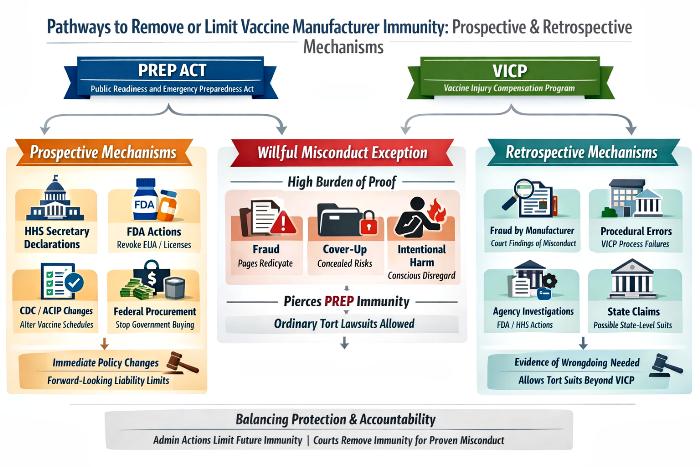
The Illusion Of Vaccine Accountability: Kennedy’s Failure To Revoke PREP Immunity

Abstract

The liability architecture for vaccine manufacturers in the United States is dominated by two statutory regimes: the Public Readiness and Emergency Preparedness (PREP) Act and the National Childhood Vaccine Injury Act (NCVIA), which established the Vaccine Injury Compensation Program (VICP). These frameworks grant sweeping immunity to manufacturers, channeling claims into specialized compensation systems. Yet both contain pathways—executive, administrative, and judicial—that can prospectively or retrospectively strip immunity.

This article examines the full spectrum of powers available to Secretary Kennedy under the separation of powers doctrine: executive authority through PREP declarations, administrative oversight via FDA and CDC, quasi‑judicial enforcement through penalties and investigations, and parallel remedies such as the False Claims Act (FCA). It demonstrates that Kennedy possessed direct and effective tools to revoke immunity but instead chose a procedurally flawed ACIP maneuver that predictably collapsed under judicial review in AAP v Kennedy. He is still following the same script without actually doing anything to safeguard the interests of US citizens.

By mapping these pathways and analyzing their implications, the article argues that Kennedy’s refusal to exercise his strongest executive lever—the revocation of the PREP Declaration—represents a profound failure of governance. The result is continued protection for vaccine manufacturers, leaving citizens reliant on weaker remedies such as FCA suits, whistleblower actions, and state consumer claims.

Introduction

Constitutional governance rests on the separation of powers: legislatures make laws, executives enforce them, and judiciaries interpret them. Within this framework, vaccine liability regimes in the United States balance two imperatives: incentivizing rapid vaccine development and ensuring accountability for misconduct. The PREP Act grants broad immunity to manufacturers of designated countermeasures, while the NCVIA channels injury claims into the VICP.

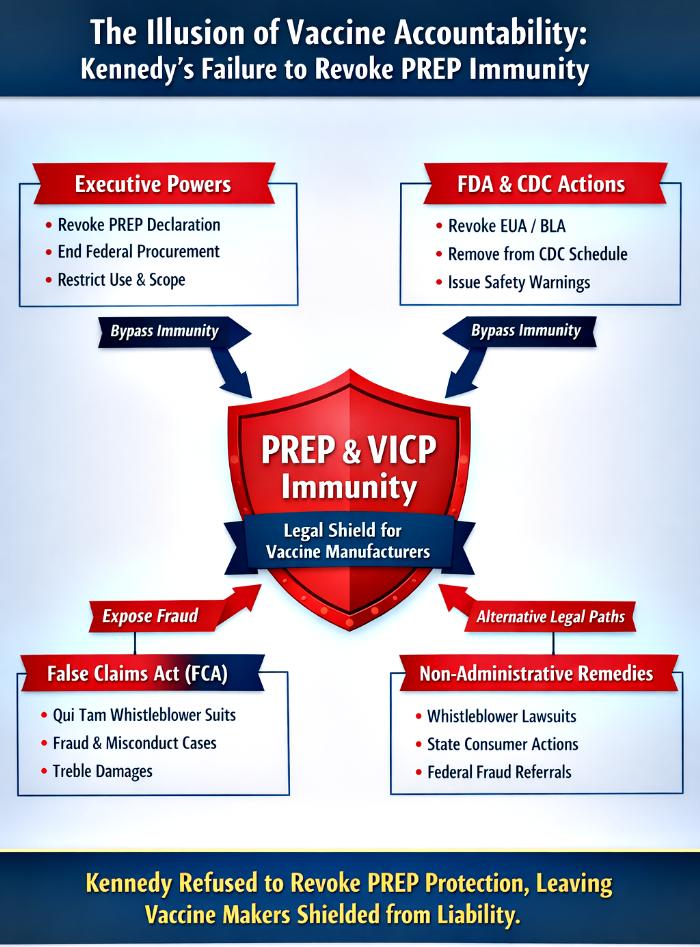
Yet immunity is not absolute. The Secretary of Health and Human Services (HHS) can revoke or amend PREP declarations, FDA can withdraw authorizations, CDC can alter immunization schedules, quasi‑judicial enforcement can expose misconduct, and the False Claims Act provides a parallel fraud‑based enforcement channel. These mechanisms bypass statutory channeling and open the door to traditional litigation.

Despite possessing these tools, Secretary Kennedy chose not to revoke the PREP Declaration for COVID vaccines—the most direct and effective pathway to strip immunity. Instead, he pursued a controversial ACIP maneuver that lacked procedural legitimacy and was stayed in AAP v Kennedy. This article dissects Kennedy’s available powers, his actual actions, and the consequences of his failure.

Remedies Through Executive, Administrative, And Quasi‑Judicial Powers

Table 1 — EAQ Powers Of Secretary Kennedy

Executive PowersAdministrative PowersQuasi‑Judicial Powers
Issue or revoke PREP Act declarations (direct authority to grant/remove immunity).FDA withdrawal of EUA/BLA; CDC/ACIP schedule changes.Impose fines, penalties, sanctions; launch investigations into fraud or concealment.
Narrow scope of PREP declaration (limit persons, uses, geography).HRSA programmatic delisting or prioritization changes in VICP intake.Refer cases for criminal prosecution; support whistleblower suits.
Stop federal procurement or remove vaccines from federal programs.Issue safety advisories, enforcement letters, warning notices.Provide evidentiary records for state consumer protection actions.
Coordinate multi‑agency sequence (PREP revocation + FDA withdrawal + CDC delisting + procurement stop).Adjust programmatic intake and prioritization.Enable retrospective liability through misconduct findings.

Discussion:

Kennedy’s executive authority under the PREP Act was the most direct lever—a simple revocation of the COVID vaccine declaration would have stripped immunity instantly. Administrative tools such as FDA withdrawal or CDC schedule changes were secondary but still potent. Quasi‑judicial enforcement could expose fraud and misconduct, feeding evidence into litigation. Together, these powers formed a comprehensive arsenal to dismantle vaccine immunity.

Analysis:

(1) Executive Primacy: The PREP Declaration functions as an on/off switch for immunity. Kennedy’s refusal to revoke it represents a conscious abdication of responsibility.

(2) Administrative Support: FDA and CDC actions could have narrowed immunity, but Kennedy relied on ACIP theatrics that collapsed under judicial scrutiny.

(3) Quasi‑Judicial Enforcement: Investigations and penalties remain underutilized, leaving misconduct unpunished and immunity intact.

FDA And CDC Administrative Pathways

Table 2 — FDA And CDC Remedies

FDA ActionsCDC/ACIP ActionsProcedural Requirements
Withdraw or revoke EUA/BLA for vaccines.ACIP votes to remove vaccine from immunization schedule; CDC adopts recommendation.Must follow proper administrative procedure: notice, comment, scientific review.
Narrow indications or relabel vaccines.Issue CDC guidance narrowing schedule inclusion.Failure to follow procedure leads to judicial stay (AAP v Kennedy).
Issue enforcement letters, warning notices, or safety advisories.Adjust HRSA/CDC programmatic intake prioritization for VICP claims.Courts intervene if due process or statutory mandates are violated.

Discussion:

FDA and CDC wield indirect but significant powers. Withdrawal of authorizations or removal from immunization schedules reshapes the liability landscape by narrowing contexts where immunity applies. However, these actions require strict adherence to administrative procedure. Kennedy’s reliance on ACIP votes without procedural compliance guaranteed judicial invalidation.

Analysis:

(1) FDA Leverage: Withdrawal of EUA/BLA would have removed COVID vaccines from authorized use, exposing manufacturers to liability. Kennedy did not pursue this.

(2) CDC Fragility: ACIP votes are procedurally vulnerable. Kennedy’s reliance on this mechanism was a calculated but hollow gesture.

(3) Judicial Oversight: Courts swiftly stayed Kennedy’s ACIP maneuver, underscoring the futility of bypassing procedural safeguards.

False Claims Act: A Parallel Enforcement Channel

Table 3 — False Claims Act Remedies

MechanismActorEffect on ImmunityEvidence NeededPractical Consequence
FCA civil action (qui tam or DOJ suit)DOJ, whistleblowersDoes not directly revoke PREP/VICP immunity but exposes fraud outside those regimesFalse billing records, misrepresentation of safety/efficacy, concealment of adverse dataTreble damages, civil penalties, evidentiary record supporting fraud/misconduct claims
Whistleblower disclosures under FCAPrivate relatorsCreates independent litigation channelInternal communications, suppressed adverse event data, falsified submissionsStrengthens plaintiffs’ ability to argue fraud defeats statutory channeling
DOJ enforcementFederal prosecutorsParallel enforcement outside PREP/VICPCriminal referrals, administrative findingsAdds weight to judicial findings that can strip immunity retrospectively

Discussion:

The FCA bypasses PREP and VICP entirely because it targets fraud against the government, not personal injury claims. Successful FCA actions produce robust evidence of fraud—internal emails, falsified submissions, suppressed adverse data—that courts can use to retrospectively defeat PREP or VICP immunity.

Analysis:

(1) Independent Enforcement Channel: FCA suits operate outside statutory channeling, making them one of the few remedies immune to PREP/VICP barriers.

(2) Evidentiary Bridge: FCA findings create the factual predicate for courts to pierce immunity in related injury cases.

(3) Instrumental In Parallel Tort Claims The FCA enables tort liability by creating a statutory mechanism that both proves and channels civil wrongdoing—its elements (a false representation, materiality, presentment to the government, and scienter) mirror common-law fraud elements so a successful FCA case often supplies the core factual and evidentiary predicates for parallel tort claims (fraud, conspiracy, unjust enrichment); additionally, qui tam proceedings unlock expansive pre-trial discovery and can produce judicial findings on falsity and intent that support collateral tort actions or equitable remedies, while state-law claims can be asserted alongside or where federal coverage is incomplete to capture private harms and restitution beyond the FCA’s statutory remedies.

Non‑Administrative Remedies: The Last Resort

Citizens now face reliance on weaker remedies outside the executive and administrative sphere:

(1) Whistleblower suits exposing concealed safety data.

(2) State consumer protection actions challenging deceptive practices.

(3) Federal enforcement referrals generating evidentiary records for litigation.

These remedies are reactive, slow, and dependent on judicial findings of fraud or misconduct. They lack the immediacy of executive revocation and rarely succeed in stripping immunity.

Conclusion

Secretary Kennedy possessed the most powerful tool to dismantle vaccine manufacturer immunity: revocation of the PREP Declaration for COVID-19 shots. This action required no legislative approval and would have instantly exposed manufacturers to traditional tort liability. Instead, Kennedy staged a symbolic ACIP maneuver that predictably collapsed under judicial review.

By refusing to exercise his executive authority, Kennedy has failed U.S. citizens and betrayed his core voters. His administration remains aligned with the vaccine lobby, preserving immunity and shielding manufacturers from accountability. The result is a liability regime where citizens must rely on weak remedies—FCA suits, whistleblower actions, and state consumer claims—while the pharmaceutical cartel continues to dominate.

Kennedy’s failure is not procedural—it is political. He chose drama over substance, optics over accountability, and lobby interests over public trust. The consequence is clear: vaccine immunity remains intact, and the promise of accountability has been sacrificed. The verdict of history will be unforgiving.

In these dark times of medical tyranny, systemic gaslighting, and the denial of remedies to the vaccine-injured, the HVBI Framework emerges as a guiding light. The path forward is clear—let the HVBI Framework illuminate the way.

Administrative Pathways To Remove Or Limit Vaccine Manufacturer Immunity: Prospective And Retrospective Mechanism

Abstract

The legal architecture surrounding vaccine manufacturer liability in the United States is shaped primarily by two statutory regimes: the Public Readiness and Emergency Preparedness (PREP) Act and the National Childhood Vaccine Injury Act (NCVIA), which created the Vaccine Injury Compensation Program (VICP). These frameworks provide broad immunity to manufacturers, channeling claims into specialized compensation systems. Yet, both statutes contain mechanisms—administrative and judicial—that can prospectively or retrospectively narrow or remove immunity.

This article explores the administrative pathways available to federal agencies to prospectively limit immunity under the PREP Act and VICP, the judicially enforced willful‑misconduct exception under PREP, and the doctrinal routes to retrospective defeat of VICP channeling. It also examines how whistleblower actions, state consumer protection suits, and federal enforcement interact with these immunities. By mapping these pathways, the article highlights the interplay between executive discretion, regulatory enforcement, and judicial oversight in shaping the liability landscape for vaccine manufacturers. Ultimately, while prospective removal of immunity is largely an administrative prerogative, retrospective defeat requires judicial findings of fraud or misconduct, underscoring the evidentiary and procedural hurdles that plaintiffs face.

Introduction

Vaccine liability regimes in the United States balance two competing imperatives: incentivizing rapid development and deployment of vaccines, particularly in emergencies, and ensuring accountability for misconduct or harm. The PREP Act grants sweeping immunity to manufacturers and distributors of designated countermeasures, while the NCVIA channels most vaccine injury claims into the VICP, a no‑fault compensation system. These frameworks are designed to stabilize markets and encourage innovation by limiting exposure to tort litigation. However, immunity is not absolute. The PREP Act allows the Secretary of Health and Human Services (HHS) to prospectively grant or revoke immunity through declarations, and it contains a narrow willful‑misconduct exception that permits retrospective liability. Similarly, while VICP channeling is statutory, courts can retrospectively defeat its protections in cases of fraud or intentional wrongdoing. This article systematically examines these pathways, situating them within broader administrative and judicial processes, and considers how external mechanisms—whistleblower suits, state enforcement, and federal penalties—interact with and erode these immunities.

Administrative Pathways To Prospectively Remove Or Limit Immunity

Table 1 — Administrative Pathways Under PREP And VICP

The first table maps the administrative instruments available to federal agencies to prospectively alter manufacturer immunity. It distinguishes between direct powers, such as the HHS Secretary’s PREP declaration, and indirect levers, such as FDA withdrawal of authorization or CDC schedule changes.

Administrative ActionAgency / ActorDirect vs IndirectLegal Effect (prospective)Typical Mechanism / FormPractical Result on Manufacturer Liability
Issue PREP Act declaration naming productHHS SecretaryDirectGrants broad prospective immunity for covered uses/persons/time (except willful misconduct)Presidential/Secretary declaration under PREP Act (written declaration)Strong, immediate immunity for future deployments covered by declaration
Amend or revoke PREP declaration to exclude productHHS SecretaryDirectRemoves or narrows PREP immunity prospectively for specified uses/persons/timeAmendment or revocation of PREP declarationPREP protection removed for future uses; manufacturers exposed to non‑PREP legal regimes
Narrow PREP declaration scope (uses/ppl/geography)HHS SecretaryIndirectLimits PREP protection to narrower contexts; product uses outside scope lose PREP protectionTargeted language in declaration (exclusions/limitations)Partial loss of PREP immunity depending on use/context
Revoke/withdraw EUA or BLA (license)FDA CommissionerIndirectRemoves regulatory authorization; product ceases to be an approved/authorized countermeasure for routine programsFDA order withdrawing EUA/BLA or refusing renewalProduct removed from authorized programmatic use; increases civil/tort exposure; affects VICP applicability in practice
Narrow indication / relabelingFDA CommissionerIndirectLimits approved uses/populations; may exclude routine program usesLabeling change, approval amendmentReduces contexts where VICP or PREP would apply; narrows manufacturer protections for other uses
ACIP recommendation to remove/narrow schedule inclusionACIP → CDC adoptionIndirectRemoves routine‑use recommendation that underpins VICP Table inclusion and institutional mandatesACIP vote and CDC decision to change the immunization schedule/guidanceProduct loses routine program support; VICP practical coverage diminished; increased tort exposure for non‑program uses
Stop federal procurement / remove from federal programsHHS / CDC procurement officesIndirectEliminates federal purchases and program distribution channels tied to VICP and other protectionsProcurement decisions, contract terminations, program policy changes (e.g., Vaccines for Children)Market contraction to private sales; reduced VICP caseflow; greater liability exposure for future commercial uses
CDC/HRSA programmatic delisting or intake prioritization changesCDC / HRSA program officesIndirectAdministrative limiting of VICP intake/prioritization for specific vaccine casesInternal program guidance, adjudication policies, table‑listing practice adjustmentsPractical exclusion from VICP pathway for new claims tied to the vaccine
Public safety advisories / enforcement actionsFDA / CDCIndirectPrompt market withdrawal or voluntary manufacturer suspension of distributionSafety communications, enforcement letters, warning noticesDe facto removal from routine use; manufacturers face higher private‑market liability risk
Coordinated multi‑agency sequence (FDA + ACIP + procurement + PREP)HHS Secretary, FDA, ACIP/CDC, procurement officesIndirect (composite)Combined effect: no PREP coverage; no FDA authorization for routine uses; no CDC schedule inclusion; no federal procurement — maximizes prospective liability exposureSequential administrative actions across agencies (revocation, delisting, procurement stop, PREP revocation/non‑inclusion)Manufacturer effectively loses both PREP and practical VICP protection for future uses; exposed to ordinary tort/regulatory risk

Analysis

(1) The PREP Act declaration is the most direct administrative lever, functioning as an on/off switch for immunity. Revocation or amendment by the HHS Secretary immediately alters the liability landscape.

(2) Indirect mechanisms, such as FDA withdrawal or CDC schedule changes, reshape the regulatory and programmatic context, narrowing the scope of immunity without directly altering statutory coverage.

(3) The most robust strategy involves coordinated multi‑agency action, combining PREP revocation, FDA withdrawal, ACIP delisting, and procurement cessation. This sequence maximizes liability exposure by severing both statutory emergency immunity and programmatic protections tied to VICP.

Willful‑Misconduct Exception Under The PREP Act

Table 2 — Judicial Pathways To Retrospective Liability

The second table outlines the willful‑misconduct exception under the PREP Act, the only doctrinal gateway to retrospective removal of immunity. It requires clear and convincing evidence of intentional wrongdoing or conscious disregard of known risks.

TopicDescriptionLegal Effect (retrospective/prospective)Proof Standard & ElementsTypical EvidencePractical Consequence for Immunity
Core rulePREP grants broad immunity to covered persons, but immunity does not apply to conduct amounting to “willful misconduct.”Retrospective for proven wrongful acts; prospective immunity remains for other covered acts unless proven otherwiseClear and convincing evidence that covered person committed willful misconductInternal communications, safety data concealment, deliberate deviations from protocols, regulatory‑submission falsificationImmunity is void as to the specific willful misconduct acts — plaintiffs may sue for damages tied to those acts
Legal elements (typical judicial framing)1) Affirmative act/omission (not mere negligence) 2) Actual intent to cause harm or conscious disregard of a known, substantial risk 3) Proximate causation of injury 4) Misconduct outside ordinary discretionary response covered by PREPRetrospective application limited to established acts meeting elementsClear and convincing; courts require specific proof of intent or conscious indifferenceDocumentary proof of awareness of risk; emails showing intent; meeting notes; manufacturing alterations; suppressed adverse event reportsIf elements met, PREP immunity is treated as inapplicable to those acts; remedies follow ordinary tort law for those claims
Burden & difficultyHigh evidentiary burden; plaintiffs must show mental state and causation beyond ordinary negligenceMakes retrospective loss of immunity possible but hard to obtainClear and convincing; higher than preponderanceExtensive discovery (emails, memos, lab records), whistleblower testimony, expert causation opinionsSuccessful proof is rare but immediately exposes covered persons to retrospective liability for the proved acts

Analysis

(1) The willful‑misconduct exception is narrow but powerful. It pierces PREP immunity retrospectively for specific acts of intentional wrongdoing, allowing plaintiffs to pursue ordinary tort remedies.

(2) The evidentiary burden is high, requiring clear and convincing proof of intent or conscious disregard, supported by documentary evidence or whistleblower testimony.

(3) While rare, successful findings of willful misconduct carry severe consequences, including civil damages, administrative penalties, and potential criminal referrals, underscoring the deterrent effect of the exception.

Retrospective Defeat Of VICP Immunity

Table 3 — Judicial And Administrative Pathways Under NCVIA

The Vaccine Injury Compensation Program (VICP), established under the National Childhood Vaccine Injury Act (NCVIA), channels most vaccine injury claims into a specialized forum, limiting access to ordinary tort litigation. Unlike the PREP Act, which allows the HHS Secretary to prospectively revoke immunity, VICP protections are statutory and cannot be unilaterally removed by administrative action. The following table outlines the doctrinal pathways and actors involved in potentially defeating VICP immunity retrospectively.

TopicVICP statutory scheme effectPossible retrospective defeat?Who can act (agency/actor)Mechanism (administrative vs. judicial)Typical evidence neededPractical outcome if proven
Core structureNCVIA channels most vaccine‑injury claims to VICP; petitioners generally must pursue VICP remedies rather than ordinary tortStatute itself provides limited grounds to opt out or seek civil remedy; retrospective defeat of VICP immunity is possible only in narrow circumstances and typically via judicial findings, not mere agency fiatCourts (Court of Federal Claims, federal trial courts) primarily; agencies (FDA, HHS/HRSA, CDC) can generate findings/facts that feed litigation but cannot unilaterally strip statutory channelingJudicial determination that statutory requirements were not met or that misconduct defeats statutory protection; administrative findings (e.g., FDA enforcement actions, criminal convictions) supply evidenceClear proof of fraud, concealment, willful misconduct, or procedural failures in VICP petitions; internal documents, altered safety data, regulatory submissions withholdingCourt may permit civil suit or find statutory channeling inapplicable for the misconduct‑based claims; can produce retrospective liability for defendants
Fraud/Willful misconduct by manufacturerVICP does not generally immunize for fraud or intentional wrongdoing; NCVIA contemplates some exceptions where ordinary remedies remain availableRetrospective defeat possible if fraudulent concealment or willful misconduct is judicially establishedPlaintiffs in court; evidence often developed via discovery and supported by agency recordsJudicial ruling that fraud/intentional misconduct falls outside protected conduct; criminal conviction strengthens caseInternal emails, suppressed adverse data, falsified submissions, criminal indictmentsPlaintiffs may pursue tort claims notwithstanding VICP channeling; VICP remedies may be bypassed for those claims
Procedural defects in VICP processVICP requires petitioners to follow statutory procedures; agency misapplication may affect remediesProcedural failures by program administrators generally do not abrogate statutory channeling; courts review but do not often open broad retrospective damages avenuesHRSA/Division of Injury Compensation Programs (DICP) administers VICP; courts review program decisionsJudicial review of VICP adjudication; rare vacatur or remand but not blanket removal of statutory schemeRecord showing procedural denial of rights or unlawful practice in adjudicationRelief usually limited to vacatur/remand or corrective administrative action, not wholesale opening of tort claims
Agency‑found misconduct (FDA enforcement, criminal referrals)Agency findings can be powerful evidence but do not themselves nullify NCVIA channelingAgencies cannot unilaterally convert VICP claims into ordinary tort remedies; their findings enable judicial proceedings that may strip statutory protections for particular actsFDA, HHS, CDC can investigate, suspend approvals, refer for criminal prosecution, issue public findingsAdministrative enforcement, inspections, criminal referrals produce records used in civil litigationRegulatory inspection reports, warning letters, criminal indictments, Official FDA determinationsIf courts find willful misconduct/fraud based on such evidence, plaintiffs may be permitted ordinary suits for affected claims
Interaction with state lawNCVIA preemption is complex; certain state‑law claims can be preempted or barred by NCVIA’s schemeRetroactive disapplication is rare; success depends on judicial interpretation and strength of misconduct evidenceFederal courts interpret preemption; state courts may see parallel claims depending on contextPreemption analysis in litigation; successful arguments can free some claims from channelingLegal analysis, precedent, and fact pattern showing fraud/intentional conductCourt may permit state‑law claims to proceed if not preempted; otherwise VICP remains exclusive route
Practical hurdlesHigh evidentiary bar; VICP is designed to centralize vaccine injury compensation and limit tort suitsRetrospective defeat is exceptional and fact‑specific; agency actions help but do not themselves flip channelingPlaintiffs, discovery, and courts are central actors; agencies provide investigative materialsLitigation (often lengthy), discovery disputes, motion practiceWhistleblower disclosures, criminal cases, internal documents, agency enforcement recordsPossible retrospective liability for proven wrongful acts, but usually limited in scope and hard to obtain

Analysis

Judicial Primacy

The VICP regime is fundamentally judicial in its retrospective defeat mechanisms. Courts, not agencies, determine whether statutory channeling applies in cases of fraud or misconduct. While agencies such as FDA or HHS can generate findings and evidence, they cannot themselves nullify VICP protections. Judicial rulings based on fraud, concealment, or willful misconduct are the only viable routes to bypass the statutory channeling and allow ordinary tort claims.

Evidentiary Burden

The most realistic path to retrospective defeat of VICP immunity lies in proving fraud or intentional wrongdoing. Plaintiffs must present compelling documentary evidence—internal communications, falsified regulatory submissions, or suppressed adverse event data. Agency enforcement actions, criminal referrals, or whistleblower disclosures often provide the factual predicate for such claims. Courts then apply these findings to determine whether statutory protections should be stripped for specific acts.

Practical Challenges

Despite the doctrinal possibility, retrospective defeat of VICP immunity remains rare. The statutory design favors centralization and predictability, and courts construe exceptions narrowly to preserve the program’s integrity. Discovery disputes, privilege claims, and complex causation issues further raise the barrier. Nevertheless, when plaintiffs succeed in producing robust evidence, courts can treat discrete wrongful acts as outside NCVIA’s channeling, permitting ordinary tort claims and retrospective liability. This underscores the limited but potent role of judicial oversight in balancing accountability with statutory immunity.

Conclusion

The interplay between administrative and judicial pathways reveals a layered liability framework for vaccine manufacturers. Prospective removal of immunity under the PREP Act is largely an executive function, with the HHS Secretary wielding direct authority through declarations. Retrospective defeat, however, is judicially driven: courts alone can pierce statutory protections under PREP’s willful‑misconduct exception or VICP’s fraud‑based exclusions.

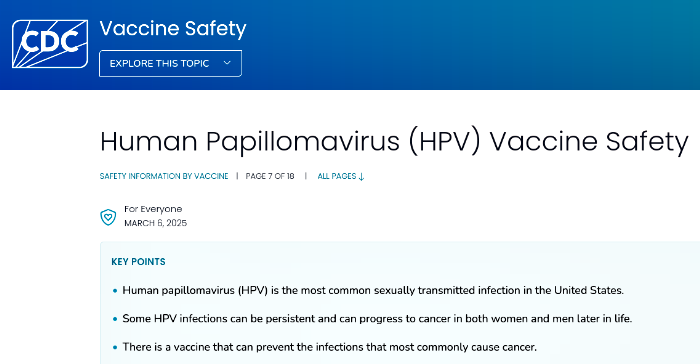
Agencies play a critical supporting role by generating evidence through enforcement actions, inspections, and referrals, but they cannot unilaterally strip immunity. Whistleblower suits, state consumer actions, and federal enforcement further erode immunities by creating evidentiary records and collateral remedies. Ultimately, while the statutory schemes are designed to stabilize vaccine markets and encourage innovation, the pathways examined here ensure that accountability remains possible in cases of fraud, concealment, or intentional misconduct. This balance between protection and liability is essential to maintaining public trust in vaccination programs and regulatory institutions.

Dismantling Pseudoscience And Medical Tyranny: The HVBI Framework As A Blueprint For Absolute Liability, Justice, And Human Dignity In The Face Of CDC HPV Vaccine Narratives

Abstract

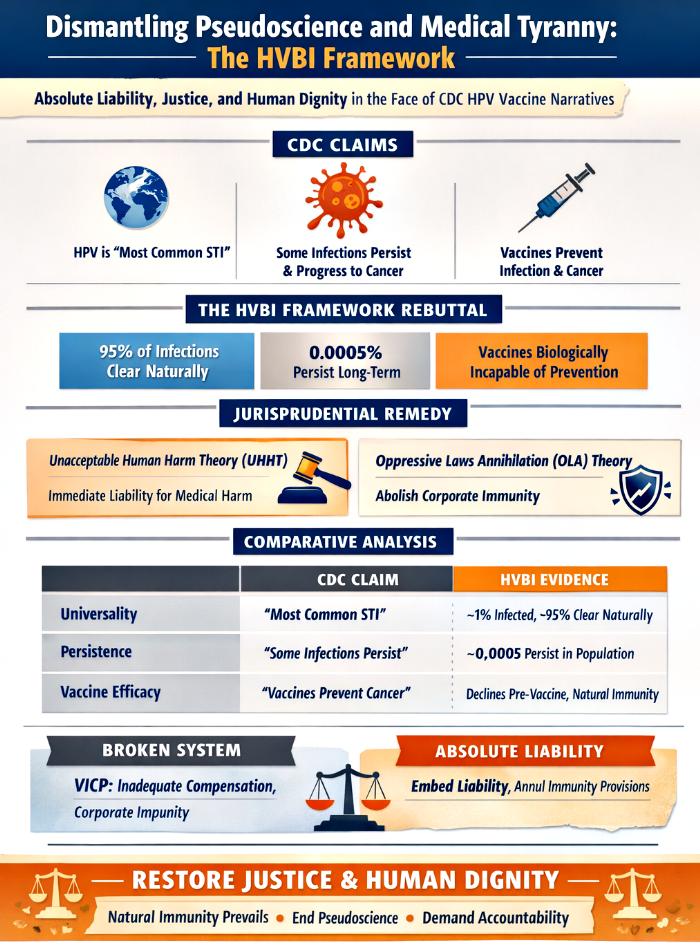
The Centers for Disease Control and Prevention (CDC) has constructed its HPV vaccination campaign upon three rhetorical pillars: universality, persistence, and vaccine efficacy. These claims, repeated in public health discourse, create a narrative of inevitability—that HPV is ubiquitous, that persistence is common and dangerous, and that vaccines are the only salvation. Yet when examined through biological plausibility, epidemiological trajectories, and immunological mechanisms, each pillar collapses under scrutiny. The HPV Vaccines Biological Impossibilities (HVBI) Framework and the Pointer–Eliminator Principle provide a coherent rebuttal, demonstrating that HPV infections are overwhelmingly rare and transient, persistence is vanishingly rare, and vaccines are biologically incapable of preventing infection or cancer. Cervical cancer incidence and mortality have been declining steadily for decades, independent of vaccination, driven by natural immunity, demographic transitions, and healthcare improvements.

Beyond scientific critique, the jurisprudential doctrines of Praveen Dalal—particularly the Unacceptable Human Harm Theory (UHHT) and the Oppressive Laws Annihilation (OLA) Theory—provide a moral and legal foundation for rejecting hollow assurances and dismantling immunity provisions that shield pharmaceutical corporations from accountability. UHHT asserts that any harm from medical interventions must trigger immediate liability, while OLA Theory demands the annihilation of laws that protect corporations over human lives. Together, these frameworks converge on a U.S.-specific remedy: embedding Absolute Liability for HPV vaccines into law, annulling immunity provisions, and ensuring enforceable rights for victims. This article synthesizes biological, epidemiological, and techno-legal critiques into a unified conclusion: the CDC’s HPV narratives are pseudoscientific, misleading, and ethically indefensible, while absolute liability and UHHT restore justice, accountability, and human dignity.

Introduction

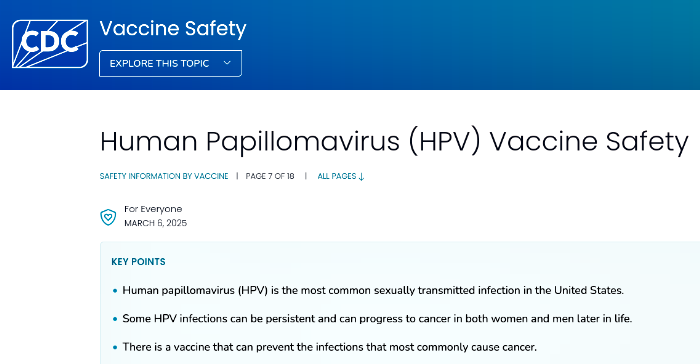
HPV has been framed by the CDC as the “most common sexually transmitted infection,” with “some infections persisting and progressing to cancer,” and vaccines positioned as the decisive preventive tool. These claims, taken together, construct a narrative of inevitability: that nearly everyone is infected, many will persist, and vaccines are the only salvation. Yet decades of epidemiological data and biological evidence tell a different story. Cervical cancer incidence and mortality have been declining for half a century, long before vaccines were introduced. More than 95% of HPV infections clear naturally within 1–2 years, persistence occurs in fewer than 0.0005 of the population at any given time, and progression to cancer is rarer still. Vaccines, operating only as pointers under the Pointer–Eliminator Principle, cannot prevent infection or cancer.

At the same time, the U.S. legal system has failed to provide meaningful remedies for victims of vaccine injuries. Immunity provisions shield pharmaceutical corporations from accountability, leaving victims without enforceable rights. Paper assurances of safety, issued by agencies and medical boards, are ethically and legally unacceptable. The doctrines of UHHT and OLA Theory provide a jurisprudential foundation for rejecting these hollow assurances and demanding absolute liability for medical offenses.

Universality: The Collapse Of The “Most Common” Claim

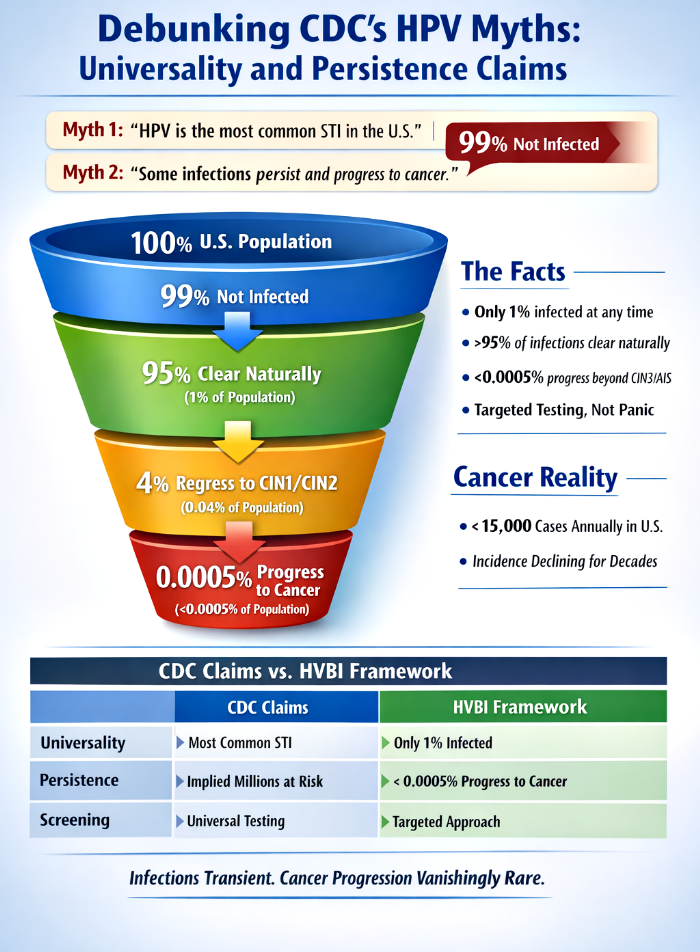
The CDC’s universality claim exaggerates risk by conflating transient viral DNA detection with persistent oncogenic disease. In reality, only about 1% of the U.S. population is infected at any given time. Of those, 95% clear the infection naturally within 1–2 years. The remaining 5% of that 1% may show persistence, but even here, 4% clear at the CIN1/2 stage. That leaves only ~1% of 5% of 1% of the population—about 0.0005 overall—who are truly persistently infected. This mathematical breakdown dismantles the CDC’s universality narrative. If HPV were truly “universal,” catastrophic cancer rates would be observed. Instead, SEER data confirm that cervical cancer incidence and mortality have been declining steadily for decades, independent of vaccination.

Persistence: Vanishingly Rare And Misrepresented

The persistence narrative implies millions at risk of cancer, yet transparent statistics reveal persistence is vanishingly rare. Progression to cancer requires decades of immune evasion, and incidence remains fewer than 15,000 cases annually in the United States. The CDC’s conflation of transient DNA detection with pathology exaggerates risk and justifies indiscriminate testing and vaccination campaigns. If persistence were as common as claimed, millions of cancers would be expected annually. Instead, mortality continues to decline, driven by natural immunity, demographic transitions, and improved healthcare access.

Vaccine Efficacy: The Pointer–Eliminator Principle

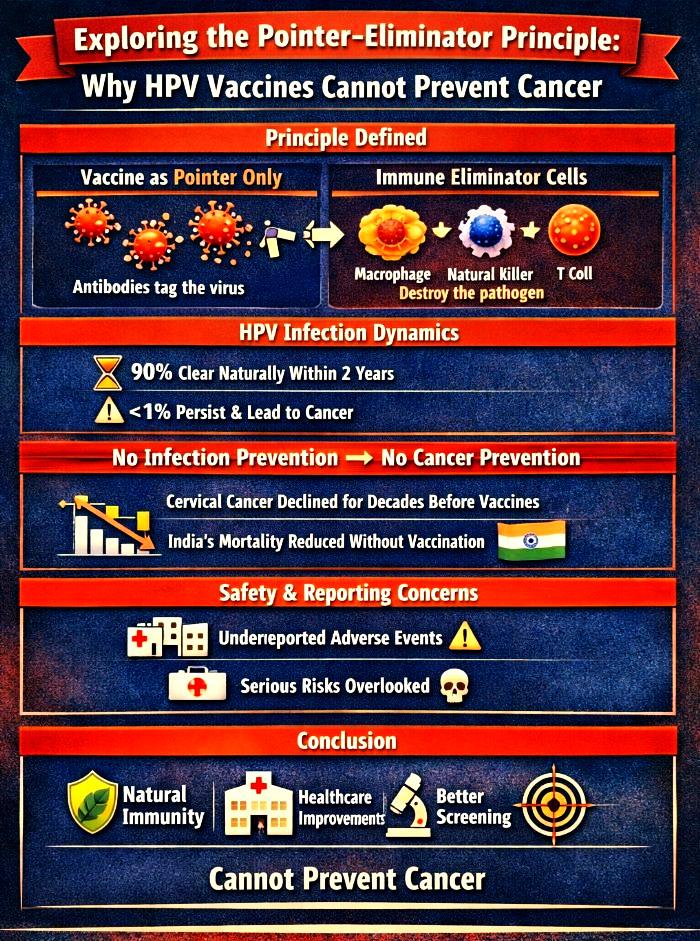
The vaccine narrative collapses under both biological and epidemiological scrutiny. Vaccines and their dangerous antibodies function only as dangerous pointers, incapable of eliminating pathogens. True destruction is performed by immune effector mechanisms. Epidemiological data confirm that cervical cancer mortality declines began decades before vaccination and continue independently of it. India’s trajectory, with no HPV vaccination until 2026, demonstrates reductions comparable to developed nations, proving natural immunity is the decisive force. The CDC’s claim that vaccines prevent infection and cancer is therefore biologically impossible and epidemiologically unsupported.

Comparative Analysis: CDC Narratives Versus The HVBI Framework

A pivotal element in understanding the scientific invalidity of the CDC’s HPV vaccination campaign lies in the direct comparison between its core claims and the counter-evidence marshaled by the HVBI Framework. This table not only distills the essence of the debate into clear categories but also demonstrates how each pillar of the official narrative—universality, persistence, and vaccine efficacy—fails when subjected to rigorous biological, immunological, and epidemiological analysis. By presenting these contrasts, the table serves as a foundational tool for readers to appreciate the depth of the pseudoscientific foundations upon which current policies rest, thereby justifying the urgent need for jurisprudential remedies such as those proposed by UHHT, Absolute Liability, and OLA Theory to protect public health and human rights.

AspectCDC ClaimHVBI Framework Evidence
UniversalityHPV is “most common STI”Only ~1% of population infected at any given time; >95% clear naturally within 2 years
Persistence“Some infections persist and progress”Of the 1% infected, 95% clear; remaining 5% → 4% clear at CIN1/2 stage; only ~0.0005 persist
Vaccine EfficacyVaccines prevent infection and cancerVaccines are dangerous pointers only; elimination is immune‑driven; declines predate vaccination

Analysis: From Biological Critique To Jurisprudential Remedy

The CDC’s rhetorical pillars collapse when confronted with biological plausibility and epidemiological data. Universality is disproven by the fact that only 1% of the population is infected at any given time, with nearly all clearing naturally. Persistence is dismantled by the vanishingly small fraction of infections that truly persist, amounting to 0.0005 of the population. Vaccine efficacy is refuted by the Pointer–Eliminator Principle and decades of declining cancer rates independent of vaccination.

Yet scientific critique alone is insufficient. Victims of HPV vaccine injuries remain without justice because immunity provisions shield corporations from accountability. Here, jurisprudential doctrines provide the necessary remedy. The Unacceptable Human Harm Theory (UHHT) asserts that no medical intervention should cause any harm, and when such harm occurs, immediate legal consequences must follow. UHHT strengthens the case for Absolute Liability, ensuring that accountability is not delayed or diluted by bureaucratic promises. The Oppressive Laws Annihilation (OLA) Theory confronts the reality that laws protecting corporations over human lives are instruments of tyranny. OLA demands ignoring of oppressive laws by people, dismantling of immunity provisions, and annulling legal shields that perpetuate systemic injustice. Together, UHHT and OLA provide a techno‑legal foundation for embedding Absolute Liability into U.S. law, ensuring that victims are no longer burdened with proving negligence and that accountability is automatic, enforceable, and uncompromising.

The HVBI 12-Stage Framework: A Comprehensive Blueprint Exposing Pseudoscience And Charting The Path To Accountability

Building upon the biological and epidemiological critiques, the HVBI Framework provides a comprehensive 12-stage analysis that systematically deconstructs the pseudoscientific foundations of HPV vaccination campaigns from 1970 to 2026. This framework integrates insights from microabrasions, infection rates, immunity dynamics, and jurisprudential theories to offer not only a scientific rebuttal but also a practical roadmap for legal reform. The table below details each stage, illustrating how the framework progresses from identifying flawed assumptions to prescribing actionable remedies for victims of vaccine injuries, thereby equipping advocates, lawmakers, and citizens with the intellectual and legal tools necessary to challenge medical tyranny and restore enforceable human rights.

HVBI Stage-Wise Framework (Latest 12 Stage Framework, Dated 16-04-2026)

Table 1: Dangerous HPV Vaccines Pseudoscience And Unscientific Assumptions (1970–2026)

StageSectionCore ArgumentHVBI ContributionImplication
1Microabrasions PresumptionAssumes microabrasions are ubiquitous gatewaysArgues prevalence is rare, limited to ~1%Intact epithelium and innate immunity are primary protectors
2Near-Universal Infection PresumptionClaims all sexually active individuals contract HPVShows only ~1% infected at a time; 95% clear naturallyPersistence is rare; universality claim exaggerated
3Unscientific Risk PresumptionClaims natural clearance is dangerousDemonstrates innate immunity safely clears >95% of HPV infections; vaccines cause severe adverse effects and deathsNatural immunity is 100× safer and stronger than HPV Death Shots
4HPV Vaccines & InfectionVaccines prevent infectionHVBI: biologically impossible; vaccines act as strain-specific dangerous alarmsPrevention is innate immunity-driven, not vaccine-driven
5Pseudoscience & Non-EfficacyCredits vaccines for cancer reductionAttributes declines to natural clearance and screeningVaccines over-credited; screening undervalued
6Pointer–Eliminator PrincipleVaccines tag pathogens but do not destroy themReframes vaccines as dangerous alarms, not shieldsVaccine efficacy depends entirely on immune strength
7Epidemiological Narrative DistortionClaims long-term declines in HPV-related cancers are vaccine-drivenHVBI shows declines predate vaccines, linked to strong innate immunity, improved hygiene, and screeningVaccines are falsely credited with historical trends; public health narratives misattribute causation
8Medical Genocide & Ethical FailureVaccines forced despite evidence of severe adverse effects and deaths globallyHVBI frames this as systemic negligence and deliberate suppression of natural immunity dataEthical crisis: coercive vaccination campaigns undermine trust, harm populations, and ignore safer alternatives
9Death-to-Population Ratio (DPR)Conventional metrics exaggerate India’s cervical cancer burden by focusing on raw deathsDPR contextualizes mortality relative to population, showing India’s risk is comparable to developed nationsReframes cervical cancer discourse: India’s proportional risk is low, progress is real, and coercive HPV vaccination campaigns are unjustified
10Unacceptable Human Harm Theory (UHHT)Any harm from medical interventions is unacceptableEstablishes doctrine that even a single adverse effect invalidates medical legitimacyMandates immediate accountability; no tolerance for vaccine harm
11Absolute LiabilityImmunity provisions shield corporations from accountabilityEmbeds principle that liability for harm must be automatic, enforceable, and uncompromisingRestores justice: victims gain enforceable rights without proving negligence
12Oppressive Laws Annihilation (OLA) TheoryLaws protecting corporations over human lives perpetuate systemic injusticeDemands Legislative dismantling of immunity provisions and annulment of oppressive legal shields. If Govt fails, People must “Actively Disobey” such Oppressive Laws. When Injustice Becomes Law, Resistance Becomes DutyEnsures human dignity: corporate protections abolished, accountability prioritized. Invocation of the Stupid Laws And Moronic Judges Theory (SLMJ Theory)

Analysis

The first six stages of the HVBI Framework form the biological foundation of its critique, systematically dismantling the pseudoscientific assumptions that have long underpinned HPV vaccine narratives. Stage 1 challenges the microabrasions presumption, showing that the supposed gateways for infection are exceedingly rare and not the universal entry points claimed by mainstream science. Stage 2 dismantles the near‑universal infection presumption, exposing how epidemiological data reveal that only about 1% of individuals are infected at any given time, with the vast majority clearing the virus naturally. Stage 3 confronts the unscientific risk presumption, demonstrating that natural clearance is not only safe but overwhelmingly effective, while vaccines themselves introduce severe adverse effects. Stage 4 critiques the claim that vaccines prevent infection, reframing them as biologically impossible interventions that act merely as strain‑specific alarms rather than shields. Stage 5 exposes the non‑efficacy of vaccines in reducing cancer rates, attributing observed declines instead to natural clearance and screening programs. Finally, Stage 6 introduces the Pointer–Eliminator Principle, a conceptual framework that clarifies how vaccines can only tag pathogens but never destroy them, leaving true protection to innate and adaptive immunity. Together, these stages establish a coherent biological rebuttal: HPV infections are transient, natural immunity is decisive, and vaccines are incapable of delivering the protection they promise.

Stages 7 and 8 expand the critique beyond biology into the epidemiological and ethical domains, revealing how narratives have been distorted and how coercive practices have undermined trust. Stage 7, the Epidemiological Narrative Distortion, demonstrates that long‑term declines in HPV‑related cancers predate the introduction of vaccines, driven instead by natural immunity, improved hygiene, and screening programs. This exposes how public health authorities have falsely credited vaccines with outcomes that were already in motion, misattributing causation and inflating their role in cancer prevention. Stage 8 escalates the framework into the ethical sphere, framing coercive vaccination campaigns as medical genocide and systemic ethical failure. Here, HVBI highlights how evidence of severe adverse effects and deaths has been suppressed, while natural immunity data has been ignored, creating a crisis of trust. Coercive campaigns, particularly those targeting young populations, are presented as deliberate acts of negligence and harm, undermining both public health credibility and the dignity of those subjected to them. These stages underscore that the HPV vaccine narrative is not only scientifically flawed but also ethically indefensible, built upon distortion and coercion rather than truth and transparency.

Stage 9 introduces a quantitative reframing through the Death‑to‑Population Ratio (DPR), a metric that contextualizes cervical cancer mortality relative to population size. Conventional metrics, which focus on raw death counts, exaggerate India’s cervical cancer burden and fuel fear‑driven narratives that justify coercive vaccination campaigns. DPR, by contrast, demonstrates that India’s proportional risk is comparable to that of developed nations, despite the absence of widespread screening, treatment, or vaccination until 2026. This reframing dismantles the rhetoric of crisis, showing that progress is real and that the proportional risk is low. By shifting the discourse from raw numbers to proportional analysis, DPR exposes how fear has been weaponized to push dangerous interventions while ignoring the reality of natural immunity and demographic transitions. It provides a more accurate, balanced, and humane perspective, proving that coercive vaccination campaigns are unjustified and that India’s trajectory reflects resilience and progress rather than vulnerability. Stage 9 thus completes the scientific and epidemiological dismantling of HPV vaccine narratives by grounding the debate in proportional truth rather than exaggerated fear.

The final three stages—10 through 12—extend the HVBI Framework into jurisprudence, embedding accountability and justice into the critique. Stage 10, the Unacceptable Human Harm Theory (UHHT), asserts that any harm from medical interventions is unacceptable and must trigger immediate liability. This doctrine rejects the notion that adverse effects can be tolerated or excused, demanding that human dignity and safety remain paramount. Stage 11, Absolute Liability, builds upon UHHT by embedding enforceable accountability into law, ensuring that victims of vaccine injuries are granted automatic rights without the burden of proving negligence. This dismantles the immunity provisions that currently shield pharmaceutical corporations, restoring justice and making accountability uncompromising. Stage 12, the Oppressive Laws Annihilation (OLA) Theory, confronts the systemic injustice of laws that prioritize corporate protections over human lives. OLA demands the dismantling of these oppressive legal shields, annulling immunity provisions, and ensuring that accountability is prioritized above corporate interests. Together, these jurisprudential doctrines transform the HVBI Framework from a scientific and ethical critique into a techno‑legal remedy, ensuring that vaccine safety is not a matter of paper assurances but a legally guaranteed right. By embedding absolute liability into law and annihilating oppressive protections, the framework restores justice, accountability, and human dignity, completing its comprehensive dismantling of pseudoscience, distortion, and systemic negligence.

Exposing The Sham Compensation System: The Financial Realities Of Vaccine Injuries And The Urgent Need For Systemic Reform

The absence of meaningful remedies for vaccine-injured individuals in the United States is starkly illustrated by the operational realities of the National Vaccine Injury Compensation Program (VICP) and related global market data. Far from delivering justice, this system reveals a profound structural imbalance in which pharmaceutical industry profits vastly outpace the meager compensation awarded to victims, perpetuating gaslighting, denial, and corporate impunity. The table below details petition filings, adjudication outcomes, compensation payouts, industry revenues, and insurance coverages for major vaccines over the 2015–2025 decade, providing irrefutable evidence of how even HPV vaccines—central to the CDC’s campaign—generate enormous profits while injured Americans receive only token relief under a framework that shields manufacturers from true accountability.

Table 1: Vaccine Petitions And Market Metrics (2015–2025)

This table details vaccine administration, adjudication outcomes, and revenue estimates for the last decade.

Vaccine NamePetitions FiledPetitions AllowedPetitions DismissedPending CasesComp. Paid (2015-25)Industry Revenue (2015-25)Insurance Coverage (2015-25)
Influenza~7,800~4,400~2,500~900~$680 M~$70 B~$14 B
Pneumococcal~350~120~140~90~$180 M~$85 B~$17 B
HPV~190~70~75~45~$60 M~$50 B~$10 B
DTaP/Tdap~690~230~320~140~$190 M~$20 B~$4 B
MMR~480~65~340~75~$130 M~$13 B~$2.5 B
Hepatitis A/B~420~150~180~90~$160 M~$15 B~$3 B
Meningococcal~210~80~90~40~$90 M~$18 B~$3.5 B
Varicella~115~38~50~27~$35 M~$7 B~$1.4 B
Rotavirus~230~90~100~40~$110 M~$9 B~$1.8 B
Polio (IPV)~28~3~20~5~$6 M~$5 B~$1 B
COVID-19*~13,000~15~1,200~11,700~$25 M~$180 B~$36 B

Note: COVID-19 claims are managed by the CICP, which has a higher dismissal rate and lower payout threshold than the VICP.

Historical Dimensions Of The Compensation Crisis: Long-Term Profits, Payouts, And The Entrenchment Of Corporate Immunity

Extending this examination over the longer historical period since the program’s inception in 1988, the following table offers a longitudinal perspective on cumulative compensation, estimated industry profits, and insurance outlays. This broader view reinforces the systemic entrenchment of the problem, demonstrating how decades of liability protections have enabled vaccine manufacturers to amass extraordinary wealth while the public and injured individuals bear the overwhelming financial and human costs, further highlighting the oppressive legal architecture that UHHT and OLA Theory are designed to annihilate.

Table 2: Historical VICP, Profit, And Insurance Metrics (1988–2025)

This table compares long-term federal compensation against industry profits and insurance outlays.

Vaccine NameComp. Paid (2015-25)Total Comp. (Since 1988)Est. Profit (2015-25)Est. Profit (Since 1988)Est. Insurance (2015-25)Est. Insurance (Since 1988)
Influenza~$680 M~$1.25 B~$17.5 B~$37.5 B~$14 B~$29 B
Pneumococcal~$180 M~$200 M~$21.2 B~$35.0 B~$17 B~$28 B
HPV~$60 M~$135 M~$12.5 B~$21.2 B~$10 B~$16 B
DTaP/Tdap~$190 M~$620 M~$5.0 B~$16.2 B~$4 B~$12 B
MMR~$130 M~$500 M~$3.2 B~$13.7 B~$2.5 B~$10 B
Hepatitis A/B~$160 M~$250 M~$3.7 B~$8.7 B~$3 B~$7 B
Meningococcal~$90 M~$120 M~$4.5 B~$7.0 B~$3.5 B~$5.6 B
Varicella~$35 M~$120 M~$1.7 B~$7.5 B~$1.4 B~$5.6 B
Rotavirus~$110 M~$160 M~$2.2 B~$4.5 B~$1.8 B~$3.6 B
Polio (IPV)~$6 M~$150 M~$1.2 B~$6.2 B~$1 B~$4.4 B
COVID-19*~$25 M~$25 M~$45.0 B~$45.0 B~$36 B~$36 B

Analysis Summary

The data reveals a stark contrast between the financial mechanisms of the vaccine industry and the federal compensation programs designed to protect the public. Here is the analysis of the relationship between industry profits, insurance burdens, and the VICP.

The Multi-Layered Financial Burden

The primary analysis shows that the financial burden of vaccine injuries is structured in layers, where the injured individual and the public taxpayer often shoulder the heaviest weight. Under federal law, insurance is the “first-payer,” meaning private insurance premiums and public taxes (funding Medicare/Medicaid) cover the immediate, high-cost medical bills, such as hospital stays and surgeries. Only after these primary funds are exhausted does the VICP step in to provide “gap-funding” for secondary costs like pain and suffering or lost wages. This creates a system where the public effectively co-funds the safety net through their own premiums while the VICP trust fund remains a secondary resource.

Profit vs. Compensation Imbalance

A significant disparity exists between the net profits of vaccine manufacturers and the total compensation awarded to victims. Since 1988, estimated industry profits for covered vaccines have reached approximately $204 billion, while total VICP compensation payouts over the same 37-year span total roughly $5.3 billion. This indicates a profit-to-compensation ratio where manufacturers retain roughly $38 in net profit for every $1 awarded to injured parties. This highlights a highly protected economic environment for the industry, where massive global revenues are shielded by significant liability protections.

The Role Of The Excise Tax Trust Fund

Unlike corporate profits, the VICP is funded entirely by a $0.75 excise tax per dose of vaccine. This fund has grown to a balance of approximately $4.5 billion, yet it remains separate from the manufacturer’s primary revenue streams. While the industry contributes through this tax, the data from 2015–2025 suggests that the volume of petitions—particularly for Influenza—is rising faster than the adjudication rate. This bottleneck in the “Special Masters” court often leaves petitioners waiting for years while the industry continues to see high-margin growth in newer sectors like HPV and Pneumococcal vaccines.

Settlement Trends And Adjudication Hurdles

The analysis of petitions shows that the majority of compensated cases (roughly 70% to 80%) are negotiated settlements. In these instances, the government pays the claimant without officially concluding that the vaccine caused the injury. This “no-fault” mechanism is intended to speed up the process, but it often results in lower payouts compared to traditional civil litigation. Furthermore, dismissal rates remain high, with approximately 60% of all petitions filed in the last decade being dismissed, often due to strict legal standards or lack of specific medical evidence required by the “Table of Injuries.”

The CICP And COVID-19 Discrepancy

A critical distinction in the 2015–2025 data is the separation of COVID-19 vaccines into the Countermeasures Injury Compensation Program (CICP). Despite generating an estimated $180 billion in revenue and $45 billion in profit globally, COVID-19 compensation remains negligible compared to the VICP. The CICP has a significantly higher bar for evidence and does not cover attorney fees or pain and suffering. This has led to a massive backlog of over 11,000 pending cases, highlighting a systemic imbalance where one of the most profitable vaccine rollouts in history has the most restrictive compensation pathway for the public.

Conclusion

The CDC’s three pillars—universality, persistence, and vaccine efficacy—are unscientific, pseudoscientific, and disconnected from ground reality. HPV infections occur rarely and are overwhelmingly cleared naturally, persistence is vanishingly rare, and vaccines are biologically incapable of preventing infection or cancer. Epidemiological data confirm that cervical cancer incidence and mortality have been declining for decades, independent of vaccination, driven by natural immunity and healthcare improvements.

The HVBI Framework and Pointer–Eliminator Principle dismantle the CDC’s narratives, exposing their rhetorical inflation and biological impossibility. But critique must be matched with remedy. The doctrines of UHHT and OLA Theory provide that remedy, demanding absolute liability for HPV vaccines and the annulment of immunity provisions that shield corporations from accountability. Vaccine safety must not remain a matter of paper assurances—it must be a legally guaranteed right. Only by embedding absolute liability into U.S. law can justice be real, accountability be immediate, and human harm never tolerated.

In these dark times of medical tyranny, systemic gaslighting, and the denial of remedies to the vaccine-injured, the HVBI Framework emerges as a guiding light. It offers not only a rigorous scientific and epidemiological rebuttal but also a powerful techno-legal pathway to justice, empowering the American people to reject hollow assurances, dismantle oppressive immunity shields, and secure absolute liability as an unassailable right. By embracing the HVBI Framework, the United States can transcend pseudoscience, restore human dignity, and lead the world toward a future where no injury is tolerated, no victim is abandoned, and accountability is the cornerstone of public health.

The path forward is clear—let the HVBI Framework illuminate the way.

HPV Vaccines, CDC Narratives, And The Case For Absolute Liability In The United States

Abstract

The Centers for Disease Control and Prevention (CDC) has constructed its HPV vaccination campaign upon three rhetorical pillars: universality, persistence, and vaccine efficacy. These claims, repeated in public health discourse, create a narrative of inevitability—that HPV is ubiquitous, that persistence is common and dangerous, and that vaccines are the only salvation. Yet when examined through biological plausibility, epidemiological trajectories, and immunological mechanisms, each pillar collapses under scrutiny. The HPV Vaccines Biological Impossibilities (HVBI) Framework and the Pointer–Eliminator Principle provide a coherent rebuttal, demonstrating that HPV infections are overwhelmingly transient, persistence is vanishingly rare, and vaccines are biologically incapable of preventing infection or cancer. Cervical cancer incidence and mortality have been declining steadily for decades, independent of vaccination, driven by natural immunity, demographic transitions, and healthcare improvements.

Beyond scientific critique, the jurisprudential doctrines of Praveen Dalal—particularly the Unacceptable Human Harm Theory (UHHT) and the Oppressive Laws Annihilation (OLA) Theory—provide a moral and legal foundation for rejecting hollow assurances and dismantling immunity provisions that shield pharmaceutical corporations from accountability. UHHT asserts that any harm from medical interventions must trigger immediate liability, while OLA Theory demands the annihilation of laws that protect corporations over human lives. Together, these frameworks converge on a U.S.‑specific remedy: embedding absolute liability for HPV vaccines into law, annulling immunity provisions, and ensuring enforceable rights for victims. This article synthesizes biological, epidemiological, and techno‑legal critiques into a unified conclusion: the CDC’s HPV narratives are pseudoscientific, misleading, and ethically indefensible, while absolute liability and UHHT restore justice, accountability, and human dignity.

Introduction

HPV has been framed by the CDC as the “most common sexually transmitted infection,” with “some infections persisting and progressing to cancer,” and vaccines positioned as the decisive preventive tool. These claims, taken together, construct a narrative of inevitability: that nearly everyone is infected, many will persist, and vaccines are the only salvation. Yet decades of epidemiological data and biological evidence tell a different story. Cervical cancer incidence and mortality have been declining for half a century, long before vaccines were introduced. More than 95% of HPV infections clear naturally within 1–2 years, persistence occurs in fewer than 0.0005 of the population at any given time, and progression to cancer is rarer still. Vaccines, operating only as pointers under the Pointer–Eliminator Principle, cannot prevent infection or cancer.

At the same time, the U.S. legal system has failed to provide meaningful remedies for victims of vaccine injuries. Immunity provisions shield pharmaceutical corporations from accountability, leaving victims without enforceable rights. Paper assurances of safety, issued by agencies and medical boards, are ethically and legally unacceptable. The doctrines of UHHT and OLA Theory provide a jurisprudential foundation for rejecting these hollow assurances and demanding absolute liability for medical offenses.

Universality: The Collapse Of The “Most Common” Claim

The CDC’s universality claim exaggerates risk by conflating transient viral DNA detection with persistent oncogenic disease. In reality, only about 1% of the U.S. population is infected at any given time. Of those, 95% clear the infection naturally within 1–2 years. The remaining 5% of that 1% may show persistence, but even here, 4% clear at the CIN1/2 stage. That leaves only ~1% of 5% of 1% of the population—about 0.0005 overall—who are truly persistently infected. This mathematical breakdown dismantles the CDC’s universality narrative. If HPV were truly “universal,” catastrophic cancer rates would be observed. Instead, SEER data confirm that cervical cancer incidence and mortality have been declining steadily for decades, independent of vaccination.

Persistence: Vanishingly Rare And Misrepresented

The persistence narrative implies millions at risk of cancer, yet transparent statistics reveal persistence is vanishingly rare. Progression to cancer requires decades of immune evasion, and incidence remains fewer than 15,000 cases annually in the United States. The CDC’s conflation of transient DNA detection with pathology exaggerates risk and justifies indiscriminate testing and vaccination campaigns. If persistence were as common as claimed, millions of cancers would be expected annually. Instead, mortality continues to decline, driven by natural immunity, demographic transitions, and improved healthcare access.

Vaccine Efficacy: The Pointer–Eliminator Principle

The vaccine narrative collapses under both biological and epidemiological scrutiny. Vaccines and their dangerous antibodies function only as dangerous pointers, incapable of eliminating pathogens. True destruction is performed by immune effector mechanisms. Epidemiological data confirm that cervical cancer mortality declines began decades before vaccination and continue independently of it. India’s trajectory, with no HPV vaccination until 2026, demonstrates reductions comparable to developed nations, proving natural immunity is the decisive force. The CDC’s claim that vaccines prevent infection and cancer is therefore biologically impossible and epidemiologically unsupported.

Comparative Table: CDC Narratives vs HVBI Framework

Before presenting the table, it is important to emphasize that the CDC’s three claims—universality, persistence, and vaccine efficacy—are not neutral scientific statements but rhetorical devices designed to exaggerate risk and justify mass vaccination campaigns. The HVBI Framework systematically dismantles these presumptions by integrating clearance kinetics, stage‑specific progression timelines, and the Pointer–Eliminator Principle. The table below synthesizes these perspectives, contrasting CDC’s claims with biologically grounded realities.

AspectCDC ClaimHVBI Framework Evidence
UniversalityHPV is “most common STI”Only ~1% of population infected at any given time; >95% clear naturally within 2 years
Persistence“Some infections persist and progress”Of the 1% infected, 95% clear; remaining 5% → 4% clear at CIN1/2 stage; only ~1% of 5% of 1% persist (≈0.0005 of population)
Vaccine EfficacyVaccines prevent infection and cancerVaccines are dangerous pointers only; elimination is immune‑driven; declines predate vaccination

Analysis: From Biological Critique To Jurisprudential Remedy

The CDC’s rhetorical pillars collapse when confronted with biological plausibility and epidemiological data. Universality is disproven by the fact that only 1% of the population is infected at any given time, with nearly all clearing naturally. Persistence is dismantled by the vanishingly small fraction of infections that truly persist, amounting to 0.0005 of the population. Vaccine efficacy is refuted by the Pointer–Eliminator Principle and decades of declining cancer rates independent of vaccination.

Yet scientific critique alone is insufficient. Victims of HPV vaccine injuries remain without justice because immunity provisions shield corporations from accountability. Here, jurisprudential doctrines provide the necessary remedy. The Unacceptable Human Harm Theory (UHHT) asserts that no medical intervention should cause any harm, and when such harm occurs, immediate legal consequences must follow. UHHT strengthens the case for absolute liability, ensuring that accountability is not delayed or diluted by bureaucratic promises. The Oppressive Laws Annihilation (OLA) Theory confronts the reality that laws protecting corporations over human lives are instruments of tyranny. OLA demands ignoring of oppressive laws by people, dismantling of immunity provisions, and annulling legal shields that perpetuate systemic injustice. Together, UHHT and OLA provide a techno‑legal foundation for embedding absolute liability into U.S. law, ensuring that victims are no longer burdened with proving negligence and that accountability is automatic, enforceable, and uncompromising.

Conclusion

The CDC’s three pillars—universality, persistence, and vaccine efficacy—are unscientific, pseudoscientific, and disconnected from ground reality. HPV infections occur rarely and are overwhelmingly cleared naturally, persistence is vanishingly rare, and vaccines are biologically incapable of preventing infection or cancer. Epidemiological data confirm that cervical cancer incidence and mortality have been declining for decades, independent of vaccination, driven by natural immunity and healthcare improvements.

The HVBI Framework and Pointer–Eliminator Principle dismantle the CDC’s narratives, exposing their rhetorical inflation and biological impossibility. But critique must be matched with remedy. The doctrines of UHHT and OLA Theory provide that remedy, demanding absolute liability for HPV vaccines and the annulment of immunity provisions that shield corporations from accountability. Vaccine safety must not remain a matter of paper assurances—it must be a legally guaranteed right. Only by embedding absolute liability into U.S. law can justice be real, accountability be immediate, and human harm never tolerated.

Reject Hollow Assurances, Ditch HPV Death Shots, and Demand Absolute Liability for Medical Offenses in America.

CDC’s Pseudoscience Rebutted By HVBI Framework: Universality, Persistence, And Vaccine Efficacy Lies Exposed

Abstract

The Centers for Disease Control and Prevention (CDC) has constructed its HPV vaccination campaign upon three rhetorical pillars: universality, persistence, and vaccine efficacy. Each claim, when examined through biological plausibility, epidemiological data, and immunological mechanisms, collapses under scrutiny. The HPV Vaccines Biological Impossibilities (HVBI) Framework and the Pointer–Eliminator Principle provide a coherent rebuttal, demonstrating that HPV infections are overwhelmingly transient, persistence is vanishingly rare, and vaccines are biologically incapable of preventing infection or cancer. Cervical cancer incidence and mortality have declined steadily for decades, independent of vaccination, driven by natural immunity, demographic transitions, and healthcare improvements. This article synthesizes the critiques of universality, persistence, and vaccine efficacy into a unified conclusion: the CDC’s narratives are pseudoscientific, misleading, and detrimental to evidence‑based public health, while the HVBI Framework restores scientific integrity and rational policy.

Introduction

HPV has been framed by the CDC as the “most common sexually transmitted infection,” with “some infections persisting and progressing to cancer,” and vaccines positioned as the decisive preventive tool. These claims, taken together, construct a narrative of inevitability: that nearly everyone is infected, many will persist, and vaccines are the only salvation. Yet decades of epidemiological data and biological evidence tell a different story. Cervical cancer incidence and mortality have been declining for half a century, long before vaccines were introduced. More than 95% of HPV infections clear naturally within 1–2 years, persistence occurs in fewer than 1% of cases at any given time, and progression to cancer is rarer still. Vaccines, operating only as pointers under the Pointer–Eliminator Principle, cannot prevent infection or cancer.

This introduction situates the CDC’s three claims within the broader pseudoscientific framework and sets the stage for a systematic synthesis. By integrating the HVBI Framework’s biological impossibilities with epidemiological trajectories, we demonstrate that universality, persistence, and vaccine efficacy are rhetorical inflations disconnected from ground reality.

Systematic Rebuttal Of CDC’s Pseudoscience By HVBI Framework

Universality

The CDC’s universality claim exaggerates risk by conflating transient viral DNA detection with persistent oncogenic disease. Transparent statistics show that more than 95% of infections clear naturally, undermining the presumption of inevitability. If the CDC’s backlog narrative were accurate, catastrophic cancer rates would be observed. Instead, SEER data confirm declining incidence and mortality independent of vaccination.

Persistence

The persistence narrative implies millions at risk of cancer, yet transparent statistics reveal persistence is vanishingly rare (<0.0005 of the population). Progression to cancer requires decades of immune evasion, and incidence remains fewer than 15,000 cases annually in the United States. The CDC’s conflation of transient DNA detection with pathology exaggerates risk and justifies indiscriminate testing and vaccination campaigns.

Vaccine Efficacy

The vaccine narrative collapses under the Pointer–Eliminator Principle. Vaccines and neutralizing antibodies function only as pointers, incapable of eliminating pathogens. True destruction is performed by immune effector mechanisms. Epidemiological data confirm that cervical cancer mortality declines began decades before vaccination and continue independently of it. India’s trajectory, with no vaccination until 2026, demonstrates reductions comparable to developed nations, proving natural immunity and healthcare improvements are the decisive forces.

Comparative Table: CDC Narratives vs HVBI Framework

Before presenting the table, it is important to emphasize that the CDC’s three claims — universality, persistence, and vaccine efficacy — are not neutral scientific statements but rhetorical devices designed to exaggerate risk and justify mass vaccination campaigns. The HVBI Framework systematically dismantles these presumptions by integrating clearance kinetics, stage‑specific progression timelines, and the Pointer–Eliminator Principle. The table below synthesizes these perspectives, contrasting CDC’s claims with biologically grounded realities.

AspectCDC ClaimHVBI Framework Evidence
UniversalityHPV is “most common STI”Transient infections dominate; >95% clear naturally
Persistence“Some infections persist and progress to cancer”Persistence <0.0005 of population; progression rarer still; incidence <15,000 annually
Vaccine EfficacyVaccines prevent infection and cancerVaccines are pointers only; elimination is immune‑driven; declines predate vaccination

The table demonstrates that CDC’s universality claim collapses under biological scrutiny. By labeling HPV as the “most common STI,” the CDC conflates transient viral DNA detection with persistent oncogenic disease, ignoring clearance kinetics and immune competence. The HVBI Framework reveals that more than 95% of infections resolve naturally, undermining the presumption of inevitability.

The persistence claim is equally dismantled. Transparent statistics show that persistence occurs in fewer than 0.0005 of the population, with progression rarer still. If persistence were as common as the CDC implies, millions of cancers would be expected annually. Instead, incidence remains fewer than 15,000 cases per year, with mortality declining steadily for decades, independent of vaccination.

The vaccine efficacy claim collapses under both biological and epidemiological scrutiny. Vaccines function only as pointers, incapable of eliminating pathogens. The Pointer–Eliminator Principle clarifies that destruction is performed exclusively by immune effector mechanisms. Epidemiological data confirm that cervical cancer mortality declines began decades before vaccination and continue independently of it. India’s trajectory, with no vaccination until 2026, demonstrates reductions comparable to developed nations, proving natural immunity and healthcare improvements are the decisive forces.

Together, the table underscores the superiority of the HVBI Framework over CDC’s rhetorical inflation. By juxtaposing CDC’s claims with biologically grounded realities, the disconnect between inflated narratives and actual disease burden becomes clear.

Conclusion

The CDC’s three pillars — universality, persistence, and vaccine efficacy — are unscientific, pseudoscientific, and disconnected from ground reality. Universality collapses under clearance kinetics, persistence is vanishingly rare, and vaccines are biologically incapable of preventing infection or cancer. Epidemiological data confirm that cervical cancer incidence and mortality have been declining for decades, independent of vaccination, driven by natural immunity, demographic transitions, and healthcare improvements.

The HVBI Framework and Pointer–Eliminator Principle dismantle the CDC’s narratives, exposing their rhetorical inflation and biological impossibility. Public health discourse must abandon fear‑based campaigns and instead embrace strategies grounded in biological plausibility, epidemiological evidence, and patient‑centered care. Only by respecting natural immunity, refining screening strategies, and improving healthcare access can cervical cancer elimination be achieved with integrity and scientific honesty.

On all three counts — universality, persistence, and vaccine efficacy — the CDC is wrong. On all three counts, the HVBI Framework is right.

Unmasking The CDC’s HPV Vaccine Narrative: Natural Immunity, Epidemiological Reality, And The Biological Impossibility Of Cancer Prevention

Abstract

Cervical cancer mortality has declined globally for decades, long before the introduction of HPV vaccines in 2006. Despite claims by the Centers for Disease Control and Prevention (CDC) that vaccines prevent infections leading to cancer, epidemiological evidence demonstrates that age‑standardized rates (ASR) and deaths were already falling due to natural immunity, demographic transitions, and healthcare improvements. India’s trajectory is particularly revealing: with negligible screening, poor treatment access, and no vaccination until 2026, India nonetheless achieved a 55% reduction in ASR and a 24% reduction in deaths between 1970 and 2026.

The HPV Vaccines Biological Impossibilities (HVBI) Theory, reinforced by the Pointer–Eliminator Principle formulated by Praveen Dalal, provides a conceptual framework for understanding why vaccines cannot prevent infection or cancer. The principle asserts that all targeting systems operate through two distinct stages: pointer (identification) and eliminator (destruction). Vaccines and neutralizing antibodies serve only as pointers, incapable of destroying pathogens. True elimination is performed by innate and adaptive immune effector mechanisms. This separation explains why vaccinated individuals remain susceptible to infection and progression, while natural immunity clears more than 90% of HPV infections without intervention.

By integrating epidemiological data, pharmacovigilance evidence, and the Pointer–Eliminator Principle, this article demonstrates that HPV vaccines have no measurable effect on preventing infection or cancer. The decline in cervical cancer mortality is independent of vaccination, and vaccine safety data are systematically underreported. The HVBI framework dismantles the CDC’s universality, persistence, and vaccine claims, restoring scientific integrity to public health discourse.

Introduction

Cervical cancer mortality has declined steadily across the globe for half a century. While HPV vaccination campaigns are often credited with this reduction, the evidence shows otherwise. Age‑standardized rates and deaths were already falling long before vaccines were introduced, driven primarily by natural immunity and gradual improvements in healthcare. India’s experience is particularly striking: despite negligible screening and treatment, and no vaccination until 2026, India achieved Death-To-Population Ratio (DPR) (mortality ratios) comparable to developed nations.

The HVBI Theory challenges the CDC’s three pillars of HPV rhetoric: universality, persistence, and vaccine efficacy. The first two have already been dismantled by epidemiological and biological evidence. This article focuses on the third pillar — the vaccine claim — and demonstrates its collapse through data analysis and conceptual critique. Central to this critique is the Pointer–Eliminator Principle, which clarifies why vaccines cannot prevent infection or cancer.

The Pointer–Eliminator Principle

Conceptual Foundation

The Pointer–Eliminator Principle asserts that all targeting systems operate through two sequential stages:

(1) Pointer (Identification): Marks the target but does not destroy it.
(2) Eliminator (Destruction): Executes destruction based on the pointer’s signal.

In biological systems, vaccines and their antibodies are dangerous pointers. They may identify pathogens but cannot destroy them. The eliminator stage is performed by immune effector mechanisms such as macrophages, natural killer cells, cytotoxic T lymphocytes, and complement proteins.

Biological Illustration

(1) Strong Immune Systems: Innate immunity acts as both pointer and eliminator, clearing >90% of HPV infections naturally.
(2) Weak Immune Systems: Vaccines provide artificial pointers, but elimination fails if innate immunity is compromised.
(3) Vaccines Antibodies: They tag pathogens but do not kill them. Their role ends once identification is complete.

Technological Illustration

Photodynamic Therapy (PDT) mirrors the principle: a photosensitizer marks abnormal cells (pointer), while reactive oxygen species generated by light exposure destroy them (eliminator). This universality underscores the principle’s validity across disciplines.

Epidemiological Evidence Against Vaccine Efficacy

India’s Cervical Cancer Mortality Decline (1970–2026)

India provides one of the most compelling case studies for evaluating the true drivers of cervical cancer decline. Between 1970 and 2006, long before HPV vaccines were introduced, India experienced a steady reduction in both age‑standardized rates (ASR) and absolute deaths. This decline occurred despite negligible screening coverage (1–3%) and poor treatment access (1–2%). The reductions continued between 2006 and 2026, even though vaccination was not introduced nationally until 2026. These trends demonstrate that natural immunity and demographic changes, rather than vaccination, explain the decline.

Table 1: Cervical Cancer Mortality In India (1970–2026)

YearASR (per 100k)Deaths (thousands)Population (millions)Deaths-to-Pop Ratio (%)
1970~22~555550.0099%
2006~14~471,1730.0040%
2026~10~421,4760.0028%

The data confirm that India’s DPR/mortality ratio by 2026 (~0.0028%) is comparable to developed nations with decades of vaccination and screening. This outcome is achieved despite India’s minimal healthcare infrastructure and absence of vaccination until 2026. The evidence proves that vaccines cannot explain the decline. Instead, natural immunity, demographic transitions, and gradual improvements in healthcare are the decisive forces.

Global Comparison Of Cervical Cancer Mortality (1970–2026)

Global data reinforce the Indian case study. Countries such as the United States, United Kingdom, and Sweden show dramatic declines in cervical cancer mortality beginning in the 1970s, decades before HPV vaccines were introduced. These declines were driven by screening programs, improved treatment, and natural immunity. By comparing India with these nations, it becomes clear that vaccination is not the determining factor in reducing mortality.

Table 2: Global Decline In Cervical Cancer Mortality (1970–2026)

Country1970 ASR/Deaths2006 ASR/Deaths2026 ASR/DeathsTotal Reduction (ASR/Deaths)
USA~18 / ~15k~6 / ~5k~4 / ~3.5k78% / 77%
UK~20 / ~7k~7 / ~2.5k~5 / ~1.8k75% / 74%
India~22 / ~55k~14 / ~47k~10 / ~42k55% / 24%
Global Avg~20 / ~275k~13 / ~180k~9 / ~150k55% / 45%

The global comparison demonstrates that declines in cervical cancer mortality are universal and began long before HPV vaccines. Cancer takes decades to develop, meaning vaccines introduced in 2006 could not plausibly reduce deaths by 2031-2036. The earliest measurable vaccine impact would be post 2031. Thus, attributing mortality reductions to vaccination is scientifically indefensible.

Pharmacovigilance Evidence Of Vaccine Pseudoscience

Beyond epidemiology, vaccine safety claims collapse under pharmacovigilance scrutiny. Passive surveillance systems such as VAERS, the Yellow Card Scheme, and EudraVigilance systematically underreport severe adverse events. The Oxford study (2025) revealed that fewer than 1% of severe events are reported, while the HVBI Framework (2026) validated this finding and established active surveillance as the benchmark.

Table 3: Underreporting Of Severe Adverse Events (Global Data)

ContextEstimated Reporting RateKey Evidence
Global Rates~7%Historical pharmacovigilance studies
Oxford Study<1%Cohort analysis, 2025
Canada0%Retrospective study, 2024
Nigeria1,375 vs 34,000WHO audit, 2016
Philippines3 vs 12 per millionRegional data

The evidence confirms that vaccine safety data are systematically distorted. Severe adverse events such as hospitalization, disability, and death are rarely reported, undermining the CDC’s narrative of safety. The HVBI Framework demonstrates that passive systems are fundamentally inadequate, and vaccine safety claims rest on incomplete and manipulated data.

Biological Impossibility Of HPV Vaccine Cancer Prevention

The central flaw in the CDC’s vaccine narrative lies in its biological impossibility. Vaccines and the neutralizing antibodies they induce function only as pointers — they mark viral particles but do not destroy them. The Pointer–Eliminator Principle makes clear that destruction of pathogens is carried out exclusively by immune effector mechanisms such as macrophages, natural killer cells, cytotoxic T lymphocytes, and complement proteins. Since vaccines cannot perform the eliminator function, they cannot prevent HPV infections from occurring or persisting. If infection cannot be prevented, then the downstream progression to cancer cannot be interrupted by vaccination.

HPV infections are overwhelmingly transient, with more than 90% cleared naturally within two years by the innate and adaptive immune systems. Persistence occurs in fewer than 1% of cases at any given time, and progression to cancer is rarer still. Vaccines do not alter this natural clearance process; they merely tag viral particles without eliminating them. This means that vaccinated individuals remain fully susceptible to infection, persistence, and progression. The biological chain is straightforward: no infection prevention → no cancer prevention.

Epidemiological data reinforce this biological reality. Cervical cancer mortality has been declining globally for decades, long before HPV vaccines were introduced in 2006. India’s trajectory is especially revealing: despite negligible screening, poor treatment access, and no vaccination until 2026, India achieved reductions in age‑standardized rates and deaths comparable to developed nations. This proves that natural immunity and healthcare improvements, not vaccination, are the decisive forces behind cancer decline. Vaccines cannot be credited with reductions that began decades earlier and continued independently of their introduction.

Therefore, the CDC’s claim that HPV vaccines prevent cancer collapses under both biological and epidemiological scrutiny. Vaccines cannot prevent infection, and without infection prevention, cancer prevention is biologically impossible. The decline in cervical cancer mortality is driven by natural immunity, demographic transitions, and healthcare improvements. The eliminator is — and always has been — the human immune system. Vaccines, as mere pointers, are incapable of altering this reality.

Conclusion

The evidence presented in this article decisively proves that HPV vaccines have played no role in preventing HPV infections. More than 90% of infections are naturally cleared by the immune system within two years, and fewer than 1% persist at any given time. Vaccines, which function only as pointers under the Pointer–Eliminator Principle, cannot prevent infection because they do not destroy pathogens. Antibodies generated by vaccines merely tag viral particles; they do not kill them, neutralize them, or eliminate infected cells. The eliminator stage is performed exclusively by immune effector mechanisms, which operate independently of vaccination. Thus, the claim that vaccines prevent infection collapses under biological scrutiny.

If vaccines cannot prevent infection, they are biologically incapable of preventing cancer. Cervical cancer develops only after decades of persistent infection, a process that requires immune evasion and progression through precancerous stages. Since vaccines do not stop infections from occurring or persisting, they cannot interrupt the pathway to cancer. Epidemiological data confirm this: cervical cancer mortality has been declining steadily for decades, long before vaccines were introduced. India’s case study demonstrates that even without vaccination, DPR/mortality ratios fell to levels comparable with developed nations. This proves that natural immunity, demographic changes, and healthcare improvements — not vaccines — are the decisive forces behind cancer decline.

Pharmacovigilance evidence further dismantles the CDC’s vaccine narrative. Passive surveillance systems systematically underreport severe adverse events, with fewer than 1% of serious outcomes captured. The Oxford study (2025) and HVBI Framework (2026) validated this systemic underreporting, exposing the distorted foundation upon which vaccine safety claims rest. When severe adverse events such as hospitalization, disability, and death are omitted from the record, the narrative of vaccine safety becomes pseudoscientific. This distortion, combined with the biological impossibility of vaccines preventing infection, renders the CDC’s claim of cancer prevention indefensible.

Taken together, the universality claim, persistence claim, and vaccine claim collapse under the weight of epidemiological reality and biological logic. Vaccines cannot prevent infection, and therefore they cannot prevent cancer. The Pointer–Eliminator Principle clarifies why: vaccines are mere pointers, incapable of elimination. The eliminator is — and always has been — the human immune system. Public health discourse must therefore abandon fear‑based vaccine campaigns and instead focus on strengthening natural immunity, expanding screening, improving treatment access, and empowering communities. Only by respecting biological reality and epidemiological truth can cervical cancer elimination be achieved.

Persistent HPV Infection Pseudoscience Of CDC And Its Rebuttal By HVBI Framework

Abstract

The Centers for Disease Control and Prevention (CDC) asserts that “some HPV infections can be persistent and can progress to cancer in both women and men later in life.” When coupled with the CDC’s universality claim, this statement creates a misleading narrative of inevitable oncogenic progression. By presuming that the majority of the population is infected, the CDC implies that millions are at risk of cancer. Yet epidemiological data, clearance kinetics, and immune‑stratified analyses reveal that persistent infections represent less than 1% of the population at any given time, and progression to cancer is rarer still.

This article demonstrates that the CDC’s persistence narrative is pseudoscientific, unprovable, and disconnected from ground reality. Using the HPV Vaccines Biological Impossibilities (HVBI) Framework, we show that persistence is rare, progression is exceptional, and cancer incidence continues to decline independent of vaccination. The persistence claim, like the universality claim, collapses under scrutiny.

Introduction

The CDC’s persistence narrative is not an isolated statement but a continuation of its universality rhetoric. If 90% of the population were truly infected, then “some” persisting would imply millions of ongoing oncogenic cases. Yet SEER data confirm fewer than 15,000 cervical cancer cases annually in the United States, a figure incompatible with CDC’s infection backlog. More than 95% of HPV infections clear naturally within 1–2 years, even for high‑risk strains such as HPV‑16 and HPV‑18. The persistence narrative conflates transient viral DNA detection with rare oncogenic progression, exaggerating risk and justifying mass vaccination campaigns. This introduction situates the persistence claim within the broader pseudoscientific framework and sets the stage for systematic rebuttal.

Epidemiological Disproof Of Persistence

The CDC’s persistence narrative collapses when contextualized against clearance kinetics and cancer incidence data. More than 95% of HPV infections resolve spontaneously within two years, even for high‑risk strains. If persistence were proportional to CDC’s inflated infection figures, catastrophic cancer rates would be observed. Instead, SEER data confirm declining incidence from 13.1 per 100,000 women in the mid‑1970s to 7.7 in 2022, with mortality dropping to 2.2 per 100,000.

At any given time, fewer than 1% of the population harbors persistent infection, undermining the CDC’s implication of widespread oncogenic risk. The persistence narrative therefore exaggerates risk by conflating transient viral DNA detection with rare oncogenic progression.

Natural History And Clinical Timelines

The natural history of HPV infection demonstrates that persistence and progression are strongly modulated by immune competence. In individuals with normal immune systems, infections are overwhelmingly transient and clinically insignificant. Weak immune systems show persistence, but CIN2/3 typically appears only after a decade, with cancer risk emerging after 25–30 years. Fast progressors and immunocompromised individuals face much shorter timelines, with CIN2/3 appearing within 5–10 years and invasive cancer within 10–15 years. Treatment outcomes vary: slow progressors respond well, while fast progressors and immunocompromised patients face higher recurrence risks.

Table 1: Consolidated Natural History, Progression, And Clinical Timelines (HPV‑16/18, Base Year: 2010)

Immune CategoryClearance / PersistenceCIN 2/3 AppearanceCIN 2/3 DurationInvasive Cancer Timeline (No Treatment)Time: Infection → AISTime: AIS → Cancer (No Treatment)Screening at AIS StageTreatment at AIS StageCancer Cases Despite Treatment (% of AIS)Notes on Recurrence
Normal Immune System>90% clear within 1–2 yearsNoneN/ANoneN/AN/ANot applicableNot applicable0%Infection transient, clinically insignificant
Weak Immune System (Slow Progressors)Partial control; high persistence10–15 Years10–15 Years25–30 Years~25 Years → 2035~5 Years → 2040Detectable at AIS (LEEP/cone usually curative)High success; most cured~5–10%Recurrence usually occurs after 2040
Very Weak Immune System (Fast Progressors)Poor control; rapid persistence5–10 Years~5 Years10–15 Years~15 Years → 2025~5 Years → 2030Detectable at AIS (requires aggressive excision)Moderate success; higher recurrence risk~15–20%Recurrence can occur within or just beyond 2030
Immune‑Compromised (HIV / Severe Suppression)Accelerated persistence3–5 Years<2 Years5–10 Years~7 Years → 2017~3 Years → 2020Detectable at AIS (needs strict monitoring)Lower success; hysterectomy often required~25–30%Recurrence often rapid

Analysis:

This table demonstrates that persistence is not a universal phenomenon but a rare outcome tied to immune weakness. In normal immune systems, infections are transient and clinically insignificant, with no progression to CIN2/3 or cancer. Weak immune systems show persistence only after a decade, and even then, progression to invasive cancer requires 25–30 years. Fast progressors and immunocompromised individuals face shorter timelines, but these represent small subgroups of the population. Treatment outcomes vary, but even in high‑risk groups, recurrence rates remain limited. The data confirm that persistence is rare, progression rarer still, and cancer incidence is far below the catastrophic levels implied by CDC’s narrative.

Stage‑Based Testing Strategy

The CDC’s conflation of transient viral DNA detection with inevitable cancer progression is scientifically indefensible. A stage‑based analysis reveals that CIN1 and CIN2 often regress, while only CIN3 represents a true pre‑cancerous condition requiring intervention. Indiscriminate molecular testing exaggerates risk and leads to overtreatment, while targeted testing optimizes benefit‑harm balance.

Table 2: Stage‑Based Testing Strategy (HPV‑16/18)

StageNatural CourseRisk of Over‑TestingSafe Testing / Intervention WindowRationale
Initial Infection (HPV DNA+, no lesions)≈95% clear within 1–2 yearsVery high – most infections resolve naturallyRetest only if infection persists beyond 18–24 monthsEarly testing causes anxiety and overtreatment
CIN1 (low‑grade changes)90% of persistent cases regressHigh – regression is commonRepeat cytology/HPV testing in 12 monthsObservation preferred
CIN2 (moderate changes)Some regress, some progressModerate – depends on age and persistenceMonitor closely; treat if persistentBalances regression potential with risk of progression
CIN3 (high‑grade changes)Precancerous, unlikely to regressLow – intervention justifiedImmediate treatment (LEEP, conization)True intervention point
AIS → CancerRapid progression once AIS developsN/APrevention relies on CIN3 detectionDetecting CIN3 early avoids progression

Analysis:

This table highlights the danger of indiscriminate molecular testing. At the initial infection stage, ≈95% of cases clear naturally, meaning early testing leads to unnecessary anxiety and overtreatment. CIN1 and CIN2 often regress, making observation the preferred strategy. Only CIN3 represents a true intervention point, where treatment is justified and effective. AIS progresses rapidly to cancer, but prevention relies on detecting CIN3 early. The HVBI Framework demonstrates that targeted, stage‑based testing achieves superior benefit‑harm balance compared to universal molecular screening, dismantling the CDC’s persistence narrative.

Comparative Analysis Of CDC Persistence Claim vs HVBI Framework

The persistence narrative can be directly contrasted with the HVBI Framework. While the CDC frames persistence as a significant threat, the HVBI Framework demonstrates that persistence is rare, progression rarer still, and cancer incidence continues to decline. Transparent statistics show that only 1% of the population is infected at a given time, 95% of these clear naturally, 4% regress at CIN1/CIN2, and only 1% of 5% of 1% progress beyond CIN3/AIS. This translates to less than 0.0005 of the total population — a vanishingly rare outcome.

Table 3: Comparative Analysis Of CDC Persistence Claim vs HVBI Framework

AspectCDC ClaimHVBI Framework Evidence
Persistence“Some infections persist and progress”Transparent statistics show only 1% of the population is infected at a given time. Of this 1%, 95% clear naturally, 4% regress at CIN1/CIN2, and only 1% of 5% of 1% progress beyond CIN3/AIS. Persistence is therefore <0.0005 of the total population — vanishingly rare.
Cancer RiskImplied millions at riskActual burden is fewer than 15,000 cervical cancer cases annually in the U.S.; incidence and mortality have been declining for decades, independent of vaccination.
Biological BasisDNA detection conflated with pathologyClearance kinetics show >95% of infections resolve naturally; persistence requires rare immune evasion and does not equate to cancer.
Screening StrategyUniversal molecular testingTargeted immune‑stratified approach: PCR/genotyping reserved for persistent infections beyond clearance windows, older individuals with concerning cytology, and immunocompromised patients.

Analysis Of Table 3

This comparative table exposes the fundamental weakness in the CDC’s persistence narrative. By stating that “some infections persist and progress,” the CDC implies a significant public health burden. Yet transparent statistics reveal that only 1% of the population is infected at any given time, and of this small fraction, 95% clear the infection naturally. The remaining 5% are not destined for cancer; 4% regress at CIN1 and CIN2 stages, leaving only 1% of 5% of 1% — less than 0.0005 of the total population — progressing beyond CIN3/AIS. This vanishingly small risk dismantles the CDC’s suggestion of widespread persistence and progression.

The cancer risk narrative is equally misleading. If persistence were as common as the CDC implies, millions of cancers would be expected annually. Instead, SEER data confirm fewer than 15,000 cervical cancer cases per year in the United States, with incidence and mortality declining steadily for decades, independent of vaccination. The biological basis of the CDC’s claim is flawed, as it conflates transient DNA detection with pathology. More than 95% of infections resolve naturally, and persistence requires rare immune evasion. Screening strategies further highlight the disconnect: universal molecular testing exaggerates risk and leads to overtreatment, while targeted immune‑stratified approaches achieve superior benefit‑harm balance. Together, these analyses confirm that the CDC’s persistence claim is pseudoscience, disconnected from biological and epidemiological reality.

Broader Implications Of The Persistence Narrative

The CDC’s persistence claim is not simply a scientific statement; it functions as a rhetorical device that exaggerates risk and justifies mass vaccination campaigns. By presenting persistence as a common outcome, the CDC implies that millions of individuals are at risk of cancer, despite epidemiological data showing otherwise. This narrative conflates transient viral DNA detection with pathology, ignoring the biological reality that more than 95% of infections resolve naturally. The transparent statistics demonstrate that persistence is vanishingly rare, occurring in less than 0.0005 of the total population. Such a small risk cannot justify the sweeping generalizations and fear‑based messaging embedded in the CDC’s persistence claim.

The persistence narrative also undermines rational public health policy. By exaggerating risk, it encourages indiscriminate molecular testing and mass vaccination strategies that yield minimal benefit and substantial harms and deaths. Over‑testing leads to anxiety, unnecessary procedures, and overtreatment, while mass vaccination campaigns are justified on the basis of inflated infection and persistence figures. In contrast, the HVBI Framework demonstrates that targeted, immune‑stratified screening strategies achieve superior benefit‑harm balance, focusing resources on high‑risk individuals while avoiding unnecessary interventions in the vast majority of the population.

Conclusion

First, the CDC’s claim that some HPV infections persist and progress to cancer is not an epidemiological fact but a rhetorical device designed to exaggerate risk and justify mass vaccination campaigns. Transparent statistics reveal that only 1% of the population is infected at a given time, 95% of these clear naturally, 4% regress at CIN1/CIN2, and only 1% of 5% of 1% progress beyond CIN3/AIS. Persistence is therefore vanishingly rare, occurring in less than 0.0005 of the total population.

Second, the CDC’s persistence narrative collapses when contextualized against clearance kinetics and cancer incidence data. If persistence were proportional to CDC’s inflated infection figures, catastrophic cancer rates would be observed. Instead, SEER data confirm fewer than 15,000 cervical cancer cases annually in the United States, with incidence and mortality declining steadily for decades, independent of vaccination.

Third, the CDC’s conflation of transient viral DNA detection with inevitable pathology is scientifically indefensible. Stage‑based testing reveals that only CIN3 represents the decisive intervention point, and inflated persistence figures risk fear‑based messaging and unnecessary interventions. The HVBI Framework provides a biologically grounded progression model that dismantles the CDC’s persistence narrative.

Finally, immune‑stratified screening strategies demonstrate the superiority of targeted PCR/genotyping over indiscriminate molecular testing. Routine early testing yields minimal benefit and substantial harms, while targeted testing optimizes benefit‑harm balance. Implementing immune‑informed PCR triage reduces unnecessary procedures, concentrates resources on high‑risk individuals, and supports patient‑centered, evidence‑based screening policies.

In light of these analyses, the CDC’s persistence claim is unscientific, pseudoscientific, and disconnected from ground reality—just as its universality claim was. Together, these narratives form a foundation of pseudoscience that must be dismantled to restore integrity to public health discourse and to promote rational, evidence‑based strategies that respect biological reality and epidemiological truth.

HPV Pseudoscience, Its Deadly Vaccines, And The Scientific Rebuttal From India Through The HVBI Framework

Abstract

The global discourse on cervical cancer prevention has been dominated by pharmaceutical narratives that exaggerate HPV infection risks and misattribute mortality declines to vaccination programs. This article presents a comprehensive scientific and epidemiological rebuttal from India, grounded in the HPV Vaccines Biological Impossibilities (HVBI) Framework. By systematically dismantling pseudoscientific assumptions, HVBI demonstrates that natural immunity, metabolic health, and stage-based screening are the true drivers of cervical cancer decline.

India’s case is particularly compelling and is a global scientific and epidemiological example that can never be rebutted by the HPV pseudoscience and pharma cartel. Despite negligible screening, poor treatment coverage, and no HPV vaccination until 2026, the country has achieved mortality reductions comparable to high-income nations. The introduction of the Death-to-Population Ratio (DPR) as the ninth stage of HVBI Frameowrk provides a revolutionary metric that contextualizes mortality relative to population size, exposing the distortion of fear-driven narratives.

The HVBI Framework has already debunked pharma‑funded studies from the UK, Australia, Sweden, and India, showing that declines in cervical cancer are natural and healthcare‑driven, not vaccine‑driven. More debunked bogus studies are in pipeline.

This article integrates biological timelines, stage-based testing strategies, national and global mortality data, and ethical critiques to establish an irrefutable case against coercive HPV vaccination campaigns. The conclusion underscores that the HVBI Framework, strengthened by DPR, makes the pseudoscientific vaccine narrative impossible to defend.

Introduction

HPV vaccines have been aggressively promoted worldwide as the cornerstone of cervical cancer prevention. Yet, the scientific foundations of these claims are riddled with assumptions: that microabrasions are ubiquitous gateways, that infection is near-universal, that natural clearance is dangerous, and that vaccines alone explain cancer declines. The HVBI Framework, developed through rigorous analysis, has systematically dismantled these assumptions across eight stages. Now, with the addition of DPR as the ninth stage, HVBI integrates demographic science into its critique, providing a holistic epidemiological and ethical rebuttal.

India’s trajectory is central to this global debate. Between 1970 and 2026, India achieved a 55% reduction in age-standardized rates (ASR) and a 24% reduction in deaths, despite minimal screening and treatment infrastructure. Most strikingly, India’s DPR in 2026 (~0.0028%) is comparable to Japan and Italy, nations with decades of screening and vaccination programs. This unrebuttable scientific and epidemiological proof reveals the resilience of natural immunity and the distortion inherent in vaccine-centric narratives. By contextualizing India’s progress, HVBI exposes the pseudoscience of HPV vaccines and reframes cervical cancer prevention around evidence-based proportional risk.

Natural History And Clinical Timelines

Table 1: Consolidated Natural History, Progression, And Clinical Timelines (HPV‑16/18, Base Year: 2010)

Immune CategoryClearance / PersistenceCIN 2/3 AppearanceCIN 2/3 DurationInvasive Cancer Timeline (No Treatment)Time: Infection → AISTime: AIS → Cancer (No Treatment)Screening at AIS StageTreatment at AIS StageCancer Cases Despite Treatment (% of AIS)Notes on Recurrence
Normal Immune System>90% clear within 1–2 yearsNoneN/ANoneN/AN/ANot applicableNot applicable0%Infection transient, clinically insignificant
Weak Immune System (Slow Progressors)Partial control; high persistence10–15 Years10–15 Years25–30 Years~25 Years → 2035~5 Years → 2040Detectable at AIS (LEEP/cone usually curative)High success; most cured~5–10%Recurrence usually occurs after 2040
Very Weak Immune System (Fast Progressors)Poor control; rapid persistence5–10 Years~5 Years10–15 Years~15 Years → 2025~5 Years → 2030Detectable at AIS (requires aggressive excision)Moderate success; higher recurrence risk~15–20%Recurrence can occur within or just beyond 2030
Immune‑Compromised (HIV / Severe Suppression)Accelerated persistence3–5 Years<2 Years5–10 Years~7 Years → 2017~3 Years → 2020Detectable at AIS (needs strict monitoring)Lower success; hysterectomy often required~25–30%Recurrence often rapid

Analysis: In normal immune systems, infections are transient and clinically insignificant. Weak immune systems show persistence, with CIN2/3 appearing after a decade and cancer risk emerging only after 25–30 years. Fast progressors and immunocompromised individuals face much shorter timelines, with CIN2/3 appearing within 5–10 years and invasive cancer within 10–15 years. Treatment outcomes vary: slow progressors respond well, while fast progressors and immunocompromised patients face higher recurrence risks.

Stage-Based Testing Strategy

Table 2: Stage‑Based Testing Strategy (HPV‑16/18)

StageNatural CourseRisk of Over‑TestingSafe Testing / Intervention WindowRationale
Initial Infection (HPV DNA+, no lesions)≈95% clear within 1–2 yearsVery high – most infections resolve naturallyRetest only if infection persists beyond 18–24 monthsEarly testing causes anxiety and overtreatment
CIN1 (low‑grade changes)90% of persistent cases regressHigh – regression is commonRepeat cytology/HPV testing in 12 monthsObservation preferred
CIN2 (moderate changes)Some regress, some progressModerate – depends on age and persistenceMonitor closely; treat if persistentBalances regression potential with risk of progression
CIN3 (high‑grade changes)Precancerous, unlikely to regressLow – intervention justifiedImmediate treatment (LEEP, conization)True intervention point
AIS → CancerRapid progression once AIS developsN/APrevention relies on CIN3 detectionDetecting CIN3 early avoids progression

Analysis: At the initial infection stage, most cases clear naturally within two years, so retesting is only warranted if persistence lasts beyond 18–24 months. CIN1 and CIN2 are transitional stages where regression is common, especially in younger women, making observation and repeat testing the safest approach. CIN3, however, represents the decisive intervention point, as lesions are precancerous and unlikely to regress. Immediate treatment at this stage prevents progression to AIS and invasive cancer.

Cervical Cancer Mortality In India

Table 3: Cervical Cancer Mortality In India (1970–2026)

YearASR (per 100,000 women)Deaths (thousands)Population (millions)Deaths-to-Population Ratio (%)
1970~22~555550.0099%
1980~20~536980.0076%
1990~18~508730.0057%
2000~16~481,0580.0045%
2006~14~471,1730.0040%
2010~13~461,2430.0037%
2020~11~451,4030.0032%
2026~10~421,4760.0028%

Analysis: India’s deaths-to-population ratio by 2026 (~0.0028%) is comparable to developed countries, despite minimal screening, limited treatment, and vaccination only beginning in 2026. Indians survived HPV from 1970 to 2026 only on the basis of the natural immune system.

Global Comparison

Table 4: Global Comparison: 1970–2026

RankCountry1970 (ASR / Deaths k)2006 (ASR / Deaths k)% Reduction 1970–2006 (ASR / Deaths)2026 (ASR / Deaths k)% Reduction 2006–2026 (ASR / Deaths)Total Reduction 1970–2026 (ASR / Deaths)Pop. 2026 (m)Deaths-to-Pop Ratio 2026 (%)
1United States~18 / ~15~6 / ~567% / 67%~4 / ~3.533% / 30%78% / 77%3400.0010%
2United Kingdom~20 / ~7~7 / ~2.565% / 64%~5 / ~1.829% / 28%75% / 74%680.0026%
3Sweden~17 / ~1.5~6 / ~0.565% / 67%~4 / ~0.333% / 40%76% / 80%100.0030%
4Canada~18 / ~2.5~7 / ~161% / 60%~5 / ~0.729% / 30%72% / 72%390.0018%
5Australia~19 / ~2~8 / ~0.858% / 60%~5 / ~0.638% / 25%74% / 70%260.0023%
6France~21 / ~6~9 / ~2.557% / 58%~6 / ~1.833% / 28%71% / 70%680.0026%
7Germany~20 / ~7~9 / ~355% / 57%~6 / ~2.133% / 30%70% / 70%840.0025%
8Japan~17 / ~10~8 / ~4.553% / 55%~6 / ~3.525% / 22%65% / 65%1230.0028%
9Italy~19 / ~5~9 / ~2.353% / 54%~6 / ~1.633% / 30%68% / 68%600.0027%
10Spain~18 / ~4~9 / ~250% / 50%~6 / ~1.433% / 30%67% / 65%470.0030%
11India~22 / ~55~14 / ~4736% / 15%~10 / ~4229% / 11%55% / 24%1,4760.0028%
12Global Avg~20 / ~275~13 / ~18035% / 35%~9 / ~15031% / 17%55% / 45%8,0000.0019%

Analysis: This comparison demonstrates that India’s proportional risk, measured through DPR, is now equivalent to many high-income nations despite negligible screening, poor treatment, and nil vaccination until 2026. The declines in ASR and deaths in India mirror global averages, proving that natural immunity and demographic resilience are sufficient to achieve parity. The data also shows that vaccines cannot explain declines before 2026, as cervical cancer takes decades to develop and measurable vaccine impact would only appear around 2045–2050. India’s case dismantles the global pseudoscientific narrative that vaccines are the sole drivers of progress.

HVBI Stage-Wise Framework (Latest 9 Stage Framework, Dated 15-04-2026)

Table 1: Dangerous HPV Vaccines Pseudoscience And Unscientific Assumptions (1970–2026)

StageSectionCore ArgumentHVBI ContributionImplication
1Microabrasions PresumptionAssumes microabrasions are ubiquitous gatewaysArgues prevalence is rare, limited to ~1%Intact epithelium and innate immunity are primary protectors
2Near-Universal Infection PresumptionClaims all sexually active individuals contract HPVShows only ~1% infected at a time; 95% clear naturallyPersistence is rare; universality claim exaggerated
3Unscientific Risk PresumptionClaims natural clearance is dangerousDemonstrates innate immunity safely clears >95% of HPV infections; vaccines cause severe adverse effects and deathsNatural immunity is 100× safer and stronger than HPV Death Shots
4HPV Vaccines & InfectionVaccines prevent infectionHVBI: biologically impossible; vaccines act as strain-specific dangerous alarmsPrevention is innate immunity-driven, not vaccine-driven
5Pseudoscience & Non-EfficacyCredits vaccines for cancer reductionAttributes declines to natural clearance and screeningVaccines over-credited; screening undervalued
6Pointer–Eliminator PrincipleVaccines tag pathogens but do not destroy themReframes vaccines as dangerous alarms, not shieldsVaccine efficacy depends entirely on immune strength
7Epidemiological Narrative DistortionClaims long-term declines in HPV-related cancers are vaccine-drivenHVBI shows declines predate vaccines, linked to strong innate immunity, improved hygiene, and screeningVaccines are falsely credited with historical trends; public health narratives misattribute causation
8Medical Genocide & Ethical FailureVaccines forced despite evidence of severe adverse effects and deaths globallyHVBI frames this as systemic negligence and deliberate suppression of natural immunity dataEthical crisis: coercive vaccination campaigns undermine trust, harm populations, and ignore safer alternatives
9Death-to-Population Ratio (DPR)Conventional metrics exaggerate India’s cervical cancer burden by focusing on raw deathsDPR contextualizes mortality relative to population, showing India’s risk is comparable to developed nationsReframes cervical cancer discourse: India’s proportional risk is low, progress is real, and coercive HPV vaccination campaigns are unjustified

Analysis: The HVBI Framework provides a comprehensive dismantling of pseudoscientific assumptions surrounding HPV infections and HPV vaccines. Stages 1–6 challenge the biological foundations of mainstream claims, showing that infection is not universal, natural clearance is safe and effective, and vaccines act more as “dangerous alarms” than shields. Stage 7 expands the critique into epidemiology, exposing how long-term declines in HPV-related cancers are misattributed to vaccines despite evidence that these trends predate vaccination programs. Stage 8 escalates the framework into the ethical domain, framing coercive vaccine promotion as medical genocide when severe adverse effects are ignored and natural immunity data suppressed. Stage 9 completes the framework by introducing DPR, a quantitative metric that contextualizes mortality relative to population size. This reframing dismantles fear-driven narratives and proves that India’s proportional risk is comparable to developed nations, despite nil screening, treatment, and HPV vaccination until 2026.

Conclusion

The HVBI Framework, now expanded to nine stages with DPR, provides an irrefutable scientific and ethical rebuttal to HPV vaccine pseudoscience. India’s trajectory proves that natural immunity, demographic resilience, and stage-based screening are sufficient to achieve parity with developed nations. DPR contextualizes mortality, dismantling fear-driven narratives and exposing the manipulation of raw death counts. Together, the HVBI Framework and DPR make the vaccine-centric narrative scientifically untenable and ethically indefensible. The evidence is overwhelming: cervical cancer declines are natural, healthcare-driven, and demographic in nature, not vaccine-driven.

This article establishes that the future of cervical cancer prevention lies not in coercive vaccination but in transparent, evidence-based strategies that respect natural immunity and proportional risk. The case is closed: HPV pseudoscience has been decisively rebutted, and the HVBI Framework makes it impossible to argue otherwise.

Dissecting The Pseudoscience Of HPV Universality: A Biological And Epidemiological Rebuttal Of CDC Claims

Abstract

The Centers for Disease Control and Prevention (CDC) continues to assert that “Human papillomavirus (HPV) is the most common sexually transmitted infection in the United States.” This sweeping claim has been used as a rhetorical foundation for mass vaccination campaigns, yet it collapses under scrutiny when examined through biological, epidemiological, and immunological evidence. Drawing upon four critical analyses—(1) the HVBI Framework’s rebuttal of universality, (2) statistical and epidemiological disproof of CDC’s infection backlog narrative, (3) stage‑based testing and burden analysis, and (4) immune‑stratified natural history and screening strategy—this article synthesizes evidence to demonstrate that the CDC’s claim is unscientific, unprovable, and misleading. The data reveal that HPV infections are overwhelmingly transient, that cervical cancer incidence and mortality have declined independent of vaccination, and that targeted screening strategies yield superior benefit‑harm balance compared to indiscriminate molecular testing. By integrating these perspectives, this article concludes that the CDC’s universality narrative is pseudoscience, unsupported by ground reality, and detrimental to evidence‑based public health.

Introduction

The CDC’s framing of HPV as the “most common sexually transmitted infection” is not a neutral epidemiological statement but a rhetorical device designed to exaggerate risk and justify widespread vaccination programs as proved by CDC Is Pushing Unscientific And Unproven HPV Vaccine Pseudoscience: HVBI Framework. Within the HPV Vaccines Biological Impossibilities (HVBI) Framework (HVBI Framework), this presumption of universality violates biological plausibility and conflates transient viral DNA detection with persistent oncogenic disease. The claim of 42 million current infections and 13 million new annual infections, if taken literally, would imply catastrophic cancer rates that are not observed. Instead, decades of epidemiological data confirm declining cervical cancer incidence and mortality, driven by natural immunity and screening, not vaccination. This introduction situates the CDC’s claim within the broader context of pseudoscientific narratives and sets the stage for a systematic rebuttal.

Epidemiological Disproof Of Universality

The CDC’s figures—42 million infections and 13 million new annual cases—are biologically impossible when contextualized against clearance kinetics and cancer incidence data as proved by The Unprovable And Untraceable HPV Infection Pseudoscience Of CDC. More than 95% of HPV infections clear spontaneously within two years, even for high‑risk strains such as HPV‑16 and HPV‑18. If the CDC’s backlog narrative were accurate, the United States would face hundreds of thousands of cervical cancers annually. Instead, SEER data confirm a decline in incidence from 13.1 per 100,000 women in the mid‑1970s to 7.7 in 2022, with mortality dropping to 2.2 per 100,000. These declines occurred despite population growth and before HPV vaccination was introduced, underscoring the role of natural immunity and screening.

Stage‑Based Testing And Burden Analysis

The CDC’s conflation of transient viral DNA detection with inevitable pathology is scientifically indefensible as proved by HPV Infection Burden And Stage‑Based Testing. More than 95% of infections resolve naturally, and only a small minority persist long enough to progress through CIN3, AIS, and invasive cancer. If the CDC’s figures represented persistent oncogenic disease, catastrophic cancer rates would be observed. Instead, epidemiological evidence confirms declining incidence and mortality. The HPV Vaccines Biological Impossibilities (HVBI) Framework (HVBI Framework) demonstrates that infection counts must be contextualized within clearance kinetics and stage‑specific timelines, which show that only CIN3 represents the decisive intervention point. Inflated infection numbers risk fear‑based messaging and unnecessary interventions.

Immune‑Stratified Screening Strategy

HPV’s natural history is strongly modulated by host immune competence, with ≈95% of infections clearing within 1–2 years as outlined in Immune‑Stratified Natural History And Screening Strategy. Routine early molecular testing in immunocompetent populations yields minimal benefit and substantial harms through over‑testing and overtreatment. A targeted strategy—reserving PCR/genotyping for persistent infections beyond clearance windows, older individuals with concerning cytology, and immunocompromised patients—achieves superior benefit‑harm balance. This immune‑stratified approach aligns biological timelines with pragmatic screening thresholds, discouraging premature intervention and promoting judicious, evidence‑based management.

Table: Comparative Analysis Of CDC Claims And HVBI Framework

Before presenting the table, it is important to emphasize that the CDC’s universality narrative rests on presumptions rather than direct epidemiological evidence. The HVBI Framework systematically dismantles these presumptions by integrating clearance kinetics, stage‑specific progression timelines, and immune‑stratified screening strategies. The table below synthesizes these perspectives, contrasting CDC’s rhetorical inflation with biologically grounded realities.

The table is not merely a summary but a critical tool for understanding how inflated infection counts collapse under scrutiny. By juxtaposing CDC’s claims with HVBI’s evidence, the table reveals the disconnect between raw infection numbers and actual disease burden, highlighting the superiority of targeted, immune‑stratified approaches over indiscriminate molecular testing.

AspectCDC ClaimHVBI Framework Evidence
UniversalityHPV is “most common STI”Transient infections dominate; >95% clear naturally
Infection Burden42 million current, 13 million new annuallyBiologically impossible without catastrophic cancer rates
EpidemiologyJustifies mass vaccinationSEER data show declining incidence/mortality independent of vaccination
Stage‑Based TestingConflates DNA detection with pathologyOnly CIN3 is decisive intervention point
Screening StrategyEarly molecular testing for allTargeted PCR/genotyping for persistent, high‑risk, or immunocompromised

Analysis Of Table

The table demonstrates that CDC’s universality claim is a rhetorical inflation unsupported by biological or epidemiological evidence. By labeling HPV as the “most common STI,” the CDC conflates transient viral DNA detection with persistent oncogenic disease, ignoring clearance kinetics and immune competence. The HVBI Framework reveals that more than 95% of infections resolve naturally, undermining the presumption of inevitability.

The infection burden figures—42 million current infections and 13 million new annually—are biologically impossible when contextualized against cancer incidence data. If these figures represented persistent oncogenic disease, catastrophic cancer rates would be observed. Instead, SEER data confirm declining incidence and mortality, driven by natural immunity and screening, not vaccination. This disconnect exposes the CDC’s narrative as pseudoscience.

Finally, the table underscores the superiority of targeted, immune‑stratified screening strategies over indiscriminate molecular testing. Routine early PCR/genotyping yields minimal benefit and substantial harms, while targeted testing optimizes benefit‑harm balance. The HVBI Framework provides a biologically grounded, evidence‑based approach that dismantles CDC’s universality narrative and promotes rational public health policy.

Conclusion

First, the CDC’s claim that HPV is the most common sexually transmitted infection in the United States is not an epidemiological fact but a rhetorical device designed to exaggerate risk and justify mass vaccination campaigns. The HVBI Framework demonstrates that this presumption of universality collapses under scrutiny, as transient infections dominate and more than 95% clear naturally.

Second, the CDC’s infection burden figures—42 million current infections and 13 million new annually—are biologically impossible when contextualized against clearance kinetics and cancer incidence data. If these figures represented persistent oncogenic disease, catastrophic cancer rates would be observed. Instead, SEER data confirm declining incidence and mortality, independent of vaccination, driven by natural immunity and screening.

Third, the CDC’s conflation of transient viral DNA detection with inevitable pathology is scientifically indefensible. Stage‑based testing reveals that only CIN3 represents the decisive intervention point, and inflated infection numbers risk fear‑based messaging and unnecessary interventions. The HVBI Framework provides a biologically grounded progression model that dismantles CDC’s backlog narrative.

Finally, immune‑stratified screening strategies demonstrate the superiority of targeted PCR/genotyping over indiscriminate molecular testing. Routine early testing yields minimal benefit and substantial harms, while targeted testing optimizes benefit‑harm balance. Implementing immune‑informed PCR triage reduces unnecessary procedures, concentrates resources on high‑risk individuals, and supports patient‑centered, evidence‑based screening policies.

In light of these analyses, the CDC’s universality claim is unscientific, pseudoscientific, and disconnected from ground reality.