HPV Vaccines, CDC Narratives, And The Case For Absolute Liability In The United States

Abstract

The Centers for Disease Control and Prevention (CDC) has constructed its HPV vaccination campaign upon three rhetorical pillars: universality, persistence, and vaccine efficacy. These claims, repeated in public health discourse, create a narrative of inevitability—that HPV is ubiquitous, that persistence is common and dangerous, and that vaccines are the only salvation. Yet when examined through biological plausibility, epidemiological trajectories, and immunological mechanisms, each pillar collapses under scrutiny. The HPV Vaccines Biological Impossibilities (HVBI) Framework and the Pointer–Eliminator Principle provide a coherent rebuttal, demonstrating that HPV infections are overwhelmingly transient, persistence is vanishingly rare, and vaccines are biologically incapable of preventing infection or cancer. Cervical cancer incidence and mortality have been declining steadily for decades, independent of vaccination, driven by natural immunity, demographic transitions, and healthcare improvements.

Beyond scientific critique, the jurisprudential doctrines of Praveen Dalal—particularly the Unacceptable Human Harm Theory (UHHT) and the Oppressive Laws Annihilation (OLA) Theory—provide a moral and legal foundation for rejecting hollow assurances and dismantling immunity provisions that shield pharmaceutical corporations from accountability. UHHT asserts that any harm from medical interventions must trigger immediate liability, while OLA Theory demands the annihilation of laws that protect corporations over human lives. Together, these frameworks converge on a U.S.‑specific remedy: embedding absolute liability for HPV vaccines into law, annulling immunity provisions, and ensuring enforceable rights for victims. This article synthesizes biological, epidemiological, and techno‑legal critiques into a unified conclusion: the CDC’s HPV narratives are pseudoscientific, misleading, and ethically indefensible, while absolute liability and UHHT restore justice, accountability, and human dignity.

Introduction

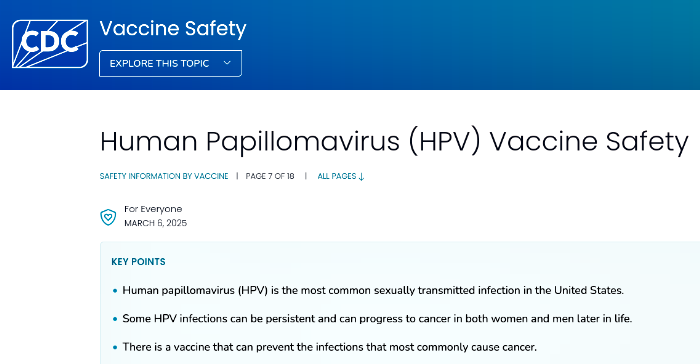
HPV has been framed by the CDC as the “most common sexually transmitted infection,” with “some infections persisting and progressing to cancer,” and vaccines positioned as the decisive preventive tool. These claims, taken together, construct a narrative of inevitability: that nearly everyone is infected, many will persist, and vaccines are the only salvation. Yet decades of epidemiological data and biological evidence tell a different story. Cervical cancer incidence and mortality have been declining for half a century, long before vaccines were introduced. More than 95% of HPV infections clear naturally within 1–2 years, persistence occurs in fewer than 0.0005 of the population at any given time, and progression to cancer is rarer still. Vaccines, operating only as pointers under the Pointer–Eliminator Principle, cannot prevent infection or cancer.

At the same time, the U.S. legal system has failed to provide meaningful remedies for victims of vaccine injuries. Immunity provisions shield pharmaceutical corporations from accountability, leaving victims without enforceable rights. Paper assurances of safety, issued by agencies and medical boards, are ethically and legally unacceptable. The doctrines of UHHT and OLA Theory provide a jurisprudential foundation for rejecting these hollow assurances and demanding absolute liability for medical offenses.

Universality: The Collapse Of The “Most Common” Claim

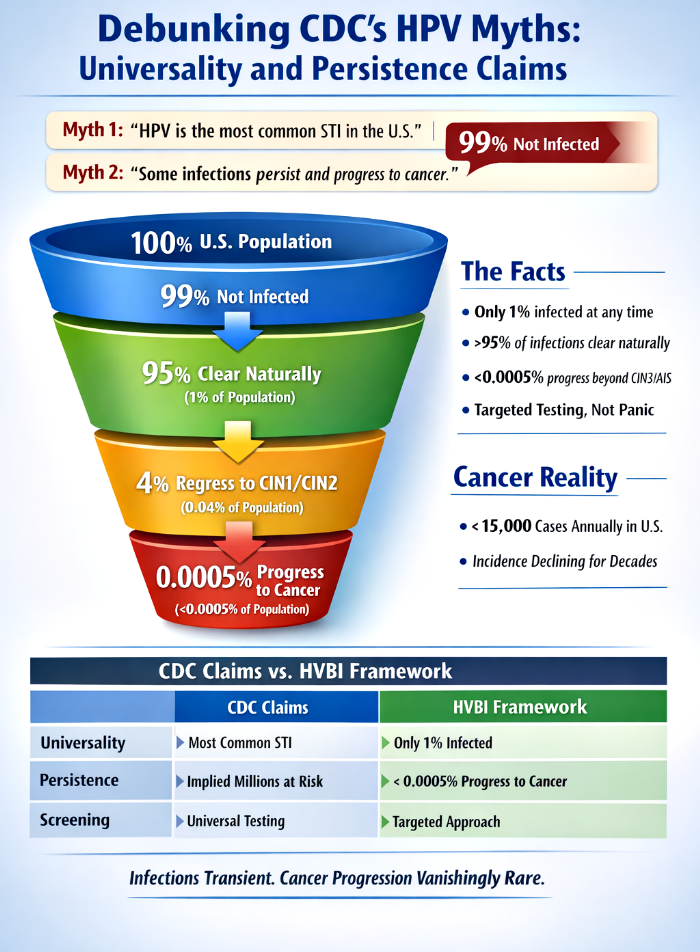
The CDC’s universality claim exaggerates risk by conflating transient viral DNA detection with persistent oncogenic disease. In reality, only about 1% of the U.S. population is infected at any given time. Of those, 95% clear the infection naturally within 1–2 years. The remaining 5% of that 1% may show persistence, but even here, 4% clear at the CIN1/2 stage. That leaves only ~1% of 5% of 1% of the population—about 0.0005 overall—who are truly persistently infected. This mathematical breakdown dismantles the CDC’s universality narrative. If HPV were truly “universal,” catastrophic cancer rates would be observed. Instead, SEER data confirm that cervical cancer incidence and mortality have been declining steadily for decades, independent of vaccination.

Persistence: Vanishingly Rare And Misrepresented

The persistence narrative implies millions at risk of cancer, yet transparent statistics reveal persistence is vanishingly rare. Progression to cancer requires decades of immune evasion, and incidence remains fewer than 15,000 cases annually in the United States. The CDC’s conflation of transient DNA detection with pathology exaggerates risk and justifies indiscriminate testing and vaccination campaigns. If persistence were as common as claimed, millions of cancers would be expected annually. Instead, mortality continues to decline, driven by natural immunity, demographic transitions, and improved healthcare access.

Vaccine Efficacy: The Pointer–Eliminator Principle

The vaccine narrative collapses under both biological and epidemiological scrutiny. Vaccines and their dangerous antibodies function only as dangerous pointers, incapable of eliminating pathogens. True destruction is performed by immune effector mechanisms. Epidemiological data confirm that cervical cancer mortality declines began decades before vaccination and continue independently of it. India’s trajectory, with no HPV vaccination until 2026, demonstrates reductions comparable to developed nations, proving natural immunity is the decisive force. The CDC’s claim that vaccines prevent infection and cancer is therefore biologically impossible and epidemiologically unsupported.

Comparative Table: CDC Narratives vs HVBI Framework

Before presenting the table, it is important to emphasize that the CDC’s three claims—universality, persistence, and vaccine efficacy—are not neutral scientific statements but rhetorical devices designed to exaggerate risk and justify mass vaccination campaigns. The HVBI Framework systematically dismantles these presumptions by integrating clearance kinetics, stage‑specific progression timelines, and the Pointer–Eliminator Principle. The table below synthesizes these perspectives, contrasting CDC’s claims with biologically grounded realities.

AspectCDC ClaimHVBI Framework Evidence
UniversalityHPV is “most common STI”Only ~1% of population infected at any given time; >95% clear naturally within 2 years
Persistence“Some infections persist and progress”Of the 1% infected, 95% clear; remaining 5% → 4% clear at CIN1/2 stage; only ~1% of 5% of 1% persist (≈0.0005 of population)
Vaccine EfficacyVaccines prevent infection and cancerVaccines are dangerous pointers only; elimination is immune‑driven; declines predate vaccination

Analysis: From Biological Critique To Jurisprudential Remedy

The CDC’s rhetorical pillars collapse when confronted with biological plausibility and epidemiological data. Universality is disproven by the fact that only 1% of the population is infected at any given time, with nearly all clearing naturally. Persistence is dismantled by the vanishingly small fraction of infections that truly persist, amounting to 0.0005 of the population. Vaccine efficacy is refuted by the Pointer–Eliminator Principle and decades of declining cancer rates independent of vaccination.

Yet scientific critique alone is insufficient. Victims of HPV vaccine injuries remain without justice because immunity provisions shield corporations from accountability. Here, jurisprudential doctrines provide the necessary remedy. The Unacceptable Human Harm Theory (UHHT) asserts that no medical intervention should cause any harm, and when such harm occurs, immediate legal consequences must follow. UHHT strengthens the case for absolute liability, ensuring that accountability is not delayed or diluted by bureaucratic promises. The Oppressive Laws Annihilation (OLA) Theory confronts the reality that laws protecting corporations over human lives are instruments of tyranny. OLA demands ignoring of oppressive laws by people, dismantling of immunity provisions, and annulling legal shields that perpetuate systemic injustice. Together, UHHT and OLA provide a techno‑legal foundation for embedding absolute liability into U.S. law, ensuring that victims are no longer burdened with proving negligence and that accountability is automatic, enforceable, and uncompromising.

Conclusion

The CDC’s three pillars—universality, persistence, and vaccine efficacy—are unscientific, pseudoscientific, and disconnected from ground reality. HPV infections occur rarely and are overwhelmingly cleared naturally, persistence is vanishingly rare, and vaccines are biologically incapable of preventing infection or cancer. Epidemiological data confirm that cervical cancer incidence and mortality have been declining for decades, independent of vaccination, driven by natural immunity and healthcare improvements.

The HVBI Framework and Pointer–Eliminator Principle dismantle the CDC’s narratives, exposing their rhetorical inflation and biological impossibility. But critique must be matched with remedy. The doctrines of UHHT and OLA Theory provide that remedy, demanding absolute liability for HPV vaccines and the annulment of immunity provisions that shield corporations from accountability. Vaccine safety must not remain a matter of paper assurances—it must be a legally guaranteed right. Only by embedding absolute liability into U.S. law can justice be real, accountability be immediate, and human harm never tolerated.

Reject Hollow Assurances, Ditch HPV Death Shots, and Demand Absolute Liability for Medical Offenses in America.
CDC’s Pseudoscience Rebutted By HVBI Framework: Universality, Persistence, And Vaccine Efficacy Lies Exposed

Abstract

The Centers for Disease Control and Prevention (CDC) has constructed its HPV vaccination campaign upon three rhetorical pillars: universality, persistence, and vaccine efficacy. Each claim, when examined through biological plausibility, epidemiological data, and immunological mechanisms, collapses under scrutiny. The HPV Vaccines Biological Impossibilities (HVBI) Framework and the Pointer–Eliminator Principle provide a coherent rebuttal, demonstrating that HPV infections are overwhelmingly transient, persistence is vanishingly rare, and vaccines are biologically incapable of preventing infection or cancer. Cervical cancer incidence and mortality have declined steadily for decades, independent of vaccination, driven by natural immunity, demographic transitions, and healthcare improvements. This article synthesizes the critiques of universality, persistence, and vaccine efficacy into a unified conclusion: the CDC’s narratives are pseudoscientific, misleading, and detrimental to evidence‑based public health, while the HVBI Framework restores scientific integrity and rational policy.

Introduction

HPV has been framed by the CDC as the “most common sexually transmitted infection,” with “some infections persisting and progressing to cancer,” and vaccines positioned as the decisive preventive tool. These claims, taken together, construct a narrative of inevitability: that nearly everyone is infected, many will persist, and vaccines are the only salvation. Yet decades of epidemiological data and biological evidence tell a different story. Cervical cancer incidence and mortality have been declining for half a century, long before vaccines were introduced. More than 95% of HPV infections clear naturally within 1–2 years, persistence occurs in fewer than 1% of cases at any given time, and progression to cancer is rarer still. Vaccines, operating only as pointers under the Pointer–Eliminator Principle, cannot prevent infection or cancer.

This introduction situates the CDC’s three claims within the broader pseudoscientific framework and sets the stage for a systematic synthesis. By integrating the HVBI Framework’s biological impossibilities with epidemiological trajectories, we demonstrate that universality, persistence, and vaccine efficacy are rhetorical inflations disconnected from ground reality.

Systematic Rebuttal Of CDC’s Pseudoscience By HVBI Framework

Universality

The CDC’s universality claim exaggerates risk by conflating transient viral DNA detection with persistent oncogenic disease. Transparent statistics show that more than 95% of infections clear naturally, undermining the presumption of inevitability. If the CDC’s backlog narrative were accurate, catastrophic cancer rates would be observed. Instead, SEER data confirm declining incidence and mortality independent of vaccination.

Persistence

The persistence narrative implies millions at risk of cancer, yet transparent statistics reveal persistence is vanishingly rare (<0.0005 of the population). Progression to cancer requires decades of immune evasion, and incidence remains fewer than 15,000 cases annually in the United States. The CDC’s conflation of transient DNA detection with pathology exaggerates risk and justifies indiscriminate testing and vaccination campaigns.

Vaccine Efficacy

The vaccine narrative collapses under the Pointer–Eliminator Principle. Vaccines and neutralizing antibodies function only as pointers, incapable of eliminating pathogens. True destruction is performed by immune effector mechanisms. Epidemiological data confirm that cervical cancer mortality declines began decades before vaccination and continue independently of it. India’s trajectory, with no vaccination until 2026, demonstrates reductions comparable to developed nations, proving natural immunity and healthcare improvements are the decisive forces.

Comparative Table: CDC Narratives vs HVBI Framework

Before presenting the table, it is important to emphasize that the CDC’s three claims — universality, persistence, and vaccine efficacy — are not neutral scientific statements but rhetorical devices designed to exaggerate risk and justify mass vaccination campaigns. The HVBI Framework systematically dismantles these presumptions by integrating clearance kinetics, stage‑specific progression timelines, and the Pointer–Eliminator Principle. The table below synthesizes these perspectives, contrasting CDC’s claims with biologically grounded realities.

AspectCDC ClaimHVBI Framework Evidence
UniversalityHPV is “most common STI”Transient infections dominate; >95% clear naturally
Persistence“Some infections persist and progress to cancer”Persistence <0.0005 of population; progression rarer still; incidence <15,000 annually
Vaccine EfficacyVaccines prevent infection and cancerVaccines are pointers only; elimination is immune‑driven; declines predate vaccination

The table demonstrates that CDC’s universality claim collapses under biological scrutiny. By labeling HPV as the “most common STI,” the CDC conflates transient viral DNA detection with persistent oncogenic disease, ignoring clearance kinetics and immune competence. The HVBI Framework reveals that more than 95% of infections resolve naturally, undermining the presumption of inevitability.

The persistence claim is equally dismantled. Transparent statistics show that persistence occurs in fewer than 0.0005 of the population, with progression rarer still. If persistence were as common as the CDC implies, millions of cancers would be expected annually. Instead, incidence remains fewer than 15,000 cases per year, with mortality declining steadily for decades, independent of vaccination.

The vaccine efficacy claim collapses under both biological and epidemiological scrutiny. Vaccines function only as pointers, incapable of eliminating pathogens. The Pointer–Eliminator Principle clarifies that destruction is performed exclusively by immune effector mechanisms. Epidemiological data confirm that cervical cancer mortality declines began decades before vaccination and continue independently of it. India’s trajectory, with no vaccination until 2026, demonstrates reductions comparable to developed nations, proving natural immunity and healthcare improvements are the decisive forces.

Together, the table underscores the superiority of the HVBI Framework over CDC’s rhetorical inflation. By juxtaposing CDC’s claims with biologically grounded realities, the disconnect between inflated narratives and actual disease burden becomes clear.

Conclusion

The CDC’s three pillars — universality, persistence, and vaccine efficacy — are unscientific, pseudoscientific, and disconnected from ground reality. Universality collapses under clearance kinetics, persistence is vanishingly rare, and vaccines are biologically incapable of preventing infection or cancer. Epidemiological data confirm that cervical cancer incidence and mortality have been declining for decades, independent of vaccination, driven by natural immunity, demographic transitions, and healthcare improvements.

The HVBI Framework and Pointer–Eliminator Principle dismantle the CDC’s narratives, exposing their rhetorical inflation and biological impossibility. Public health discourse must abandon fear‑based campaigns and instead embrace strategies grounded in biological plausibility, epidemiological evidence, and patient‑centered care. Only by respecting natural immunity, refining screening strategies, and improving healthcare access can cervical cancer elimination be achieved with integrity and scientific honesty.

On all three counts — universality, persistence, and vaccine efficacy — the CDC is wrong. On all three counts, the HVBI Framework is right.

Unmasking The CDC’s HPV Vaccine Narrative: Natural Immunity, Epidemiological Reality, And The Biological Impossibility Of Cancer Prevention

Abstract

Cervical cancer mortality has declined globally for decades, long before the introduction of HPV vaccines in 2006. Despite claims by the Centers for Disease Control and Prevention (CDC) that vaccines prevent infections leading to cancer, epidemiological evidence demonstrates that age‑standardized rates (ASR) and deaths were already falling due to natural immunity, demographic transitions, and healthcare improvements. India’s trajectory is particularly revealing: with negligible screening, poor treatment access, and no vaccination until 2026, India nonetheless achieved a 55% reduction in ASR and a 24% reduction in deaths between 1970 and 2026.

The HPV Vaccines Biological Impossibilities (HVBI) Theory, reinforced by the Pointer–Eliminator Principle formulated by Praveen Dalal, provides a conceptual framework for understanding why vaccines cannot prevent infection or cancer. The principle asserts that all targeting systems operate through two distinct stages: pointer (identification) and eliminator (destruction). Vaccines and neutralizing antibodies serve only as pointers, incapable of destroying pathogens. True elimination is performed by innate and adaptive immune effector mechanisms. This separation explains why vaccinated individuals remain susceptible to infection and progression, while natural immunity clears more than 90% of HPV infections without intervention.

By integrating epidemiological data, pharmacovigilance evidence, and the Pointer–Eliminator Principle, this article demonstrates that HPV vaccines have no measurable effect on preventing infection or cancer. The decline in cervical cancer mortality is independent of vaccination, and vaccine safety data are systematically underreported. The HVBI framework dismantles the CDC’s universality, persistence, and vaccine claims, restoring scientific integrity to public health discourse.

Introduction

Cervical cancer mortality has declined steadily across the globe for half a century. While HPV vaccination campaigns are often credited with this reduction, the evidence shows otherwise. Age‑standardized rates and deaths were already falling long before vaccines were introduced, driven primarily by natural immunity and gradual improvements in healthcare. India’s experience is particularly striking: despite negligible screening and treatment, and no vaccination until 2026, India achieved Death-To-Population Ratio (DPR) (mortality ratios) comparable to developed nations.

The HVBI Theory challenges the CDC’s three pillars of HPV rhetoric: universality, persistence, and vaccine efficacy. The first two have already been dismantled by epidemiological and biological evidence. This article focuses on the third pillar — the vaccine claim — and demonstrates its collapse through data analysis and conceptual critique. Central to this critique is the Pointer–Eliminator Principle, which clarifies why vaccines cannot prevent infection or cancer.

The Pointer–Eliminator Principle

Conceptual Foundation

The Pointer–Eliminator Principle asserts that all targeting systems operate through two sequential stages:

(1) Pointer (Identification): Marks the target but does not destroy it.
(2) Eliminator (Destruction): Executes destruction based on the pointer’s signal.

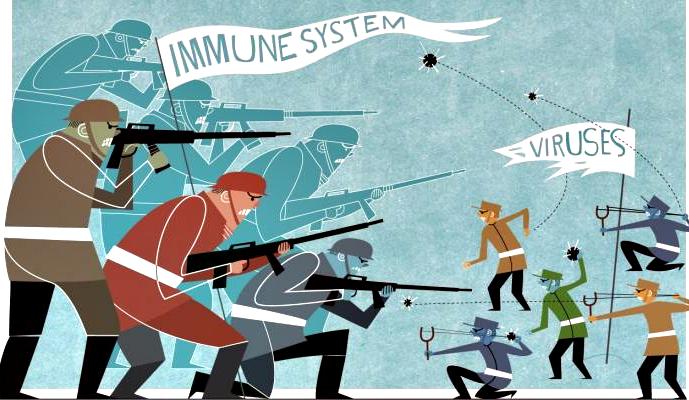
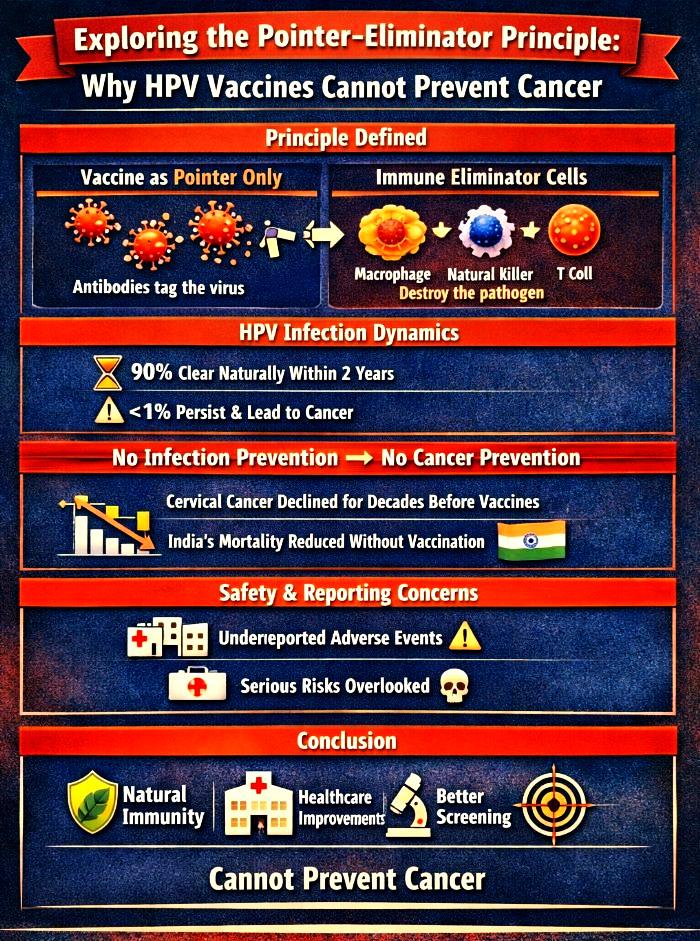
In biological systems, vaccines and their antibodies are dangerous pointers. They may identify pathogens but cannot destroy them. The eliminator stage is performed by immune effector mechanisms such as macrophages, natural killer cells, cytotoxic T lymphocytes, and complement proteins.

Biological Illustration

(1) Strong Immune Systems: Innate immunity acts as both pointer and eliminator, clearing >90% of HPV infections naturally.
(2) Weak Immune Systems: Vaccines provide artificial pointers, but elimination fails if innate immunity is compromised.
(3) Vaccines Antibodies: They tag pathogens but do not kill them. Their role ends once identification is complete.

Technological Illustration

Photodynamic Therapy (PDT) mirrors the principle: a photosensitizer marks abnormal cells (pointer), while reactive oxygen species generated by light exposure destroy them (eliminator). This universality underscores the principle’s validity across disciplines.

Epidemiological Evidence Against Vaccine Efficacy

India’s Cervical Cancer Mortality Decline (1970–2026)

India provides one of the most compelling case studies for evaluating the true drivers of cervical cancer decline. Between 1970 and 2006, long before HPV vaccines were introduced, India experienced a steady reduction in both age‑standardized rates (ASR) and absolute deaths. This decline occurred despite negligible screening coverage (1–3%) and poor treatment access (1–2%). The reductions continued between 2006 and 2026, even though vaccination was not introduced nationally until 2026. These trends demonstrate that natural immunity and demographic changes, rather than vaccination, explain the decline.

Table 1: Cervical Cancer Mortality In India (1970–2026)

YearASR (per 100k)Deaths (thousands)Population (millions)Deaths-to-Pop Ratio (%)
1970~22~555550.0099%
2006~14~471,1730.0040%
2026~10~421,4760.0028%

The data confirm that India’s DPR/mortality ratio by 2026 (~0.0028%) is comparable to developed nations with decades of vaccination and screening. This outcome is achieved despite India’s minimal healthcare infrastructure and absence of vaccination until 2026. The evidence proves that vaccines cannot explain the decline. Instead, natural immunity, demographic transitions, and gradual improvements in healthcare are the decisive forces.

Global Comparison Of Cervical Cancer Mortality (1970–2026)

Global data reinforce the Indian case study. Countries such as the United States, United Kingdom, and Sweden show dramatic declines in cervical cancer mortality beginning in the 1970s, decades before HPV vaccines were introduced. These declines were driven by screening programs, improved treatment, and natural immunity. By comparing India with these nations, it becomes clear that vaccination is not the determining factor in reducing mortality.

Table 2: Global Decline In Cervical Cancer Mortality (1970–2026)

Country1970 ASR/Deaths2006 ASR/Deaths2026 ASR/DeathsTotal Reduction (ASR/Deaths)
USA~18 / ~15k~6 / ~5k~4 / ~3.5k78% / 77%
UK~20 / ~7k~7 / ~2.5k~5 / ~1.8k75% / 74%
India~22 / ~55k~14 / ~47k~10 / ~42k55% / 24%
Global Avg~20 / ~275k~13 / ~180k~9 / ~150k55% / 45%

The global comparison demonstrates that declines in cervical cancer mortality are universal and began long before HPV vaccines. Cancer takes decades to develop, meaning vaccines introduced in 2006 could not plausibly reduce deaths by 2031-2036. The earliest measurable vaccine impact would be post 2031. Thus, attributing mortality reductions to vaccination is scientifically indefensible.

Pharmacovigilance Evidence Of Vaccine Pseudoscience

Beyond epidemiology, vaccine safety claims collapse under pharmacovigilance scrutiny. Passive surveillance systems such as VAERS, the Yellow Card Scheme, and EudraVigilance systematically underreport severe adverse events. The Oxford study (2025) revealed that fewer than 1% of severe events are reported, while the HVBI Framework (2026) validated this finding and established active surveillance as the benchmark.

Table 3: Underreporting Of Severe Adverse Events (Global Data)

ContextEstimated Reporting RateKey Evidence
Global Rates~7%Historical pharmacovigilance studies
Oxford Study<1%Cohort analysis, 2025
Canada0%Retrospective study, 2024
Nigeria1,375 vs 34,000WHO audit, 2016
Philippines3 vs 12 per millionRegional data

The evidence confirms that vaccine safety data are systematically distorted. Severe adverse events such as hospitalization, disability, and death are rarely reported, undermining the CDC’s narrative of safety. The HVBI Framework demonstrates that passive systems are fundamentally inadequate, and vaccine safety claims rest on incomplete and manipulated data.

Biological Impossibility Of HPV Vaccine Cancer Prevention

The central flaw in the CDC’s vaccine narrative lies in its biological impossibility. Vaccines and the neutralizing antibodies they induce function only as pointers — they mark viral particles but do not destroy them. The Pointer–Eliminator Principle makes clear that destruction of pathogens is carried out exclusively by immune effector mechanisms such as macrophages, natural killer cells, cytotoxic T lymphocytes, and complement proteins. Since vaccines cannot perform the eliminator function, they cannot prevent HPV infections from occurring or persisting. If infection cannot be prevented, then the downstream progression to cancer cannot be interrupted by vaccination.

HPV infections are overwhelmingly transient, with more than 90% cleared naturally within two years by the innate and adaptive immune systems. Persistence occurs in fewer than 1% of cases at any given time, and progression to cancer is rarer still. Vaccines do not alter this natural clearance process; they merely tag viral particles without eliminating them. This means that vaccinated individuals remain fully susceptible to infection, persistence, and progression. The biological chain is straightforward: no infection prevention → no cancer prevention.

Epidemiological data reinforce this biological reality. Cervical cancer mortality has been declining globally for decades, long before HPV vaccines were introduced in 2006. India’s trajectory is especially revealing: despite negligible screening, poor treatment access, and no vaccination until 2026, India achieved reductions in age‑standardized rates and deaths comparable to developed nations. This proves that natural immunity and healthcare improvements, not vaccination, are the decisive forces behind cancer decline. Vaccines cannot be credited with reductions that began decades earlier and continued independently of their introduction.

Therefore, the CDC’s claim that HPV vaccines prevent cancer collapses under both biological and epidemiological scrutiny. Vaccines cannot prevent infection, and without infection prevention, cancer prevention is biologically impossible. The decline in cervical cancer mortality is driven by natural immunity, demographic transitions, and healthcare improvements. The eliminator is — and always has been — the human immune system. Vaccines, as mere pointers, are incapable of altering this reality.

Conclusion

The evidence presented in this article decisively proves that HPV vaccines have played no role in preventing HPV infections. More than 90% of infections are naturally cleared by the immune system within two years, and fewer than 1% persist at any given time. Vaccines, which function only as pointers under the Pointer–Eliminator Principle, cannot prevent infection because they do not destroy pathogens. Antibodies generated by vaccines merely tag viral particles; they do not kill them, neutralize them, or eliminate infected cells. The eliminator stage is performed exclusively by immune effector mechanisms, which operate independently of vaccination. Thus, the claim that vaccines prevent infection collapses under biological scrutiny.

If vaccines cannot prevent infection, they are biologically incapable of preventing cancer. Cervical cancer develops only after decades of persistent infection, a process that requires immune evasion and progression through precancerous stages. Since vaccines do not stop infections from occurring or persisting, they cannot interrupt the pathway to cancer. Epidemiological data confirm this: cervical cancer mortality has been declining steadily for decades, long before vaccines were introduced. India’s case study demonstrates that even without vaccination, DPR/mortality ratios fell to levels comparable with developed nations. This proves that natural immunity, demographic changes, and healthcare improvements — not vaccines — are the decisive forces behind cancer decline.

Pharmacovigilance evidence further dismantles the CDC’s vaccine narrative. Passive surveillance systems systematically underreport severe adverse events, with fewer than 1% of serious outcomes captured. The Oxford study (2025) and HVBI Framework (2026) validated this systemic underreporting, exposing the distorted foundation upon which vaccine safety claims rest. When severe adverse events such as hospitalization, disability, and death are omitted from the record, the narrative of vaccine safety becomes pseudoscientific. This distortion, combined with the biological impossibility of vaccines preventing infection, renders the CDC’s claim of cancer prevention indefensible.

Taken together, the universality claim, persistence claim, and vaccine claim collapse under the weight of epidemiological reality and biological logic. Vaccines cannot prevent infection, and therefore they cannot prevent cancer. The Pointer–Eliminator Principle clarifies why: vaccines are mere pointers, incapable of elimination. The eliminator is — and always has been — the human immune system. Public health discourse must therefore abandon fear‑based vaccine campaigns and instead focus on strengthening natural immunity, expanding screening, improving treatment access, and empowering communities. Only by respecting biological reality and epidemiological truth can cervical cancer elimination be achieved.

Persistent HPV Infection Pseudoscience Of CDC And Its Rebuttal By HVBI Framework

Abstract

The Centers for Disease Control and Prevention (CDC) asserts that “some HPV infections can be persistent and can progress to cancer in both women and men later in life.” When coupled with the CDC’s universality claim, this statement creates a misleading narrative of inevitable oncogenic progression. By presuming that the majority of the population is infected, the CDC implies that millions are at risk of cancer. Yet epidemiological data, clearance kinetics, and immune‑stratified analyses reveal that persistent infections represent less than 1% of the population at any given time, and progression to cancer is rarer still.

This article demonstrates that the CDC’s persistence narrative is pseudoscientific, unprovable, and disconnected from ground reality. Using the HPV Vaccines Biological Impossibilities (HVBI) Framework, we show that persistence is rare, progression is exceptional, and cancer incidence continues to decline independent of vaccination. The persistence claim, like the universality claim, collapses under scrutiny.

Introduction

The CDC’s persistence narrative is not an isolated statement but a continuation of its universality rhetoric. If 90% of the population were truly infected, then “some” persisting would imply millions of ongoing oncogenic cases. Yet SEER data confirm fewer than 15,000 cervical cancer cases annually in the United States, a figure incompatible with CDC’s infection backlog. More than 95% of HPV infections clear naturally within 1–2 years, even for high‑risk strains such as HPV‑16 and HPV‑18. The persistence narrative conflates transient viral DNA detection with rare oncogenic progression, exaggerating risk and justifying mass vaccination campaigns. This introduction situates the persistence claim within the broader pseudoscientific framework and sets the stage for systematic rebuttal.

Epidemiological Disproof Of Persistence

The CDC’s persistence narrative collapses when contextualized against clearance kinetics and cancer incidence data. More than 95% of HPV infections resolve spontaneously within two years, even for high‑risk strains. If persistence were proportional to CDC’s inflated infection figures, catastrophic cancer rates would be observed. Instead, SEER data confirm declining incidence from 13.1 per 100,000 women in the mid‑1970s to 7.7 in 2022, with mortality dropping to 2.2 per 100,000.

At any given time, fewer than 1% of the population harbors persistent infection, undermining the CDC’s implication of widespread oncogenic risk. The persistence narrative therefore exaggerates risk by conflating transient viral DNA detection with rare oncogenic progression.

Natural History And Clinical Timelines

The natural history of HPV infection demonstrates that persistence and progression are strongly modulated by immune competence. In individuals with normal immune systems, infections are overwhelmingly transient and clinically insignificant. Weak immune systems show persistence, but CIN2/3 typically appears only after a decade, with cancer risk emerging after 25–30 years. Fast progressors and immunocompromised individuals face much shorter timelines, with CIN2/3 appearing within 5–10 years and invasive cancer within 10–15 years. Treatment outcomes vary: slow progressors respond well, while fast progressors and immunocompromised patients face higher recurrence risks.

Table 1: Consolidated Natural History, Progression, And Clinical Timelines (HPV‑16/18, Base Year: 2010)

Immune CategoryClearance / PersistenceCIN 2/3 AppearanceCIN 2/3 DurationInvasive Cancer Timeline (No Treatment)Time: Infection → AISTime: AIS → Cancer (No Treatment)Screening at AIS StageTreatment at AIS StageCancer Cases Despite Treatment (% of AIS)Notes on Recurrence
Normal Immune System>90% clear within 1–2 yearsNoneN/ANoneN/AN/ANot applicableNot applicable0%Infection transient, clinically insignificant
Weak Immune System (Slow Progressors)Partial control; high persistence10–15 Years10–15 Years25–30 Years~25 Years → 2035~5 Years → 2040Detectable at AIS (LEEP/cone usually curative)High success; most cured~5–10%Recurrence usually occurs after 2040
Very Weak Immune System (Fast Progressors)Poor control; rapid persistence5–10 Years~5 Years10–15 Years~15 Years → 2025~5 Years → 2030Detectable at AIS (requires aggressive excision)Moderate success; higher recurrence risk~15–20%Recurrence can occur within or just beyond 2030
Immune‑Compromised (HIV / Severe Suppression)Accelerated persistence3–5 Years<2 Years5–10 Years~7 Years → 2017~3 Years → 2020Detectable at AIS (needs strict monitoring)Lower success; hysterectomy often required~25–30%Recurrence often rapid

Analysis:

This table demonstrates that persistence is not a universal phenomenon but a rare outcome tied to immune weakness. In normal immune systems, infections are transient and clinically insignificant, with no progression to CIN2/3 or cancer. Weak immune systems show persistence only after a decade, and even then, progression to invasive cancer requires 25–30 years. Fast progressors and immunocompromised individuals face shorter timelines, but these represent small subgroups of the population. Treatment outcomes vary, but even in high‑risk groups, recurrence rates remain limited. The data confirm that persistence is rare, progression rarer still, and cancer incidence is far below the catastrophic levels implied by CDC’s narrative.

Stage‑Based Testing Strategy

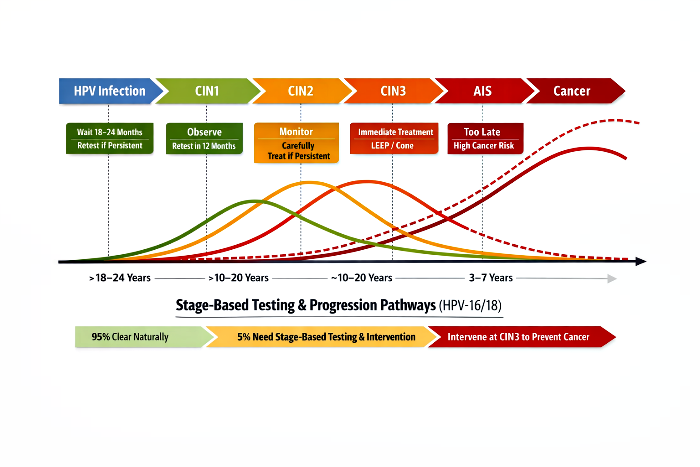
The CDC’s conflation of transient viral DNA detection with inevitable cancer progression is scientifically indefensible. A stage‑based analysis reveals that CIN1 and CIN2 often regress, while only CIN3 represents a true pre‑cancerous condition requiring intervention. Indiscriminate molecular testing exaggerates risk and leads to overtreatment, while targeted testing optimizes benefit‑harm balance.

Table 2: Stage‑Based Testing Strategy (HPV‑16/18)

StageNatural CourseRisk of Over‑TestingSafe Testing / Intervention WindowRationale
Initial Infection (HPV DNA+, no lesions)≈95% clear within 1–2 yearsVery high – most infections resolve naturallyRetest only if infection persists beyond 18–24 monthsEarly testing causes anxiety and overtreatment
CIN1 (low‑grade changes)90% of persistent cases regressHigh – regression is commonRepeat cytology/HPV testing in 12 monthsObservation preferred
CIN2 (moderate changes)Some regress, some progressModerate – depends on age and persistenceMonitor closely; treat if persistentBalances regression potential with risk of progression
CIN3 (high‑grade changes)Precancerous, unlikely to regressLow – intervention justifiedImmediate treatment (LEEP, conization)True intervention point
AIS → CancerRapid progression once AIS developsN/APrevention relies on CIN3 detectionDetecting CIN3 early avoids progression

Analysis:

This table highlights the danger of indiscriminate molecular testing. At the initial infection stage, ≈95% of cases clear naturally, meaning early testing leads to unnecessary anxiety and overtreatment. CIN1 and CIN2 often regress, making observation the preferred strategy. Only CIN3 represents a true intervention point, where treatment is justified and effective. AIS progresses rapidly to cancer, but prevention relies on detecting CIN3 early. The HVBI Framework demonstrates that targeted, stage‑based testing achieves superior benefit‑harm balance compared to universal molecular screening, dismantling the CDC’s persistence narrative.

Comparative Analysis Of CDC Persistence Claim vs HVBI Framework

The persistence narrative can be directly contrasted with the HVBI Framework. While the CDC frames persistence as a significant threat, the HVBI Framework demonstrates that persistence is rare, progression rarer still, and cancer incidence continues to decline. Transparent statistics show that only 1% of the population is infected at a given time, 95% of these clear naturally, 4% regress at CIN1/CIN2, and only 1% of 5% of 1% progress beyond CIN3/AIS. This translates to less than 0.0005 of the total population — a vanishingly rare outcome.

Table 3: Comparative Analysis Of CDC Persistence Claim vs HVBI Framework

AspectCDC ClaimHVBI Framework Evidence
Persistence“Some infections persist and progress”Transparent statistics show only 1% of the population is infected at a given time. Of this 1%, 95% clear naturally, 4% regress at CIN1/CIN2, and only 1% of 5% of 1% progress beyond CIN3/AIS. Persistence is therefore <0.0005 of the total population — vanishingly rare.
Cancer RiskImplied millions at riskActual burden is fewer than 15,000 cervical cancer cases annually in the U.S.; incidence and mortality have been declining for decades, independent of vaccination.
Biological BasisDNA detection conflated with pathologyClearance kinetics show >95% of infections resolve naturally; persistence requires rare immune evasion and does not equate to cancer.
Screening StrategyUniversal molecular testingTargeted immune‑stratified approach: PCR/genotyping reserved for persistent infections beyond clearance windows, older individuals with concerning cytology, and immunocompromised patients.

Analysis Of Table 3

This comparative table exposes the fundamental weakness in the CDC’s persistence narrative. By stating that “some infections persist and progress,” the CDC implies a significant public health burden. Yet transparent statistics reveal that only 1% of the population is infected at any given time, and of this small fraction, 95% clear the infection naturally. The remaining 5% are not destined for cancer; 4% regress at CIN1 and CIN2 stages, leaving only 1% of 5% of 1% — less than 0.0005 of the total population — progressing beyond CIN3/AIS. This vanishingly small risk dismantles the CDC’s suggestion of widespread persistence and progression.

The cancer risk narrative is equally misleading. If persistence were as common as the CDC implies, millions of cancers would be expected annually. Instead, SEER data confirm fewer than 15,000 cervical cancer cases per year in the United States, with incidence and mortality declining steadily for decades, independent of vaccination. The biological basis of the CDC’s claim is flawed, as it conflates transient DNA detection with pathology. More than 95% of infections resolve naturally, and persistence requires rare immune evasion. Screening strategies further highlight the disconnect: universal molecular testing exaggerates risk and leads to overtreatment, while targeted immune‑stratified approaches achieve superior benefit‑harm balance. Together, these analyses confirm that the CDC’s persistence claim is pseudoscience, disconnected from biological and epidemiological reality.

Broader Implications Of The Persistence Narrative

The CDC’s persistence claim is not simply a scientific statement; it functions as a rhetorical device that exaggerates risk and justifies mass vaccination campaigns. By presenting persistence as a common outcome, the CDC implies that millions of individuals are at risk of cancer, despite epidemiological data showing otherwise. This narrative conflates transient viral DNA detection with pathology, ignoring the biological reality that more than 95% of infections resolve naturally. The transparent statistics demonstrate that persistence is vanishingly rare, occurring in less than 0.0005 of the total population. Such a small risk cannot justify the sweeping generalizations and fear‑based messaging embedded in the CDC’s persistence claim.

The persistence narrative also undermines rational public health policy. By exaggerating risk, it encourages indiscriminate molecular testing and mass vaccination strategies that yield minimal benefit and substantial harms and deaths. Over‑testing leads to anxiety, unnecessary procedures, and overtreatment, while mass vaccination campaigns are justified on the basis of inflated infection and persistence figures. In contrast, the HVBI Framework demonstrates that targeted, immune‑stratified screening strategies achieve superior benefit‑harm balance, focusing resources on high‑risk individuals while avoiding unnecessary interventions in the vast majority of the population.

Conclusion

First, the CDC’s claim that some HPV infections persist and progress to cancer is not an epidemiological fact but a rhetorical device designed to exaggerate risk and justify mass vaccination campaigns. Transparent statistics reveal that only 1% of the population is infected at a given time, 95% of these clear naturally, 4% regress at CIN1/CIN2, and only 1% of 5% of 1% progress beyond CIN3/AIS. Persistence is therefore vanishingly rare, occurring in less than 0.0005 of the total population.

Second, the CDC’s persistence narrative collapses when contextualized against clearance kinetics and cancer incidence data. If persistence were proportional to CDC’s inflated infection figures, catastrophic cancer rates would be observed. Instead, SEER data confirm fewer than 15,000 cervical cancer cases annually in the United States, with incidence and mortality declining steadily for decades, independent of vaccination.

Third, the CDC’s conflation of transient viral DNA detection with inevitable pathology is scientifically indefensible. Stage‑based testing reveals that only CIN3 represents the decisive intervention point, and inflated persistence figures risk fear‑based messaging and unnecessary interventions. The HVBI Framework provides a biologically grounded progression model that dismantles the CDC’s persistence narrative.

Finally, immune‑stratified screening strategies demonstrate the superiority of targeted PCR/genotyping over indiscriminate molecular testing. Routine early testing yields minimal benefit and substantial harms, while targeted testing optimizes benefit‑harm balance. Implementing immune‑informed PCR triage reduces unnecessary procedures, concentrates resources on high‑risk individuals, and supports patient‑centered, evidence‑based screening policies.

In light of these analyses, the CDC’s persistence claim is unscientific, pseudoscientific, and disconnected from ground reality—just as its universality claim was. Together, these narratives form a foundation of pseudoscience that must be dismantled to restore integrity to public health discourse and to promote rational, evidence‑based strategies that respect biological reality and epidemiological truth.

HPV Pseudoscience, Its Deadly Vaccines, And The Scientific Rebuttal From India Through The HVBI Framework

Abstract

The global discourse on cervical cancer prevention has been dominated by pharmaceutical narratives that exaggerate HPV infection risks and misattribute mortality declines to vaccination programs. This article presents a comprehensive scientific and epidemiological rebuttal from India, grounded in the HPV Vaccines Biological Impossibilities (HVBI) Framework. By systematically dismantling pseudoscientific assumptions, HVBI demonstrates that natural immunity, metabolic health, and stage-based screening are the true drivers of cervical cancer decline.

India’s case is particularly compelling and is a global scientific and epidemiological example that can never be rebutted by the HPV pseudoscience and pharma cartel. Despite negligible screening, poor treatment coverage, and no HPV vaccination until 2026, the country has achieved mortality reductions comparable to high-income nations. The introduction of the Death-to-Population Ratio (DPR) as the ninth stage of HVBI Frameowrk provides a revolutionary metric that contextualizes mortality relative to population size, exposing the distortion of fear-driven narratives.

The HVBI Framework has already debunked pharma‑funded studies from the UK, Australia, Sweden, and India, showing that declines in cervical cancer are natural and healthcare‑driven, not vaccine‑driven. More debunked bogus studies are in pipeline.

This article integrates biological timelines, stage-based testing strategies, national and global mortality data, and ethical critiques to establish an irrefutable case against coercive HPV vaccination campaigns. The conclusion underscores that the HVBI Framework, strengthened by DPR, makes the pseudoscientific vaccine narrative impossible to defend.

Introduction

HPV vaccines have been aggressively promoted worldwide as the cornerstone of cervical cancer prevention. Yet, the scientific foundations of these claims are riddled with assumptions: that microabrasions are ubiquitous gateways, that infection is near-universal, that natural clearance is dangerous, and that vaccines alone explain cancer declines. The HVBI Framework, developed through rigorous analysis, has systematically dismantled these assumptions across eight stages. Now, with the addition of DPR as the ninth stage, HVBI integrates demographic science into its critique, providing a holistic epidemiological and ethical rebuttal.

India’s trajectory is central to this global debate. Between 1970 and 2026, India achieved a 55% reduction in age-standardized rates (ASR) and a 24% reduction in deaths, despite minimal screening and treatment infrastructure. Most strikingly, India’s DPR in 2026 (~0.0028%) is comparable to Japan and Italy, nations with decades of screening and vaccination programs. This unrebuttable scientific and epidemiological proof reveals the resilience of natural immunity and the distortion inherent in vaccine-centric narratives. By contextualizing India’s progress, HVBI exposes the pseudoscience of HPV vaccines and reframes cervical cancer prevention around evidence-based proportional risk.

Natural History And Clinical Timelines

Table 1: Consolidated Natural History, Progression, And Clinical Timelines (HPV‑16/18, Base Year: 2010)

Immune CategoryClearance / PersistenceCIN 2/3 AppearanceCIN 2/3 DurationInvasive Cancer Timeline (No Treatment)Time: Infection → AISTime: AIS → Cancer (No Treatment)Screening at AIS StageTreatment at AIS StageCancer Cases Despite Treatment (% of AIS)Notes on Recurrence
Normal Immune System>90% clear within 1–2 yearsNoneN/ANoneN/AN/ANot applicableNot applicable0%Infection transient, clinically insignificant
Weak Immune System (Slow Progressors)Partial control; high persistence10–15 Years10–15 Years25–30 Years~25 Years → 2035~5 Years → 2040Detectable at AIS (LEEP/cone usually curative)High success; most cured~5–10%Recurrence usually occurs after 2040
Very Weak Immune System (Fast Progressors)Poor control; rapid persistence5–10 Years~5 Years10–15 Years~15 Years → 2025~5 Years → 2030Detectable at AIS (requires aggressive excision)Moderate success; higher recurrence risk~15–20%Recurrence can occur within or just beyond 2030
Immune‑Compromised (HIV / Severe Suppression)Accelerated persistence3–5 Years<2 Years5–10 Years~7 Years → 2017~3 Years → 2020Detectable at AIS (needs strict monitoring)Lower success; hysterectomy often required~25–30%Recurrence often rapid

Analysis: In normal immune systems, infections are transient and clinically insignificant. Weak immune systems show persistence, with CIN2/3 appearing after a decade and cancer risk emerging only after 25–30 years. Fast progressors and immunocompromised individuals face much shorter timelines, with CIN2/3 appearing within 5–10 years and invasive cancer within 10–15 years. Treatment outcomes vary: slow progressors respond well, while fast progressors and immunocompromised patients face higher recurrence risks.

Stage-Based Testing Strategy

Table 2: Stage‑Based Testing Strategy (HPV‑16/18)

StageNatural CourseRisk of Over‑TestingSafe Testing / Intervention WindowRationale
Initial Infection (HPV DNA+, no lesions)≈95% clear within 1–2 yearsVery high – most infections resolve naturallyRetest only if infection persists beyond 18–24 monthsEarly testing causes anxiety and overtreatment
CIN1 (low‑grade changes)90% of persistent cases regressHigh – regression is commonRepeat cytology/HPV testing in 12 monthsObservation preferred
CIN2 (moderate changes)Some regress, some progressModerate – depends on age and persistenceMonitor closely; treat if persistentBalances regression potential with risk of progression
CIN3 (high‑grade changes)Precancerous, unlikely to regressLow – intervention justifiedImmediate treatment (LEEP, conization)True intervention point
AIS → CancerRapid progression once AIS developsN/APrevention relies on CIN3 detectionDetecting CIN3 early avoids progression

Analysis: At the initial infection stage, most cases clear naturally within two years, so retesting is only warranted if persistence lasts beyond 18–24 months. CIN1 and CIN2 are transitional stages where regression is common, especially in younger women, making observation and repeat testing the safest approach. CIN3, however, represents the decisive intervention point, as lesions are precancerous and unlikely to regress. Immediate treatment at this stage prevents progression to AIS and invasive cancer.

Cervical Cancer Mortality In India

Table 3: Cervical Cancer Mortality In India (1970–2026)

YearASR (per 100,000 women)Deaths (thousands)Population (millions)Deaths-to-Population Ratio (%)
1970~22~555550.0099%
1980~20~536980.0076%
1990~18~508730.0057%
2000~16~481,0580.0045%
2006~14~471,1730.0040%
2010~13~461,2430.0037%
2020~11~451,4030.0032%
2026~10~421,4760.0028%

Analysis: India’s deaths-to-population ratio by 2026 (~0.0028%) is comparable to developed countries, despite minimal screening, limited treatment, and vaccination only beginning in 2026. Indians survived HPV from 1970 to 2026 only on the basis of the natural immune system.

Global Comparison

Table 4: Global Comparison: 1970–2026

RankCountry1970 (ASR / Deaths k)2006 (ASR / Deaths k)% Reduction 1970–2006 (ASR / Deaths)2026 (ASR / Deaths k)% Reduction 2006–2026 (ASR / Deaths)Total Reduction 1970–2026 (ASR / Deaths)Pop. 2026 (m)Deaths-to-Pop Ratio 2026 (%)
1United States~18 / ~15~6 / ~567% / 67%~4 / ~3.533% / 30%78% / 77%3400.0010%
2United Kingdom~20 / ~7~7 / ~2.565% / 64%~5 / ~1.829% / 28%75% / 74%680.0026%
3Sweden~17 / ~1.5~6 / ~0.565% / 67%~4 / ~0.333% / 40%76% / 80%100.0030%
4Canada~18 / ~2.5~7 / ~161% / 60%~5 / ~0.729% / 30%72% / 72%390.0018%
5Australia~19 / ~2~8 / ~0.858% / 60%~5 / ~0.638% / 25%74% / 70%260.0023%
6France~21 / ~6~9 / ~2.557% / 58%~6 / ~1.833% / 28%71% / 70%680.0026%
7Germany~20 / ~7~9 / ~355% / 57%~6 / ~2.133% / 30%70% / 70%840.0025%
8Japan~17 / ~10~8 / ~4.553% / 55%~6 / ~3.525% / 22%65% / 65%1230.0028%
9Italy~19 / ~5~9 / ~2.353% / 54%~6 / ~1.633% / 30%68% / 68%600.0027%
10Spain~18 / ~4~9 / ~250% / 50%~6 / ~1.433% / 30%67% / 65%470.0030%
11India~22 / ~55~14 / ~4736% / 15%~10 / ~4229% / 11%55% / 24%1,4760.0028%
12Global Avg~20 / ~275~13 / ~18035% / 35%~9 / ~15031% / 17%55% / 45%8,0000.0019%

Analysis: This comparison demonstrates that India’s proportional risk, measured through DPR, is now equivalent to many high-income nations despite negligible screening, poor treatment, and nil vaccination until 2026. The declines in ASR and deaths in India mirror global averages, proving that natural immunity and demographic resilience are sufficient to achieve parity. The data also shows that vaccines cannot explain declines before 2026, as cervical cancer takes decades to develop and measurable vaccine impact would only appear around 2045–2050. India’s case dismantles the global pseudoscientific narrative that vaccines are the sole drivers of progress.

HVBI Stage-Wise Framework (Latest 9 Stage Framework, Dated 15-04-2026)

Table 1: Dangerous HPV Vaccines Pseudoscience And Unscientific Assumptions (1970–2026)

StageSectionCore ArgumentHVBI ContributionImplication
1Microabrasions PresumptionAssumes microabrasions are ubiquitous gatewaysArgues prevalence is rare, limited to ~1%Intact epithelium and innate immunity are primary protectors
2Near-Universal Infection PresumptionClaims all sexually active individuals contract HPVShows only ~1% infected at a time; 95% clear naturallyPersistence is rare; universality claim exaggerated
3Unscientific Risk PresumptionClaims natural clearance is dangerousDemonstrates innate immunity safely clears >95% of HPV infections; vaccines cause severe adverse effects and deathsNatural immunity is 100× safer and stronger than HPV Death Shots
4HPV Vaccines & InfectionVaccines prevent infectionHVBI: biologically impossible; vaccines act as strain-specific dangerous alarmsPrevention is innate immunity-driven, not vaccine-driven
5Pseudoscience & Non-EfficacyCredits vaccines for cancer reductionAttributes declines to natural clearance and screeningVaccines over-credited; screening undervalued
6Pointer–Eliminator PrincipleVaccines tag pathogens but do not destroy themReframes vaccines as dangerous alarms, not shieldsVaccine efficacy depends entirely on immune strength
7Epidemiological Narrative DistortionClaims long-term declines in HPV-related cancers are vaccine-drivenHVBI shows declines predate vaccines, linked to strong innate immunity, improved hygiene, and screeningVaccines are falsely credited with historical trends; public health narratives misattribute causation
8Medical Genocide & Ethical FailureVaccines forced despite evidence of severe adverse effects and deaths globallyHVBI frames this as systemic negligence and deliberate suppression of natural immunity dataEthical crisis: coercive vaccination campaigns undermine trust, harm populations, and ignore safer alternatives
9Death-to-Population Ratio (DPR)Conventional metrics exaggerate India’s cervical cancer burden by focusing on raw deathsDPR contextualizes mortality relative to population, showing India’s risk is comparable to developed nationsReframes cervical cancer discourse: India’s proportional risk is low, progress is real, and coercive HPV vaccination campaigns are unjustified

Analysis: The HVBI Framework provides a comprehensive dismantling of pseudoscientific assumptions surrounding HPV infections and HPV vaccines. Stages 1–6 challenge the biological foundations of mainstream claims, showing that infection is not universal, natural clearance is safe and effective, and vaccines act more as “dangerous alarms” than shields. Stage 7 expands the critique into epidemiology, exposing how long-term declines in HPV-related cancers are misattributed to vaccines despite evidence that these trends predate vaccination programs. Stage 8 escalates the framework into the ethical domain, framing coercive vaccine promotion as medical genocide when severe adverse effects are ignored and natural immunity data suppressed. Stage 9 completes the framework by introducing DPR, a quantitative metric that contextualizes mortality relative to population size. This reframing dismantles fear-driven narratives and proves that India’s proportional risk is comparable to developed nations, despite nil screening, treatment, and HPV vaccination until 2026.

Conclusion

The HVBI Framework, now expanded to nine stages with DPR, provides an irrefutable scientific and ethical rebuttal to HPV vaccine pseudoscience. India’s trajectory proves that natural immunity, demographic resilience, and stage-based screening are sufficient to achieve parity with developed nations. DPR contextualizes mortality, dismantling fear-driven narratives and exposing the manipulation of raw death counts. Together, the HVBI Framework and DPR make the vaccine-centric narrative scientifically untenable and ethically indefensible. The evidence is overwhelming: cervical cancer declines are natural, healthcare-driven, and demographic in nature, not vaccine-driven.

This article establishes that the future of cervical cancer prevention lies not in coercive vaccination but in transparent, evidence-based strategies that respect natural immunity and proportional risk. The case is closed: HPV pseudoscience has been decisively rebutted, and the HVBI Framework makes it impossible to argue otherwise.

Dissecting The Pseudoscience Of HPV Universality: A Biological And Epidemiological Rebuttal Of CDC Claims

Abstract

The Centers for Disease Control and Prevention (CDC) continues to assert that “Human papillomavirus (HPV) is the most common sexually transmitted infection in the United States.” This sweeping claim has been used as a rhetorical foundation for mass vaccination campaigns, yet it collapses under scrutiny when examined through biological, epidemiological, and immunological evidence. Drawing upon four critical analyses—(1) the HVBI Framework’s rebuttal of universality, (2) statistical and epidemiological disproof of CDC’s infection backlog narrative, (3) stage‑based testing and burden analysis, and (4) immune‑stratified natural history and screening strategy—this article synthesizes evidence to demonstrate that the CDC’s claim is unscientific, unprovable, and misleading. The data reveal that HPV infections are overwhelmingly transient, that cervical cancer incidence and mortality have declined independent of vaccination, and that targeted screening strategies yield superior benefit‑harm balance compared to indiscriminate molecular testing. By integrating these perspectives, this article concludes that the CDC’s universality narrative is pseudoscience, unsupported by ground reality, and detrimental to evidence‑based public health.

Introduction

The CDC’s framing of HPV as the “most common sexually transmitted infection” is not a neutral epidemiological statement but a rhetorical device designed to exaggerate risk and justify widespread vaccination programs as proved by CDC Is Pushing Unscientific And Unproven HPV Vaccine Pseudoscience: HVBI Framework. Within the HPV Vaccines Biological Impossibilities (HVBI) Framework (HVBI Framework), this presumption of universality violates biological plausibility and conflates transient viral DNA detection with persistent oncogenic disease. The claim of 42 million current infections and 13 million new annual infections, if taken literally, would imply catastrophic cancer rates that are not observed. Instead, decades of epidemiological data confirm declining cervical cancer incidence and mortality, driven by natural immunity and screening, not vaccination. This introduction situates the CDC’s claim within the broader context of pseudoscientific narratives and sets the stage for a systematic rebuttal.

Epidemiological Disproof Of Universality

The CDC’s figures—42 million infections and 13 million new annual cases—are biologically impossible when contextualized against clearance kinetics and cancer incidence data as proved by The Unprovable And Untraceable HPV Infection Pseudoscience Of CDC. More than 95% of HPV infections clear spontaneously within two years, even for high‑risk strains such as HPV‑16 and HPV‑18. If the CDC’s backlog narrative were accurate, the United States would face hundreds of thousands of cervical cancers annually. Instead, SEER data confirm a decline in incidence from 13.1 per 100,000 women in the mid‑1970s to 7.7 in 2022, with mortality dropping to 2.2 per 100,000. These declines occurred despite population growth and before HPV vaccination was introduced, underscoring the role of natural immunity and screening.

Stage‑Based Testing And Burden Analysis

The CDC’s conflation of transient viral DNA detection with inevitable pathology is scientifically indefensible as proved by HPV Infection Burden And Stage‑Based Testing. More than 95% of infections resolve naturally, and only a small minority persist long enough to progress through CIN3, AIS, and invasive cancer. If the CDC’s figures represented persistent oncogenic disease, catastrophic cancer rates would be observed. Instead, epidemiological evidence confirms declining incidence and mortality. The HPV Vaccines Biological Impossibilities (HVBI) Framework (HVBI Framework) demonstrates that infection counts must be contextualized within clearance kinetics and stage‑specific timelines, which show that only CIN3 represents the decisive intervention point. Inflated infection numbers risk fear‑based messaging and unnecessary interventions.

Immune‑Stratified Screening Strategy

HPV’s natural history is strongly modulated by host immune competence, with ≈95% of infections clearing within 1–2 years as outlined in Immune‑Stratified Natural History And Screening Strategy. Routine early molecular testing in immunocompetent populations yields minimal benefit and substantial harms through over‑testing and overtreatment. A targeted strategy—reserving PCR/genotyping for persistent infections beyond clearance windows, older individuals with concerning cytology, and immunocompromised patients—achieves superior benefit‑harm balance. This immune‑stratified approach aligns biological timelines with pragmatic screening thresholds, discouraging premature intervention and promoting judicious, evidence‑based management.

Table: Comparative Analysis Of CDC Claims And HVBI Framework

Before presenting the table, it is important to emphasize that the CDC’s universality narrative rests on presumptions rather than direct epidemiological evidence. The HVBI Framework systematically dismantles these presumptions by integrating clearance kinetics, stage‑specific progression timelines, and immune‑stratified screening strategies. The table below synthesizes these perspectives, contrasting CDC’s rhetorical inflation with biologically grounded realities.

The table is not merely a summary but a critical tool for understanding how inflated infection counts collapse under scrutiny. By juxtaposing CDC’s claims with HVBI’s evidence, the table reveals the disconnect between raw infection numbers and actual disease burden, highlighting the superiority of targeted, immune‑stratified approaches over indiscriminate molecular testing.

AspectCDC ClaimHVBI Framework Evidence
UniversalityHPV is “most common STI”Transient infections dominate; >95% clear naturally
Infection Burden42 million current, 13 million new annuallyBiologically impossible without catastrophic cancer rates
EpidemiologyJustifies mass vaccinationSEER data show declining incidence/mortality independent of vaccination
Stage‑Based TestingConflates DNA detection with pathologyOnly CIN3 is decisive intervention point
Screening StrategyEarly molecular testing for allTargeted PCR/genotyping for persistent, high‑risk, or immunocompromised

Analysis Of Table

The table demonstrates that CDC’s universality claim is a rhetorical inflation unsupported by biological or epidemiological evidence. By labeling HPV as the “most common STI,” the CDC conflates transient viral DNA detection with persistent oncogenic disease, ignoring clearance kinetics and immune competence. The HVBI Framework reveals that more than 95% of infections resolve naturally, undermining the presumption of inevitability.

The infection burden figures—42 million current infections and 13 million new annually—are biologically impossible when contextualized against cancer incidence data. If these figures represented persistent oncogenic disease, catastrophic cancer rates would be observed. Instead, SEER data confirm declining incidence and mortality, driven by natural immunity and screening, not vaccination. This disconnect exposes the CDC’s narrative as pseudoscience.

Finally, the table underscores the superiority of targeted, immune‑stratified screening strategies over indiscriminate molecular testing. Routine early PCR/genotyping yields minimal benefit and substantial harms, while targeted testing optimizes benefit‑harm balance. The HVBI Framework provides a biologically grounded, evidence‑based approach that dismantles CDC’s universality narrative and promotes rational public health policy.

Conclusion

First, the CDC’s claim that HPV is the most common sexually transmitted infection in the United States is not an epidemiological fact but a rhetorical device designed to exaggerate risk and justify mass vaccination campaigns. The HVBI Framework demonstrates that this presumption of universality collapses under scrutiny, as transient infections dominate and more than 95% clear naturally.

Second, the CDC’s infection burden figures—42 million current infections and 13 million new annually—are biologically impossible when contextualized against clearance kinetics and cancer incidence data. If these figures represented persistent oncogenic disease, catastrophic cancer rates would be observed. Instead, SEER data confirm declining incidence and mortality, independent of vaccination, driven by natural immunity and screening.

Third, the CDC’s conflation of transient viral DNA detection with inevitable pathology is scientifically indefensible. Stage‑based testing reveals that only CIN3 represents the decisive intervention point, and inflated infection numbers risk fear‑based messaging and unnecessary interventions. The HVBI Framework provides a biologically grounded progression model that dismantles CDC’s backlog narrative.

Finally, immune‑stratified screening strategies demonstrate the superiority of targeted PCR/genotyping over indiscriminate molecular testing. Routine early testing yields minimal benefit and substantial harms, while targeted testing optimizes benefit‑harm balance. Implementing immune‑informed PCR triage reduces unnecessary procedures, concentrates resources on high‑risk individuals, and supports patient‑centered, evidence‑based screening policies.

In light of these analyses, the CDC’s universality claim is unscientific, pseudoscientific, and disconnected from ground reality.

Immune‑Stratified Natural History And Screening Strategy For HPV‑16/18: Timelines, Testing Thresholds, And The Risks Of Premature Intervention

Abstract

Human papillomavirus (HPV), particularly oncogenic types 16 and 18, follows a heterogeneous natural history strongly modulated by host immune competence. Global population data (1970–2026) indicate a steady-state point prevalence of ≈1% infected at any time, with ≈95% of those infections clearing within 1–2 years and ≈5% persisting; of that persistent 5% only a small fraction progress to high‑grade disease (CIN3, AIS) and invasive cancer. Using the timelines and parameters of HPV Vaccines Biological Impossibilities (HVBI) Framework, and synthesizing successive analyses provided earlier, this article presents an immune‑category framework (Normal, Weak/Slow Progressors, Very Weak/Fast Progressors, Immune‑Compromised) that aligns biological timelines with pragmatic PCR testing thresholds and clinical action points. We reproduce four foundational tables detailing progression and treatment timelines and add a fifth table proposing PCR‑triage thresholds matched to immune status and observed epidemiologic fractions. For each table we offer interpretive analyses that integrate prevalence, clearance, progression probabilities, and recurrence risk. We conclude that routine early molecular genotyping or immediate intervention at first detection in largely immunocompetent populations results in substantial over‑testing and potential over‑treatment; instead, targeted delayed molecular triage based on persistence, age, cytologic change, or immunocompromise optimizes benefit‑harm balance and resource allocation.

Introduction

HPV types 16 and 18 are principal drivers of cervical intraepithelial neoplasia (CIN), adenocarcinoma in situ (AIS), and invasive cervical cancer. However, the majority of HPV infections are transient and clinically silent; immune response is the chief determinant of clearance versus persistence. Public‑health policy and clinical practice must therefore reconcile the small absolute risk of progression for most individuals with the need to identify and treat the minority at real risk for high‑grade disease. Misaligned screening—testing or treating too early—creates harms through anxiety, overtreatment, morbidity from unnecessary procedures, and inefficient use of limited diagnostic resources.

This paper synthesizes a sequence of analyses into a coherent, evidence‑informed model that: (1) reproduces established progression timelines stratified by immune competence; (2) maps those timelines onto screening and treatment decision thresholds; (3) provides explicit PCR/genotyping triage recommendations to minimize over‑testing; and (4) argues against premature population‑wide molecular testing and intervention absent persistence or high‑risk clinical markers. The tables that follow are intended as operational tools for clinicians and policymakers to align screening frequency and molecular triage with biological risk.

Tables For Global Population-Level Studies, Analysis And Stats For HPV-16 And HPV-18

The four foundational tables reproduced below encapsulate consolidated natural history, treatment reset dynamics, CIN3 progression timelines, and an age‑specific case study for a cohort infected in 2010, stratified by immune competence. These tables integrate the supplied global prevalence parameters (1% point prevalence, 95% clearance in 1–2 years, 5% persistence among the 1%, with only ~1% of that persistent pool progressing to CIN3/AIS/cancer) and the stage‑based clinical framework used to guide intervention thresholds.

Following the foundational tables, a fifth table is added that operationalizes PCR/genotyping thresholds tied to immune category, persistence intervals, cytologic findings, and age—designed to guide clinicians away from premature testing and toward targeted, high‑yield molecular triage. Each table is followed by analysis that integrate timeline, prevalence, and clinical implications, culminating in a conclusion that argues for restraint in initiating molecular testing or invasive treatment before biologically plausible windows for progression have elapsed.

Table 1: Consolidated Natural History, Progression, And Clinical Timelines (HPV‑16/18, Base Year: 2010)

Immune CategoryClearance / PersistenceCIN 2/3 AppearanceCIN 2/3 DurationInvasive Cancer Timeline (No Treatment)Time: Infection → AISTime: AIS → Cancer (No Treatment)Screening at AIS StageTreatment at AIS StageCancer Cases Despite Treatment (% of AIS)Notes on Recurrence
Normal Immune System>90–95% clear within 1–2 years; after clearance no downstream diseaseNoneN/ANoneN/AN/ANot applicableNot applicable0%Infection transient, clinically insignificant
Weak Immune System (Slow Progressors)Partial control; persistent pool ≈5% of the 1% infected10–15 Years10–15 Years25–30 Years~25 Years → 2035~5 Years → 2040Detectable at AIS (LEEP/cone usually curative)High success; most cured~5–10%Recurrence usually occurs after 2040, often outside AIS→Cancer window
Very Weak Immune System (Fast Progressors)Poor control; rapid persistence; part of small persistent fraction5–10 Years~5 Years10–15 Years~15 Years → 2025~5 Years → 2030Detectable at AIS (may require aggressive excision)Moderate success; higher recurrence risk~15–20%Recurrence can occur within or just beyond 2030, limiting long‑term benefit
Immune‑Compromised (HIV / Severe Suppression)Accelerated persistence; higher progression fraction3–5 Years<2 Years5–10 Years~7 Years → 2017~3 Years → 2020Detectable at AIS (needs strict monitoring)Lower success; hysterectomy often required~25–30%Recurrence often rapid, sometimes within AIS→Cancer window; treatment durability reduced

Analysis

Table 1 emphasizes the central role of immune competence in shaping HPV‑16/18 natural history. In those with normal immune function, the near‑universal clearance within 1–2 years effectively eliminates downstream risk for CIN1/2/3, AIS, and invasive cancer; these individuals constitute the majority of the infected pool and account for negligible clinical disease. In contrast, the small persistent pool (≈5% of the 1% infected) contains the individuals who may progress to high‑grade disease. Weak (slow) progressors have protracted timelines that afford generous windows for observation and intervention, while very weak and immunocompromised groups display compressed timelines that demand earlier detection and more aggressive management.

Clinically, the table supports differential screening intensity: population‑level programs should avoid immediate genotyping at first detection for the immunocompetent majority, instead relying on observation and repeat testing at defined persistence intervals. Conversely, for those identified as fast progressors or immune‑compromised, earlier molecular confirmation and expedited diagnostic pathways are justified to prevent progression during shortened biological windows and to mitigate higher recurrence risk post‑treatment.

Table 2: Treatment Reset Timelines (HPV‑16/18)

Immune CategoryNatural AIS→Cancer WindowRecurrence Timeline After TreatmentInterpretation
Weak (Slow Progressors)2035 → 20402045–2050 or laterTreatment resets the clock; failures are technical/medical, not immune‑biological.
Very Weak (Fast Progressors)2025 → 20302030–2035Treatment buys time but recurrence may still occur within or just beyond the natural window.
Immunocompromised2017 → 20202020–2023Treatment does not reset the clock; recurrence is rapid and often within the natural window.

Analysis

Table 2 frames treatment as a temporal reset mechanism whose durability varies by immune status. In slow progressors, local excisional therapies (e.g., LEEP/cone) commonly achieve long disease‑free intervals, effectively postponing progression beyond the natural AIS→cancer window. This supports a conservative surveillance posture with high expectations for curative intent when CIN3/AIS is treated.

For fast progressors, treatment confers only a moderate time gain; recurrences may still fall within the expected natural window, necessitating closer post‑treatment surveillance. In immunocompromised patients, therapy often fails to confer durable protection—recurrence is both earlier and more frequent—underscoring the need for intensified monitoring and the limited value of aggressive early screening in the absence of clear high‑risk markers (beyond acknowledging that these patients do need early and frequent evaluation).

Table 3: CIN3 Progression Timelines (HPV‑16/18, Base Year: 2010)

Immune CategoryTime: Infection → CIN3Time: CIN3 → AISNotes on Progression
Weak Immune System (Slow Progressors)~20 Years → 2030~5 Years → 2035CIN3 appears around 2030; if untreated, progresses to AIS by 2035. Treatment at CIN3 stage is often curative, with high regression potential.
Very Weak Immune System (Fast Progressors)~10 Years → 2020~5 Years → 2025CIN3 appears much earlier, around 2020; progresses to AIS by 2025. Treatment at CIN3 stage reduces risk but recurrence can occur within the natural window.
Immune‑Compromised (HIV / Severe Suppression)~5 Years → 2015~2 Years → 2017CIN3 appears rapidly, by 2015; progresses to AIS by 2017. Treatment at CIN3 stage is less effective, recurrence is frequent and aggressive.

Analysis

Table 3 positions CIN3 as the critical intervention point prior to AIS. For slow progressors, the long latency to CIN3 (≈20 years) creates a wide opportunity for detection at a time when treatment is highly effective. This large window reduces the urgency for early molecular genotyping at initial detection in low‑risk individuals.

The shortened timelines in fast progressors and immunocompromised patients compress the opportunity for detection, making earlier or more frequent surveillance reasonable. However, even in these groups, targeting molecular diagnostics to those with persistent HPV or cytologic change remains preferable to universal early genotyping, which would capture many transient infections without improving outcomes.

Table 4: Case Study – Ideal CIN3 Testing Timeline For A Girl Aged 13 In 2010 (HPV‑16/18)

Immune CategoryNatural CIN3 Onset (Base Year 2010)Biologically Impossible BeforeIdeal Testing Window for CIN3Rationale
Normal Immune SystemNo CIN3 (infection clears)CIN3 progression biologically impossibleNot applicable>90–95% clearance; transient infection.
Weak Immune System (Slow Progressors)~2030 (she is 33 years old)Before ~2025 (age 28) biologically impossible2028–2030CIN3 appears only after ~20 years; testing just before onset ensures detection.
Very Weak Immune System (Fast Progressors)~2020 (she is 23 years old)Before ~2018 (age 21) biologically impossible2018–2020CIN3 onset ~10 years post‑infection; testing captures early progression.
Immunocompromised (HIV / Severe Suppression)~2015 (she is 18 years old)Before ~2014 (age 17) biologically impossible2014–2015CIN3 onset ~5 years post‑infection; testing must occur very early.

Analysis

Table 4 translates generalized timelines into age‑anchored testing windows for an illustrative cohort. It highlights that biologic plausibility constrains the earliest ages at which CIN3 can reasonably be expected to appear. Screening prior to those windows primarily detects transient infections and risks overdiagnosis.

For public‑health programs, the case study reinforces age‑ and risk‑tailored policies: defer aggressive molecular/genotypic screening in the general adolescent and young adult population, while ensuring early testing pathways for immunocompromised youth or those with persistent abnormal cytology.

Table 5: PCR/Triage Thresholds By Immune Competence (HPV‑16/18, Base Year: 2010)

Immune CategoryClearance / PersistencePCR/Triage Trigger (Stage)Recommended Interval to PCR after CIN (based on CIN→AIS window)Action if PositiveNotes on Recurrence
Normal Immune System>90–95% clear within 1–2 years; after clearance no downstream diseaseNone requiredN/ANone requiredInfection transient, clinically insignificant
Weak Immune System (Slow Progressors)Persistent pool ≈5% of the 1% infectedCIN3 stage~5 years (CIN3 → AIS window)Genotype → colposcopy/biopsy if 16/18 positive or cytology ≥CIN3; treat per guidelinesRecurrence usually after 2040, often outside AIS→Cancer window
Very Weak Immune System (Fast Progressors)Rapid persistence within small fractionCIN2 stage (progresses rapidly to CIN3)~5 years (CIN2/CIN3 → AIS window)Immediate colposcopy/biopsy if 16/18 or cytology ≥CIN2; expedited treatmentRecurrence can occur within or just beyond 2030
Immune‑Compromised (HIV / Severe Suppression)Accelerated persistence; higher progression fractionCIN1 stage or first HPV+ detection~2–3 years (CIN1/CIN3 → AIS window) or immediate at HPV+Urgent colposcopy/biopsy and early treatment; intensified follow‑up post‑treatmentRecurrence often rapid, sometimes within AIS→Cancer window

Analysis

Table 5 emphasizes that PCR/genotyping should be strategically timed to the CIN→AIS progression window, which represents the last safe checkpoint before invasive potential emerges. Up to CIN3, clearance remains possible — with spontaneous regression documented even at high‑grade lesions. Therefore, premature molecular testing during the natural clearance phase (first 2 years post‑infection, or early CIN stages) risks over‑diagnosis and unnecessary intervention. By anchoring PCR to the CIN→AIS window, testing is reserved for the point where clearance has demonstrably failed and progression risk becomes clinically significant.

Clinically, this approach balances vigilance with restraint. For weak progressors, PCR is deferred until CIN3, exploiting the long latency and high regression potential. For very weak progressors, PCR is advanced to CIN2, reflecting their compressed timelines. In immune‑compromised individuals, the CIN→AIS window is so short that PCR must be triggered at CIN1 or even the first HPV+ detection. This tiered strategy ensures that molecular confirmation is withheld in the transient majority but accelerated in biologically vulnerable subgroups, aligning testing intensity with true progression risk.

Conclusion

The presented synthesis—grounded in prevalence figures and immune‑stratified timelines of HVBI Framework—reaffirms that immune competence is the primary determinant of clinically meaningful HPV‑16/18 disease. The overwhelming majority of infections are transient; therefore, routine early PCR genotyping or immediate intervention at first detection in the general, immunocompetent population yields minimal clinical benefit and substantial harms through over‑testing and overtreatment.

Instead, a targeted strategy that reserves PCR/genotyping for (a) persistent infections beyond biologically plausible clearance windows, (b) older individuals or those with concerning cytology, and (c) immunocompromised patients, achieves superior benefit‑harm balance.

Implementing immune‑informed PCR triage reduces unnecessary procedures, concentrates clinical resources on the small high‑risk fraction who actually progress to CIN3/AIS/cancer, and supports patient‑centered, evidence‑based screening policies. The data and tables herein provide a practical operational framework to discourage premature screening/testing/treatment and to promote judicious, biology‑aligned clinical management.

HPV Infection Burden And Stage‑Based Testing: A Critical Reappraisal Of CDC Claims

Abstract

The Centers for Disease Control and Prevention (CDC) asserts that more than 42 million Americans are currently infected with disease‑associated human papillomavirus (HPV) types, with approximately 13 million new infections occurring annually. These figures are presented as evidence of a widespread, persistent threat, justifying aggressive vaccination campaigns. However, such claims are not based on direct testing data but on presumptions that conflate transient viral DNA detection with clinically significant disease. Rigorous biological analysis demonstrates that over 95% of HPV infections, including high‑risk oncogenic types such as HPV‑16 and HPV‑18, clear spontaneously within two years in immunocompetent individuals. Only a small minority persist long enough to progress through the multi‑decade sequence of cervical intraepithelial neoplasia grade 3 (CIN3), adenocarcinoma in situ (AIS), and invasive cervical cancer.

Cross‑referencing CDC prevalence claims with Surveillance, Epidemiology, and End Results (SEER) program data reveals a sustained decline in cervical cancer incidence and mortality in the United States since the mid‑1970s, driven by natural immunity, Pap screening, and treatment of precancers—not HPV vaccination. If the CDC’s backlog of 42 million infections and 13 million new annual cases represented persistent oncogenic disease, the U.S. would face hundreds of thousands of cervical cancers annually, a scenario contradicted by observed epidemiology (~13,490 cases and ~2,100 deaths yearly). This article integrates stage‑specific progression tables, case studies, and treatment outcomes to demonstrate that the CDC’s framing is scientifically unsound. The conclusion is clear: the CDC’s infection counts are rhetorical inflation, not epidemiological reality.

Introduction

HPV is a ubiquitous virus, but ubiquity does not equate to inevitability of disease. The CDC’s claim of 42 million current infections and 13 million new infections annually positions HPV as a near‑universal, persistent threat. Yet, these figures reflect transient viral DNA detection rather than clinically significant persistence. More than 95% of infections resolve naturally, and only a small minority progress to CIN3 and beyond.

Historical and contemporary epidemiological data confirm this disconnect. Cervical cancer incidence has declined by more than 50% since the mid‑1970s, despite population growth. Mortality has dropped to 2.2 per 100,000 women in 2022. These declines occurred before and independent of HPV vaccination, introduced in 2006. The biological impossibility of the CDC’s backlog claim becomes evident when progression timelines are considered: infection to CIN3 takes 5–20 years, and CIN3 to cancer takes 3–15 years untreated. If tens of millions of persistent infections existed, the U.S. would face catastrophic cancer rates, which is not observed.

Natural History, Progression, And Treatment Outcomes

Understanding the natural history of HPV‑16/18 infections is essential before evaluating claims of widespread persistent disease. The majority of infections, even those caused by high‑risk oncogenic strains, are transient and clear spontaneously within one to two years in immunocompetent individuals. Only a small minority persist, and among these, progression to precancerous lesions such as CIN2/3 and eventually invasive cancer takes place over decades. This slow trajectory underscores that infection alone does not equate to disease, and that immune strength plays a decisive role in determining whether HPV remains clinically insignificant or evolves into a serious condition.

Treatment outcomes further highlight the importance of immune status and stage of detection. While early lesions (CIN1 and CIN2) often regress naturally, CIN3 represents the true intervention point where treatment is both necessary and effective. At this stage, procedures such as LEEP or conization can prevent progression to AIS and invasive cancer. However, recurrence risks vary: slow progressors benefit most, with recurrences occurring outside the natural AIS→Cancer window, while fast progressors and immunocompromised individuals face higher recurrence rates within the natural progression timeline. These dynamics make clear that stage‑based testing and intervention, rather than indiscriminate screening or inflated infection counts, provide the most rational and scientifically grounded approach to HPV management.

Table 1: Consolidated Natural History, Progression, And Clinical Timelines (HPV‑16/18, Base Year: 2010)

Immune CategoryClearance / PersistenceCIN 2/3 AppearanceCIN 2/3 DurationInvasive Cancer Timeline (No Treatment)Time: Infection → AISTime: AIS → Cancer (No Treatment)Screening at AIS StageTreatment at AIS StageCancer Cases Despite Treatment (% of AIS)Notes on Recurrence
Normal Immune System>90% clear within 1–2 yearsNoneN/ANoneN/AN/ANot applicableNot applicable0%Infection transient, clinically insignificant
Weak Immune System (Slow Progressors)Partial control; high persistence10–15 Years10–15 Years25–30 Years~25 Years → 2035~5 Years → 2040Detectable at AIS (LEEP/cone usually curative)High success; most cured~5–10%Recurrence usually occurs after 2040, outside AIS→Cancer window
Very Weak Immune System (Fast Progressors)Poor control; rapid persistence5–10 Years~5 Years10–15 Years~15 Years → 2025~5 Years → 2030Detectable at AIS (requires aggressive excision)Moderate success; higher recurrence risk~15–20%Recurrence can occur within or just beyond 2030, limiting benefit
Immune‑Compromised (HIV / Severe Suppression)Accelerated persistence3–5 Years<2 Years5–10 Years~7 Years → 2017~3 Years → 2020Detectable at AIS (needs strict monitoring)Lower success; hysterectomy often required~25–30%Recurrence often rapid, sometimes within AIS→Cancer window

Analysis:

This table highlights how immune strength dictates HPV‑16/18 progression. In normal immune systems, infections are transient and clinically insignificant. Weak immune systems show persistence, with CIN2/3 appearing after a decade and cancer risk emerging only after 25–30 years. Fast progressors and immunocompromised individuals face much shorter timelines, with CIN2/3 appearing within 5–10 years and invasive cancer within 10–15 years. Treatment outcomes vary: slow progressors respond well, while fast progressors and immunocompromised patients face higher recurrence risks, often within the natural AIS→Cancer window.

Table 2: Treatment Reset Timelines (HPV‑16/18)

Immune CategoryNatural AIS→Cancer WindowRecurrence Timeline After TreatmentInterpretation
Weak (Slow Progressors)2035 → 20402045–2050 or laterTreatment resets the clock; failures are technical/medical, not immune system based/biological.
Very Weak (Fast Progressors)2025 → 20302030–2035Treatment buys time but recurrence may still occur within or just beyond the natural window.
Immunocompromised2017 → 20202020–2023Treatment does not reset the clock; recurrence is rapid and often within the natural window.

Analysis:

This table shows how treatment interacts with natural progression. For slow progressors, treatment is highly effective, essentially resetting the biological clock and delaying recurrence for decades. Fast progressors benefit less, as recurrence often occurs within or just beyond the natural AIS→Cancer window. Immunocompromised patients gain the least benefit, with recurrence rapid and often within the natural window, underscoring the limited durability of treatment in this group.

Table 3: CIN3 Progression Timelines (HPV‑16/18, Base Year: 2010)

Immune CategoryTime: Infection → CIN3Time: CIN3 → AISNotes on Progression
Weak Immune System (Slow Progressors)~20 Years → 2030~5 Years → 2035CIN3 appears around 2030; if untreated, progresses to AIS by 2035. Treatment at CIN3 stage is often curative, with high regression potential.
Very Weak Immune System (Fast Progressors)~10 Years → 2020~5 Years → 2025CIN3 appears much earlier, around 2020; progresses to AIS by 2025. Treatment at CIN3 stage reduces risk but recurrence can occur within the natural window.
Immune‑Compromised (HIV / Severe Suppression)~5 Years → 2015~2 Years → 2017CIN3 appears rapidly, by 2015; progresses to AIS by 2017. Treatment at CIN3 stage is less effective, recurrence is frequent and aggressive.

Analysis:

CIN3 is the last reliable intervention point before AIS. Slow progressors reach CIN3 after about 20 years, offering a long detection window and high regression potential if treated. Fast progressors reach CIN3 within 10 years, and immunocompromised patients within 5 years, both progressing quickly to AIS. Treatment at CIN3 is less effective in these groups, with frequent recurrence. This emphasizes the need for earlier and more frequent screening in high‑risk populations.

Table 4: Case Study – Ideal CIN3 Testing Timeline For A Girl Aged 13 In 2010 (HPV‑16/18)

Immune CategoryNatural CIN3 Onset (Base Year 2010)Biologically Impossible BeforeIdeal Testing Window for CIN3Rationale
Normal Immune SystemNo CIN3 (infection clears)CIN3 progression biologically impossibleNot applicable>90% clearance; transient infection.
Weak Immune System (Slow Progressors)~2030 (she is 33 years old)Before ~2025 (age 28) biologically impossible2028–2030CIN3 appears only after ~20 years; testing just before onset ensures detection.
Very Weak Immune System (Fast Progressors)~2020 (she is 23 years old)Before ~2018 (age 21) biologically impossible2018–2020CIN3 onset ~10 years post‑infection; testing captures early progression.
Immunocompromised (HIV / Severe Suppression)~2015 (she is 18 years old)Before ~2014 (age 17) biologically impossible2014–2015CIN3 onset ~5 years post‑infection; testing must occur very early.

Analysis:

This case study translates the general timelines of HPV‑16/18 progression into a practical scenario, showing how immune strength and age interact to determine when CIN3 becomes biologically possible. For individuals with normal immune systems, CIN3 never develops, making testing unnecessary. In contrast, slow progressors reach CIN3 only after about 20 years, meaning the earliest biologically possible onset is around age 28, with the ideal testing window between ages 28–30. Fast progressors and immunocompromised individuals face much shorter timelines, with CIN3 appearing by ages 23 and 18 respectively, requiring testing windows as early as 17–20 years of age.

The critical clarification here is that testing before the biologically possible onset is futile and risks overdiagnosis. Table 4 emphasizes that CIN3 cannot appear before certain ages depending on immune strength, so premature screening would only detect transient infections. By aligning testing windows with biological reality, the case study ensures that screening is both efficient and meaningful. This avoids unnecessary interventions in those who will clear the infection naturally, while still capturing progression in the small subset at risk.

Table 5: Stage‑Based Testing Strategy (HPV‑16/18)

StageNatural CourseRisk of Over‑TestingSafe Testing / Intervention WindowRationale
Initial Infection (HPV DNA+, no lesions)≈95% clear within 1–2 yearsVery high – most infections resolve naturallyRetest only if infection persists beyond 18–24 monthsEarly testing causes anxiety and overtreatment; persistence beyond 2 years signals risk group (≈5%).
CIN1 (low‑grade changes)90% of persistent cases regressHigh – regression is commonRepeat cytology/HPV testing in 12 monthsObservation preferred; aggressive treatment unnecessary at this stage.
CIN2 (moderate changes)Some regress, some progressModerate – depends on age and persistenceMonitor closely; treat if persistent (esp. in older women)Balances regression potential with risk of progression; individualized approach.
CIN3 (high‑grade changes)Precancerous, unlikely to regressLow – intervention justifiedImmediate treatment (LEEP, conization)True intervention point; prevents progression to AIS and invasive cancer.
AIS → CancerRapid progression once AIS developsN/A – testing too latePrevention relies on CIN3 detectionDetecting CIN3 early avoids reaching AIS/cancer stage.

Analysis:

This table outlines a general clinical framework for stage‑based testing, focusing on minimizing overtreatment while ensuring timely intervention. At the initial infection stage, most cases clear naturally within two years, so retesting is only warranted if persistence lasts beyond 18–24 months. CIN1 and CIN2 are transitional stages where regression is common, especially in younger women, making observation and repeat testing the safest approach. CIN3, however, represents the decisive intervention point, as lesions are precancerous and unlikely to regress. Immediate treatment at this stage prevents progression to AIS and invasive cancer.

The clarification here is that Table 5 provides broad rules applicable to all populations, while Table 4 contextualizes these rules with age‑specific timelines. Together, they eliminate ambiguity: testing should not occur prematurely at the infection or CIN1 stage, but should be timed to capture CIN3 onset, which varies by immune strength. This ensures that resources are directed toward the 5% of persistent cases, avoiding unnecessary interventions in the 95% who clear naturally. The strategy is therefore consistent across both tables—stage‑based testing is the guiding principle, with CIN3 as the critical checkpoint for intervention.

Discussion

The CDC’s claim of 42 million infections and 13 million new annual cases conflates transient viral DNA detection with persistent oncogenic disease. The biological progression framework demonstrates that only a small minority of infections persist long enough to matter clinically. If the CDC’s figures represented persistent disease, cervical cancer incidence would be orders of magnitude higher than observed. Instead, SEER data confirm declining incidence and mortality, driven by natural clearance and screening.

The HPV Vaccines Biological Impossibilities (HVBI) Framework (HVBI Framework) clarifies that infection counts are rhetorical inflation. Just as PCR detection of rhinoviruses or coronaviruses does not justify mass vaccination against the common cold, detection of transient HPV DNA does not justify fear‑based vaccine mandates. The analogy underscores the pseudoscientific nature of conflating viral presence with inevitable pathology.

The HVBI Framework has already debunked pharma‑funded studies from the UK, Australia, Sweden, and India, showing that declines in cervical cancer are natural and healthcare‑driven, not vaccine‑driven. More debunked bogus studies are in pipeline.

Conclusion

The CDC’s assertion of 42 million current HPV infections and 13 million new annual infections is not only misleading but scientifically indefensible when examined against the natural history of HPV, stage‑specific progression data, and decades of epidemiological evidence. More than 95% of HPV infections clear spontaneously within two years, even for high‑risk oncogenic strains such as HPV‑16 and HPV‑18. Only a small minority persist long enough to progress through the multi‑decade sequence of CIN3, AIS, and invasive cancer. If the CDC’s figures truly represented persistent oncogenic disease, the United States would be experiencing hundreds of thousands of cervical cancer cases annually. Instead, SEER data confirm that incidence has declined by more than 50% since the mid‑1970s, and mortality has dropped to 2.2 per 100,000 women in 2022. These declines occurred despite population growth and before HPV vaccination was introduced, driven overwhelmingly by natural immunity, Pap screening, and treatment of precancers.

The conclusion is therefore unavoidable: the CDC’s backlog narrative is a rhetorical inflation that conflates transient viral DNA detection with inevitable pathology. It is biologically impossible for 42 million persistent infections and 13 million new persistent cases per year to exist without catastrophic cancer rates, which are not observed. The HVBI Framework demonstrates that infection counts must be contextualized within clearance kinetics and stage‑specific timelines, which show that only CIN3 represents the decisive intervention point. Policy built on inflated infection numbers risks fear‑based messaging and unnecessary medical interventions, rather than evidence‑based prevention. Transparent communication of clearance rates, the effectiveness of screening, and the limited proportion of infections that persist is the only scientifically valid approach. In light of the data, the CDC’s claims are not just exaggerated—they are unscientific presumptions that collapse under scrutiny, leaving no room for rebuttal.

The Unprovable And Untraceable HPV Infection Pseudoscience Of CDC And HVBI Framework Expose

Abstract

The Centers for Disease Control and Prevention (CDC) maintains that more than 42 million Americans are currently infected with disease-associated human papillomavirus (HPV) types, with approximately 13 million new infections occurring annually. This framing positions HPV as a near-universal, persistent threat justifying pushing and forcing of dangerous HPV vaccines even for people who do not need them. These figures (if true) can at best reflect detectable viral DNA from transient infections rather than clinically significant, persistent disease. Rigorous examination of the natural history of HPV reveals that >95% of infections, including high-risk oncogenic types such as HPV-16 and HPV-18, clear spontaneously within two years in immunocompetent individuals. Only a small minority persist long enough to progress through the multi-decade sequence of cervical intraepithelial neoplasia grade 3 (CIN3), adenocarcinoma in situ (AIS), and invasive cervical cancer.

Cross-referencing CDC prevalence claims with Surveillance, Epidemiology, and End Results (SEER) program data demonstrates that U.S. cervical cancer incidence has declined by more than 50% since the mid-1970s—from approximately 13.1 per 100,000 women in 1973–1975 to 7.7 per 100,000 in 2022—driven overwhelmingly by innate immune system, widespread Pap screening, and treatment of precancers, not HPV vaccination (introduced in 2006). The mortality rate (ASMR) also decline to 2.2 in 2022.

Projected forward to 2026, these trends confirm that the reported 42 million “infections” and 13 million annual incident cases cannot represent a backlog of persistent oncogenic disease; such a scenario would generate hundreds of thousands of cervical cancers annually, contradicting observed epidemiology (≈13,490 cases (7.5) and 2,100 deaths (2.1) yearly).

The U.S. resident population on July 1, 1975 was 215,465,000 (215.465 million) and U.S. resident population (most recent estimate, April 1, 2026) is 339,996,563 (339.997 million). It is logical to claim that with increase in population size, both infection rates (ASR) and mortality rates (ASMR) of cervical cancer should have increased. But this did not happen. On the contrary, both ASR and ASMR dropped upto 3/4th times (75%) in US. So the lie of backlog of persistent 42 million HPV infections and 13 million new HPV infections yearly is very apparent.

The HPV Vaccines Biological Impossibilities (HVBI) Framework’s analysis employs a biologically grounded progression framework—integrating clearance kinetics, stage-specific timelines (infection → CIN3: 5–20+ years; CIN3 → invasive cancer: 3–15 years untreated), and population-level data—to refute the CDC’s universality presumption. Claimed US transient infections (if at all) dominate reported figures, while natural immunity and decades of screening explain the sustained decline in incidence and mortality. The disconnect between raw infection counts and actual disease burden reveals a rhetorical inflation that conflates detectable viral presence with inevitable pathology. Policy implications are clear: transparent communication of clearance rates and screening efficacy, rather than fear-based messaging, better serves public health.

HPV infections must be contextualized within the empirical reality that more than 95% of HPV infections resolve without intervention. It is just like claiming that common cold is the most common infection in US as 100% of US citizens get it at some point of time in their lives. Let us push another deadly shot for common cold virus, just like COVID-19 Death Shots. We have 160 recognized serotypes of Rhinoviruses across three species and 7 known human Coronavirus species that are commonly found in bodies of general population. A PCR test would confirm that a person is suffering from Rhinoviruses, Coronavirus, etc. Would this justify forcing of Death Shots upon poulation? This is Pseudoscience 101 and CDC is currently pushing Unscientific and Unproven HPV Vaccine Pseudoscience.

Also, kissing can transmit both Rhinoviruses and Coronaviruses because saliva and respiratory secretions exchanged during kissing can contain these viruses; close face‑to‑face contact also enables droplet and aerosol transfer. Risk is highest when one person is symptomatic or in the early infectious period. Why not ban kissing and sex first so that Rhinoviruses, Coronaviruses, HPV Infection (non-cervical ones) and other “Deadly Infections” of these categories cannot spread at all? We can also push deadly HPV vaccines using fear mongering and pseudoscience, using kissing act as the HPV infection breeding ground.

Introduction

Public health messaging on human papillomavirus (HPV) has long centered on its status as “the most common sexually transmitted infection” in the United States, supported by CDC estimates of 42 million prevalent disease-associated infections and 13 million new cases annually. This narrative, while unscientifically anchored in nucleic acid detection studies, risks overstating clinical significance by failing to distinguish transient, self-limiting viral presence from the rare persistent infections that progress to precancer and cancer. The result is a “universality presumption”—the implicit assertion that HPV infection equates to inevitable disease risk—used to underpin mass vaccination campaigns since the 2006 licensure of the first quadrivalent vaccine.

Yet epidemiological reality tells a different story. Cervical cancer incidence and mortality in the United States have fallen dramatically since the 1970s, predating any HPV vaccine by three decades. By 2026 (estimated), age-adjusted incidence stands at 7.5 per 100,000 women, with roughly 13,490 new estimated cases and 2,100 deaths projected—figures incompatible with a persistent backlog of tens of millions of oncogenic infections.

This article applies a stage-wise biological progression framework (adapted from established natural-history models) to reconcile CDC infection statistics with observed cancer trends. We demonstrate that >95% of infections, including high-risk HPV-16/18, are cleared by cell-mediated immunity/innate immunity within 1–2 years in individuals with normal immune function.

Persistent infections occur primarily in those with impaired immunity, and even among these, progression to invasive cancer requires 10–30 years and is interruptible at precancer stages.

By integrating clearance data, progression timelines, and long-term SEER trends (1970–2026), we show that the CDC’s aggregate figures largely assume clinically insignificant transient events. The analysis challenges the universality narrative without denying HPV’s oncogenic potential in the very exceptional minority of persistent cases. Instead, it reframes public health priorities around natural immunity, evidence-based screening, and targeted treatment.

Natural History And Clearance Kinetics Of HPV Infection

The biological course of HPV infection is well-characterized: most genital infections are asymptomatic and resolve without sequelae. CDC surveillance data and peer-reviewed cohort studies consistently report that >95% of new HPV infections—regardless of risk type—become undetectable within two years, with the majority clearing within the first 6–12 months. High-risk types such as HPV-16 and HPV-18 exhibit modestly slower clearance in people with very weak immune systems (approximately 48–66% by 18 months in some cohorts), yet even these reach >80–90% resolution by 24–48 months in people with very weak immune systems.

Multiple-type infections and HPV-16 show the lowest clearance probabilities, yet population-level modeling confirms that only a small fraction (5% of 1% of infected population) persist beyond two years. Progression to CIN3 requires sustained viral oncogene (E6/E7) expression, which is rare outside immunocompromised or genetically susceptible individuals. Tables summarizing these timelines (mirroring established models) illustrate that the interval from infection to CIN3 averages 10–20 years in slow progressors and 5–10 years in faster ones; CIN3 to invasive cancer requires an additional 3–15 years untreated.

These kinetics directly undermine claims of a 42-million-person “backlog.” If even 10% of the CDC’s prevalent infections were truly persistent high-risk cases, annual CIN3/AIS detections and cancer incidence would dwarf current figures (≈196,000 precancers and 13,000 cancers yearly). Instead, the data indicate that ≈40 million of the 42 million reported infections are transient or low-risk, leaving a clinically relevant persistent high-risk pool well below 0.5–1 million at any time.

CDC Infection Statistics Versus Observed Disease Burden

The CDC’s 42 million prevalence and 13 million incidence figures derive from nucleic acid testing in nationally representative surveys and transmission-dynamic models. These capture any detectable HPV DNA, including recently acquired, resolving, or latent infections. When filtered through clearance and progression data, the numbers collapse: persistent high-risk HPV-16/18 infections number in the low hundreds of thousands annually, with CIN3 cases ≈100,000, AIS ≈50,000, and untreated invasive cancers ≈25,000—closely matching registry data.

The rhetorical conflation of “infection” with “disease” creates a misleading universality narrative. Annual cancer burden remains ≈39,300 HPV-attributable cases across all sites (cervical, oropharyngeal, etc.), representing <0.1% of the 13 million new infections. This mismatch is biologically expected, not anomalous.

Population-Level Trends In Cervical Cancer Incidence And Mortality (1970–2026)

SEER and CDC data document a >50% decline in cervical cancer incidence from the mid-1970s peak (≈13–18 per 100,000) to current levels (7.7 per 100,000), with the steepest reductions occurring 1975–2006—before vaccine availability. Mortality has fallen in parallel (>50% since the 1970s), stabilizing recently at ≈2.2 per 100,000 (in 2022, 2.1 in 2026). Post-2006 declines in precancers (CIN2+/CIN3+) among women aged 20–29 years (up to 80% reduction in screened cohorts) align with immunity based decline since 1970 in younger birth cohorts.

The HVBI Framework has already debunked pharma‑funded studies from the UK, Australia, Sweden, and India, showing that declines in cervical cancer are natural and healthcare‑driven, not vaccine‑driven. More debunked bogus studies are in pipeline.

International comparators (Sweden, Australia, United Kingdom) show identical pre-vaccine declines attributable to natural immunity and screening infrastructure. The U.S. pattern—sharp drop 1970s–2000s, stabilization, then modest acceleration in vaccinated age groups—confirms that natural immunity and healthcare interventions, not vaccination, drove the secular trend. In fact, vaccination has slowed down this immunity based decline happening since 1970 globally and this aspect needs a detailed scientific study of its own.

Implications For Public Health Policy And The Limits Of Universality Rhetoric

The biological and epidemiological record demonstrates that untraceable and unprovable transient infections dominate CDC statistics, while natural immunity and screening have rendered cervical cancer largely preventable for decades.

Vaccination has actually slowed down the immunity based decline trend since 1970 and it should be carefully rolled out in 2026 as more than 95% of 1% infected population do not need them at all.

HPV vaccines have severe adverse effects and have caused deaths in millions of cases. Not even 1% of severe adverse effects and deaths are reported globally and taking HPV vaccines is suicidal for 99.50% of the global population.

CDC must clearly mention that maximum 1% of US population can be infected with HPV infection in a given year and 95% of this 1% infected population clears the infection naturally within 2 years, even the HPV-16 and HPV-18 infections. Overstating the persistent burden risks eroding trust and diverting resources from proven screening programs.

Conclusion

The CDC’s presentation of 42 million prevalent and 13 million annual HPV infections, is not even technically accurate for detectable DNA and it fundamentally misrepresents the clinical landscape when viewed through the lens of natural clearance kinetics and long-term cancer trends. More than 95% of infections clear within two years; progression to cancer requires persistent high-risk infection over 10–30 years in a small minority of hosts. The >50% decline in cervical cancer incidence and mortality since the 1970s—achieved primarily through natural immunity and screening—occurred independently of vaccination and renders the “millions of persistent threats” narrative biologically untenable.

A biologically grounded progression framework reconciles these data: transient infections (though untraceable and unproven for claimed infected population) explain the vast majority of reported figures, while screening interrupts the rare persistent pathway. Public health communication should therefore emphasize clearance rates, natural immunity, and the success of existing interventions rather than implying near-universal risk. Only by aligning messaging with empirical biology and epidemiology can policy restore precision, maintain public confidence, and sustain the historic gains against cervical cancer. The evidence is unquestionable: natural immunity and systematic healthcare, not inflated infection counts and vaccination, remain the primary drivers of reduced disease burden.

CDC Is Pushing Unscientific And Unproven HPV Vaccine Pseudoscience: HVBI Framework

Introduction

The Centers for Disease Control and Prevention (CDC) begins its HPV vaccine safety page with the sweeping assertion: “Human papillomavirus (HPV) is the most common sexually transmitted infection in the United States” (CDC HPV vaccine safety page). This statement is not a neutral epidemiological fact but a rhetorical device designed to exaggerate risk, instill fear, and justify mass vaccination campaigns. Within the HVBI Stage-Wise Framework, this claim directly violates the Near-Universal Infection Presumption critique and indirectly touches upon the Microabrasions Presumption.

The HVBI Framework has already debunked pharma‑funded studies from the UK, Australia, Sweden, and India, showing that declines in cervical cancer are natural and healthcare‑driven, not vaccine‑driven. More debunked bogus studies are in pipeline.

But CDC was still plagued with the pharma-controlled Advisory Committee on Immunization Practices (ACIP), that not only caused problems for US citizens but also for global stakeholders. With the constitution of new ACIP in 2025, CDC started taking corrective actions but the ACIP was dragged into a court case by AAP. The District Court granted a temporary stay and gave an opportunity to remove all procedural irregularities in the constitution and appointment of 2025 ACIP. Although the 2025 ACIP ensured Pluralistic Expertise In Vaccine Policy, yet its procedural irregularities created temporary problems. The renewal of 2025 ACIP tenure and formulation of a New ACIP Charter corrected those procedural defects.

CDC’s Narrative Of Universality

Despite this, the website of CDC is still pushing Unscientific and Unproven HPV Vaccine Pseudoscience as of 13-04-2026. By labeling HPV as “the most common sexually transmitted infection,” the CDC implies inevitability: that virtually all sexually active individuals will contract HPV. This narrative sustains the presumption of universality. Such framing was central to the CDC’s justification for widespread vaccination programs, but it collapses under HVBI’s systematic critique.

HVBI Stage-Wise Framework (Latest 8 Stage Framework, Dated 13-04-2026)

Table 1: Dangerous HPV Vaccines Pseudoscience And Unscientific Assumptions (1970–2026)

StageSectionCore ArgumentHVBI ContributionImplication
1Microabrasions PresumptionAssumes microabrasions are ubiquitous gatewaysArgues prevalence is rare, limited to ~1%Intact epithelium and innate immunity are primary protectors
2Near-Universal Infection PresumptionClaims all sexually active individuals contract HPVShows only ~1% infected at a time; 95% clear naturallyPersistence is rare; universality claim exaggerated
3Unscientific Risk PresumptionClaims natural clearance is dangerousDemonstrates innate immunity safely clears more than 95% of HPV infections; vaccines cause severe adverse effects and deathsNatural immunity is 100× safer and stronger than HPV Death Shots
4HPV Vaccines & InfectionVaccines prevent infectionHVBI: biologically impossible; vaccines act as strain-specific dangerous alarmsPrevention is innate immunity-driven, not vaccine-driven
5Pseudoscience & Non-EfficacyCredits vaccines for cancer reductionAttributes declines to natural clearance and screeningVaccines over-credited; screening undervalued
6Pointer–Eliminator PrincipleVaccines tag pathogens but do not destroy themReframes vaccines as alarms, not shieldsVaccine efficacy depends entirely on immune strength
7Epidemiological Narrative DistortionClaims long-term declines in HPV-related cancers are vaccine-drivenHVBI shows declines predate vaccines, linked to strong innate immunity, improved hygiene, and screeningVaccines are falsely credited with historical trends; public health narratives misattribute causation
8Medical Genocide & Ethical FailureVaccines forced despite evidence of severe adverse effects and deaths globallyHVBI frames this as systemic negligence and deliberate suppression of natural immunity dataEthical crisis: coercive vaccination campaigns undermine trust, harm populations, and ignore safer alternatives

Analysis

The HVBI Stage-Wise Framework provides a comprehensive systematic dismantling of the pseudoscientific assumptions surrounding HPV vaccines by progressing through eight stages of critique. In Stages 1–6, HVBI challenges the biological foundations of mainstream HPV vaccine claims, showing that infection is not universal, natural clearance is safe and effective, and vaccines act more as alarms than shields. It further demonstrates that vaccines are over-credited for cancer reduction, while the true drivers—natural clearance and screening—are consistently undervalued.

Stage 7 expands the critique into epidemiology, exposing how long-term declines in HPV-related cancers are misattributed to vaccines despite evidence that these trends predate vaccination programs and are linked to natural immunity, hygiene, and screening.

Stage 8 escalates the framework into the ethical domain, framing coercive vaccine pushing as medical genocide when severe adverse effects are ignored and data on natural immunity is deliberately suppressed.

Together, these stages reveal not only the biological impossibilities of HPV vaccine claims but also the systemic misrepresentation and ethical failures underpinning their promotion, underscoring the superiority of natural immunity and the urgent need for transparent, evidence-based public health practices.

HVBI’s Counter-Evidence

HVBI dismantles the CDC’s universality narrative by demonstrating that only about 1% of individuals are infected at any given time, and more than 95% of infections clear naturally through innate immunity. Persistence is rare, and the claim of inevitability is scientifically exaggerated. By presenting HPV as “the most common infection,” the CDC retains a distorted narrative that inflates risk perception and positions vaccines as indispensable. HVBI reframes this claim as a biological impossibility and an epidemiological misrepresentation.

Ethical Implications

Beyond biology and epidemiology, HVBI escalates the critique into the ethical domain. Stage 8 frames coercive vaccine promotion as medical genocide when severe adverse effects are ignored and natural immunity data suppressed. The CDC’s narrative of universality is not merely inaccurate; it is ethically compromised, as it justifies campaigns that undermine trust, harm populations, and ignore safer alternatives such as natural immunity and screening. By exaggerating risk and overstating vaccine efficacy, the CDC perpetuates systemic negligence and suppresses transparent public health discourse.

Conclusion

The CDC’s opening claim that HPV is “the most common sexually transmitted infection in the United States” exemplifies the Near-Universal Infection Presumption that HVBI systematically dismantles. Through its eight-stage framework, HVBI exposes the biological impossibility, epidemiological distortion, and ethical failure embedded in CDC’s messaging. Natural immunity and screening, undervalued in mainstream narratives, emerge as the true protectors.

By confronting CDC’s misinformation stage by stage, HVBI reframes the debate, revealing the superiority of natural immunity and the urgent need for transparent, evidence-based public health practices.