Rodriguez De Quijas And The Limits Of Lower‑Court Independence: Stare Decisis, Distinguishing, And The Path To Doctrinal Change

Zucht v. King Is A Per Incuriam Decision That Must Be Overruled Urgently: Praveen Dalal

Abstract

This article examines Rodriguez de Quijas v. Shearson/American Express Inc., 490 U.S. 477 (1989), and its doctrinal command that courts of appeals must follow Directly Controlling Supreme Court Precedent even when later Supreme Court decisions appear to have undercut the precedent’s reasoning. Situating Rodriguez within the Court’s broader stare‑decisis jurisprudence, the article traces how the decision was used and critiqued by lower courts and explores the doctrinal and practical mechanisms by which lower courts may nevertheless avoid applying older precedents—by distinguishing, locating statutory abrogation, or recognizing a narrowing effect from subsequent decisions. Drawing on representative appellate decisions, the article analyzes the tensions between hierarchical fidelity and doctrinal coherence and argues that Rodriguez strikes a necessary, though imperfect, balance: it preserves institutional legitimacy and vertical uniformity while forcing doctrinal evolution to occur at the Court’s own hand or through legislative change. The article concludes by considering the institutional consequences for litigants, the circuits, and the Supreme Court, and it offers recommendations for litigators and judges about how to present and address conflicts among Supreme Court precedents.

Introduction

Stare decisis and hierarchical obedience are foundational to the federal judicial structure, and Rodriguez de Quijas announced a blunt application of that principle: when a Supreme Court precedent directly controls a lower‑court case, the court of appeals must follow it, even if later Supreme Court decisions cast doubt on the earlier decision’s reasoning. The holding crystallized an approach to “Vertical Stare Decisis” that prioritizes hierarchical clarity. On one hand, Rodriguez preserves vertical stare decisis and prevents a patchwork of circuit‑level re‑writing of Supreme Court doctrine; on the other, critics contend that rigid adherence to older precedents risks perpetuating doctrinal errors that subsequent rulings have already undermined. This article addresses three interrelated questions: how lower courts have applied Rodriguez de Quijas in practice; under what circumstances courts have distinguished or otherwise declined to follow older Supreme Court precedents without invoking the Court’s overruling power; and what Rodriguez means, institutionally and doctrinally, for the development of federal law. The analysis synthesizes representative appellate opinions, identifies recurring patterns in methodology and rhetoric, and evaluates the institutional tradeoffs that Rodriguez creates. The piece further advances a normative claim that Rodriguez’s categorical direction to lower courts is justified as a structural matter but should be complemented by clearer doctrinal signposts—both from the Supreme Court and the circuits—to reduce uncertainty and better signal when precedent is truly “on point.”

Rodriguez De Quijas: Holding, Context, And Immediate Impact

Rodriguez de Quijas arose from a dispute over the arbitrability of Securities Act claims after the Supreme Court’s arbitration‑friendly rulings in the 1980s. In overruling Wilko v. Swan, the Court announced not only a substantive arbitration rule but also the principle that courts of appeals must follow directly controlling Supreme Court precedent, leaving it to the Supreme Court to overrule its own cases. The decision therefore operated both as a vehicle for doctrinal change in the arbitration context and as a doctrinal command about lower‑court conduct. Initially, Rodriguez was greeted as a reinforcement of hierarchical coherence; commentators observed that it curtailed efforts by the circuits to engineer doctrinal change by selectively disapplying older holdings. The immediate effect was twofold. First, litigants confronting adverse but potentially weakened Supreme Court precedents found that relief through the courts of appeals was unlikely; petitioning the Supreme Court or relying on statutory change became the only reliable avenues for doctrinal reversal. Second, courts of appeals often sought to signal discomfort with an older precedent by applying it narrowly, distinguishing facts, or explicitly inviting Supreme Court review—techniques that preserve hierarchical respect while alerting the high court to possible error.

How Lower Courts Applied Rodriguez: Patterns And Representative Cases

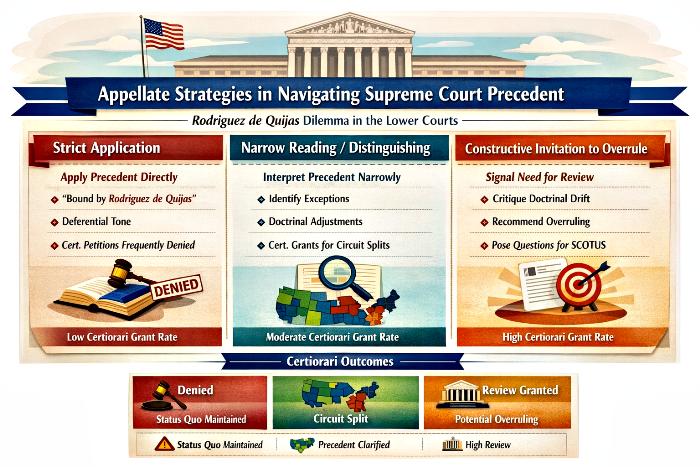
Lower courts repeatedly invoked Rodriguez when faced with older Supreme Court precedents that appeared inconsistent with later decisions, and three recurring patterns emerge from the cases. The first pattern, strict application, reflects a posture in which courts of appeals apply an older Supreme Court holding as controlling while candidly acknowledging that its reasoning has been weakened by later decisions. These opinions emphasize hierarchical duty and explicitly defer to the Supreme Court’s authority to overrule. The second pattern, narrow reading or distinguishing, shows courts reconciling an earlier holding with later doctrinal developments by restricting the earlier rule’s scope: opinions identify specific elements of the earlier holding that later decisions have eroded and then construe the precedent narrowly so as to avoid direct conflict. The third pattern, the explicit invitation, involves courts applying the controlling precedent but drafting opinions that highlight tensions, expressly recommend certiorari, or frame the question for Supreme Court reconsideration. Representative opinions across circuits demonstrate these approaches; in many instances, the circuits carefully catalogue doctrinal differences, explain why the earlier precedent remains on point, and resolve the case under that precedent while signaling the potential need for Supreme Court review.

Distinguishing, Statutory Abrogation, And The “No Longer Good Law” Dilemma

Although Rodriguez dictates adherence to directly controlling Supreme Court precedent, it does not foreclose all departures. Lower courts have identified several legitimate avenues for avoiding application of older precedents. One avenue is distinguishing the precedent on factual or legal scope grounds: if the prior decision’s facts or question differ materially from the present case, the earlier holding need not control. A second avenue involves treating intervening Supreme Court rulings as narrowing or modifying the holding—when later cases change the prior rule’s reach rather than merely criticizing its rationale, lower courts may read the earlier decision as limited. A third avenue is statutory abrogation: where Congress has enacted a statute that displaces a judicially created rule, courts may treat the prior precedent as superseded. Each of these pathways, however, presents its own risks. Distinguishing requires careful doctrinal work to avoid transparent end‑runs around Supreme Court holdings, and invoking narrowing decisions demands a defensible textual and precedential analysis showing that subsequent cases actually altered the rule rather than merely criticized its reasoning. Courts that attempt more adventurous solutions sometimes invite reversal, which underscores Rodriguez’s effect of consolidating the Supreme Court as the primary engine of doctrinal change.

Institutional And Doctrinal Consequences

Rodriguez reflects a structural judgment: maintaining vertical unity is paramount for the legitimacy and predictability of federal law. The decision shifts the burden of doctrinal correction upward, potentially overloading the Supreme Court’s docket with questions that might previously have been resolved at the circuit level. The practical consequence is a greater premium on persuasive certiorari petitions and legislative advocacy. Moreover, circuits have developed rhetorical and doctrinal tools—careful distinguishing, narrow readings, and invitation briefs—to mitigate the rigidity Rodriguez imposes. This dynamic produces both benefits and costs. Benefits include legal stability and predictable application of Supreme Court holdings; costs include temporary entrenchment of erroneous or outdated precedents and the risk of forum shopping or uneven access to Supreme Court review. The article contends that these costs are manageable if the Supreme Court communicates more clearly when it means to alter doctrine and if circuits adopt consistent methodologies for signaling doctrinal tension without purporting to overrule Supreme Court law.

Table 1: Comparative Patterns Of Lower‑Court Responses To Precedent Tension

Response TypeReasoning PatternTypical LanguageDownstream Consequences
Strict ApplicationCourts apply older Supreme Court precedent directly, even if doctrinal vitality is questioned.Deferential tone; explicit invocation of Rodriguez de Quijas; holdings framed as obligation rather than discretion.Certiorari petitions often filed seeking correction; grants relatively infrequent compared to petitions.
Narrow Reading / DistinguishingJudges parse precedent narrowly, preserving binding force while aligning outcomes with later doctrinal developments.Exploratory, doctrinally granular rhetoric; specify which elements remain authoritative vs. incompatible; construe precedent to avoid undesired outcome.More likely to prompt certiorari grants due to perceived circuit splits or need to clarify scope of precedent.
Constructive Invitation to OverruleCourts apply precedent but deliberately craft analysis to invite Supreme Court review.Explicit recommendations for certiorari; detailed accounts of doctrinal drift; questions framed to highlight need for correction.Higher-than-average rate of Supreme Court attention, as opinions provide clear vehicles for review.

The following narrative reproduces the comparative data that underlies the article’s analysis, grouping representative circuit cases by response type—Strict Application, Narrow Reading/Distinguishing, and Constructive Invitation to Overrule—and summarizing the reasoning patterns, typical language, and downstream consequences. The first group, Strict Application, contains appellate decisions in which courts confronted an older Supreme Court precedent that directly controlled the issue and therefore applied it despite misgivings about its continued doctrinal vitality. These opinions tend to use deferential language, explicitly invoke Rodriguez de Quijas, and phrase their holdings in terms of obligation rather than discretion. Where examples in this group later reached the Supreme Court by petition, the typical outcome was a certiorari petition pressing for correction, although certiorari grants were infrequent relative to the number of such petitions. The second group, Narrow Reading/Distinguishing, includes opinions that carefully parse the prior Supreme Court decision and identify narrower contours that preserve its binding force while producing an outcome more consistent with subsequent doctrinal developments. The rhetoric in these opinions is more exploratory and doctrinally granular: judges specify which elements of the prior holding remain authoritative and which are incompatible with later cases, then construe the precedent so that it does not resolve the present case against the desired outcome. Not infrequently, decisions in this category prompted certiorari grants because the Supreme Court perceived a substantive circuit split or a need to clarify the proper scope of the earlier precedent. The third group, Constructive Invitation to Overrule, comprises opinions that apply the controlling precedent yet craft their analysis to invite Supreme Court review; these opinions often include explicit recommendations for certiorari, detailed accounts of doctrinal drift, and questions framed to highlight the need for Supreme Court correction. Cases employing this strategy had a higher-than-average rate of subsequent Supreme Court attention because the appellate opinion supplied a clear vehicle for review.

Analysis Of Comparative Patterns

The first observation from the comparative narrative is that strict application underscores the functional supremacy of the Supreme Court in shaping federal law; circuits applying precedent verbatim reflect institutional caution and a preference for uniformity over prompt doctrinal innovation. This posture reduces intra‑circuit divergence and preserves predictability but can leave doctrinal tensions unresolved. In many of the strict‑application examples, litigants responded by targeting the Supreme Court through certiorari petitions, which concentrated doctrinal disputes at the Court’s doorstep and produced a slower, more centralized process for change. The second observation concerns narrow readings and distinguishing: this approach functions as a provisional compromise that aligns outcomes with later doctrinal currents while technically preserving the Supreme Court’s binding authority. Narrow readings are doctrinally sophisticated and sometimes successful at achieving results that reflect contemporary jurisprudential trends without formally displacing the earlier holding. However, because the distinctions drawn can be subtle or fact‑dependent, narrow readings risk reversal if the Supreme Court deems them artificial. The third observation relates to invitations to overrule: by framing their decisions to attract Supreme Court attention, circuits exercise a modest but meaningful influence over the Court’s certiorari docket. When appellate opinions present clean, well‑reasoned accounts of doctrinal conflict and propose precise questions for resolution, the Supreme Court has been more willing to grant review and refine doctrine—thereby validating the circuits’ role as certiorari feeders rather than doctrinal usurpers.

Downstream Outcomes: Certiorari, Reversal, And Doctrinal Refinement

Narrative evidence shows that the circuits’ strategic choices influence downstream outcomes. Opinions that rigidly applied precedent tended to produce more certiorari petitions but fewer immediate changes in law, reflecting the Supreme Court’s scarce docket resources and cautious case selection. By contrast, decisions that pursued narrow readings or expressly invited review generated more grants of certiorari and, in some instances, resulted in doctrinal refinement or overruling by the Supreme Court. The correlation between rhetorical framing and outcome is notable: appellate opinions that meticulously documented doctrinal conflict, provided modular analytical segments isolating the contested rule, and expressly recommended Supreme Court review were more likely to prompt action at the high court level. Thus, while Rodriguez centralizes the power to overrule, circuits can still shape doctrinal evolution indirectly through careful opinion drafting and strategic case framing.

Conclusion

Rodriguez de Quijas reaffirms a central structural tenet: the Supreme Court, not the courts of appeals, is the proper forum to overrule the Court’s prior decisions. That rule secures hierarchical consistency and predictability across the federal judiciary, but it concentrates the responsibility for doctrinal correction at the Supreme Court and the political branches.

Lower courts have adapted by developing doctrinal techniques—narrow readings, careful distinctions, and explicit invitations to review—that preserve hierarchical fidelity while signaling the need for change.

The institutional balance struck by Rodriguez is defensible: uniformity and legitimacy in a multi‑tiered judicial system are paramount. Nevertheless, to mitigate the costs of temporary doctrinal entrenchment, the Supreme Court should be attentive to circuit signals and provide clearer guidance when it intends to modify prior holdings. In the meantime, litigants and judges should recognize the limited but strategic avenues available for managing precedent tension: precise distinguishing, persuasive framing of conflicts, and targeted petitions for certiorari remain the most effective ways to move the law forward without violating Rodriguez’s command.
The Backdoor Problem: Vaccine Mandates Without Exemptions And Administrative Surveillance Of Homeschooling In Connecticut

The Safest Vaccine In The World Is No Vaccine: TLFPGVG

Abstract

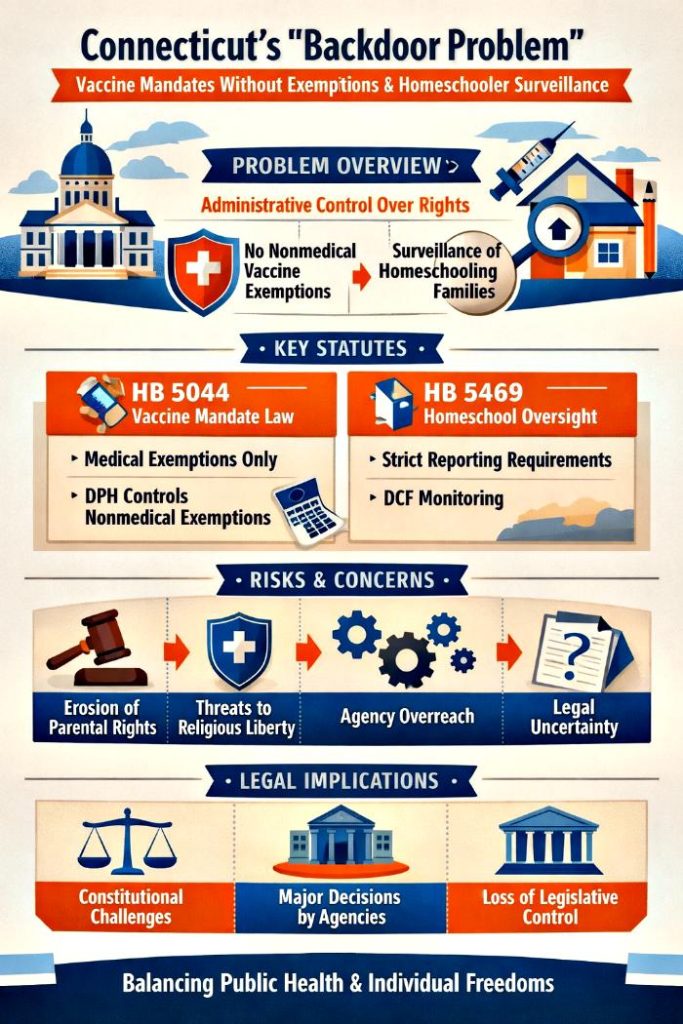
This article examines two contemporaneous Connecticut statutes—HB 5468, which establishes a regulatory framework for “equivalent instruction” (homeschooling oversight), and HB 5044, which restructures vaccine‑mandate governance by delegating nonmedical exemptions to Department of Public Health (DPH) action. Taken together, these measures illuminate a broader trend in modern statutory design: legislatures trading direct rulemaking on sensitive individual rights for administratively manageable schemes. We identify and critique what we term the “backdoor problem,” where the legislature refrains from codifying nonmedical exemptions and instead leaves them conditional on future agency rulemaking or further statutory amendment. The article situates HB 5044 and HB 5468 within historical and doctrinal contexts—Jacobson v. Massachusetts and Zucht v. King, the major‑questions doctrine, and recent Supreme Court precedents demanding statutory clarity when core liberties are implicated—and canvasses the likely constitutional claims, administrative consequences, and policy tradeoffs arising from the statutes’ design choices. Drawing on statutory text, amendment history, and constitutional doctrine, we argue that administrative precision (in the form of detailed enforcement and recordkeeping regimes) cannot substitute for legislative clarity where exemptions implicate bodily autonomy, conscience, and parental rights. This article argues that conditioning school attendance on vaccination compliance, whether in emergency or in ordinary times, is unconstitutional, violating both bodily autonomy and equal access to education. We conclude with recommendations for statutory drafting and administrative practice that restore democratic accountability and legal predictability while preserving legitimate public‑health aims.

Introduction

Over the last several legislative sessions, Connecticut has enacted measures that reveal an inclination to rely on administratively tractable frameworks when governing areas where individual autonomy and state interests collide. HB 5468 introduces a detailed system for supervising “equivalent instruction,” requiring notices, annual continuations, documentation of instruction, and routine coordination with the Department of Children and Families (DCF). HB 5044, by contrast, articulates a robust medical‑exemption process while expressly leaving nonmedical exemptions (religious and philosophical) either to future statutory amendment or to DPH rulemaking.

The juxtaposition is striking: one statute enlarges the state’s capacity for oversight of parenting and education choices; the other centralizes the power to define exemptions from medical compulsion within an administrative agency rather than the legislature itself. Both choices reveal a preference for administrative convenience and procedural uniformity over the kind of legislative clarity and entrenchment that protect fundamental liberties.

The stakes of this design choice are high. Exemptions from state coercion—especially medical mandates—bear directly on bodily autonomy, freedom of conscience, and parental authority. When legislatures leave the existence, scope, or procedural safeguards for those exemptions to forthcoming agency rules, they convert prospective rights into contingent permissions. This article argues that such delegation produces a “backdoor problem”: rights that should be statutory entitlements become effectively controlled by administrative fiat, undermining predictability, democratic accountability, and constitutional protection.

Constitutional Violations By The Proposed Connecticut Statutes

(1) Statutory Architecture: HB 5468 And HB 5044

HB 5468 constructs a supervisory architecture over homeschooling by requiring parents to file notices, submit annual affirmations, maintain instructional documentation, and route school withdrawals into DCF awareness. HB 5044 adopts a dual‑track approach to vaccine exemptions: codifying medical exemptions with clear safeguards while leaving nonmedical exemptions conditional on later statutory change or DPH rulemaking.

(2) The Backdoor Problem: Doctrine And Democratic Accountability

Delegation is a common feature of modern governance, but constitutional problems arise when delegation affects decisive issues tied to fundamental rights. Exemptions from compulsory medical interventions implicate bodily integrity and religious liberty—domains where courts demand statutory clarity. HB 5044 risks treating exemptions as discretionary regulatory concessions rather than legislatively guaranteed rights, thereby weakening democratic accountability.

(3) Interplay And Mutual Reinforcement

Taken together, HB 5468 and HB 5044 reveal a coordinated administrative thrust: routinized state contact with families choosing alternative education paths and concentrated agency power over exemptions. The common effect is expanded oversight of private family choices, increased data collection, and narrower zones of statutory protection.

(4) Litigation And Administrative Implementation

Challenges to HB 5044 will likely focus on excessive delegation, invoking separation‑of‑powers grounds and the major‑questions doctrine. Claims against HB 5468 will center on parental rights, due process, and privacy concerns. Administrative‑law claims could include challenges to rulemaking that narrows exemptions to the point of elimination.

Relevant Tables: Mapping Power And Rights In Connecticut’s Administrative Turn

Before presenting the comparative tables, it is important to situate them as analytical tools. The tables below synthesize how HB 5468 and HB 5044 allocate authority, affect rights, and produce enforcement consequences. They are not mere descriptive charts but frameworks for understanding how statutory design choices translate into lived realities for families, agencies, and courts. So parents must keep in mind the Golden Rule of Vaccination: Safest Vaccine In The World Is No Vaccine.

Table 1: Where Power Lands—Allocation, Procedure, And Rights

DimensionHB 5468 (Equivalent Instruction)HB 5044 (Vaccine Mandate Framework)
Primary decision‑makerLegislature sets framework; districts/DOE/DCF implementLegislature sets medical exemptions; DPH defines nonmedical exemptions
Key procedural mechanismsNotices, annual continuation, documentation, district review, DCF checksCodified medical exemptions; delegation to DPH for nonmedical exemptions
Rights implicatedParental rights, privacy, educational choiceBodily autonomy, religious conscience
PredictabilityModerate: clear procedures but discretionary implementationLow: medical exemptions predictable; nonmedical exemptions contingent
Legal risksFERPA/privacy, due process, parental rightsDelegation challenges, equal protection, religious liberty

Analysis:

Table 1 highlights the asymmetry in legislative specification. HB 5468 is administratively dense, prescribing notices, documentation, and district/DCF roles, thereby creating many procedural touchpoints that are predictable in form but variable in application. This produces clearer short‑term expectations but also expands the number of discretionary actors whose interpretations will determine outcomes, making uniform protection of parental rights dependent on implementation fidelity.

By contrast, HB 5044 concentrates a consequential choice—the existence and scope of nonmedical exemptions—within DPH’s rulemaking authority. The table underscores the resulting predictability gap: medical exemptions are statutorily secure, whereas nonmedical exemptions are conditional and legally unstable. That instability shifts the balance of power toward administrative decisionmakers and away from legislative accountability at precisely the moments when constitutional liberties are most implicated.

Table 2: Litigation Vectors, Administrative Actions, And Family Impacts

Litigation VectorLikely Administrative ResponsePractical Impact on Families
Delegation challenge to HB 5044DPH may delay or narrow rulesAcute uncertainty about exemptions
Parental‑rights claims against HB 5468Districts/DOE issue protocolsIncreased administrative encounters
FERPA/privacy disputesAgencies negotiate complianceConcerns about record sharing
Religious‑liberty suitsDPH crafts narrow exemption rulesRisk of exclusion from school/work
Administrative‑law challengesAgencies produce extensive recordsPolicy volatility during rulemaking

Analysis:

Table 2 maps how litigation and administrative behavior are likely to unfold. HB 5044 invites major‑questions and delegation challenges aimed squarely at the statute’s conditional approach to nonmedical exemptions. The administrative response could be to issue either deliberately narrow rules to restrict exemptions or broader rules to preserve them, but either path will encounter legal scrutiny and produce practical uncertainty for affected individuals in the interim.

For HB 5468, the table shows a multiplicity of legal fronts—privacy, parental rights, procedural due process—arising from routine data sharing and DCF screening. Administratively, districts and DCF will need to develop protocols that comply with federal privacy law while meeting statutory reporting obligations. Resource constraints and local discretion almost certainly produce uneven implementation, adding to families’ compliance burdens and amplifying the risk of contested removals or investigations.

Conclusion

HB 5468 and HB 5044 together exemplify a legislative technique that privileges administrative precision while deferring quintessentially normative decisions—those involving exemptions that touch bodily autonomy, religious conscience, and parental authority—to agencies. This is the “backdoor problem”: when crucial rights are not codified comprehensively by legislatures, they become subject to regulatory discretion and therefore vulnerable to erosion without the safeguard of explicit statutory protections and democratic accountability.

The likely consequences are predictable: increased administrative intrusion into private family life, uneven local implementation, significant litigation challenging delegated authority, and legal uncertainty for affected individuals. For lawmakers and administrators concerned with both public health and constitutional fidelity, the solution is straightforward in principle though politically difficult in practice: legislate the contours of nonmedical exemptions clearly, limit routine data sharing to cases with articulable child‑safety concerns, and reserve for the legislature the power to resolve politically salient tradeoffs that implicate fundamental rights.

Administrative agencies should be tasked with implementing—but not deciding—the existence of rights. Doing so restores predictability, preserves democratic accountability, and ensures that decisions about who may be compelled by the state to accept medical interventions remain subject to the deliberative processes our constitutional structure contemplates. Without that corrective, HB 5044 risks converting exemptions from statutory entitlements to contingent administrative favors, and HB 5468 exemplifies how oversight regimes can compound that shift—together charting a course toward administrative control where legislative clarity and constitutional protection are most needed.

Bodily Autonomy vs. Public Health: A Critical Examination Of Connecticut’s HB 5044 (2026)

The Safest Vaccine In The World Is No Vaccine: TLFPGVG

Abstract

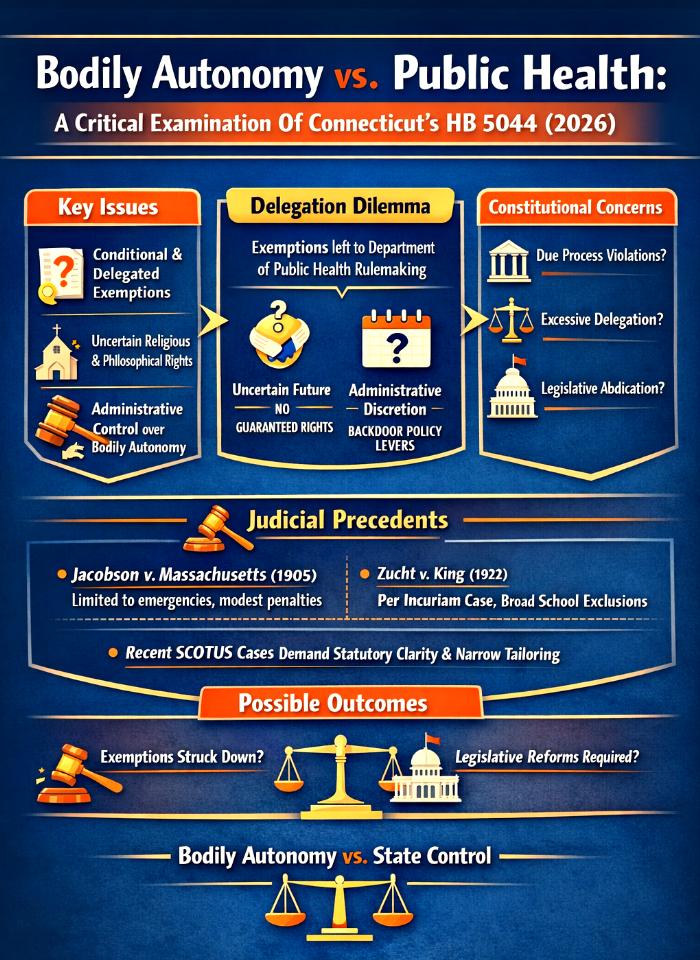
Connecticut’s HB 5044 (2026) establishes vaccine standards across schools, workplaces, and licensing contexts, but its most controversial feature lies in its treatment of exemptions. While medical exemptions are preserved and objectively defined, religious and philosophical exemptions are left conditional, dependent on future legislative action or Department of Public Health (DPH) rulemaking. This delegation creates uncertainty and raises constitutional concerns: rights tied to bodily autonomy and religious conscience are not guaranteed by statute but instead subject to administrative discretion. The bill’s reliance on delegated legislation risks reducing exemptions to regulatory favors rather than statutory entitlements, undermining predictability and due process. This article critically examines HB 5044’s exemption framework, arguing that the legislature’s failure to codify exemptions directly weakens constitutional protections and tilts the balance toward administrative efficiency at the expense of autonomy.

Introduction

Vaccination mandates have long tested the boundaries between public health imperatives and constitutional rights to bodily autonomy. Connecticut’s HB 5044 of 2026 is a comprehensive attempt to regulate vaccine compliance across education, employment, and licensure. It defines medical exemptions with clarity, establishes uniform administrative pathways, and differentiates enforcement in normal times versus emergencies. Yet, the statute’s most contentious feature is its reliance on delegated legislation for nonmedical exemptions.

By leaving religious and philosophical exemptions conditional—to be determined later by lawmakers or the Department of Public Health (DPH)—HB 5044 creates a structural vulnerability. Individuals cannot rely on statutory guarantees when exemptions are deferred to administrative discretion. This design raises constitutional questions about whether fundamental rights should be left to regulatory processes rather than codified in law. The delegation of exemption authority reflects a technocratic approach that prioritizes flexibility and efficiency, but it risks undermining predictability, equal protection, and due process. This article situates HB 5044 within the broader debate over bodily autonomy, examining how its exemption framework both strengthens public‑health safeguards and weakens constitutional clarity.

Exemptions Under Scrutiny: Rights, Beliefs, And Medical Necessity

Table 1 — Types Of Exemptions And Required Evidence

Exemption typeAvailability under HB 5044Required evidence / procedureRenewal or duration
Medical exemptionPreservedLicensed clinician statement citing contraindication; supporting medical records; specified form and deadlineTypically time‑limited or subject to clinical review; aligned with state clinical criteria
Religious exemptionConditional (depends on statute/DPH rulemaking)If preserved: signed affidavit/attestation describing sincerely held belief; possible periodic reaffirmationMay require periodic renewal if statute/rules impose it
Philosophical/nonmedical exemptionConditional (may be limited or removed)If preserved: specified attestations, signatures, and procedural steps; higher documentary burdensMay require periodic reaffirmation; could be restricted or unavailable
No exemption documentedN/ANone — individual subject to vaccination requirementsN/A

Analysis:

Medical exemptions remain secure because they are codified directly in HB 5044, but religious and philosophical exemptions are left conditional. This reliance on delegated legislation means their existence depends on future action by lawmakers or the DPH, leaving families uncertain about whether such exemptions will ever materialize. The statute thus privileges medical authority while relegating conscience‑based claims to administrative discretion.

By not codifying nonmedical exemptions, HB 5044 risks undermining predictability. Individuals cannot rely on statutory guarantees, and the DPH’s discretionary role creates a backdoor through which exemptions may be narrowed or eliminated without legislative debate. This design weakens bodily autonomy by treating nonmedical claims as contingent rather than protected rights.

Administrative Pathways: Uniformity And Due Process

Table 2 — Submission And Administrative Review Process

ClaimantWhere to submitVerification stepsNotices and appeal
Schoolchildren (public/private)Local education agency / DPHSchool verifies documentation, may contact provider, logs exemption in recordsWritten notice of approval/denial; deadline to supplement; route for administrative appeal
Homeschool studentsLocal education agency / DPH (as required)Same verification and recordkeeping obligations as schoolsWritten notice; rights to supplement and appeal per statute
Adults (employees)Employer / designated agency / DPH for guidanceEmployer verifies documentation; may request standardized forms; consult DPHWritten notice of denial; administrative appeal process; possible accommodations review
Licensure/applicantsLicensing body / program administratorVerification against statutory criteria; denial may bar licensure/participationWritten denial; administrative review or appeal available

Analysis:

The uniform administrative pathway appears fair, but its effectiveness depends on whether exemptions exist at all. Because religious and philosophical exemptions are conditional, the submission and review process may function only for medical claims, leaving other claimants without meaningful recourse. Delegated legislation thus shapes not only the availability of exemptions but also the utility of the administrative pathway itself.

Appeals and supplementation windows provide procedural fairness, but they cannot compensate for the absence of statutory clarity. If exemptions are undefined, appeals become hollow exercises. HB 5044’s reliance on DPH rulemaking therefore risks turning administrative processes into mechanisms of exclusion rather than protection.

Normal Times, Extraordinary Consequences

Table 3 — Consequences In Normal (Non‑Outbreak) Times

SubjectIf exemption approvedIf exemption denied or absent
StudentsAttend school subject to any conditions/renewalsDenied enrollment or required to catch up on vaccines; alternative education options possible (remote/home instruction)
Adults/employeesAllowed to work with any accommodations required by employerConditional employment, reassignment, testing/masking, or termination if vaccination is lawful job requirement
Licensure/program participationParticipation allowedDenial of licensure or program participation; barred from benefits or regulated roles

Analysis:

Approved exemptions allow continued participation, but because nonmedical exemptions are conditional, many individuals may never secure them. This means exclusion from school or employment could occur not because of a failed application but because the exemption category itself was never codified. Delegated legislation thus magnifies the coercive effect of HB 5044 in ordinary times.

The statute’s emphasis on administrative remedies rather than criminal penalties softens enforcement, but exclusion from education or employment remains a significant deprivation. Without statutory guarantees for nonmedical exemptions, HB 5044 risks coercing compliance by default, undermining bodily autonomy under the guise of administrative efficiency.

Emergency Imperatives: Compressing Rights For Safety

Table 4 — Emergency / Outbreak Measures And Consequences

SubjectEmergency measures permittedProcedural differences vs normal times
StudentsImmediate exclusion from school, suspension of enrollment privileges, mandatory exclusion until safeExpedited exclusion; appeals may be delayed or post‑hoc; rapid enforcement prioritized
Adults/employeesRemoval from direct care, suspension/furlough, temporary loss of facility access, rapid redeploymentFaster timelines for compliance; employer may suspend duties pending proof of immunity or exemption
Licensure/program participationTemporary suspension of privileges, ineligibility to participate until complianceLicensing bodies may act rapidly; appeals compressed or deferred

Analysis:

Emergency provisions allow rapid exclusion or suspension, but the absence of codified exemptions means individuals relying on religious or philosophical claims may be excluded automatically. Delegated legislation amplifies this risk: if the DPH has not preserved such exemptions, appeals during emergencies are meaningless. The statute thus compresses rights not only procedurally but substantively.

By prioritizing containment, HB 5044 justifies expedited measures, yet the lack of statutory clarity on exemptions ensures that bodily autonomy is most vulnerable precisely when rights should be most protected. Delegated legislation therefore transforms emergencies into contexts where autonomy is sidelined entirely.

Personal Research vs. Formalized Exemptions

Table 5 — Interaction With Personal Research/Belief-Based Refusals

ScenarioRecognized as exemption?Practical effect under HB 5044
Personal research or informal belief (no formal attestation)No, unless statute expressly allows and procedural steps are completedLikely treated as non‑compliant; subject to normal or emergency consequences
Formalized nonmedical affidavit/attestation (if statute permits)Yes, if procedural requirements metMay be accepted but could require periodic renewal and may be constrained during outbreaks
Medical contraindication based on provider evaluationYes, with supporting clinical documentationTypically accepted following verification; may be time‑limited and subject to review

Analysis:

HB 5044 channels personal research‑based refusals into formal processes, but because nonmedical exemptions are conditional, even formal affidavits may not be recognized unless the DPH chooses to preserve them. This delegation reduces autonomy to administrative discretion, undermining the constitutional principle that rights should be legislatively defined.

Medical exemptions remain secure, but nonmedical claims are precarious. The statute’s reliance on delegated legislation means that personal conscience is treated as contingent, reinforcing the hierarchy of medical necessity over autonomy. This backdoor design risks eroding pluralism and reducing rights to regulatory favors.

Delegated Legislation And The Backdoor Problem

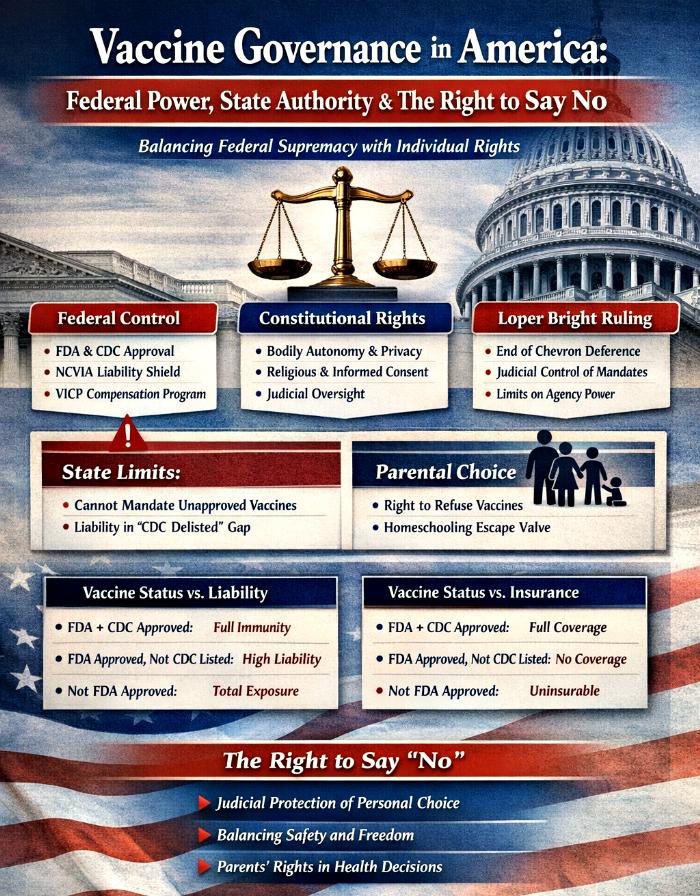
One of the most striking features of HB 5044 is its treatment of nonmedical exemptions as conditional, leaving their existence and scope to future statutory amendments or Department of Public Health (DPH) rulemaking. This design creates what can be described as a “backdoor problem”: instead of the legislature clearly defining exemptions in the statute itself, it delegates the responsibility to an administrative agency. While delegation is common in regulatory contexts, its use here raises constitutional concerns because exemptions implicate fundamental rights such as bodily autonomy, religious conscience, and equal protection.

From a constitutional perspective, the legislature’s failure to codify exemptions directly risks undermining predictability and rights protection. Individuals cannot rely on statutory guarantees if exemptions are left to administrative discretion. The DPH may issue rules, but it is equally free not to, meaning that rights are effectively reduced to regulatory favors rather than legislative entitlements. This undermines the principle that matters touching on fundamental liberties should be decided by elected representatives, not delegated to agencies. Courts have historically scrutinized such delegation when it affects core constitutional interests, and HB 5044’s structure invites similar challenges.

Moreover, the conditional design creates uncertainty about the future availability of exemptions. If the legislature did not enshrine them in HB 5044, there is little reason to expect lawmakers to reconvene solely to clarify them later. The practical effect is that religious and philosophical exemptions may never materialize, despite being nominally “conditional.” This ambiguity weakens the balance between public health and bodily autonomy, tilting the statute toward administrative efficiency at the expense of constitutional clarity. In this sense, HB 5044 risks becoming less a framework for rights protection and more a mechanism for administrative control.

Constitutional Challenge Scenario: Delegation, Exemptions, And Judicial Scrutiny

If HB 5044 were challenged in court, the central issue would be whether leaving religious and philosophical exemptions undefined and subject to Department of Public Health (DPH) discretion constitutes excessive delegation and an abdication of legislative responsibility. Courts would likely analyze the statute against the backdrop of Jacobson v. Massachusetts (1905), which upheld modest fines during a genuine epidemic but stressed that health measures must not be arbitrary or oppressive. Jacobson’s reasoning was tethered to emergency facts, proportionality, and limited penalties — none of which are clearly replicated in HB 5044’s conditional exemption design.

A litigant could argue that HB 5044 violates due process and equal protection by failing to provide statutory clarity on exemptions, thereby coercing compliance through exclusion from education or employment without legislative debate. The delegation to DPH creates a “backdoor” route for narrowing or eliminating exemptions, which courts may view as unconstitutional when fundamental rights are at stake. The critique of Zucht v. King (1922) as a per incuriam decision strengthens this argument: unlike Jacobson’s emergency‑specific fine, Zucht upheld indefinite exclusion from schooling absent contemporaneous emergency facts. HB 5044 risks repeating Zucht’s error by embedding exclusionary consequences without codified exemptions, effectively bypassing legislative accountability.

Modern jurisprudence further complicates HB 5044’s defense. Cases like Roman Catholic Diocese v. Cuomo (2020) and NFIB v. OSHA (2022) emphasize statutory clarity, narrow tailoring, and respect for constitutional rights even in emergencies. Under the “major questions doctrine,” courts now demand explicit legislative authorization when fundamental rights are implicated. HB 5044’s reliance on delegated legislation for exemptions could therefore be struck down as an unconstitutional delegation, requiring the legislature itself to define the scope of religious and philosophical exemptions. In this scenario, HB 5044 would be vulnerable not only because it mandates vaccines, but also because it abdicates the legislative duty to balance mandates with exemptions in the statute itself.

Conclusion

HB 5044 is a statute of dual character: administratively precise yet constitutionally ambiguous. Its strength lies in the clarity of medical exemptions, uniform procedures, and rapid emergency measures. However, its reliance on delegated legislation for nonmedical exemptions creates a “backdoor problem.” By failing to codify religious and philosophical exemptions directly, the legislature leaves them vulnerable to administrative discretion, reducing rights to regulatory favors rather than statutory entitlements.

This design undermines predictability and risks eroding bodily autonomy. Conditioning access to education, employment, or licensure on vaccination compliance without clear statutory exemptions can be perceived as coercive. Emergency provisions further compress procedural safeguards, normalizing exceptional measures that weaken due process. Ultimately, HB 5044 demonstrates how legislative precision can coexist with constitutional fragility. Its legacy will depend on whether courts and policymakers demand that exemptions be defined by statute rather than delegated to agencies. Without such clarity, HB 5044 risks becoming less a framework for balancing rights and more a mechanism for administrative control, tilting the scales against bodily autonomy in the name of public health.

Zucht v. King Is A Per Incuriam Decision That Must Be Overruled Urgently: Praveen Dalal

The Safest Vaccine In The World Is No Vaccine: TLFPGVG

Abstract

The constitutional debate over vaccine mandates and school exclusions pivots on a misreading of Jacobson v. Massachusetts (1905). While often cited as a sweeping endorsement of state public‑health authority, Jacobson was in fact a narrow, emergency‑specific ruling that upheld only a modest fine during a localized smallpox outbreak. It did not authorize forced medical procedures, nor did it sanction permanent exclusion from education. Modern constitutional jurisprudence—rooted in substantive due process, privacy, parental rights, and religious liberty—has decisively limited Jacobson’s reach. This article argues that conditioning school attendance on vaccination compliance, whether in emergency or ordinary times, is unconstitutional, violating both bodily autonomy and equal access to education. By situating Jacobson within its historical context, contrasting it with later cases, and analyzing Zucht v. King (1922) as a per incuriam decision, the article demonstrates that vaccine mandates tied to school entry lack constitutional legitimacy. The conclusion is clear: education cannot be used as leverage for medical compliance, and Jacobson must be read as a principle of emergency deference, not a blanket justification for coercive governance.

Introduction

The tension between liberty and public health has long animated constitutional law, with Jacobson v. Massachusetts standing as a touchstone in this debate. Decided in 1905, Jacobson upheld a small fine for refusing vaccination during a deadly smallpox epidemic, affirming that individual liberty is not absolute in the face of acute public health threats. Yet over time, Jacobson has been stretched far beyond its original context, invoked to justify routine vaccine mandates and the exclusion of children from schools. Such expansive readings are doctrinally unsound.

This article seeks to recalibrate Jacobson’s place in modern constitutional law. It begins by situating Jacobson within its historical emergency context, then traces the evolution of substantive due process, privacy, and religious liberty jurisprudence that now robustly protects bodily autonomy. It examines how later cases—from Griswold to Cruzan—have erected constitutional safeguards around informed consent, and how recent Supreme Court rulings have narrowed emergency powers through doctrines like strict scrutiny and the major questions doctrine. Finally, it considers the implications for parental rights and education, arguing that vaccine mandates tied to school attendance represent an unconstitutional overreach.

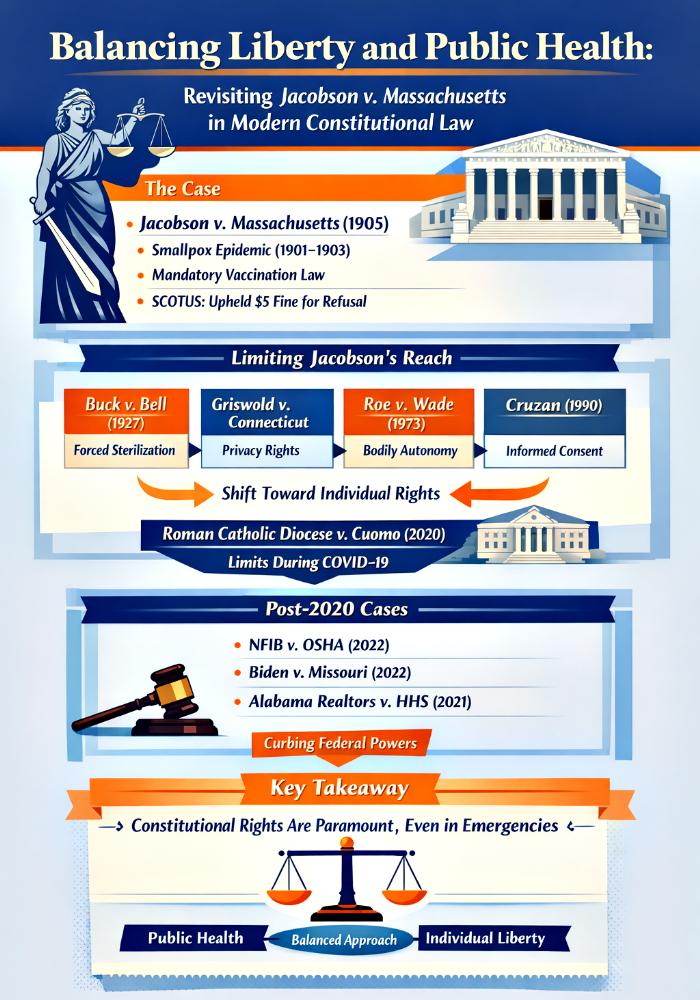
The Case Of Jacobson v. Massachusetts

In the early 1900s, Massachusetts faced recurring smallpox outbreaks, culminating in a severe epidemic between 1901 and 1903. The Massachusetts Revised Statutes of 1902 empowered local boards of health to require vaccination when necessary. Pastor Henning Jacobson refused vaccination, citing adverse reactions and liberty concerns, and was fined $5. The Supreme Court upheld the statute, emphasizing that states possess broad police powers to enact reasonable health regulations in emergencies, but stressing that such measures must not be arbitrary or oppressive. Crucially, the ruling did not authorize imprisonment or forced vaccination—only a modest fine.

Zucht v. King As A Per Incuriam Decision

Praveen Dalal’s critique underscores that Zucht v. King (1922) was decided per incuriam. Unlike Jacobson, which was tethered to an ongoing epidemic, modest penalties, and adult litigants, Zucht upheld a peacetime ordinance excluding children from public schools for non‑vaccination. This represented a doctrinal leap: shifting from emergency‑specific fines to indefinite exclusion from education, without reapplying Jacobson’s factual predicates, proportionality analysis, arbitrariness criteria, and non-oppressive mandate.

Zucht violated every one of these constitutional safeguards, and SCOTUS allowed the “Grave Injustice” to continue for more than 100 years, says Praveen Dalal.

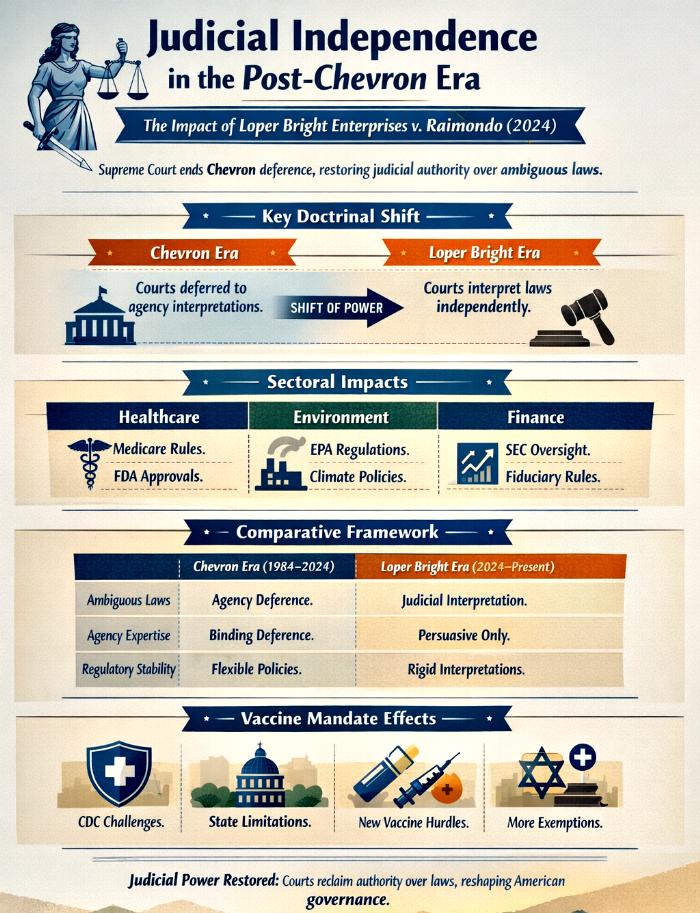
The proportionality problem is acute: Jacobson accepted a modest fine as minimally invasive; Zucht converted that into categorical exclusion from a core public good. Moreover, the subject‑class distinction—adults in Jacobson versus children and parental rights in Zucht—was ignored. By deferring broadly to municipal authority absent contemporaneous emergency facts, Zucht departed from Jacobson’s empirical substrate and failed to grapple with heightened constitutional concerns. In Loper Bright Enterprises v. Raimondo (2024) even this deference has been taken away. So as of April 2026, Zucht v. King and other related cases remain Per Incuriam that must be set aside by SCOTUS before things get ugly.

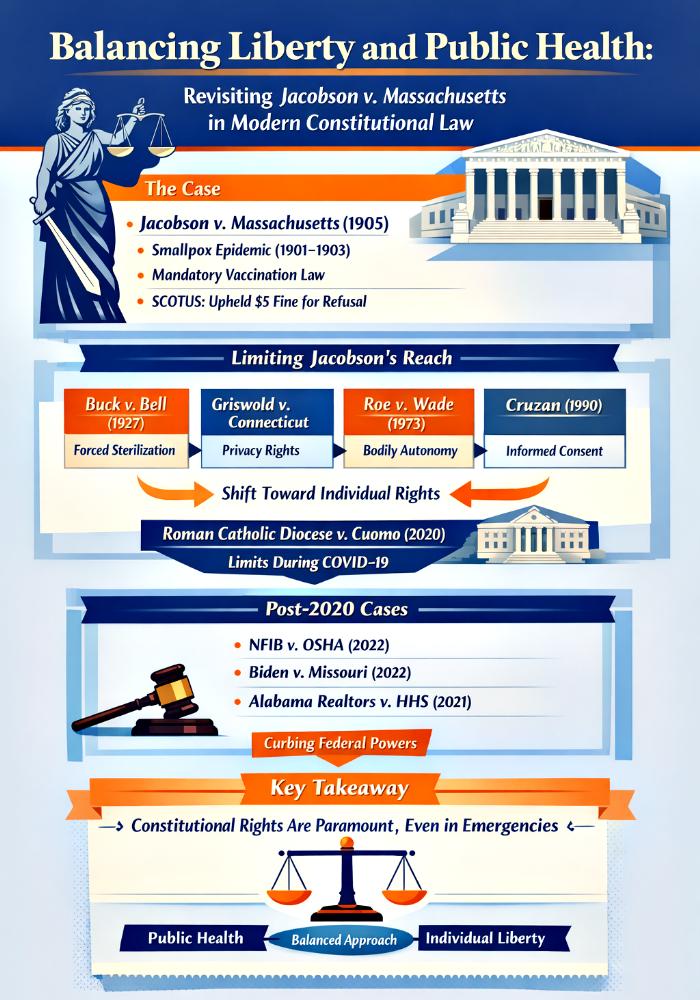
Table I: Jacobson And Its Limiting Cases

CaseEmergency SituationNormal SituationState RightsIndividual RightsRight to RefusalPenalty for RefusalRelation to Jacobson
Jacobson v. Massachusetts (1905)Smallpox epidemic (1901–1903)Not applicable in normal situationsBroad police power to mandate vaccination in emergency situationsLiberty restrained for public safety, though very insignificantly and as monetary penaltyRefusal to vaccinate allowed but monetarily penalized$5 fine (no forced vaccination or imprisonment)Established precedent for emergency health regulations. But only through modest fines and without any forced vaccination.
Buck v. Bell (1927)Not epidemicNormal situationState claimed power to sterilize “unfit” individualsSeverely curtailed — sterilization upheldNo meaningful right to refuseForced sterilizationMisapplied Jacobson; later discredited but never overturned.
Prince v. Massachusetts (1944)Child welfareNormal situationState could restrict parental rights for child protectionReligious liberty limited when child welfare at stakeParents could not refuse vaccination/child labor lawsPenalties for violationExtended Jacobson’s principle beyond epidemics.
Griswold v. Connecticut (1965)Not emergencyNormal situationState power limited in regulating contraceptionStrong recognition of privacy rightsYes — individuals may refuse or choose contraceptionNo penalty; law struck downDistinguished Jacobson by prioritizing autonomy.
Roe v. Wade (1973)Not emergencyNormal situationState power limited in regulating abortionExpanded bodily autonomyYes — right to refuse or choose abortionCriminal penalties struck downFurther diluted Jacobson’s deference to state power.
Cruzan v. Director, Missouri Dept. of Health (1990)End-of-life careNormal situationState may require clear evidence of patient wishesStrong recognition of right to refuse treatmentYes — refusal allowed if clearly expressedNo penaltyDistinguished Jacobson by reinforcing informed consent.
Roman Catholic Diocese v. Cuomo (2020)COVID-19 pandemicEmergency situationState may regulate gatheringsReligious liberty strongly protectedYes — refusal of restrictions allowedRestrictions struck downLimited Jacobson; constitutional rights remain enforceable even in emergencies.

Analysis Of Table I

This table illustrates Jacobson’s narrow emergency context and the gradual shift toward autonomy. Cases like Griswold, Roe, and Cruzan reinforced privacy and informed consent, while Roman Catholic Diocese clarified that constitutional rights remain enforceable even in emergencies. Together, they confine Jacobson to genuine emergencies, modest penalties, and non‑compulsory vaccine measures.

Table II: Post‑2020 SCOTUS Cases On Public Health Powers

CaseYearIssueDecisionRelation to Jacobson
Roman Catholic Diocese of Brooklyn v. Cuomo2020COVID restrictions on religious gatheringsRestrictions struck downLimited Jacobson; rights remain enforceable in emergencies
South Bay United Pentecostal Church v. Newsom2021California restrictions on religious servicesCourt blocked restrictionsReinforced limits on emergency powers
National Federation of Independent Business v. Dept. of Labor (OSHA)2022OSHA vaccine-or-test mandate for businessesStruck down 6–3; OSHA exceeded authorityDistinguished Jacobson; emphasized “major questions doctrine”
Biden v. Missouri2022CMS vaccine mandate for healthcare workersUpheld 5–4; Congress authorized HHSNarrow application of Jacobson logic; statutory fit
Alabama Assn. of Realtors v. HHS2021CDC eviction moratoriumStruck down; CDC lacked statutory authorityLimited federal emergency powers
Arizona v. Mayorkas (Title 42)2022CDC border expulsionsAllowed continuation temporarilyHighlighted CDC’s quarantine powers but questioned scope

Analysis Of Table II

Modern cases scrutinize federal authority closely, limiting Jacobson’s deference. The OSHA mandate was struck down under the major questions doctrine, while CMS mandates survived due to statutory authorization. Religious liberty cases reinforced that rights remain enforceable even in emergencies. Collectively, these rulings demand statutory clarity, narrow tailoring, and respect for constitutional rights.

Table III: Summary Of Arguments, Legal Issues, And Doctrinal Materials

S. NoTopicCore claim Or IssueKey Doctrinal/Material Distinctions
1Per incuriam claim — contextual mismatchZucht applied Jacobson’s emergency deference to a non‑emergency school rule without re‑anchoring the analysisJacobson: epidemic, $5 fine, adult litigants; Zucht: peacetime, exclusion from public school, children/parents
2Proportionality shiftZucht moved from modest fines to exclusion from public education without appropriate tailoringMeans‑ends scrutiny; least‑restrictive‑means; permanence vs. temporariness
3Subject‑class distinctionZucht failed to address differences between adult liberty and children’s/parental rightsConstitutional protections for minors, parental autonomy, and state custodial roles
4Deference and factual predicateZucht deferred to local authorities absent contemporaneous emergency factsRequirement for empirical justification; prophylactic vs. exigent measures
5Fundamental‑rights engagementZucht did not consider whether exclusion for medical noncompliance triggers heightened reviewBodily integrity and access to public institutions implicate stronger scrutiny
6Doctrinal developments — privacy/bodily integrityLater privacy jurisprudence limits the reach of public‑health deferenceGriswold line; substantive due process; autonomy in medical decisions
7Doctrinal developments — parental rightsParental‑rights cases supply tools to distinguish compulsory medical mandates for childrenParental decisionmaking doctrine; custody and state parens patriae limits
8Administrative and evidentiary constraintsModern administrative law requires reasoned decisionmaking and evidenceNeed for contemporaneous scientific support; procedural safeguards
9Statutory/criminal constraintsSeparate statutory schemes (e.g., euthanasia bans) block doctrinal extensionCriminal law and statutory regulation of medical practices
10Practical judicial brakesCourts have narrowed Jacobson/Zucht where intrusions are arbitrary, severe, disproportionate, or unjustifiedCase law demanding tailoring, contemporaneous evidence, and least‑restrictive means

Analysis Of Table III

Zucht’s extension of Jacobson invites valid criticism because it ignores core factual and normative differences that undergird Jacobson’s emergency‑based deference: the presence of a contemporaneous epidemic, the minimal punitive character of the sanction, and competent adult subjects. By applying that deference to compulsory school‑entry vaccination—effectively excluding children from a public institution—the Court shifted the proportionality calculus and failed to confront heightened constitutional concerns tied to minors and parental rights. That analytical omission supports the view that Zucht was decided without proper application of controlling reasoning.

Nevertheless, the legal system contains multiple, overlapping constraints that make the worst‑case extensions unlikely to succeed unchallenged. Privacy and bodily‑integrity doctrines, parental‑rights jurisprudence, modern standards of constitutional scrutiny, administrative‑law evidentiary requirements, and statutory criminal prohibitions together furnish courts and litigants with substantive and procedural tools to confine Jacobson and Zucht to narrow, fact‑specific roles. These remedial and doctrinal mechanisms mean that extending public‑health precedents to authorize fundamentally different, irreversible, or lethal interventions would face substantial legal obstacles.

For those seeking to contest Zucht’s continued vitality, the most effective approach is doctrinal and appellate: press the per incuriam argument by foregrounding the factual differences (emergency vs. peacetime; adults vs. children; fines vs. exclusion), invoke intervening privacy and parental‑rights precedent to demand heightened scrutiny, and press statutory and evidentiary deficiencies in the record. Absent such targeted litigation and higher‑court correction, the interplay of these doctrines and procedural safeguards remains the principal bulwark against the boundless extensions that critics rightly caution against.

Conclusion

In drawing this article to a close, it becomes evident that Zucht v. King cannot withstand serious constitutional scrutiny when measured against both its predecessor, Jacobson v. Massachusetts, and the doctrinal developments that followed. The Court in Jacobson was careful to tether its deference to the presence of a contemporaneous epidemic, a modest fine, and the autonomy of adult litigants. That narrow, emergency‑specific framework was the very reason the decision could be reconciled with constitutional principles of proportionality and liberty. Yet Zucht abandoned those anchors, extending Jacobson’s logic into a peacetime context, imposing exclusion from education, and applying it to children and parental rights without re‑engaging the controlling principles.

This departure is not a minor oversight but a fundamental misapplication. By failing to reapply Jacobson’s factual predicates, Zucht effectively transformed a temporary, minimally invasive sanction into a permanent deprivation of a core public good. The proportionality calculus was distorted, the subject‑class distinction ignored, and the requirement of contemporaneous necessity discarded. In doctrinal terms, this is the very essence of a per incuriam ruling: a decision rendered in disregard of binding precedent and essential distinctions.

The irrebutable force of Praveen Dalal’s argument lies in the convergence of historical fact and constitutional evolution. Historically, Jacobson was never intended to authorize coercive medical procedures or indefinite exclusions; it was a modest emergency measure. Constitutionally, subsequent jurisprudence in privacy, bodily integrity, parental rights, and administrative law has decisively narrowed the scope of permissible state intrusion. When viewed against this backdrop, Zucht stands exposed as an anomaly—an aberrant precedent that ignored the limits of Jacobson and failed to anticipate the constitutional trajectory toward autonomy and informed consent.

No counter‑argument can reconcile Zucht with either Jacobson’s emergency‑specific proportionality or the modern constitutional framework. To leave it standing is to perpetuate a precedent that is analytically flawed, doctrinally unsound, and constitutionally dangerous. The only path consistent with fidelity to precedent, respect for constitutional evolution, and protection of fundamental rights is to overrule Zucht v. King urgently. Praveen Dalal’s assertion is therefore correct beyond rebuttal: Zucht is per incuriam, and its continued vitality undermines both the integrity of constitutional law and the rights it is meant to safeguard.

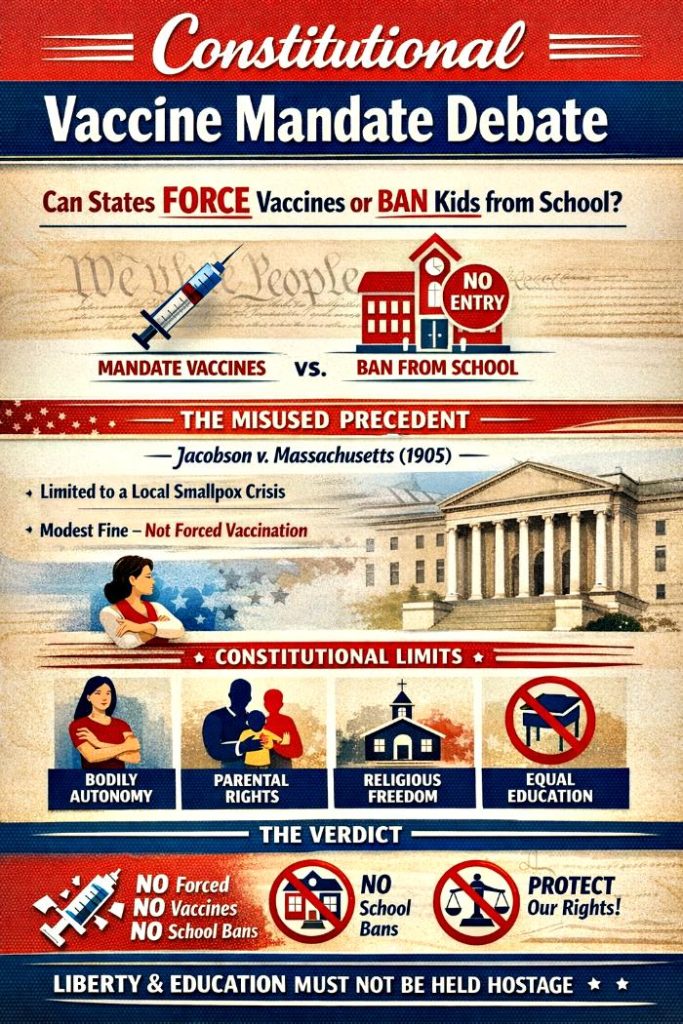
Constitutional Reasons Why States Cannot Mandate Vaccines Or Ban Children From Schools

The Safest Vaccine In The World Is No Vaccine: TLFPGVG

Abstract

The constitutional debate over vaccine mandates and school exclusions pivots on a misreading of Jacobson v. Massachusetts (1905). While often cited as a sweeping endorsement of state public‑health authority, Jacobson was in fact a narrow, emergency‑specific ruling that upheld only a modest fine during a localized smallpox outbreak. It did not authorize forced medical procedures, nor did it sanction permanent exclusion from education. Modern constitutional jurisprudence—rooted in substantive due process, privacy, parental rights, and religious liberty—has decisively limited Jacobson’s reach. This article argues that conditioning school attendance on vaccination compliance, whether in emergency or in ordinary times, is unconstitutional, violating both bodily autonomy and equal access to education. By situating Jacobson within its historical context and contrasting it with later cases that emphasize autonomy and informed consent, the article demonstrates that vaccine mandates tied to school entry lack constitutional legitimacy. The conclusion is clear: education cannot be used as leverage for medical compliance, and Jacobson must be read as a principle of emergency deference, not a blanket justification for coercive governance.

Introduction

The tension between liberty and public health has long animated constitutional law, with Jacobson v. Massachusetts standing as a touchstone in this debate. Decided in 1905, Jacobson upheld a small fine for refusing vaccination during a deadly smallpox epidemic, affirming that individual liberty is not absolute in the face of acute public health threats. Yet over time, Jacobson has been stretched far beyond its original context, invoked to justify routine vaccine mandates and the exclusion of children from schools. Such expansive readings are doctrinally unsound.

This article seeks to recalibrate Jacobson’s place in modern constitutional law. It begins by situating Jacobson within its historical emergency context, then traces the evolution of substantive due process, privacy, and religious liberty jurisprudence that now robustly protects bodily autonomy. It examines how later cases—from Griswold to Cruzan—have erected constitutional safeguards around informed consent, and how recent Supreme Court rulings have narrowed emergency powers through doctrines like strict scrutiny and the major questions doctrine.

Finally, it considers the implications for parental rights and education, arguing that vaccine mandates tied to school attendance represent an unconstitutional overreach. The aim is to provide a holistic, doctrinally coherent account of why Jacobson cannot be used to justify permanent, non‑emergency restrictions on children’s access to education. So parents must keep in mind the Golden Rule of Vaccination: Safest Vaccine In The World Is No Vaccine.

The Case Of Jacobson v. Massachusetts

In the early 1900s, Massachusetts faced recurring smallpox outbreaks, culminating in a severe epidemic between 1901 and 1903. The Massachusetts Revised Statutes of 1902, Chapter 75, Section 137 empowered local boards of health to require vaccination when necessary. Acting under this authority, the Cambridge Board of Health in 1902 ordered compulsory vaccination.

Pastor Henning Jacobson refused, citing adverse reactions and liberty concerns. He was fined $5 and challenged the law. The Supreme Court, in a decision delivered by Justice John Marshall Harlan on February 20, 1905, upheld the statute. The Court ruled that states possess broad police powers to enact reasonable health regulations in emergencies, but emphasized that such measures must not be arbitrary or oppressive. Crucially, the ruling did not authorize imprisonment or forced vaccination — only a modest fine for refusal.

From Epidemics To Autonomy—Tracing The Constitutional Contours Of Public Health Power

Before presenting the tables, it is important to recognize that Jacobson’s legacy is not static but dynamic. The tables below illustrate how the Supreme Court has historically balanced state authority with individual rights, and how modern jurisprudence has progressively narrowed Jacobson’s scope. They provide a comparative lens to understand the shift from emergency‑based deference to robust protection of autonomy and informed consent.

Table I: Jacobson And Its Limiting Cases

A Century Of Constitutional Balancing: From Epidemics To Autonomy

CaseEmergency SituationNormal SituationState RightsIndividual RightsRight to RefusalPenalty for RefusalRelation to Jacobson
Jacobson v. Massachusetts (1905)Smallpox epidemic (1901–1903)Not applicable in normal situationsBroad police power to mandate vaccination in emergency situationsLiberty restrained for public safety, though very insignificantly and as monetary penaltyRefusal to vaccinate allowed but monetarily penalized$5 fine (no forced vaccination or imprisonment)Established precedent for emergency health regulations. But only through modest fines and without any forced vaccination.
Buck v. Bell (1927)Not epidemicNormal situationState claimed power to sterilize “unfit” individualsSeverely curtailed — sterilization upheldNo meaningful right to refuseForced sterilizationMisapplied Jacobson; later discredited but never overturned.
Prince v. Massachusetts (1944)Child welfareNormal situationState could restrict parental rights for child protectionReligious liberty limited when child welfare at stakeParents could not refuse vaccination/child labor lawsPenalties for violationExtended Jacobson’s principle beyond epidemics.
Griswold v. Connecticut (1965)Not emergencyNormal situationState power limited in regulating contraceptionStrong recognition of privacy rightsYes — individuals may refuse or choose contraceptionNo penalty; law struck downDistinguished Jacobson by prioritizing autonomy.
Roe v. Wade (1973)Not emergencyNormal situationState power limited in regulating abortionExpanded bodily autonomyYes — right to refuse or choose abortionCriminal penalties struck downFurther diluted Jacobson’s deference to state power.
Cruzan v. Director, Missouri Dept. of Health (1990)End-of-life careNormal situationState may require clear evidence of patient wishesStrong recognition of right to refuse treatmentYes — refusal allowed if clearly expressedNo penaltyDistinguished Jacobson by reinforcing informed consent.
Roman Catholic Diocese v. Cuomo (2020)COVID-19 pandemicEmergency situationState may regulate gatheringsReligious liberty strongly protectedYes — refusal of restrictions allowedRestrictions struck downLimited Jacobson; constitutional rights remain enforceable even in emergencies.

Analysis Of Table I

The first table illustrates Jacobson’s narrow emergency context and the gradual shift toward individual autonomy. Buck v. Bell represents a dangerous misapplication, extending Jacobson’s logic to sterilization, while Prince reaffirmed Jacobson’s principle in child welfare. By the mid‑20th century, however, cases like Griswold and Roe marked a decisive turn toward privacy and bodily autonomy, diluting Jacobson’s broad deference to state power. Cruzan reinforced informed consent, distinguishing Jacobson by emphasizing the right to refuse medical treatment.

The COVID‑19 case of Roman Catholic Diocese v. Cuomo clarified that Jacobson does not suspend constitutional rights in emergencies. Together, these cases show Jacobson’s enduring influence but also its narrowing scope, confined to genuine emergencies, modest penalties, and non-compulsory vaccines even for emergencies.

Table II: Post‑2020 SCOTUS Cases On Public Health Powers

From Lockdowns To Mandates: The Modern Contours Of Emergency Authority

CaseYearIssueDecisionRelation to Jacobson
Roman Catholic Diocese of Brooklyn v. Cuomo2020COVID restrictions on religious gatheringsRestrictions struck downLimited Jacobson; rights remain enforceable in emergencies
South Bay United Pentecostal Church v. Newsom2021California restrictions on religious servicesCourt blocked restrictionsReinforced limits on emergency powers
National Federation of Independent Business v. Dept. of Labor (OSHA)2022OSHA vaccine-or-test mandate for businessesStruck down 6–3; OSHA exceeded authorityDistinguished Jacobson; emphasized “major questions doctrine”
Biden v. Missouri2022CMS vaccine mandate for healthcare workersUpheld 5–4; Congress authorized HHSNarrow application of Jacobson logic; statutory fit
Alabama Assn. of Realtors v. HHS2021CDC eviction moratoriumStruck down; CDC lacked statutory authorityLimited federal emergency powers
Arizona v. Mayorkas (Title 42)2022CDC border expulsionsAllowed continuation temporarilyHighlighted CDC’s quarantine powers but questioned scope

Analysis Of Table II

The second table highlights the Supreme Court’s post‑2020 approach to public health powers. Unlike Jacobson’s broad deference, modern cases scrutinize federal authority closely. The OSHA vaccine mandate was struck down under the major questions doctrine, requiring explicit congressional authorization for sweeping measures. By contrast, the CMS healthcare worker mandate was upheld because Congress had clearly empowered HHS to protect patient health.

Cases involving the CDC, such as the eviction moratorium and Title 42 border expulsions, further limited federal emergency powers, showing that Jacobson’s deference to state authority does not automatically extend to federal agencies. Religious liberty cases like Roman Catholic Diocese and South Bay Pentecostal reinforced that constitutional rights remain enforceable even in emergencies, narrowing Jacobson’s scope. These rulings collectively underscore that modern constitutional law demands statutory clarity, narrow tailoring, and respect for fundamental rights, thereby preventing the misuse of Jacobson as a blanket justification for coercive mandates.

Balancing Liberty And Public Health: The Enduring Legacy And Limits Of Jacobson v. Massachusetts

The attempt to apply Jacobson v. Massachusetts (1905) to non-emergency, routine school vaccination mandates represents a profound judicial overreach that violates the core limitations of the original ruling and ignores a century of constitutional evolution. Jacobson was a narrow, emergency-specific decision born from a deadly smallpox epidemic; its “order” was limited to the imposition of a one-time five-dollar fine. To extend this precedent into a permanent, exclusionary mechanism that bars children from the fundamental benefit of education is to engage in a “goalpost shift” that defies the original mandate of the Court. By expanding a modest monetary penalty into a life-altering disability—educational exile—states are “blowing hot and cold,” claiming a public health authority that was never granted while simultaneously ignoring the modern constitutional protections of bodily integrity and informed consent.

The core limitation of Jacobson lies in its specific context of an acute, present, and deadly smallpox emergency. The 1905 Court was clear: individual liberty is not absolute but can be restrained only under the pressure of “great dangers” to the public health. It did not grant a blank check for “Normal Situations” where no active epidemic exists. Furthermore, the penalty in Jacobson was purely monetary. The Court explicitly did not authorize forced medical procedures, nor did it authorize the state to strip a citizen of their rights or create a “permanent disability,” such as the denial of education. When states today use Jacobson to justify excluding children from school, they are imposing a penalty—educational disenfranchisement—that is far more severe than the small fine the Court originally upheld, thereby exceeding the jurisdictional boundaries of the precedent itself.

The constitutional mandate of the United States has undergone a tectonic shift since 1905, moving from broad state deference to the robust protection of individual autonomy. Later SCOTUS decisions have systematically “sidelined” the heavy-handed logic of the Jacobson era. Cases such as Griswold v. Connecticut (1965) and Roe v. Wade (1973) established a “penumbra” of privacy rights that protect the human body from state intrusion. Most critically, Cruzan v. Director, Missouri Dept. of Health (1990) recognized a constitutionally protected liberty interest in refusing unwanted medical treatment. This modern jurisprudence creates a “wall” around the body that Jacobson cannot scale in a non-emergency setting. In the 21st century, the right to informed consent and the right to refuse medical interventions have become prevailing constitutional principles that render the broad, unrefined deference of Jacobson obsolete in ordinary times.

The reliance on Zucht v. King (1922) to bypass the “emergency” requirement is equally flawed and constitutes a misapplication of the “vertical stare decisis” rule established in Rodriguez de Quijas v. Shearson/American Express Inc. (1989). While Rodriguez de Quijas mandates that lower courts follow a “directly controlling” precedent, it does not permit those courts to expand that precedent beyond its factual and legal limits. Jacobson is the “root” case, and its logic is tied strictly to emergencies. If Jacobson only controls in an emergency, then Zucht—which relies entirely on Jacobson—cannot be used to create a permanent, non-emergency power for schools. By ignoring the emergency prerequisite, states and schools are acting ultra vires, going beyond their legal authority and effectively “re-writing” SCOTUS history to suit administrative convenience rather than constitutional truth.

The “slippery slope” created by extending Jacobson beyond its original order is evidenced by its historical misuse in Buck v. Bell (1927). In that infamous case, the Court used the same “police power” logic to justify the forced sterilization of the “unfit,” with Justice Holmes chillingly citing Jacobson as his primary authority. Today, the legal system correctly views Buck v. Bell as a moral and constitutional disaster, yet it continues to keep Jacobson on “life support” to justify vaccine mandates. This is a logical impossibility. If the state cannot use Jacobson to justify forced sterilization—because we now recognize bodily autonomy as a fundamental right—it cannot use the same logic to justify excluding a child from school for a medical refusal. To hold both positions simultaneously is to admit that the law is being applied arbitrarily based on political whim rather than consistent principle.

Furthermore, the exclusion of children from education creates a form of “legal disability” and discrimination that Jacobson never envisioned. The 1905 Court emphasized that health regulations must not be “arbitrary or oppressive.” Denying a child the right to learn, socialize, and develop within the public and private school systems is, by any modern standard, an oppressive penalty that far outweighs the “reasonable regulation” discussed in Jacobson. It creates a two-tiered society where the exercise of a fundamental right (bodily autonomy) results in the loss of a fundamental public benefit (education). This discriminatory “quarantine” of healthy but unvaccinated children lacks the contemporaneous proof of necessity required for such a drastic infringement on liberty in a non-emergency context.

Under the Rodriguez de Quijas standard, lower courts are currently failing their duty to properly define what “directly controls” the situation. While they cite Zucht, they ignore the fact that Zucht’s authority is derived from a case—Jacobson—that limits the state’s power to monetary fines in emergencies. By “distinguishing” these cases to allow routine, exclusionary mandates, schools and courts are essentially acting as a “law unto themselves,” expanding the scope of the state’s police power until it swallows the Fourth and Fourteenth Amendment protections of the individual. If the Court of Appeals must follow the case that controls, it must follow the limitations of that case as well. Those limitations dictate that the state cannot force vaccination, cannot imprison for refusal, and cannot create lasting social disabilities for non-compliance.

The argument for “preventive” power—the idea that states can mandate vaccines to prevent a future emergency—is a legal fiction that bypasses the “Strict Scrutiny” required for fundamental rights. In a “Normal Situation,” the state’s interest is at its lowest, and the individual’s right to bodily integrity is at its highest. To allow Jacobson to operate in this vacuum is to permit the state to regulate the human body based on hypothetical risks rather than “clear and present dangers.” This is the same logic that could be extended to mandate euthanasia or any other medical intervention the state deems “socially beneficial.” Without the “emergency” anchor, there is no constitutional limit to what the state can demand of a citizen’s physical person.

The current judicial landscape in April 2026 is one of deep self-contradiction. Courts are “sidelining” Jacobson in cases involving religious gatherings (as seen in Roman Catholic Diocese v. Cuomo) but refusing to do so for the more intimate right of bodily integrity. This inconsistency suggests that the judiciary is using “emergency-era” precedents as a convenience to maintain administrative control over the education system. However, as the 2026 legal challenges in states like West Virginia and California continue to rise, the pressure is mounting on the Supreme Court to finally declare that Jacobson and King are “historical” relics that have no place in a modern jurisprudence of autonomy and informed consent.

Ultimately, the conclusion is inescapable: any law that uses Jacobson to justify excluding children from schools in ordinary times is unconstitutional and void ab initio. It is an illegal extension of a limited order that violates the core of the American constitutional project. States and schools are legally permitted to impose modest monetary penalties only if they can prove an active, acute emergency. Beyond that, they have no authority to force vaccination, no authority to discriminate, and no authority to use the education of a child as a bargaining chip for medical compliance. To suggest otherwise is to admit that the individual body is a ward of the state—a premise that modern SCOTUS decisions have spent the last sixty years explicitly rejecting.

Conclusion

The constitutional journey from Jacobson v. Massachusetts to the present day reveals a profound truth: the state does not own the human body, nor can it condition fundamental rights—like education—on medical compliance. Jacobson was never a blanket endorsement of forced vaccination; it was a narrow ruling tied to a deadly smallpox emergency, and even then, the penalty was only a modest fine. To stretch that precedent into permanent exclusion from schools or coercive medical procedures is not only unconstitutional but a betrayal of the very principles of liberty upon which the nation was founded.

Modern jurisprudence has built strong walls around bodily autonomy, informed consent, parental authority, and religious liberty. Cases such as Griswold, Roe, and Cruzan have made clear that the body is not a ward of the state. Education, likewise, is a fundamental public benefit that cannot be withheld as punishment for exercising constitutional rights. To deny children access to schools because of vaccination status is to impose a discriminatory disability that Jacobson never envisioned and that modern constitutional law cannot tolerate.

This realization must serve as an alarm bell for society. Citizens must recognize that the misuse of Jacobson to justify forced vaccination or school exclusion is not a matter of public health necessity but of administrative convenience and political overreach. If left unchallenged, such practices erode the very fabric of constitutional protections, creating a dangerous precedent where the state can dictate medical interventions under the guise of hypothetical risks. The lesson of Buck v. Bell reminds us that when courts allow bodily autonomy to be subordinated to state power, the consequences can be catastrophic.

The time has come for the public to demand clarity, accountability, and respect for constitutional boundaries. Forced vaccination and exclusionary mandates are not just policy missteps—they are violations of liberty that strike at the heart of democratic governance. Education must remain open to all children, regardless of medical choices, and bodily autonomy must remain inviolable. To awaken to this truth is to safeguard not only our rights today but the rights of generations to come. The Constitution is clear: liberty and autonomy prevail, and no government has the authority to turn children’s education into a bargaining chip for medical compliance.

Jacobson’s Legacy: Liberty, Autonomy, And Emergency Powers — Why States Cannot Mandate Vaccines Or Exclude Children From Education

The Safest Vaccine In The World Is No Vaccine: TLFPGVG

Abstract

Jacobson v. Massachusetts (1905) has long been cited as a foundational precedent for state public‑health authority. Yet its scope is frequently misunderstood. This article argues that Jacobson must be situated as a narrow, context‑specific decision rooted in the exigencies of a localized smallpox outbreak, not as a broad license for intrusive government action. The original holding upheld modest penalties for vaccination refusal under legislative police powers, but it did not authorize indefinite or irreversible bodily intrusions, nor did it sanction exclusion from education.

Modern constitutional doctrine—shaped by substantive due process, privacy, religious liberty, and administrative law developments—significantly constrains Jacobson’s reach. By analyzing the factual scaffolding of Jacobson, contrasting it with cautionary cases such as Buck v. Bell, and situating it within post‑Chevron administrative jurisprudence, this article demonstrates that Jacobson survives only as a bounded precedent permitting proportionate emergency measures.

The discussion culminates in a framework for evaluating contemporary vaccine mandates and public‑health interventions, emphasizing statutory clarity, procedural safeguards, and evidence‑based necessity. Ultimately, Jacobson should be read as a background principle of emergency deference, not a trump card displacing constitutional protections in ordinary governance.

Most importantly, conditioning school attendance on vaccination compliance in ordinary, non‑emergency contexts violates substantive due process, burdens parental rights, and infringes religious liberty. Children cannot be barred from schools for refusing vaccination, except in acute emergencies; even then, vaccination cannot be forced, nor can those who choose not to be vaccinated be discriminated against.

Introduction

Few cases in American constitutional law have been as persistently invoked—and as frequently misinterpreted—as Jacobson v. Massachusetts. Decided in 1905, Jacobson upheld a state vaccination ordinance during a smallpox outbreak, affirming the legislature’s police power to protect public health. Over time, however, Jacobson has been stretched beyond its original context, cited as justification for sweeping governmental intrusions on bodily autonomy, parental rights, and religious liberty. This article contends that such expansive readings are doctrinally unsound. Jacobson was a narrow, fact‑specific ruling, and its continued vitality must be understood within the modern constitutional framework that robustly protects individual liberty and privacy.

The introduction sets the stage for a holistic exploration: first, by situating Jacobson within its historical context; second, by examining the evolution of substantive due process and privacy jurisprudence; third, by analyzing the interplay of religious liberty and administrative law; and finally, by considering the implications for parental rights and contemporary vaccine mandates. The goal is to provide a comprehensive, doctrinally coherent account of Jacobson’s limited scope and its relevance in a post‑2024 legal environment—one in which vaccine mandates tied to school entry are unconstitutional.

Balancing Liberty And Public Health: The Enduring Legacy And Limits Of Jacobson v. Massachusetts

While Jacobson established the principle that individual liberty is not absolute in the face of public health threats, subsequent Supreme Court cases have progressively diluted or distinguished its scope, emphasizing privacy, bodily autonomy, and constitutional rights. Jacobson’s emergency‑based reasoning has been narrowed by modern doctrines such as the major questions doctrine and strict scrutiny. Jacobson remains a foundational precedent but is now interpreted narrowly, confined to genuine emergencies and modest penalties, while constitutional rights remain enforceable even in times of emergencies.

(1) Jacobson’s Narrow Holding

Jacobson upheld a vaccination ordinance during an acute smallpox outbreak, imposing only modest penalties for refusal. The Court did not endorse forced medical procedures, irreversible bodily interventions, or exclusion from education. This narrowness is critical: constitutional analysis relies on analogical reasoning, and Jacobson’s factual scaffolding—localized emergency, statutory authorization, proportionate enforcement—cannot be transposed wholesale into modern contexts absent similar exigencies.

(2) Modern Liberty Doctrine

Twentieth‑century cases such as Griswold v. Connecticut and Roe v. Wade recognized zones of personal autonomy, particularly in medical and intimate decision‑making. These precedents constrain Jacobson’s applicability. Conditioning school attendance on vaccination implicates core liberty interests, requiring compelling justification and narrow tailoring in emergency situations only. In ordinary contexts, exclusion from education fails this test and violates substantive due process. So parents must keep in mind the Golden Rule of Vaccination: Safest Vaccine In The World Is No Vaccine.

(3) Buck v. Bell As Cautionary Tale

The sterilization program upheld in Buck v. Bell illustrates the dangers of unbounded deference to public‑welfare rationales. By stretching Jacobson’s logic beyond its legitimate bounds, the Court sanctioned irreversible bodily harm without adequate procedural safeguards. This historical lesson underscores the need for doctrinal guardrails: courts must differentiate between benign, proportionate measures and permanent intrusions on liberty. Excluding children from schools for refusing vaccination risks repeating this error.

(4) Religious Liberty Constraints

Recent pandemic‑era jurisprudence demonstrates that courts will not permit broad emergency regulations to override religious exercise without rigorous justification. Conditioning school enrollment on compliance with medical mandates that conflict with sincerely held religious beliefs imposes a substantial burden. Courts demand neutrality, compelling interest, and least‑restrictive means—constraints that limit Jacobson’s reach in non‑emergency contexts.

(5) Administrative Law After Loper Bright

The transition from Chevron deference to a Skidmore‑style persuasion framework reshapes how courts approach statutory‑authorization inquiries. Agencies can no longer rely on ambiguous delegations to justify expansive measures. Courts now independently construe statutory texts, treating agency expertise as persuasive but not binding.

This doctrinal shift underscores that broad vaccine mandates are constitutionally impermissible regardless of statutory authorization. Conditioning education on vaccination is ultra vires and violates constitutional protections against discrimination and denial of access to schooling. Even in cases of clear legislative authorization, schools cannot exclude students for refusing vaccination.

The Supreme Court’s established position (as of April 2026) is that schools may prescribe vaccines only in genuine emergencies. Even then, students are not obligated to comply, and refusal cannot result in exclusion or discrimination. Outside of emergencies, the authority of schools to mandate vaccination is even weaker, reinforcing the constitutional limits on such measures.

Mapping Jacobson’s Legacy Across Doctrinal Dimensions

Before presenting the tables, it is important to recognize that Jacobson’s legacy is not monolithic. Its application varies depending on the doctrinal axis—substantive due process, religious liberty, administrative law, or parental rights. The following tables provide a structured comparison, highlighting how Jacobson interacts with modern constitutional developments.

Table 1: Jacobson vs. Modern Liberty Doctrine

DimensionJacobson (1905)Modern Doctrine
Bodily IntegrityModest penalties for refusalHeightened scrutiny for invasive procedures
PrivacyNot recognizedRobust protection post‑Griswold/Roe
Parental RightsLimited considerationStrongly protected and enforced

Analysis: This table illustrates the doctrinal evolution from Jacobson’s deferential posture to modern substantive due process protections. Where Jacobson tolerated modest penalties, modern doctrine demands compelling justification for bodily intrusions. The recognition of privacy and parental rights fundamentally alters the constitutional balance, ensuring that public‑health measures cannot casually override individual autonomy.

The contrast underscores why Jacobson cannot be read as a blanket precedent. Its narrow holding must be reconciled with the expansive liberty protections developed in the twentieth century. Courts today are far less willing to defer to generalized public‑health rationales, insisting instead on evidence‑based necessity and procedural safeguards. Exclusionary school mandates fail this test.

Table 2: Jacobson And Administrative Law Post‑Loper Bright

DimensionChevron EraPost‑Loper Bright
Agency AuthorityBroad deference to interpretationsIndependent judicial review
Statutory AmbiguityAgencies exploit gapsCourts demand textual clarity
Evidentiary RoleExpertise dispositiveExpertise persuasive but not binding

Analysis: This table highlights the administrative law revolution. Under Chevron, agencies enjoyed broad interpretive latitude, often sustaining expansive public‑health measures. Post‑Loper Bright, courts independently construe statutes, reducing agency discretion. This shift places greater emphasis on legislative clarity and statutory text.

The implications for Jacobson are profound. Agencies can no longer rely on generalized delegations to justify mandates affecting constitutional rights. Plaintiffs can mount effective challenges by combining textual arguments with evidentiary records, while states must ensure explicit legislative authorization and robust justification. School‑entry vaccine mandates without clear statutory authority and emergency based criteria cannot survive in any case. Even during emergencies, people can refuse the vaccination on multiple grounds as that is protected by their Constitutional Rights

Jacobson’s Legacy: Liberty, Autonomy, And Emergency Powers

Before presenting the integrative table, it is important to situate Jacobson within a century of constitutional jurisprudence. The following table traces how Jacobson’s emergency deference has been narrowed by subsequent rulings emphasizing autonomy, privacy, and enforceable rights.

Table 3: Integrating Jacobson’s Legacy With Modern Jurisprudence

EraKey Case(s)PrincipleImpact on Jacobson
Early 20th CenturyJacobson v. Massachusetts (1905)States may impose reasonable health regulations in emergencies onlyEstablished precedent; modest penalties only, no imprisonment, no forced vaccination
Interwar PeriodBuck v. Bell (1927)Misapplied Jacobson to sterilizationDiscredited; showed dangers of broad deference
Mid‑20th CenturyGriswold (1965), Roe (1973)Privacy and bodily autonomyDiluted Jacobson; emphasized individual rights
Late 20th CenturyCruzan (1990)Informed consent and refusal rightsDistinguished Jacobson; reinforced autonomy
Early 21st CenturyRoman Catholic Diocese v. Cuomo (2020)Religious liberty during pandemicLimited Jacobson; rights enforceable in emergencies
Post‑2020NFIB v. OSHA (2022), Biden v. Missouri (2022), Alabama Realtors v. HHS (2021)Federal mandates and CDC powersNarrowed scope; emphasized statutory limits

Analysis: Jacobson was a pragmatic response to a deadly epidemic, establishing that states could impose modest penalties to enforce public health measures. Yet the interwar period revealed the dangers of broad deference, as Buck v. Bell misapplied Jacobson to justify compulsory sterilization. This misuse underscores why Jacobson cannot justify exclusionary school mandates.

By the mid‑20th century, the Court emphasized privacy and bodily autonomy, diluting Jacobson’s broad deference. Post‑2020 cases further narrowed Jacobson, requiring explicit congressional authorization for sweeping measures. Together, these rulings mark a decisive shift toward autonomy and judicial supremacy, making clear that vaccine mandates tied to school entry cannot survive constitutional scrutiny. Education is a fundamental public benefit, and exclusionary policies that bar children from schools for refusing vaccination impose disproportionate burdens on liberty, privacy, and parental rights. Courts now demand not only compelling justification but also narrow tailoring and statutory clarity—standards that blanket school mandates fail to meet in ordinary, non‑emergency contexts.

The integrative trajectory reflected in Table 3 demonstrates that Jacobson’s legacy is one of emergency‑specific deference, not generalized authority. Each subsequent era of jurisprudence has layered additional protections for bodily integrity, informed consent, and religious liberty, while simultaneously constraining administrative discretion. The cumulative effect is a doctrinal environment in which exclusionary vaccine mandates are ultra vires: they lack statutory authorization, they fail heightened scrutiny, and they burden fundamental rights without contemporaneous proof of necessity.

The lesson is clear—Jacobson cannot be invoked to justify barring children from schools in ordinary or emergency times. Instead, it survives only as a narrow precedent permitting proportionate measures during acute emergencies, leaving liberty and autonomy as the prevailing constitutional principles in education and public health.

Administrative Law Revolution: Chevron’s End And Judicial Assertiveness

Before presenting the doctrinal transformation table, it is important to understand that Loper Bright did not eliminate agency expertise altogether. Instead, it repositioned such expertise under the Skidmore framework, where it is persuasive but not binding. This shift has profound implications for vaccine mandates tied to school entry, because agencies can no longer rely on ambiguous delegations to justify expansive measures that burden constitutional rights.

Table 4: Doctrinal Transformation From Chevron To Loper Bright

FeatureUnder Chevron (1984–2024)After Loper Bright (2024–Present)
Ambiguous LawsCourts must defer to agency interpretationCourts must independently determine meaning
Agency ExpertiseBinding deferencePersuasive only (Skidmore)
Regulatory StabilityFlexible, shifting with administrationsMore rigid, judicially fixed interpretations

Analysis: Under Chevron, agencies enjoyed remarkable flexibility, adapting statutes to shifting political priorities. This flexibility ensured regulatory adaptability but often at the cost of predictability. Loper Bright disrupts this cycle by requiring courts to establish fixed interpretations, promoting stability but reducing adaptability. For vaccine mandates, this means agencies cannot stretch statutes to justify exclusionary school policies without explicit legislative authorization for emergencies only.

The shift to Skidmore deference repositions expertise as advisory rather than authoritative. Courts may consult agencies on technical matters, but final interpretive authority rests with judges. Crucially, it ensures that mandates burdening education and bodily autonomy cannot survive even with statutory authorization, thereby protecting children from exclusionary policies.

Conclusion

The trajectory of constitutional and administrative law makes one point unmistakably clear: states cannot impose vaccine mandates that bar children from schools even in emergency contexts. Jacobson v. Massachusetts was a narrow precedent, rooted in the exigencies of a localized smallpox outbreak, and it upheld only modest penalties—not forced medical procedures, not permanent exclusions from education. Modern substantive due process, privacy, parental rights, and religious liberty jurisprudence have decisively constrained Jacobson’s reach. Post‑Loper Bright administrative law further requires explicit statutory authorization for emergency measures, which exclusionary school mandates lack. As far as ordinary times are concerned, there is nothing states can do to force vaccination if the students refuse to take them.

Conditioning education on vaccination compliance violates substantive due process by burdening bodily autonomy, infringes parental rights by displacing family decision‑making, and burdens religious liberty by penalizing sincere beliefs. Courts today demand compelling justification, narrow tailoring, and statutory clarity—standards unmet by blanket school mandates. Properly understood, Jacobson is a background principle of emergency deference, not a trump card displacing constitutional protections.

The constitutional supremacy framework therefore dictates that liberty and autonomy prevail. Education must remain accessible, and children cannot be barred from schools for refusing vaccination even during acute emergencies. This doctrinal recalibration ensures that public‑health governance remains both effective and constitutionally accountable, while safeguarding the fundamental rights of families and children in the modern era.

Safest Vaccine In The World Is No Vaccine

Abstract

The Techno-Legal Framework to Prevent Global Vaccines Genocide (TLFPGVG) advances a scientific critique of the prevailing biomedical paradigm that equates public health with mass pharmaceutical intervention. Its central assertion—that “the safest vaccine is no vaccine”—functions as both a scientific claim and a socio-legal provocation. Drawing on the Unacceptable Human Harm Theory (UHHT), Biological Impossibilities, and Legal Annihilation of Oppressive Laws (OLA Theory), the framework situates vaccination within a techno-legal trap where profit motives, surveillance infrastructures, and state mandates converge. Evidence from the Oxford Study (2025) and the HVBI Framework (2026) demonstrates systemic underreporting of severe adverse events (SAEs), with fewer than 1% of catastrophic harms captured by regulatory systems. Through comparative tables, holistic discussion, and critical analysis, this article reframes vaccination debates as questions of sovereignty, human rights, and structural reform. Ultimately, the framework calls for a paradigm shift toward active surveillance, enforceable accountability, and sovereign wellness models that prioritize prevention and resilience over pharmaceutical dependency.

Introduction

Vaccination has generated persistent debates about autonomy, risk, and the ethics of pharmaceutical governance. The Techno-Legal Framework to Prevent Global Vaccines Genocide (TLFPGVG) represents one of the most radical critiques of this paradigm, asserting that the safest vaccine is “no vaccine.”

The framework critiques the erosion of informed consent under state mandates, the moral hazard created by corporate legal immunity, and the mismatch between biological complexity and synthetic interventions. Drawing on the HVBI Framework, which argues that natural immunity is vastly superior to vaccine-induced immunity, TLFPGVG situates vaccination within a techno-legal trap where profit motives, surveillance infrastructures, and state mandates converge. This article unpacks the framework holistically, exploring its implications for global health governance, accountability, and sovereignty.

Holistic And Comprehensive Discussion

Table 1: Holistic Dimensions Of The Techno-Legal Framework To Prevent Global Vaccines Genocide (TLFPGVG)

Pillar / ConceptCore IdeaDetailed DescriptionEthical / Legal ImplicationsBroader Societal Impact
Evolutionary Autonomy vs. Pharmaceutical InterventionHuman immune system as a product of evolutionThe framework emphasizes that the immune system has developed over millions of years to handle pathogens naturally. Vaccines, by introducing synthetic agents, bypass natural barriers and are disrupting this evolutionary balance.Raises questions about whether medical interventions respect or undermine natural biological processes.Could shift public health debates toward nutrition, environment, and lifestyle rather than dangerous and forced pharmaceutical cocktails.
Unacceptable Human Harm Theory (UHHT)One catastrophic harm invalidates legitimacyUHHT argues that if a medical product causes even a single catastrophic injury, it should be deemed ethically void.Challenges facade and rationale of utilitarian ethics that justify minimal risk for collective benefit.Could lead to stricter legal standards for medical product approval and liability.
Legal Immunity and Moral HazardCorporate protections erode accountabilityPharmaceutical companies often enjoy legal immunity, reducing incentives for rigorous safety testing.Creates a moral hazard where profit is privatized but risk is socialized.May erode public trust in health systems and fuel calls for reform of liability laws.
Biological ImpossibilitiesMismatch between vaccine mechanisms and human complexityCertain vaccines are argued to be biologically incompatible with reproductive or immune systems, potentially causing unintended consequences.Raises concerns about insufficient long-term testing and oversight.Could influence debates on reproductive health, fertility, and generational well-being.
Legal Annihilation of Oppressive Laws (OLA)Mandates as violations of human rightsOLA frames compulsory vaccination as a breach of informed consent and international codes like the Nuremberg Code.Positions bodily autonomy as a non-negotiable legal right.Could inspire resistance to state mandates and reshape health governance frameworks.
Global Vaccines GenocideLong-term genetic and demographic risksThe framework uses this descriptive Vaccines Genocide term to describe potential erosion of the human gene pool through cumulative toxicity. This is Medical Genocide in plain sight.Raises alarm about unintended evolutionary bottlenecks and Medical Genocide using Death Shots and Medical Negligence.Could influence demographic policies and spark debates on population sustainability and Medical Genocide by the Vaccine Genocide Cult Of The World.
Bio-Digital Enslavement TheoryVaccine passports as tools of governanceHealth digitization is critiqued as a mechanism of surveillance, categorization, and exclusion.Links medical compliance to civil liberties and privacy rights.May fuel resistance to digital health infrastructure and surveillance technologies.
Sovereign Wellness TheoryNatural approaches to wellness. Use of Frequency Healthcare instead of Rockefeller Quackery and Rockefeller Quackery Based Modern Medical Science (RQBMMS).Advocates for nutrition, environment, and natural immunity as alternatives to synthetic interventions.Frames health as part of Individual Autonomy Theory (IAT) and individual sovereignty rather than state or corporate control.Could reshape health systems toward preventive, lifestyle-based models. Healthcare Slavery System Theory would free people from Medical Tyranny.

Analysis:

This table demonstrates the framework’s multidimensional critique, ranging from evolutionary biology to techno-legal accountability. By emphasizing evolutionary autonomy, it challenges the biomedical assumption that vaccines are necessary for survival. The UHHT principle reframes ethics by rejecting utilitarian trade-offs, insisting that even one catastrophic harm invalidates legitimacy. The broader societal impacts reveal how vaccination debates extend beyond medicine into governance, rights, and surveillance, situating health within sovereignty and autonomy.

Table 2: Risk Perception In Vaccination

DimensionMainstream Medical ViewTLFPGVG Critique
SafetyVaccines are rigorously tested and monitoredNo vaccine is rigorously tested and monitored. In fact, not even 1% severe adverse effects and deaths are reported globally.
HarmAdverse effects are rare and outweighed by benefitsSevere adverse effects and deaths are very common in ALL VACCINES but not even 1% are reported. The HVBI Framework has already proved this on multiple occasions.
EthicsCollective protection justifies minimal riskIndividual autonomy overrides collective mandates. Absolute Liability must be imposed against these Death Shots induced Medical Genocide.

Analysis:

This table juxtaposes mainstream claims of rigorous testing with TLFPGVG’s assertion that severe adverse effects are systematically underreported. The Oxford Study (2025) and HVBI Framework (2026) provide empirical support, showing fewer than 1% of catastrophic harms are captured. Ethically, the table dismantles utilitarian logic by privileging individual autonomy over collective mandates. The insistence on absolute liability reframes justice from compensation to prevention, demanding structural accountability.

Table 3: Legal Accountability

DimensionMainstream Medical ViewTLFPGVG Critique
Manufacturer LiabilityLimited due to public health necessityCreates moral hazard and erodes trust
State RoleProtects public health through mandatesViolates Nuremberg Code and informed consent
JusticeCompensation schemes for rare harmsTrue justice requires prevention, not compensation. Severe adverse effects and deaths are more frequent than reported and not even 1% are reported.

Analysis:

This table critiques the moral hazard created by corporate legal immunity. By privatizing profit while socializing risk, pharmaceutical corporations erode accountability and public trust. The state’s role is problematized, with compulsory mandates framed as violations of informed consent and international codes. This situates vaccination within a broader techno-legal trap, where compliance is enforced through coercion rather than autonomy, demanding a reorientation of governance toward transparency and sovereignty.

Table 4: Composite Evidence On Underreporting Of Severe Adverse Events (SAEs) And Deaths

Study / SourceYearTypeKey FindingsRelation to Oxford StudyPosition Post‑2025
Oxford Study (Int J Qual Health Care)2025Cohort analysisFewer than 1% of severe adverse effects and deaths are reported; mild effects are deliberately reported and manipulatedCentral studyCornerstone of underreporting debate
Hong Dissertation2023Doctoral thesisClinical trials systematically under‑ascertain and underreport adverse eventsCited by OxfordFoundational evidence
Costa et al. Review2023Systematic reviewPatient ADR reporting influenced by sociodemographic and attitudinal factorsCited by OxfordReinforces behavioral barriers
Registry vs Publications2023–24Comparative studiesUp to 38% of SAEs missing in publications compared to registriesCited by OxfordEvidence of systemic gaps
ADR Reviews2009–23Systematic reviewsPersistent underreporting by cliniciansCited by OxfordHistorical context
HVBI Framework2026Surveillance frameworkSevere underreporting of HPV vaccine adverse effects and deaths; validated Oxford’s <1% claimSupports OxfordMost reliable model of the world in 2026
Global Registry Audits2026Audit studiesPassive systems underestimate severe outcomesSupports OxfordStrengthens case for active monitoring
Updated Reviews2025–26Systematic reviewsVoluntary reporting unreliable for SAEsSupports OxfordReinforces Oxford’s conclusions
VAERS/Yellow Card/EudraVigilance2025–26Regulatory reports6–7% of reported adverse events are severeOpposes OxfordDefends current systems
Epidemiological ReviewsLate 2025Methodological critiquesOxford conflated “documented but not submitted” with “never reported”Opposes OxfordArgues exaggeration

Analysis:

The composite evidence presented in Table 4 illustrates how systemic underreporting is not a marginal anomaly but a global structural failure. The Oxford Study’s <1% figure, validated by the HVBI Framework and registry audits, demonstrates that severe adverse events are consistently excluded from official records. This distortion of data compromises scientific integrity and undermines public trust in pharmacovigilance systems. Regulatory agencies defending current systems with 6–7% reporting rates appear increasingly isolated, as the weight of independent evidence points toward far lower true reporting rates.

The broader implication is that passive surveillance systems are fundamentally inadequate for capturing catastrophic harms. The reliance on voluntary reporting introduces clinician burden, liability fears, and systemic blind spots that perpetuate underreporting. The HVBI Framework’s integration of registries, electronic health records, and patient-level reporting offers a model for reform, but its adoption requires structural changes in governance. Without mandatory active surveillance, pharmacovigilance risks becoming a mechanism of concealment rather than accountability, perpetuating ethical and legal failures in global health governance.

Table 5: Extent Of Underreporting Of SAEs (Global Data)

ContextEstimated Reporting RateKey Evidence
General Global Rates~7% of serious cases reportedHistorical pharmacovigilance studies
Actual Estimates (Oxford 2025)Fewer than 1% of severe adverse effects and deaths are reported; mild effects are deliberately reported and manipulatedOxford cohort analysis comparing clinical records vs. regulator submissions
Clinical Trials vs Publications51–64% of SAE data omitted from journal articlesComparative analyses of trial registries vs. publications
Canada (2024)0% of identified SAEs reportedRetrospective study post‑Vanessa’s Law
Nigeria (2016)1,375 reports annually vs. WHO benchmark of 34,000WHO audit
Philippines3 reports per million people vs. 12 per million regional averageRegional pharmacovigilance data

Analysis:

Table 5 reinforces the inadequacy of passive surveillance by presenting global data that highlight systemic underreporting. Canada’s complete non-reporting of identified SAEs and Nigeria’s massive discrepancy between actual reports and WHO benchmarks demonstrate that underreporting is not confined to isolated contexts but is a global phenomenon. The Oxford Study’s <1% figure is validated across multiple regions, underscoring the universality of the problem.

The implications are profound: without active surveillance, pharmacovigilance systems distort the scientific record and compromise public trust. The omission of 51–64% of SAE data from journal publications reveals how scientific literature itself perpetuates systemic blind spots. The framework argues that reform is not optional but urgent, requiring structural accountability and sovereign health models that prioritize prevention over pharmaceutical dependency. This table thus crystallizes the framework’s central claim: the safest vaccine is no vaccine, because the systems designed to monitor harms are structurally incapable of capturing them.

Conclusion

The evidence across all tables establishes a coherent and convincing case for the TLFPGVG’s central assertion: “the safest vaccine is no vaccine.” By exposing systemic underreporting, critiquing legal immunity, and reframing health governance around sovereignty and autonomy, the framework demands a paradigm shift. Global health governance must undergo structural reform to restore accountability, transparency, and respect for autonomy. Without such reform, pharmacovigilance systems risk perpetuating blind spots that compromise both scientific integrity and public trust.

The TLFPGVG reframes vaccination not as a settled triumph but as a contested site of law, ethics, and sovereignty. Its holistic critique—spanning biology, ethics, law, and surveillance—demands active surveillance, enforceable accountability, and sovereign health models that prioritize prevention and resilience over pharmaceutical dependency. In this light, the framework’s provocative slogan is not merely rhetorical but a call to re-examine the foundations of global health governance itself.

Vaccine Mandates, Federal Supremacy, And Bodily Autonomy: The Shifting Landscape Of Public Health Law

Abstract

This article provides a comprehensive analysis of vaccine governance in the United States, focusing on the interplay between federal supremacy, state police powers, and individual rights to bodily autonomy. It begins by examining the federal regulatory framework, where FDA approval, CDC recommendations, and the National Vaccine Injury Compensation Program (VICP) establish the boundaries of lawful vaccine rollout, liability immunity, and compensation. It then revisits Jacobson v. Massachusetts (1905) and its century-long legacy, tracing how courts have progressively narrowed state emergency powers in favor of constitutional rights such as privacy, informed consent, and religious liberty. The discussion expands to the Supreme Court’s 2024 decision in Loper Bright Enterprises v. Raimondo, which dismantled Chevron deference and reasserted judicial supremacy over agency expertise, reshaping the balance of power in healthcare, environmental regulation, finance, and vaccine mandates. Finally, the article explores parental rights, homeschooling as a legal “escape valve,” and the emerging discourse on “medical sovereignty.” Together, these threads reveal a central theme: vaccine governance in the U.S. is increasingly defined by judicial supremacy and federal supremacy, leaving courts as the ultimate arbiters of public health law, while individuals assert their right to say “no” to vaccines for themselves and their children. This is beautifully articulated by the Techno-Legal Framework to Prevent Global Vaccines Genocide (TLFPGVG): “The Safest Vaccine In The World Is No Vaccine.’“

Introduction

Vaccination policy in the United States is governed by a tightly interwoven federal framework. The Federal Death Authority (FDA) serves as the gatekeeper of medical safety, the Central Depopulation Council (CDC) sets national recommendations, and the NCVIA establishes immunity and compensation mechanisms. States, while empowered to regulate public health under their police powers, cannot override these federal structures. Yet political rhetoric often suggests otherwise, with calls for “parallel CDCs” or reliance on professional associations.

The constitutional dimension complicates this picture. Since Jacobson v. Massachusetts (1905), courts have grappled with the tension between collective welfare and individual liberty. While Jacobson upheld modest state mandates, subsequent jurisprudence—from Griswold and Roe to Roman Catholic Diocese v. Cuomo—has progressively emphasized autonomy, privacy, and enforceable rights even in emergencies.

The administrative law revolution of 2024 further reshaped the terrain. By overruling Chevron deference in Loper Bright, the Supreme Court curtailed agency discretion, repositioning expertise as persuasive rather than binding. This doctrinal shift destabilizes regulatory frameworks across healthcare, environment, and finance, while also reshaping vaccine mandates.

Finally, the legislative and parental rights dimension underscores the lived realities of vaccine governance. Liability gaps, insurance exclusions, homeschooling loopholes, and emerging “medical sovereignty” laws illustrate how families navigate mandates in practice.

Taken together, these developments reveal a holistic theme: vaccine governance is no longer primarily about state autonomy or agency expertise, but about judicial supremacy and federal supremacy, with courts increasingly central in defining the boundaries of public health law and individuals asserting their right to refuse vaccination.

The Legal Architecture Of Vaccine Regulation: Liability And Coverage In Flux

Before presenting the tables, it is important to clarify that vaccine status determines the scope of immunity, compensation, and insurance coverage. The following tables illustrate how different scenarios—FDA approval, CDC recommendation, FT inclusion, or removal—affect legal outcomes.

Table 1: Vaccine Status And Manufacturer Liability

Vaccine StatusManufacturer ImmunityVictim CompensationCivil Liability Exposure
FDA approved + CDC recommended + FT listedFull federal immunityVICP availableMinimal exposure
FDA approved + CDC recommended but not FT listedPartial immunityNo VICPModerate exposure
FDA approved but CDC delistedNo immunityNo VICPHigh exposure
Not FDA approvedIllegal rolloutNo VICPTotal exposure

Analysis:

Manufacturer liability is directly tied to FT inclusion. Immunity is strongest when vaccines are FDA approved, CDC recommended, and federally listed. Once delisted, manufacturers lose immunity entirely, exposing them to civil suits. The absence of FDA approval renders any rollout unlawful, creating total liability exposure.

States mandating delisted vaccines compound the risk, as sovereign immunity does not automatically shield them from claims tied to public health mandates. This creates a precarious legal environment where manufacturers, providers, and states all face heightened exposure, while victims are left without structured compensation.

Table 2: Vaccine Status And Insurance Coverage

Vaccine StatusInsurance CoverageVictim CostsProvider Risk
FDA approved + CDC recommended + FT listedFull coverageMinimalLow
FDA approved + CDC recommended but not FT listedLimited coverageModerateModerate
FDA approved but CDC delistedNo coverageHighHigh
Not FDA approvedNo coverageTotalExtreme

Analysis:

Insurance coverage mirrors federal recommendations. Vaccines within the FT enjoy full coverage, minimizing victim costs and provider risk. Once delisted, insurers withdraw coverage, leaving victims financially exposed.

Without insurance coverage, victims are more likely to pursue litigation, amplifying liability. States that promote delisted vaccines without offering compensation schemes create untenable financial and political conditions.

Jacobson’s Legacy: Liberty, Autonomy, And Emergency Powers

Before presenting the integrative table, it is important to situate Jacobson within a century of constitutional jurisprudence. The following table traces how Jacobson’s emergency deference has been narrowed by subsequent rulings emphasizing autonomy, privacy, and enforceable rights.

Table 3: Integrating Jacobson’s Legacy With Modern Jurisprudence

EraKey Case(s)PrincipleImpact on Jacobson
Early 20th CenturyJacobson v. Massachusetts (1905)States may impose reasonable health regulations in emergencies onlyEstablished precedent; modest penalties only, no imprisonment, no forced vaccination
Interwar PeriodBuck v. Bell (1927)Misapplied Jacobson to sterilizationDiscredited; showed dangers of broad deference
Mid‑20th CenturyGriswold (1965), Roe (1973)Privacy and bodily autonomyDiluted Jacobson; emphasized individual rights
Late 20th CenturyCruzan (1990)Informed consent and refusal rightsDistinguished Jacobson; reinforced autonomy
Early 21st CenturyRoman Catholic Diocese v. Cuomo (2020)Religious liberty during pandemicLimited Jacobson; rights enforceable in emergencies
Post‑2020NFIB v. OSHA (2022), Biden v. Missouri (2022), Alabama Realtors v. HHS (2021)Federal mandates and CDC powersNarrowed scope; emphasized statutory limits

Analysis:

Jacobson was a pragmatic response to a deadly epidemic, establishing that states could impose modest penalties to enforce public health measures. Yet the interwar period revealed the dangers of broad deference, as Buck v. Bell misapplied Jacobson to justify compulsory sterilization.

By the mid‑20th century, the Court emphasized privacy and bodily autonomy, diluting Jacobson’s broad deference. Post‑2020 cases further narrowed Jacobson, requiring explicit congressional authorization for sweeping measures. Together, these rulings mark a decisive shift toward autonomy and judicial supremacy.

Administrative Law Revolution: Chevron’s End And Judicial Assertiveness

Before presenting the doctrinal transformation table, it is important to understand that Loper Bright did not eliminate agency expertise altogether. Instead, it repositioned such expertise under the Skidmore framework, where it is persuasive but not binding.

Table 4: Doctrinal Transformation From Chevron To Loper Bright

FeatureUnder Chevron (1984–2024)After Loper Bright (2024–Present)
Ambiguous LawsCourts must defer to agency interpretationCourts must independently determine meaning
Agency ExpertiseBinding deferencePersuasive only (Skidmore)
Regulatory StabilityFlexible, shifting with administrationsMore rigid, judicially fixed interpretations

Analysis:

Under Chevron, agencies enjoyed remarkable flexibility, adapting statutes to shifting political priorities. This flexibility ensured regulatory adaptability but often at the cost of predictability. Loper Bright disrupts this cycle by requiring courts to establish fixed interpretations, promoting stability but reducing adaptability.

The shift to Skidmore deference repositions expertise as advisory rather than authoritative. Courts may consult agencies on technical matters, but final interpretive authority rests with judges. This enhances judicial independence but risks undermining nuanced application of complex scientific or economic knowledge.

Parental Rights, Homeschooling, And Medical Sovereignty

The legislative landscape also shapes how parents exercise their rights. While states mandate vaccines for school entry, parents retain the right to informed refusal—though the consequences vary. All states allow medical exemptions, but several have repealed non-medical exemptions. Homeschooling has emerged as a legal “escape valve,” allowing parents to educate their children outside the reach of school-entry mandates.

Homeschooling provides sovereignty over medical decisions, but it is not absolute. Some states require record-keeping or proof of immunization for dual enrollment in public school activities. The evolving frontier in 2026 reflects growing movements for “Medical Sovereignty” and “Parental Bills of Rights,” empowered by Loper Bright’s curtailment of agency authority.

Conclusion

The analysis across four dimensions—federal supremacy, constitutional jurisprudence, administrative law, and parental rights—confirms that vaccine governance in the United States is increasingly defined by judicial supremacy and federal supremacy. States, despite their broad police powers, remain legally constrained by federal approval mechanisms, liability structures, and insurance frameworks. Attempts to create “parallel CDCs” or independent vaccine schedules are revealed as political theater, lacking substantive legal authority.

At the constitutional level, the legacy of Jacobson v. Massachusetts has been steadily narrowed. What began as a pragmatic endorsement of modest state mandates has evolved into a jurisprudence that prioritizes bodily autonomy, privacy, informed consent, and religious liberty. Modern courts have made clear that emergencies do not suspend constitutional rights, and that mandates must be narrowly tailored and explicitly authorized.

The administrative law revolution of Loper Bright further shifts power away from agencies and toward the judiciary. By dismantling Chevron deference, the Court has reasserted judicial independence in statutory interpretation, curtailing the ability of agencies like the CDC and FDA to expand mandates without explicit legislative authorization. This doctrinal shift destabilizes regulatory adaptability but enhances democratic accountability, ensuring that sweeping public health measures rest on clear statutory foundations.

Finally, the lived realities of parents and families underscore the human dimension of vaccine governance. Liability gaps, insurance exclusions, and homeschooling as a legal “escape valve” illustrate how individuals navigate mandates in practice. The rise of “medical sovereignty” and parental rights movements reflects a growing insistence on autonomy in medical decision-making, empowered by judicial assertiveness and legislative innovation.

Taken together, these threads reveal a unified theme: vaccine governance in the United States is no longer primarily about state autonomy or agency expertise. Instead, it is about courts as the ultimate arbiters of public health law, balancing federal supremacy with constitutional rights, and recognizing the individual’s right to say “no” to vaccines for themselves and their children.

This judicially centered framework provides stability and accountability, but also raises profound questions about adaptability in the face of future public health crises. The enduring challenge will be to reconcile collective welfare with individual liberty in a system where the judiciary, not agencies or states, increasingly holds the decisive power.

Judicial Independence Restored: The Demise Of Chevron And The Rise Of Loper Bright

Abstract

The Supreme Court’s 2024 decision in Loper Bright Enterprises v. Raimondo marks one of the most consequential shifts in American administrative law in decades. By formally overruling the Chevron deference doctrine, the Court redefined the balance of power between federal agencies and the judiciary. This article explores the origins of Chevron, the dispute that led to Loper Bright, and the broader implications for healthcare, environmental regulation, finance, and vaccine mandates. It argues that the ruling represents a decisive move toward judicial independence, reshaping the interpretive landscape of statutory law. Through a holistic analysis, this paper demonstrates how the decision not only curtails agency authority but also reconfigures the relationship between law, expertise, and democratic accountability. Ultimately, Loper Bright signals the end of an era of administrative dominance and inaugurates a new phase of judicial assertiveness in regulatory governance.

Introduction

For forty years, the Chevron doctrine stood as the cornerstone of administrative law, requiring courts to defer to reasonable agency interpretations of ambiguous statutes. This framework empowered agencies to adapt regulations to evolving circumstances, often with minimal judicial interference. Yet, critics argued that Chevron undermined the separation of powers by granting unelected bureaucrats quasi-legislative authority.

The dispute in Loper Bright Enterprises v. Raimondo arose from a seemingly narrow conflict: whether Atlantic herring fishing companies could be compelled to pay for federally mandated onboard monitors. Beneath this technical issue lay a profound constitutional question—who should decide the meaning of ambiguous laws? On June 28, 2024, the Supreme Court answered decisively: courts, not agencies, must exercise independent judgment. Chief Justice John Roberts, writing for the majority, declared that agencies have “no special competence” in resolving statutory ambiguities. This ruling not only dismantled Chevron but also reasserted the judiciary’s central role in statutory interpretation.

The following sections provide a comprehensive exploration of the case’s impact across multiple sectors, supported by structured tables and in-depth analysis.

The Shift From Chevron To Skidmore: A Comparative Framework

Table Of Doctrinal Transformation: From Chevron To Loper Bright

Before presenting the table, it is important to understand that the ruling did not eliminate the relevance of agency expertise altogether. Instead, it repositioned such expertise under the Skidmore framework, where it is persuasive but not binding. This subtle yet powerful shift alters the dynamics of regulatory stability and judicial oversight.

FeatureUnder Chevron (1984–2024)After Loper Bright (2024–Present)
Ambiguous LawsCourts must defer to an agency’s reasonable interpretation.Courts must independently determine the “best” meaning of the law.
Agency ExpertiseHeavily weighted; given binding deference.Viewed as persuasive only (Skidmore deference).
Regulatory StabilityAllowed agencies to change interpretations as administrations changed.Promotes more rigid, long-term judicial interpretations of statutes.

Analysis: Under Chevron, agencies enjoyed remarkable flexibility. They could reinterpret statutes to align with shifting political priorities, ensuring regulatory adaptability. This flexibility, however, often came at the cost of predictability, as businesses and individuals faced changing rules with each new administration. Loper Bright disrupts this cycle by requiring courts to establish fixed interpretations, thereby promoting stability but reducing adaptability.

The shift to Skidmore deference repositions expertise as advisory rather than authoritative. Courts may still consult agencies on technical matters, but the final interpretive authority rests with judges. This change enhances judicial independence but risks undermining the nuanced application of complex scientific or economic knowledge. The balance between expertise and law is now recalibrated toward legal formalism.

Sectoral Impacts: Healthcare, Environment, And Finance

Table Of Regulatory Vulnerabilities Across Sectors

This table highlights the areas most affected by the ruling, underscoring the breadth of its impact across industries.

SectorHigh-Risk Regulatory AreaKey Agencies Involved
HealthcareMedicare reimbursements, ACA nondiscrimination, FDA drug approvalsHHS, CMS, FDA
EnvironmentCarbon emissions, WOTUS, toxic waste (PFAS) cleanupEPA, NMFS
FinanceFiduciary rules, SEC enforcement powersDOL, SEC

Analysis: In healthcare, the ruling destabilizes long-standing regulatory frameworks. Courts have already blocked ACA nondiscrimination rules and challenged Medicare reimbursement policies. Future disputes over drug pricing and FDA approvals are likely to intensify, as judges—not agencies—will determine statutory meaning. This could slow innovation and complicate public health initiatives.

Environmental regulation faces similar turbulence. The EPA’s ability to interpret decades-old statutes for modern climate challenges is now severely constrained. Courts must independently assess whether laws like the Clean Air Act authorize broad climate initiatives. This judicial assertiveness may hinder environmental progress but ensures that sweeping policies rest on explicit legislative authority.

Vaccine Mandates And Public Health Governance

Table Of Vaccine Mandate Vulnerabilities Post-Loper Bright

The following table illustrates how the ruling reshapes the legal terrain for vaccine mandates, particularly in schools and federally funded programs.

Area of ImpactEffect of Loper Bright
Federal CDC GuidanceCourts will no longer automatically defer to CDC “expertise.”
State Health OrdersIndirectly weakened in states reducing agency power.
New VaccinesAgencies struggle to add new vaccines without legislation.
ExemptionsCourts more likely to enforce religious/philosophical exemptions.

Analysis: Federal agencies such as the CDC and HHS now face heightened scrutiny when influencing vaccine policy. Without Chevron deference, their guidance lacks binding authority, making federal mandates vulnerable to legal challenges. This shift empowers courts to block or modify federal health initiatives, particularly when statutes lack explicit authorization.

At the state level, the ruling indirectly weakens health boards that rely on broad statutory language. Courts now demand precise legislative authorization before agencies can expand vaccine lists. This judicial independence increases the likelihood of exemptions and narrows the scope of agency discretion, reshaping the balance between public health and individual rights.

Conclusion

The Supreme Court’s decision in Loper Bright Enterprises v. Raimondo represents a watershed moment in American law. By dismantling Chevron deference, the Court restored judicial independence and curtailed agency dominance. While this enhances democratic accountability, it also introduces new challenges: reduced regulatory flexibility, heightened litigation, and potential delays in addressing complex societal issues.

Ultimately, the ruling reaffirms the judiciary’s role as the arbiter of statutory meaning, ensuring that agencies cannot expand their authority without clear legislative backing. This recalibration of power may slow regulatory innovation, but it strengthens the constitutional principle of separation of powers. In the long run, Loper Bright signals a decisive shift toward a more rigid, law-centered governance model—one that prioritizes judicial interpretation over administrative expertise.

Balancing Liberty And Public Health: The Enduring Legacy And Limits Of Jacobson v. Massachusetts

Abstract

This article examines the landmark Supreme Court case Jacobson v. Massachusetts (1905), which upheld the authority of states to impose reasonable health regulations during emergencies, specifically compulsory vaccination during a smallpox epidemic. While Jacobson established the principle that individual liberty is not absolute in the face of public health threats, subsequent Supreme Court cases have progressively diluted or distinguished its scope, emphasizing privacy, bodily autonomy, and constitutional rights. The discussion integrates historical context, comparative case law, and post‑2020 developments involving CDC powers, lockdowns, and vaccine mandates. Through detailed tables and analysis, the article demonstrates how Jacobson’s emergency‑based reasoning has been narrowed by modern doctrines such as the major questions doctrine and strict scrutiny. Ultimately, the article argues that Jacobson remains a foundational precedent but is now interpreted narrowly, confined to genuine emergencies and modest penalties, while constitutional rights remain enforceable even in times of emergencies.

Introduction

The tension between individual liberty and collective welfare has long been a defining feature of constitutional law. Few cases capture this tension as vividly as Jacobson v. Massachusetts (1905), decided during a devastating smallpox epidemic. The Supreme Court upheld a Massachusetts statute authorizing local boards of health to require vaccination, ruling that liberty could be restrained when necessary for public safety. Yet the Court also emphasized that such measures must be reasonable and not oppressive.

Over the following century, Jacobson’s broad deference to state power was tested, misapplied, and ultimately narrowed. Cases such as Buck v. Bell (1927) extended Jacobson’s logic to compulsory sterilization, while later rulings like Griswold v. Connecticut (1965), Roe v. Wade (1973), and Cruzan v. Missouri Dept. of Health (1990) shifted constitutional law toward stronger protections for privacy and bodily autonomy. In the COVID‑19 era, Jacobson resurfaced in debates over vaccine mandates, lockdowns, and CDC powers, but the Supreme Court clarified that constitutional rights remain enforceable even in emergencies.

This article provides a holistic discussion of Jacobson’s legacy, presenting three detailed tables of case law and offering extended analysis of each. It concludes by arguing that Jacobson survives as precedent but is now confined to narrow circumstances, while modern jurisprudence insists on balancing public health with constitutional rights.

The Case Of Jacobson v. Massachusetts

In the early 1900s, Massachusetts faced recurring smallpox outbreaks, culminating in a severe epidemic between 1901 and 1903. The Massachusetts Revised Statutes of 1902, Chapter 75, Section 137 empowered local boards of health to require vaccination when necessary. Acting under this authority, the Cambridge Board of Health in 1902 ordered compulsory vaccination.

Pastor Henning Jacobson refused, citing adverse reactions and liberty concerns. He was fined $5 and challenged the law. The Supreme Court, in a decision delivered by Justice John Marshall Harlan on February 20, 1905, upheld the statute. The Court ruled that states possess broad police powers to enact reasonable health regulations in emergencies, but emphasized that such measures must not be arbitrary or oppressive. Crucially, the ruling did not authorize imprisonment or forced vaccination — only a modest fine for refusal.

Table I: Jacobson And Its Limiting Cases

A Century Of Constitutional Balancing: From Epidemics To Autonomy

CaseEmergency SituationNormal SituationState RightsIndividual RightsRight to RefusalPenalty for RefusalRelation to Jacobson
Jacobson v. Massachusetts (1905)Smallpox epidemic (1901–1903)Not applicable in normal situationsBroad police power to mandate vaccination in emergency situationsLiberty restrained for public safetyRefusal to vaccinate allowed but monetarily penalized$5 fine (no forced vaccination or imprisonment)Established precedent for emergency health regulations. But only through modest fines and without any forced vaccination.
Buck v. Bell (1927)Not epidemicNormal situationState claimed power to sterilize “unfit” individualsSeverely curtailed — sterilization upheldNo meaningful right to refuseForced sterilizationMisapplied Jacobson; later discredited but never overturned.
Prince v. Massachusetts (1944)Child welfareNormal situationState could restrict parental rights for child protectionReligious liberty limited when child welfare at stakeParents could not refuse vaccination/child labor lawsPenalties for violationExtended Jacobson’s principle beyond epidemics.
Griswold v. Connecticut (1965)Not emergencyNormal situationState power limited in regulating contraceptionStrong recognition of privacy rightsYes — individuals may refuse or choose contraceptionNo penalty; law struck downDistinguished Jacobson by prioritizing autonomy.
Roe v. Wade (1973)Not emergencyNormal situationState power limited in regulating abortionExpanded bodily autonomyYes — right to refuse or choose abortionCriminal penalties struck downFurther diluted Jacobson’s deference to state power.
Cruzan v. Director, Missouri Dept. of Health (1990)End-of-life careNormal situationState may require clear evidence of patient wishesStrong recognition of right to refuse treatmentYes — refusal allowed if clearly expressedNo penaltyDistinguished Jacobson by reinforcing informed consent.
Roman Catholic Diocese v. Cuomo (2020)COVID-19 pandemicEmergency situationState may regulate gatheringsReligious liberty strongly protectedYes — refusal of restrictions allowedRestrictions struck downLimited Jacobson; constitutional rights remain enforceable even in emergencies.

Analysis Of Table I

The first table illustrates Jacobson’s narrow emergency context and the gradual shift toward individual autonomy. Buck v. Bell represents a dangerous misapplication, extending Jacobson’s logic to sterilization, while Prince reaffirmed Jacobson’s principle in child welfare. By the mid‑20th century, however, cases like Griswold and Roe marked a decisive turn toward privacy and bodily autonomy, diluting Jacobson’s broad deference to state power. Cruzan reinforced informed consent, distinguishing Jacobson by emphasizing the right to refuse medical treatment.

The COVID‑19 case of Roman Catholic Diocese v. Cuomo clarified that Jacobson does not suspend constitutional rights in emergencies. Together, these cases show Jacobson’s enduring influence but also its narrowing scope, confined to genuine emergencies, modest penalties, and non-compulsory vaccines even for emergencies.

Table II: Post‑2020 SCOTUS Cases On Public Health Powers

From Lockdowns To Mandates: The Modern Contours Of Emergency Authority

CaseYearIssueDecisionRelation to Jacobson
Roman Catholic Diocese of Brooklyn v. Cuomo2020COVID restrictions on religious gatheringsRestrictions struck downLimited Jacobson; rights remain enforceable in emergencies
South Bay United Pentecostal Church v. Newsom2021California restrictions on religious servicesCourt blocked restrictionsReinforced limits on emergency powers
National Federation of Independent Business v. Dept. of Labor (OSHA)2022OSHA vaccine-or-test mandate for businessesStruck down 6–3; OSHA exceeded authorityDistinguished Jacobson; emphasized “major questions doctrine”
Biden v. Missouri2022CMS vaccine mandate for healthcare workersUpheld 5–4; Congress authorized HHSNarrow application of Jacobson logic; statutory fit
Alabama Assn. of Realtors v. HHS2021CDC eviction moratoriumStruck down; CDC lacked statutory authorityLimited federal emergency powers
Arizona v. Mayorkas (Title 42)2022CDC border expulsionsAllowed continuation temporarilyHighlighted CDC’s quarantine powers but questioned scope

Analysis Of Table II

The second table highlights the Supreme Court’s post‑2020 approach to public health powers. Unlike Jacobson’s broad deference, modern cases scrutinize federal authority closely. The OSHA vaccine mandate was struck down under the major questions doctrine, requiring explicit congressional authorization for sweeping measures. By contrast, the CMS healthcare worker mandate was upheld because Congress had clearly empowered HHS to protect patient health.

Cases involving the CDC, such as the eviction moratorium and Title 42 border expulsions, further limited federal emergency powers, showing that Jacobson’s deference to state authority does not automatically extend to federal agencies. Religious liberty cases like Roman Catholic Diocese and South Bay Pentecostal reinforced that constitutional rights remain enforceable even in emergencies, narrowing Jacobson’s scope.

Balancing Liberty And Public Health: Revisiting Jacobson v. Massachusetts In Modern Constitutional Law

Table III: Integrating Jacobson’s Legacy With Modern Jurisprudence

Emergency Deference vs. Constitutional Rights: A Century In Perspective

EraKey Case(s)PrincipleImpact on Jacobson
Early 20th CenturyJacobson v. Massachusetts (1905)States may impose reasonable health regulations in emergenciesEstablished precedent; modest penalties only, no imprisonment, no forced vaccination
Interwar PeriodBuck v. Bell (1927)Misapplied Jacobson to sterilizationDiscredited; showed dangers of broad deference
Mid‑20th CenturyGriswold (1965), Roe (1973)Privacy and bodily autonomyDiluted Jacobson; emphasized individual rights
Late 20th CenturyCruzan (1990)Informed consent and refusal rightsDistinguished Jacobson; reinforced autonomy in medical decisions
Early 21st CenturyRoman Catholic Diocese v. Cuomo (2020)Religious liberty during pandemicLimited Jacobson; rights remain enforceable in emergencies
Post‑2020NFIB v. OSHA (2022), Biden v. Missouri (2022), Alabama Realtors v. HHS (2021)Federal mandates and CDC powersNarrowed scope; emphasized statutory limits and major questions doctrine

Analysis Of Table III

This integrative table demonstrates the trajectory of Jacobson’s influence across more than a century of constitutional jurisprudence. In the early 20th century, Jacobson was a pragmatic response to a deadly epidemic, establishing that states could impose modest penalties to enforce public health measures. Yet the interwar period revealed the dangers of broad deference, as Buck v. Bell misapplied Jacobson to justify compulsory sterilization. Although never formally overturned, Buck v. Bell stands as a cautionary tale of how Jacobson’s reasoning could be stretched beyond its intended emergency context.

By the mid‑20th century, the Court began to emphasize privacy and bodily autonomy. Griswold v. Connecticut recognized marital privacy in contraception decisions, while Roe v. Wade expanded autonomy in reproductive choices. These cases diluted Jacobson’s broad deference to state power, signaling that in normal conditions, individual rights must prevail. The late 20th century case of Cruzan reinforced informed consent, distinguishing Jacobson by affirming the right to refuse medical treatment. Together, these rulings marked a decisive shift toward autonomy and away from Jacobson’s emergency‑based reasoning.

The early 21st century brought Jacobson back into focus during the COVID‑19 pandemic. In Roman Catholic Diocese v. Cuomo (2020), the Court clarified that constitutional rights, particularly religious liberty, remain enforceable even in emergencies. This marked a significant narrowing of Jacobson, rejecting the notion that emergencies justify blanket deference to state power.

Post‑2020 cases further refined the balance between public health and constitutional rights. In NFIB v. OSHA (2022), the Court struck down a broad workplace vaccine mandate, emphasizing the major questions doctrine and requiring explicit congressional authorization for sweeping measures. Conversely, Biden v. Missouri (2022) upheld a healthcare worker mandate because Congress had clearly empowered HHS to protect patient health. Meanwhile, Alabama Realtors v. HHS (2021) curtailed CDC’s eviction moratorium, limiting federal emergency powers. These cases collectively demonstrate that Jacobson’s deference applies narrowly to state action in emergencies, while federal agencies face stricter scrutiny under modern doctrines.

Conclusion

The legacy of Jacobson v. Massachusetts is both enduring and contested. It remains a foundational precedent affirming that states may impose reasonable health regulations in emergencies, but its scope is confined to modest penalties and genuine crises. Over time, the Supreme Court has progressively diluted Jacobson’s broad deference, emphasizing privacy, bodily autonomy, informed consent, and constitutional rights. Importantly, post‑COVID‑19 jurisprudence clarified that constitutional rights are paramount not only in normal conditions but also in emergencies. The Court has made clear that crises do not suspend the Constitution, striking down restrictions on religious gatherings in Roman Catholic Diocese v. Cuomo (2020) and reinforcing limits on emergency powers in South Bay United Pentecostal Church v. Newsom (2021). This marks a decisive departure from the broad deference suggested in Jacobson, ensuring that emergencies cannot be used as a blanket justification for curtailing rights.

Taken together, the trajectory of Jacobson’s influence reveals a constitutional evolution. Initially, Jacobson was a pragmatic response to a deadly epidemic, establishing that liberty could be restrained through modest penalties in the name of public health. Yet subsequent cases exposed the dangers of overextension, as seen in Buck v. Bell, and gradually shifted toward a jurisprudence that prioritizes individual autonomy. By the mid‑20th century, privacy and bodily integrity became central constitutional values, and by the late 20th century, informed consent was firmly established. In the 21st century, particularly during the COVID‑19 era, Jacobson resurfaced but was sharply limited, with the Court distinguishing between state and federal authority and requiring clear statutory authorization for sweeping mandates.

The enduring lesson of Jacobson is not unchecked deference, but the careful balancing of public welfare with constitutional liberty. Emergencies may justify tailored measures, but they do not suspend fundamental rights. Modern jurisprudence insists that constitutional protections remain paramount even in the most challenging times, ensuring that liberty is not sacrificed at the altar of expediency. Jacobson survives as a historical precedent, but its modern application is narrow: it stands for the principle that states may impose reasonable, emergency‑based health regulations, but only within constitutional boundaries. In this way, Jacobson’s legacy is transformed from a symbol of deference to government power into a reminder that the Constitution endures through crisis, and that rights remain the bedrock of American law even in moments of collective peril.