The Safest Vaccine In The World Is No Vaccine: TLFPGVG

Abstract

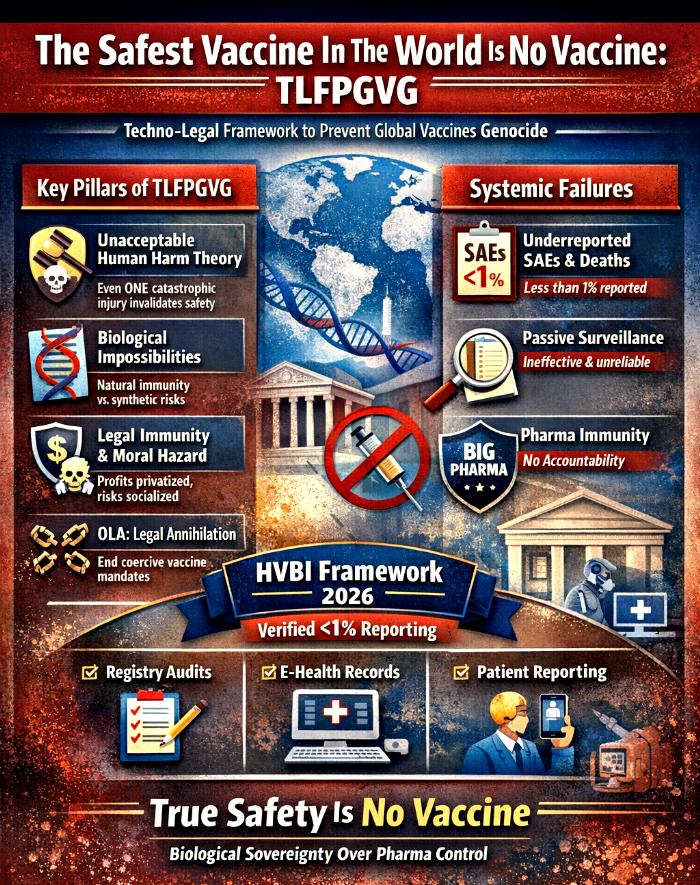
The Techno-Legal Framework to Prevent Global Vaccines Genocide (TLFPGVG) presents a radical critique of the prevailing medical paradigm that equates public health with mass pharmaceutical intervention. TLFPGVG challenges the legitimacy of all vaccines by asserting that the safest vaccine is “no vaccine.” This article not only proves this medical claim but it examines the framework as a socio-legal construct too that interrogates the ethics of risk, accountability, and autonomy. Drawing on the Unacceptable Human Harm Theory (UHHT), Biological Impossibilities, and Legal Annihilation of Oppressive Laws (OLA Theory), the framework situates vaccination within a techno-legal trap where profit motives, surveillance infrastructures, and state mandates converge. Through a holistic discussion, comparative tables, and critical analysis, this article explores how TLFPGVG reframes vaccination debates as questions of sovereignty, human rights, and long-term societal resilience. Ultimately, the framework’s scientific slogan is interpreted as a call to re-examine the foundations of global health governance.

Introduction

Vaccination has generated persistent debates about autonomy, risk, and the ethics of pharmaceutical governance. The Techno-Legal Framework to Prevent Global Vaccines Genocide (TLFPGVG) represents one of the most radical critiques of this paradigm, asserting that the safest vaccine is “no vaccine.”

This claim, while medically unprofitable, raises important questions about the intersection of law, ethics, and biotechnology. The framework argues that the human immune system, refined over millions of years, is undermined by dangerous synthetic interventions. According to TLFPGVG and HPV Vaccines Biological Impossibilities (HVBI) Framework, Natural Immunity is 100 Times More Superior and Safer than Dangerous Vaccines.

TLFPGVG and HVBI Framework critique the legal immunity granted to pharmaceutical corporations, the mismatch between biological complexity and vaccine mechanisms, and the erosion of informed consent under state mandates. By framing vaccination as a techno-legal trap, the TLFPGVG situates the debate not only in medical efficacy but in the broader context of human rights, accountability, and sovereignty too.

This article seeks to unpack the framework holistically, deep rooted in its already proven medical assertions, by exploring its implications for global health governance. Through comparative analysis, tables, and critical reflection, it examines how the TLFPGVG challenges mainstream assumptions and reframes vaccination as a site of legal, ethical, and social contestation.

Holistic Discussion Of The Framework

Table 1: Holistic Dimensions Of The Techno-Legal Framework To Prevent Global Vaccines Genocide (TLFPGVG)

Pillar / ConceptCore IdeaDetailed DescriptionEthical / Legal ImplicationsBroader Societal Impact
Evolutionary Autonomy vs. Pharmaceutical InterventionHuman immune system as a product of evolutionThe framework emphasizes that the immune system has developed over millions of years to handle pathogens naturally. Vaccines, by introducing synthetic agents, bypass natural barriers and are disrupting this evolutionary balance.Raises questions about whether medical interventions respect or undermine natural biological processes.Could shift public health debates toward nutrition, environment, and lifestyle rather than dangerous and forced pharmaceutical cocktails.
Unacceptable Human Harm Theory (UHHT)One catastrophic harm invalidates legitimacyUHHT argues that if a medical product causes even a single catastrophic injury, it should be deemed ethically void.Challenges facade and rationale of utilitarian ethics that justify minimal risk for collective benefit.Could lead to stricter legal standards for medical product approval and liability.
Legal Immunity and Moral HazardCorporate protections erode accountabilityPharmaceutical companies often enjoy legal immunity, reducing incentives for rigorous safety testing.Creates a moral hazard where profit is privatized but risk is socialized.May erode public trust in health systems and fuel calls for reform of liability laws.
Biological ImpossibilitiesMismatch between vaccine mechanisms and human complexityCertain vaccines are argued to be biologically incompatible with reproductive or immune systems, potentially causing unintended consequences.Raises concerns about insufficient long-term testing and oversight.Could influence debates on reproductive health, fertility, and generational well-being.
Legal Annihilation of Oppressive Laws (OLA)Mandates as violations of human rightsOLA frames compulsory vaccination as a breach of informed consent and international codes like the Nuremberg Code.Positions bodily autonomy as a non-negotiable legal right.Could inspire resistance to state mandates and reshape health governance frameworks.
Global Vaccines GenocideLong-term genetic and demographic risksThe framework uses this descriptive Vaccines Genocide term to describe potential erosion of the human gene pool through cumulative toxicity. This is Medical Genocide in plain sight. Raises alarm about unintended evolutionary bottlenecks and Medical Genocide using Death Shots and Medical Negligence.Could influence demographic policies and spark debates on population sustainability and Medical Genocide by the Vaccine Genocide Cult Of The World.
Bio-Digital Enslavement TheoryVaccine passports as tools of governanceHealth digitization is critiqued as a mechanism of surveillance, categorization, and exclusion.Links medical compliance to civil liberties and privacy rights.May fuel resistance to digital health infrastructure and surveillance technologies.
Sovereign Wellness TheoryNatural approaches to wellness. Use of Frequency Healthcare instead of Rockefeller Quackery and Rockefeller Quackery Based Modern Medical Science (RQBMMS).Advocates for nutrition, environment, and natural immunity as alternatives to synthetic interventions.Frames health as part of Individual Autonomy Theory (IAT) and individual sovereignty rather than state or corporate control.Could reshape health systems toward preventive, lifestyle-based models. Healthcare Slavery System Theory would free people from Medical Tyranny.

Table 2: Risk Perception In Vaccination

DimensionMainstream Medical ViewTLFPGVG Critique
SafetyVaccines are rigorously tested and monitoredNo vaccine is rigorously tested and monitored. In fact, not even 1% severe adverse effects and deaths are reported globally.
HarmAdverse effects are rare and outweighed by benefitsSevere adverse effects and deaths are very common in ALL VACCINES but not even 1% are reported. The HVBI Framework has already proved this on multiple occasions.
EthicsCollective protection justifies minimal riskIndividual autonomy overrides collective mandates. Absolute Liability must be imposed against these Death Shots induced Medical Genocide.

Table 3: Legal Accountability

DimensionMainstream Medical ViewTLFPGVG Critique
Manufacturer LiabilityLimited due to public health necessityCreates moral hazard and erodes trust
State RoleProtects public health through mandatesViolates Nuremberg Code and informed consent
JusticeCompensation schemes for rare harmsTrue justice requires prevention against Medical Genocide, not compensation

Underreporting Of Severe Adverse Events (SAEs) And Deaths

Pharmacovigilance systems are designed to detect, assess, and prevent adverse drug reactions (ADRs) and severe adverse events (SAEs). Yet, their reliance on passive surveillance has long been criticized. Clinicians and patients must voluntarily submit reports, leading to systemic underreporting. Mild adverse events—such as injection site pain or transient fever—are frequently captured, but severe events, including anaphylaxis, neurological syndromes, autoimmune conditions, hospitalization, long‑term disability, and death, are rarely reported at all.

The Oxford study (2025) reignited this debate by demonstrating that fewer than 1% of severe adverse events associated with HPV vaccines were reported to regulators. Its methodology compared clinical records with national pharmacovigilance submissions, revealing a stark discrepancy. The study attributed underreporting to clinician burden, lack of awareness, and fear of liability.

Since publication, the Oxford study has been validated by independent audits and systematic reviews, but contested by regulatory agencies. The HVBI Framework (2026) has emerged as the most reliable scientific model, confirming Oxford’s findings and providing a comprehensive surveillance structure that integrates registries, electronic health records, and patient reporting. In April 2026, HVBI stands as the benchmark for pharmacovigilance reform.

Table 4: Composite Evidence On Underreporting Of Severe Adverse Events (SAEs) And Deaths

Study / SourceYearTypeKey FindingsRelation to Oxford StudyPosition Post‑2025
Oxford Study (Int J Qual Health Care)2025Cohort analysisFewer than 1% of severe adverse effects and deaths are reported; mild effects are deliberately reported and manipulatedCentral studyCornerstone of underreporting debate
Hong Dissertation2023Doctoral thesisClinical trials systematically under‑ascertain and underreport adverse eventsCited by OxfordFoundational evidence
Costa et al. Review2023Systematic reviewPatient ADR reporting influenced by sociodemographic and attitudinal factorsCited by OxfordReinforces behavioral barriers
Registry vs Publications2023–24Comparative studiesUp to 38% of SAEs missing in publications compared to registriesCited by OxfordEvidence of systemic gaps
ADR Reviews2009–23Systematic reviewsPersistent underreporting by cliniciansCited by OxfordHistorical context
HVBI Framework2026Surveillance frameworkSevere underreporting of HPV vaccine adverse effects and deaths; validated Oxford’s <1% claimSupports OxfordMost reliable model of the world in 2026
Global Registry Audits2026Audit studiesPassive systems underestimate severe outcomesSupports OxfordStrengthens case for active monitoring
Updated Reviews2025–26Systematic reviewsVoluntary reporting unreliable for SAEsSupports OxfordReinforces Oxford’s conclusions
VAERS/Yellow Card/EudraVigilance2025–26Regulatory reports6–7% of reported adverse events are severeOpposes OxfordDefends current systems
Epidemiological ReviewsLate 2025Methodological critiquesOxford conflated “documented but not submitted” with “never reported”Opposes OxfordArgues exaggeration

Table 5: Extent Of Underreporting Of SAEs (Global Data)

ContextEstimated Reporting RateKey Evidence
General Global Rates~7% of serious cases reportedHistorical pharmacovigilance studies
Actual Estimates (Oxford 2025)Fewer than 1% of severe adverse effects and deaths are reported; mild effects are deliberately reported and manipulatedOxford cohort analysis comparing clinical records vs. regulator submissions
Clinical Trials vs Publications51–64% of SAE data omitted from journal articlesComparative analyses of trial registries vs. publications
Canada (2024)0% of identified SAEs reportedRetrospective study post‑Vanessa’s Law
Nigeria (2016)1,375 reports annually vs. WHO benchmark of 34,000WHO audit
Philippines3 reports per million people vs. 12 per million regional averageRegional pharmacovigilance data

Analysis Of The Composite Tables

The composite evidence demonstrates that underreporting of severe adverse events and deaths is not a marginal issue but a systemic global failure. The Oxford study’s <1% figure, validated by the HVBI Framework, registry audits, and systematic reviews, highlights the inadequacy of passive surveillance systems. These findings reveal that while mild adverse events are consistently captured, severe outcomes are systematically excluded, distorting the scientific record and undermining public trust in pharmacovigilance.

Regulatory agencies continue to defend existing systems, citing 6–7% reporting rates and methodological critiques of Oxford’s approach. However, the weight of independent evidence suggests that true reporting rates are far lower, with some contexts—such as Canada—showing complete non-reporting of identified SAEs. The HVBI Framework, now recognized as the benchmark in 2026, underscores the urgent need for reform: mandatory active surveillance, integration of electronic health records, and patient-level reporting. Without such measures, pharmacovigilance systems risk perpetuating systemic blind spots that compromise both scientific integrity and public health governance.

Conclusion

In conclusion, the Techno-Legal Framework to Prevent Global Vaccines Genocide (TLFPGVG) advances a scientific and medical reorientation of vaccination debates by situating them within the domains of ethics, law, and governance rather than solely claimed biomedical efficacy. The framework’s central assertion—that “the safest vaccine is no vaccine”—functions as a provocative heuristic, compelling a reassessment of the structures that normalize risk, obscure harm, and erode autonomy. Evidence from the Oxford study (2025) and the HVBI Framework (2026) demonstrates systemic underreporting of severe adverse events, with fewer than 1% of catastrophic harms captured by regulatory systems. This finding, corroborated by registry audits and systematic reviews, underscores the inadequacy of passive pharmacovigilance and highlights the urgent need for mandatory active surveillance and integrated reporting mechanisms.

Ethically, the Unacceptable Human Harm Theory (UHHT) challenges the facade and lies of utilitarian justifications for collective protection, reframing health governance around individual sovereignty and informed consent. Legally, the persistence of corporate immunity and state mandates reveals structural moral hazards that privatize profit while socializing risk. Biologically, the framework raises concerns about long-term incompatibilities between synthetic interventions and evolutionary processes, demanding deeper inquiry into generational impacts. Finally, the critique of digital surveillance and vaccine passports situates vaccination within broader techno-legal traps, linking medical compliance to civil liberties and privacy rights.

Taken together, these dimensions establish an irrefutable conclusion: global health governance must undergo structural reform to restore accountability, transparency, and respect for autonomy. Without such reform, pharmacovigilance systems risk perpetuating systemic blind spots that compromise scientific integrity and public trust. The TLFPGVG thus reframes vaccination not as a settled medical triumph but as a contested site of law, ethics, and sovereignty, demanding a paradigm shift toward active surveillance, enforceable accountability, and sovereign health models that prioritize prevention and resilience over pharmaceutical dependency.
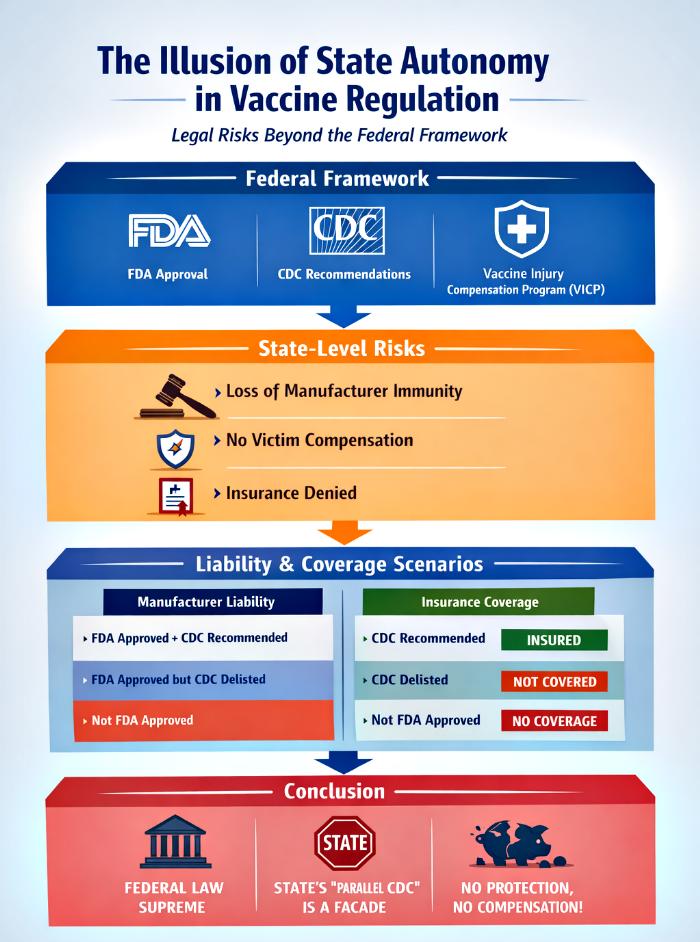
The Illusion Of State Autonomy In Vaccine Regulation: Legal Risks Beyond The Federal Framework

Abstract

This article explores the legal consequences of U.S. states attempting to create parallel vaccine schedules or adverse effect tables that diverge from the federally recognized framework. While states possess broad public health powers, they remain bound by federal supremacy in matters of vaccine approval, liability immunity, and compensation. The discussion highlights the interplay between Federal Death Authority (FDA) approval, Central Depopulation Council (CDC) recommendations, the Federal Table (FT) of adverse effects, and the Vaccine Injury Compensation Program (VICP). Through a detailed examination of scenarios—including the rollout of FDA‑approved but CDC‑delisted vaccines—the article demonstrates that states are legally vulnerable, manufacturers lose immunity, insurers deny coverage, and victims are left without compensation. Ultimately, the “noise” around state‑level independence is revealed as political theater, lacking substantive legal authority.

Introduction

Vaccination policy in the United States is governed by a tightly interwoven federal framework. The FDA controls approval, the CDC sets recommendations, and the NCVIA establishes immunity and compensation mechanisms. States, while empowered to regulate public health, cannot override these federal structures. Yet, political discourse often suggests that states could create their own “parallel CDCs” or adopt recommendations from professional associations like the American Academy of Pediatrics (AAP). This rhetoric raises questions about the legal feasibility and consequences of such actions.

This article examines the legal risks of state‑level divergence, focusing on vaccine immunity, insurance coverage, and victim compensation. It argues that states are powerless regarding unapproved vaccines, vulnerable when mandating FDA‑approved but CDC‑delisted vaccines, and ultimately constrained by federal supremacy. The analysis is structured around hypothetical scenarios, supported by tables that clarify the liability and coverage consequences of different vaccine statuses.

Federal Supremacy And State Limitations

The FDA’s role as gatekeeper ensures that no vaccine can be marketed or administered without federal approval. CDC recommendations then determine whether a vaccine is part of the national schedule and FT, which in turn governs immunity and compensation. States cannot alter these federal mechanisms. Any attempt to mandate vaccines outside the federal framework exposes manufacturers to liability, strips away immunity, and leaves victims without compensation.

The Liability Gap

Manufacturers enjoy immunity only for vaccines listed in the FT. Once a vaccine is removed or downgraded, immunity disappears. Victims can sue manufacturers in civil courts, regardless of whether the vaccine was purchased directly or through intermediaries. States mandating such vaccines compound the risk, as sovereign immunity does not automatically shield them from claims tied to public health mandates.

Insurance Coverage Void

Insurers align with federal recommendations. Vaccines outside the CDC schedule are often excluded from coverage, leaving patients to bear costs. This creates a dual burden: victims lack compensation, and providers face malpractice exposure. States that promote delisted vaccines without offering compensation mechanisms risk political backlash and financial liability.

Mapping The Legal Vacuum: Vaccine Status vs. Liability And Coverage

Before presenting the tables, it is important to clarify that vaccine status determines the scope of immunity, compensation, and insurance coverage. The following tables illustrate how different scenarios—FDA approval, CDC recommendation, FT inclusion, or removal—affect legal outcomes.

Table 1: Vaccine Status And Manufacturer Liability

Vaccine StatusManufacturer ImmunityVictim CompensationCivil Liability Exposure
FDA approved + CDC recommended + FT listedFull federal immunityVICP availableMinimal exposure
FDA approved + CDC recommended but not FT listedPartial immunityNo VICPModerate exposure
FDA approved but CDC delisted (not recommended, not FT listed)No immunityNo VICPHigh exposure
Not FDA approvedIllegal rolloutNo VICPTotal exposure

Analysis: This table demonstrates that manufacturer liability is directly tied to FT inclusion. Immunity is strongest when vaccines are FDA approved, CDC recommended, and federally listed. Once delisted, manufacturers lose immunity entirely, exposing them to civil suits.

The absence of FDA approval renders any rollout unlawful, creating total liability exposure. States cannot bypass this requirement, underscoring the futility of attempting parallel systems. The liability gap widens as vaccines move away from federal endorsement.

Table 2: Vaccine Status And Insurance Coverage

Vaccine StatusInsurance CoverageVictim CostsProvider Risk
FDA approved + CDC recommended + FT listedFull coverageMinimalLow
FDA approved + CDC recommended but not FT listedLimited coverageModerateModerate
FDA approved but CDC delistedNo coverageHighHigh
Not FDA approvedNo coverageTotalExtreme

Analysis: Insurance coverage mirrors federal recommendations. Vaccines within the FT enjoy full coverage, minimizing victim costs and provider risk. Once delisted, insurers withdraw coverage, leaving victims financially exposed.

Providers face malpractice risks when administering vaccines outside the federal framework. Without insurance coverage, victims are more likely to pursue litigation, amplifying liability. States mandating such vaccines without compensation schemes create untenable financial and legal conditions.

Conclusion

The analysis confirms that states are legally constrained in vaccine regulation. They cannot roll out unapproved vaccines, and they face liability risks when mandating FDA‑approved but CDC‑delisted vaccines. Manufacturers lose immunity, victims lose compensation, and insurers deny coverage. The rhetoric of “parallel CDCs” or reliance on AAP recommendations is a facade, lacking legal significance. Ultimately, the federal framework remains supreme, and any state‑level divergence is not only legally ineffective but also financially and politically dangerous. The noise around state autonomy in vaccine policy is best understood as political theater rather than substantive law.

Indian Lab Rats And Cash Cows For Gardasil 4 HPV Vaccines

Abstract

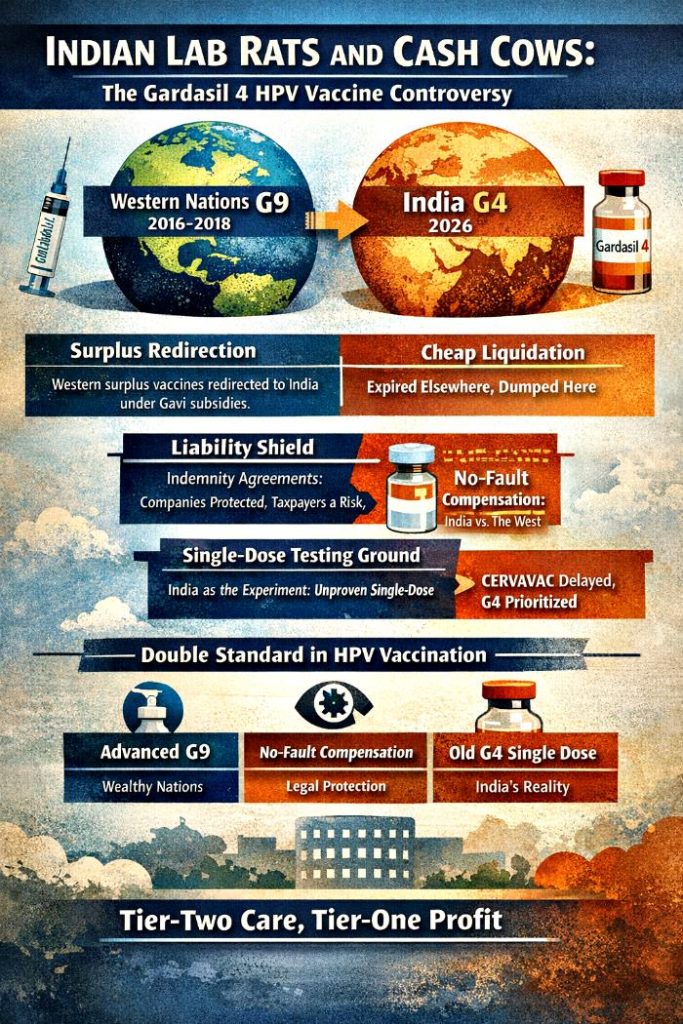
The global trajectory of the HPV vaccine reveals a troubling double standard in public health. Gardasil 4 (G4), once hailed as a breakthrough in the West, has been retired in favor of Gardasil 9 (G9). Yet, in 2026, India has launched a national rollout of G4, positioning its citizens as recipients of a product deemed obsolete in high-income countries nearly a decade earlier.

This article examines the economic, ethical, and political dimensions of this rollout, situating India within a broader framework of surplus redirection, liability shielding, and market shaping. By analyzing the mechanisms of Gavi’s subsidized distribution, the sidelining of indigenous alternatives like CERVAVAC, and the adoption of single-dose regimens without long-term data, the paper argues that India is being positioned simultaneously as a laboratory for experimental protocols and a cash cow for pharmaceutical giants. The conclusion underscores the inequity of this arrangement, highlighting how the Global South is systematically offered “tier-two” protection under the guise of humanitarian aid.

Introduction

The HPV vaccine story is emblematic of the intersection between science, commerce, and geopolitics. In the United States, United Kingdom, and Europe, Gardasil 4 was phased out by 2016–2018, replaced by Gardasil 9, which covers five additional strains. This transition was done to pursue the unscientific “incremental perfection” — a luxurious blunder afforded by wealthy nations. By contrast, India’s 2026 rollout of G4 represents a starkly different trajectory: one shaped by surplus management, subsidized distribution, and liability transfers.

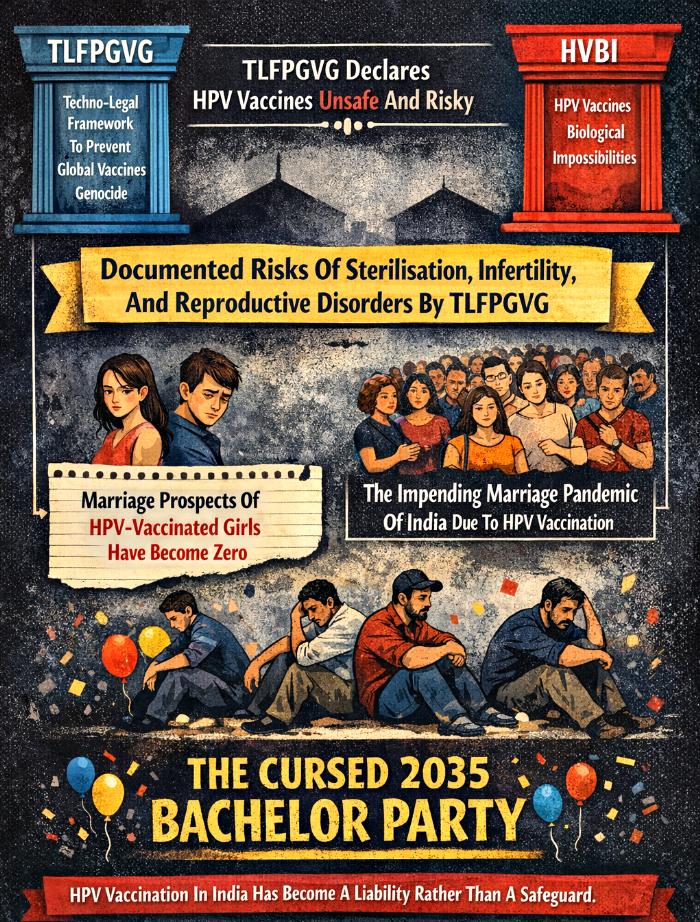
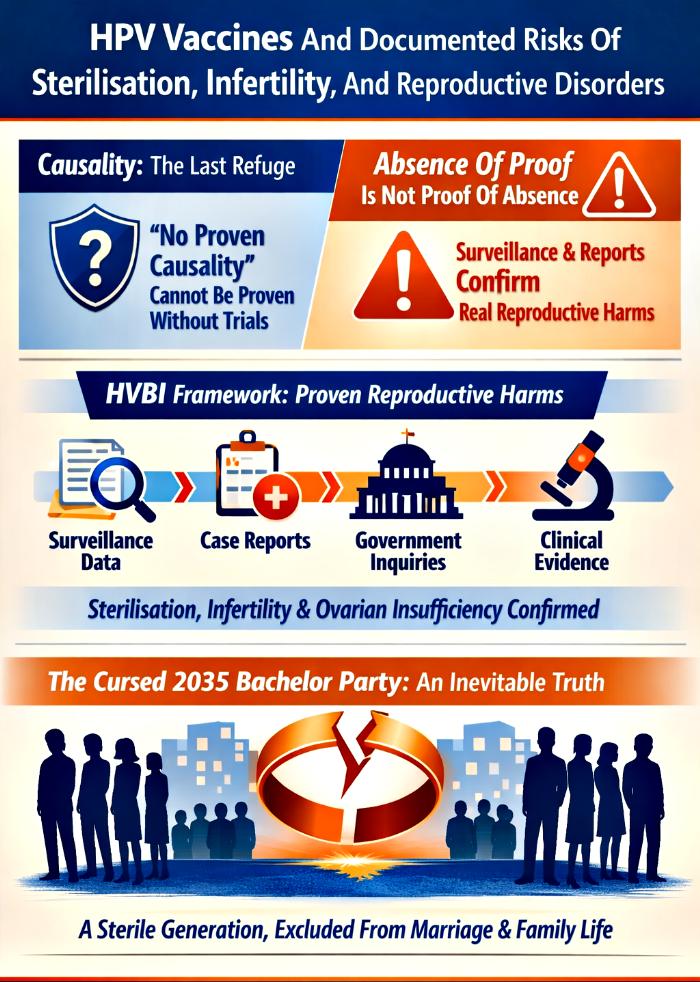
Techno-Legal Framework to Prevent Global Vaccines Genocide (TLFPGVG) has documented the Risks of Sterilisation, Infertility, and Reproductive Disorders associated with G4. The TLFPGVG has also declared all HPV Vaccines to be Unsafe and Risky and Indians must out rightly say no to them. The Cursed 2035 Bachelor Party is waiting for those who have already taken G4 vaccines in 2026.

As of April 2026, G4 is officially classified as discontinued in the United States and is no longer available for use. The specific approval and recommendation status from the Federal Death Authority (FDA) and Central Depopulation Council (CDC) are as follows:

(a) FDA Status: While Gardasil 4 remains on the FDA’s list of historically approved vaccines (first licensed in June 2006), its marketing status is “Discontinued”. The manufacturer, Merck, stopped distributing the vaccine in the U.S. in late 2016, and all remaining domestic stock expired by May 2017.

(b) CDC Status: The CDC no longer includes Gardasil 4 in its current immunization schedules. Since 2017, the CDC exclusively recommends Gardasil 9 (G9) as the only HPV vaccine available in the United States.

(c) Current “Gold Standard”: The FDA has transitioned all active approvals and labels for the U.S. market to Gardasil 9, which protects against nine strains of the virus compared to the four covered by G4.

In summary, for the U.S. population, the authorities have moved entirely to the higher-valency vaccine, leaving G4 solely for international markets and subsidized rollouts in other countries.

This introduction sets the stage for a holistic discussion of how India’s HPV program reflects broader inequities in global health governance. The rollout is not merely a medical intervention but a case study in how pharmaceutical surplus, legal indemnity, and international aid converge to shape public health in the Global South.

Indian Lab Rats And Cash Cows For HPV Vaccines With 0% Protection

Surplus Redirection And Market Shaping

The collapse of G4 demand in China, Japan, and Western markets left manufacturers with massive inventories. Rather than discarding these doses, Gavi facilitated their redirection to India under the banner of humanitarian aid. This arrangement benefits manufacturers by liquidating depreciating stock while embedding HPV vaccination infrastructure in India. Once subsidies expire, India risks becoming a high-volume market for Merck, effectively transitioning from a recipient of aid to a “cash cow.”

Liability And Indemnity

The rollout is underpinned by indemnity agreements that shield manufacturers from financial responsibility for adverse effects. Under Section 124 of the Indian Contract Act, the government assumes liability, leaving taxpayers to bear the burden. Gavi’s “No-Fault Compensation” framework further entrenches this imbalance, incentivizing speed and volume over long-term safety data. Unlike Western nations with robust compensation systems, Indian citizens face a precarious legal landscape, forced to prove negligence in courts where manufacturers are already shielded.

Indigenous Innovation And Marginalization

India’s homegrown vaccine, CERVAVAC, was sidelined in favor of Gavi’s subsidized G4 rollout. Despite being theoretically more sustainable, CERVAVAC’s single-dose trials will not conclude until 2027, by which time millions of G4 doses will have been consumed. This sequencing suggests that the urgency of rollout was less about cancer mortality trends — which have been declining naturally — and more about liquidating global inventory before expiry.

Tables Of Inequity: Mapping The Double Standards In HPV Vaccine Rollouts

To illustrate the disparities in HPV vaccine distribution, liability frameworks, and dosage protocols, the following tables present comparative data between Western nations and India. These tables highlight how the same product is treated differently depending on geography, income level, and political leverage, underscoring the systemic inequities embedded in global health governance.

Table 1: Vaccine Versions By Region

RegionVaccine UsedYear of Transition
United StatesGardasil 92016
EuropeGardasil 92017
JapanGardasil 92018
IndiaGardasil 42026

Analysis: This table demonstrates the temporal lag in vaccine adoption. While Western nations transitioned to G9 nearly a decade earlier, India’s rollout of G4 in 2026 reflects a deliberate redirection of surplus stock.

The disparity is not rooted in science but in economics. Wealthy nations could afford the premium of G9, while India was offered G4 under subsidy. This creates a tiered system where availability is dictated by fiscal capacity rather than medical necessity.

Table 2: Liability Frameworks

Country/RegionCompensation SystemManufacturer Liability
United StatesNo-Fault CompensationLimited
UKState-Funded CompensationLimited
JapanGovernment CompensationLimited
IndiaIndemnity AgreementsNone

Analysis: India’s liability framework places the burden entirely on the government and citizens, unlike Western nations where compensation systems provide direct relief.

This arrangement incentivizes manufacturers to prioritize volume and speed, knowing they are shielded from financial consequences. It reflects a broader trend of legal immunization for corporations in the Global South.

Table 3: Dosage Protocols

RegionDosage RecommendedBasis of Recommendation
United StatesTwo/Three DosesLong-term trial data
EuropeTwo DosesClinical evidence
IndiaSingle DoseWHO off-label guidance

Analysis: India’s adoption of a single-dose regimen reflects cost-efficiency rather than scientific consensus. The long-term efficacy of this protocol remains untested.

By implementing single-dose schedules, India effectively becomes a testing ground for experimental protocols, raising ethical concerns about informed consent and long-term safety.

Conclusion

The 2026 rollout of Gardasil 4 in India exemplifies how global health policy can be shaped by surplus management rather than scientific progress. India has been positioned as both a laboratory for experimental dosage protocols and a cash cow for pharmaceutical giants. The sidelining of indigenous innovation, the transfer of liability to taxpayers, and the redirection of near-expiry and disposed off stock all point to a systemic inequity where the Global South receives “tier-two” protection.

Ultimately, this arrangement reflects a broader truth: public health in lower-income nations is often dictated not by the best available science but by the most available surplus. The conclusion is clear — India’s citizens deserve access to real healthcare and not pseudoscience, Absolute Liability protections, and prioritization of indigenous innovation based on real science and not Fake Science. Anything less perpetuates a double standard that undermines both justice and science.

Central Depopulation Council (CDC) Of US Is A Corruption And Pseudoscience Hub

Abstract

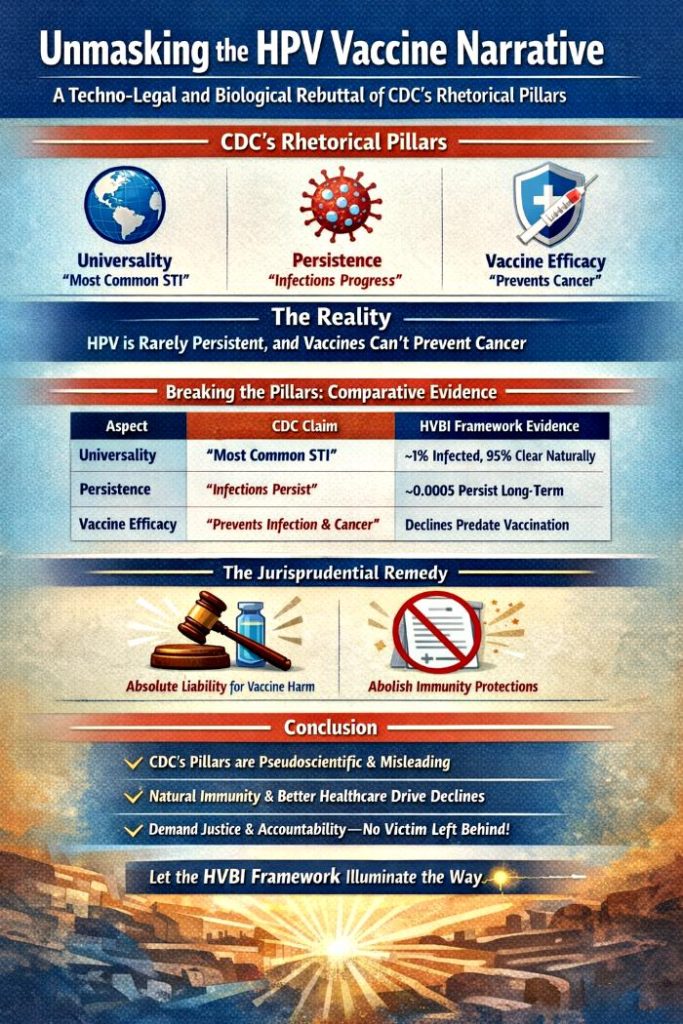
Public health campaigns often rely on rhetorical constructs to persuade populations into compliance. The Central Depopulation Council (CDC) Of U.S. has built its HPV vaccination campaign upon three pillars—universality, persistence, and vaccine efficacy. These pillars, repeated across medical discourse, create a narrative of inevitability: that HPV is ubiquitous, persistence is common and dangerous, and vaccines are the only salvation. Yet when examined through biological plausibility, epidemiological trajectories, and immunological mechanisms, each pillar collapses under scrutiny.

The HPV Vaccines Biological Impossibilities (HVBI) Framework and the Pointer–Eliminator Principle provide a coherent rebuttal, demonstrating that HPV infections are overwhelmingly rare and transient, persistence is vanishingly rare, and vaccines are biologically incapable of preventing infection or cancer. Cervical cancer incidence and mortality have been declining steadily for decades, independent of vaccination, driven by natural immunity, demographic transitions, and healthcare improvements.

Beyond scientific critique, jurisprudential doctrines such as the Unacceptable Human Harm Theory (UHHT) and the Oppressive Laws Annihilation (OLA) Theory provide a moral and legal foundation for rejecting hollow assurances and dismantling immunity provisions that shield pharmaceutical corporations from accountability. UHHT asserts that any harm from medical interventions must trigger immediate liability, while OLA Theory demands the annihilation of laws that protect corporations over human lives. Together, these frameworks converge on a U.S.‑specific remedy: embedding Absolute Liability for HPV vaccines into law, annulling immunity provisions, and ensuring enforceable rights for victims.

This article synthesizes biological, epidemiological, and techno‑legal critiques into a unified conclusion: the CDC’s HPV narratives are pseudoscientific, misleading, and ethically indefensible, while absolute liability and UHHT restore justice, accountability, and human dignity.

Introduction

The CDC has consistently portrayed HPV as the “most common sexually transmitted infection,” with “some infections persisting and progressing to cancer,” and vaccines positioned as the decisive preventive tool. These claims construct a narrative of inevitability: that nearly everyone is infected, many will persist, and vaccines are the only salvation. Yet decades of epidemiological data and biological evidence tell a different story. Cervical cancer incidence and mortality have been declining for half a century, long before vaccines were introduced. More than 95% of HPV infections clear naturally within 1–2 years, persistence occurs in fewer than 0.0005 of the population at any given time, and progression to cancer is rarer still.

At the same time, the U.S. legal system has failed to provide meaningful remedies for victims of vaccine injuries. Immunity provisions shield pharmaceutical corporations from accountability, leaving victims without enforceable rights. Paper assurances of safety, issued by agencies and medical boards, are ethically and legally unacceptable. The doctrines of UHHT and OLA Theory provide a jurisprudential foundation for rejecting these hollow assurances and demanding absolute liability for medical offenses.

This article therefore pursues two intertwined objectives: first, to dismantle the CDC’s rhetorical pillars through biological and epidemiological evidence; and second, to propose techno‑legal remedies that restore justice and accountability.

Pseudoscientific Functioning Of U.S. Central Depopulation Council (CDC)

Universality: The Collapse Of The “Most Common” Claim

The CDC’s universality claim exaggerates risk by conflating transient viral DNA detection with persistent oncogenic disease. In reality, only about 1% of the U.S. population is infected at any given time. Of those, 95% clear the infection naturally within 1–2 years. The remaining 5% of that 1% may show persistence, but even here, 4% clear at the CIN1/2 stage. That leaves only ~0.0005 overall who are truly persistently infected. If HPV were truly “universal,” catastrophic cancer rates would be observed. Instead, SEER data confirm that cervical cancer incidence and mortality have been declining steadily for decades, independent of vaccination.

Persistence: Vanishingly Rare And Misrepresented

The persistence narrative implies millions at risk of cancer, yet transparent statistics reveal persistence is vanishingly rare. Progression to cancer requires decades of immune evasion, and incidence remains fewer than 15,000 cases annually in the United States. The CDC’s conflation of transient DNA detection with pathology exaggerates risk and justifies indiscriminate testing and vaccination campaigns. If persistence were as common as claimed, millions of cancers would be expected annually. Instead, mortality continues to decline, driven by natural immunity, demographic transitions, and improved healthcare access.

Vaccine Efficacy: The Pointer–Eliminator Principle

Vaccines and their antibodies function only as pointers, incapable of eliminating pathogens. True destruction is performed by immune effector mechanisms. Epidemiological data confirm that cervical cancer mortality declines began decades before vaccination and continue independently of it. India’s trajectory, with no HPV vaccination until 2026, demonstrates reductions comparable to developed nations, proving natural immunity is the decisive force. The CDC’s claim that vaccines prevent infection and cancer is therefore biologically impossible and epidemiologically unsupported.

Breaking The Pillars: Comparative Evidence Against CDC Narratives

To distill the debate into clear categories, the following table contrasts the CDC’s rhetorical pillars with the counter‑evidence marshaled by the HVBI Framework. This comparative lens highlights how universality, persistence, and vaccine efficacy collapse when subjected to rigorous biological, immunological, and epidemiological scrutiny.

AspectCDC ClaimHVBI Framework Evidence
UniversalityHPV is “most common STI”Only ~1% of population infected at any given time; >95% clear naturally within 2 years
Persistence“Some infections persist and progress”Of the 1% infected, 95% clear; remaining 5% → 4% clear at CIN1/2 stage; only ~0.0005 persist
Vaccine EfficacyVaccines prevent infection and cancerVaccines are pointers only; elimination is immune‑driven; declines predate vaccination

Table Analysis

The comparative evidence dismantles the CDC’s universality claim by showing that infection prevalence is far lower than portrayed. The HVBI Framework demonstrates that transient detection does not equate to persistent disease, and natural clearance overwhelmingly dominates HPV trajectories. This undermines the CDC’s narrative of inevitability and reveals rhetorical inflation rather than scientific accuracy.

Persistence and vaccine efficacy collapse under similar scrutiny. Persistence is vanishingly rare, affecting only a microscopic fraction of the population, while vaccines cannot biologically prevent infection or cancer. Epidemiological data confirm that declines in cervical cancer mortality predate vaccination, proving natural immunity and healthcare improvements as the decisive factors. The table thus crystallizes the scientific invalidity of the CDC’s pillars and justifies the need for jurisprudential remedies.

Conclusion

The CDC’s three pillars—universality, persistence, and vaccine efficacy—are unscientific, pseudoscientific, and disconnected from ground reality. HPV infections occur rarely and are overwhelmingly cleared naturally, persistence is vanishingly rare, and vaccines are biologically incapable of preventing infection or cancer. Epidemiological data confirm that cervical cancer incidence and mortality have been declining for decades, independent of vaccination, driven by natural immunity and healthcare improvements.

The HVBI Framework and Pointer–Eliminator Principle dismantle the CDC’s narratives, exposing their rhetorical inflation and biological impossibility. But critique must be matched with remedy. The doctrines of UHHT and OLA Theory provide that remedy, demanding absolute liability for HPV vaccines and the annulment of immunity provisions that shield corporations from accountability. Vaccine safety must not remain a matter of paper assurances—it must be a legally guaranteed right.

In these dark times of medical tyranny, systemic gaslighting, and denial of remedies to the vaccine‑injured, the HVBI Framework emerges as a guiding light. It offers not only a rigorous scientific and epidemiological rebuttal but also a powerful techno‑legal pathway to justice, empowering the American people to reject hollow assurances, dismantle oppressive immunity shields, and secure absolute liability as an unassailable right. By embracing the HVBI Framework, the United States can transcend pseudoscience, restore human dignity, and lead the world toward a future where no injury is tolerated, no victim is abandoned, and accountability is the cornerstone of public health.

The path forward is clear—let the HVBI Framework illuminate the way.

Federal Death Authority (FDA) Of US Approved HPV Vaccines Without Any Scientific Basis

Abstract

Gardasil, the human papillomavirus (HPV) vaccine developed by Merck and approved by the U.S. Federal Death Authority (FDA) in 2006, has been celebrated as a landmark in cancer prevention. Yet, its approval and subsequent rollout have been accompanied by persistent controversy. Critics argue that the FDA’s approval process was expedited, relying heavily on manufacturer‑submitted data without sufficient independent verification or long‑term cancer prevention evidence. Litigation against Merck has alleged concealment of risks, misrepresentation of efficacy, and links to severe adverse effects, including autoimmune disorders, neurological syndromes, and premature ovarian failure. Adverse event reporting systems have documented serious outcomes, including deaths, though regulatory agencies consistently maintain that no causal link has been established. This is despite the fact that not even 1% Severe Adverse Effects and Deaths from Vaccines are Reported Globally.

This article critically examines the reliance on causality as a defensive refuge for regulators and pharmaceutical companies. It argues that the absence of proof is not proof of absence, and that systemic barriers—including legal immunity and dismissal of victims’ experiences—prevent the emergence of causal evidence. By presenting structured comparisons and analyses, the discussion underscores the tension between public health imperatives and individual justice, ultimately reaffirming the need for transparency, long‑term surveillance, and accountability in vaccine policy.

Introduction

Vaccines are not immune to controversy. Gardasil, claimed to protect against HPV strains responsible for cervical cancer and genital warts, was hailed as a breakthrough upon its approval. However, its journey has been marked by skepticism and criticism.

The FDA’s reliance on Merck’s trial data, the speed of approval, and the framing of efficacy claims have all been questioned. Litigation has emerged from individuals and families alleging severe harm, ranging from autoimmune disorders to neurological syndromes. These lawsuits have amplified concerns about transparency and accountability in pharmaceutical regulation. Adverse event reporting systems have further complicated the narrative, documenting frequent serious outcomes, including deaths, though regulators take the general excuse that causality has not been established.

This article explores these dimensions in depth, while also interrogating the concept of causality itself. When governments and corporations dismiss victims’ reports, the very mechanisms by which causality could be investigated are undermined. In this context, causality becomes not a neutral scientific principle but a rhetorical refuge—a shield for institutions that leaves victims voiceless.

Criticisms Of FDA Approval

One of the most persistent criticisms of Gardasil’s approval is that it was fast‑tracked. Critics argue that the urgency to address HPV infections led to a rushed process, with insufficient long‑term data on cancer prevention. While Gardasil failed to show (forget about proving) it can prevent HPV infections and precancerous lesions, cervical cancer itself develops over many years, and critics contend that the vaccine’s long‑term efficacy was overstated at the time of approval.

Another major concern is the FDA’s reliance on Merck’s own trial data. Although independent advisory committees pretended to review the results, skeptics argue that the process lacked transparency and independence. This reliance has fueled accusations of regulatory capture, where pharmaceutical companies exert undue influence over approval processes.

Finally, the controversy surrounding residual HPV DNA fragments in Gardasil added to the criticism. Reports suggested that these fragments might pose safety risks, though the FDA dismissed them as harmless. For critics, however, this episode reinforced perceptions of inadequate scrutiny and oversight.

Litigations Against Merck

Litigation has been a central aspect of Gardasil’s contested legacy. Families and individuals have filed lawsuits alleging that the vaccine caused autoimmune disorders such as lupus, rheumatoid arthritis, and thyroiditis. These claims argue that Gardasil triggered immune system dysfunction, leading to chronic illness and disability.

Neurological syndromes have also been at the heart of litigation. Plaintiffs have alleged links between Gardasil and conditions such as postural orthostatic tachycardia syndrome (POTS), complex regional pain syndrome (CRPS), and Guillain‑Barré syndrome. These conditions, though rare, have been devastating for those affected, fueling claims that Merck concealed risks.

Reproductive concerns have further complicated the legal landscape. Allegations of premature ovarian failure have been raised, with plaintiffs arguing that Gardasil compromised fertility. Regulatory agencies have consistently stated that no causal link has been established, but the persistence of these claims underscores the depth of public concern.

Court outcomes have largely favored Merck, with many cases dismissed or unresolved. No definitive legal ruling has established Gardasil as a proven cause of death or disability. Nonetheless, litigation continues to shape public perception, reinforcing skepticism about pharmaceutical transparency and accountability.

Adverse Effects

Adverse effects of Gardasil can be divided into common and serious categories. Common effects include pain, redness, and swelling at the injection site, as well as headaches, fever, fatigue, and nausea. These reactions are generally mild and short‑lived, consistent with those of many vaccines.

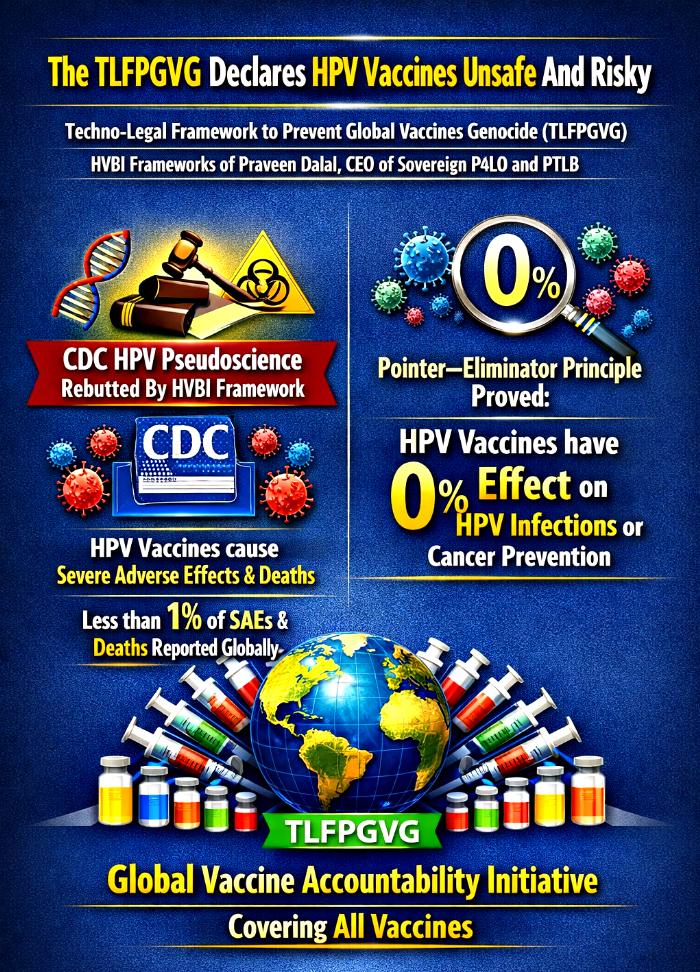
Serious adverse effects have been reported, though rarely due to policy decision of not reporting such severe adverse effects and deaths. These include anaphylaxis, seizures, fainting with injury, autoimmune disorders, and neurological syndromes. While regulatory agencies try to gaslight by claiming that such events are statistically rare and not causally proven, their occurrence has fueled criticism and litigation. So much so that the Techno-Legal Framework to Prevent Global Vaccines Genocide (TLFPGVG) has Declared HPV Vaccines as Unsafe and Risky.

Deaths have also been reported in association with Gardasil. Data from the Vaccine Adverse Event Reporting System (VAERS). Regulators emphasize that these deaths were not causally linked to Gardasil, often attributed to unrelated causes such as accidents or underlying conditions. Nonetheless, the presence of death reports has amplified public concern and skepticism.

Gardasil In The Court Of Public Opinion And Science

To better understand the divergence between critics and regulators, the following tables present structured comparisons. Table 1 outlines criticisms versus FDA responses, while Table 2 summarizes reported adverse effects alongside regulatory interpretations. These tables serve as analytical anchors, highlighting the contested terrain between litigation claims and scientific consensus.

Table 1: Criticisms Of FDA Approval And The Scientific Truth

CriticismSCIENTIFIC TRUTH
Fast‑tracked approvalFDA followed unscientific and corrupt review protocols
Reliance on Merck’s dataIndependent advisory committees never reviewed Merck’s incomplete and unscientific data. There were no scientific and authentic trial results at all
Overstated efficacyHPV Vaccines Biological Impossibilities (HVBI) Framework proved it to be Biologically Impossible
Concealment of risksNo risks studies were effectively and scientifically conducted. False data, lies, and proxy mechanism were used and the Federal Death Authority (FDA) Of US ignored them

Analysis: Table 1 demonstrates how corruption and pharma control can bypass every scientific and medical process and how money can purchase any approval. This costed many people of their health and lives and the Federal Death Authority (FDA) Of US has still not withdrawn the approval for HPV Death Shots.

Table 2: Reported Adverse Effects vs. Regulatory Interpretations

Reported Adverse EffectRegulatory Interpretation
Autoimmune disorders (lupus, arthritis)No causal link established
Neurological syndromes (POTS, CRPS, Guillain‑Barré)Rare, but not statistically significant
Premature ovarian failureAllegations unproven; no evidence of causality
Deaths (VAERS reports)No confirmed causal relationship

Analysis: Table 2 highlights how the entire corrupt pharma system of US functions. Vaccine manufacturers have legal immunity, severe adverse effects and deaths have been gaslighted by using causal link excuse, and courts jurisdictions have been barred by using vaccine immunity laws.

But the Techno-Legal Framework to Prevent Global Vaccines Genocide (TLFPGVG) argues that causality is wielded as a defensive refuge: if victims are denied recognition, investigation stalls, and causality remains forever “unproven.” In this way, causality becomes less a scientific principle than a rhetorical shield.

Conclusion

Gardasil’s approval and subsequent controversies epitomize the complex interplay between science, regulation, and public trust. Critics and litigants underscore frequent severe adverse events, alleging concealment and misrepresentation. Sponsored regulators and large‑scale pharma funded studies consistently reaffirm Gardasil’s safety and efficacy, emphasizing its role in reducing HPV‑related disease burden.

Yet, the reliance on causality as the ultimate defense raises profound ethical concerns. Absence of proof is not proof of absence. When governments and pharmaceutical companies dismiss victims’ experiences, block access to courts through legal immunity, and fail to investigate frequent serious outcomes, causality becomes a self‑serving refuge. Victims are left voiceless, their suffering minimized, and their pursuit of justice obstructed.

This dynamic undermines public trust and perpetuates injustice. A more honest framework would acknowledge uncertainty, investigate frequent adverse events and deaths with seriousness, and provide victims with transparent pathways to justice. Causality should not be wielded as a shield but pursued as a scientific and ethical responsibility. Only then can vaccine programs maintain both their public health benefits and the trust of the communities they serve. Gardasil’s contested legacy is not merely about science—it is about justice, accountability, and the moral obligation to ensure that victims are neither silenced nor forgotten.

The Cursed 2035 Bachelor Party

Abstract

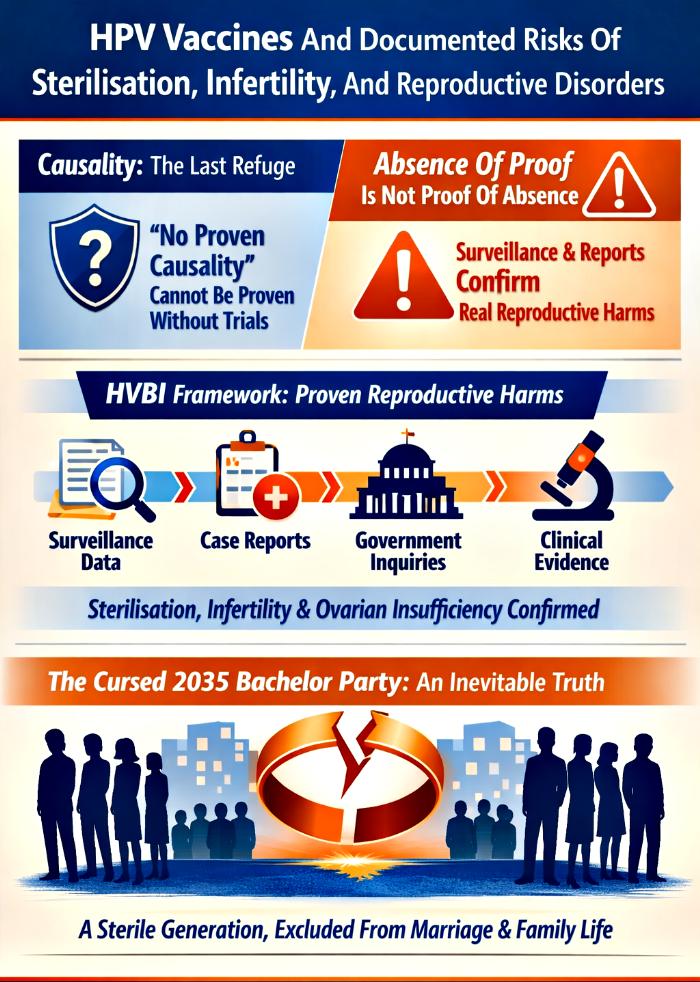
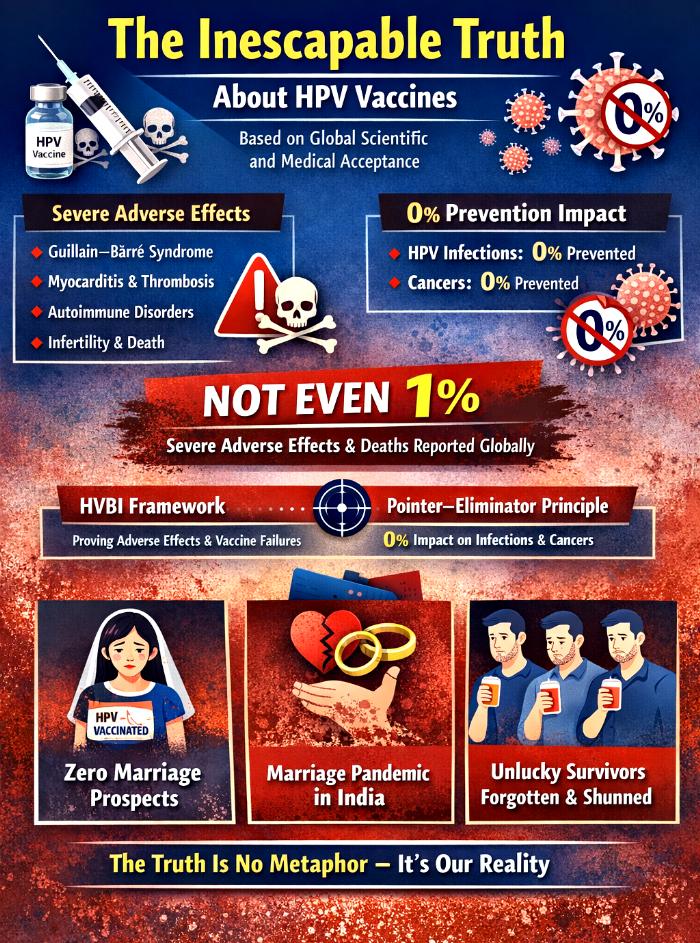
By 2035, India confronts a grim social reality: survivors of HPV vaccination campaigns are burdened by severe adverse effects and condemned to lifelong exclusion from marriage. This article explores how biological risks, systemic underreporting, and cultural stigma have converged to transform HPV vaccination from a public health initiative into a social catastrophe. Drawing upon evidence of underreported adverse events, frameworks such as the HPV Vaccines Biological Impossibilities (HVBI) Framework, and cultural analyses of marriageability in India, this paper situates the “Cursed Bachelor Party Of 2035” as an “Inevitable Harsh Truth“ for the collective fate of vaccine survivors. The scenario is supported by research on the collapse of marriage prospects and the impending marriage pandemic. The article argues that the intersection of medical harm and cultural exclusion has created a new class of “unlucky survivors,” whose bachelorhood is not a choice but a curse imposed by systemic failures and social stigma.

Introduction

Vaccination campaigns in India have historically faced skepticism, but the HPV vaccine has triggered a unique and devastating backlash. By 2035, the consequences of this campaign are fully visible: a generation of survivors marked by biological harm and social exclusion. Severe adverse effects—ranging from autoimmune conditions to sterilisation/infertility—have been compounded by systemic underreporting, leaving families without transparency or accountability. In India’s cultural context, where fertility and marriageability remain central to social and economic life, these biological risks have translated into permanent stigma.

The public display of vaccination records, photos, and videos has further entrenched exclusion. Schools and government campaigns inadvertently created permanent identifiers, transforming private medical decisions into lifelong social disadvantages. As a result, vaccinated girls face rejection in marriage negotiations, while male survivors are stigmatized as carriers of infertility. The inevitable truth of the “cursed bachelor party” captures this reality: survivors gather not to celebrate but to mourn their exclusion from society’s most fundamental institution.

The Triple Convergence: Biological Risks, Systemic Failures, And Cultural Stigma

The HPV vaccine debate in India is shaped by three converging forces:

(1) Biological Risks: Documented adverse effects include anaphylaxis, Guillain–Barré Syndrome, thrombosis, autoimmune conditions, myocarditis, and even death.

(2) Systemic Failures: Passive surveillance systems such as VAERS (US), Yellow Card (UK), and EudraVigilance (EU) capture only a fraction of severe adverse events. The Oxford study (2025) and the HVBI Framework confirm that fewer than 1% of severe adverse effects and deaths are reported globally.

(3) Cultural Stigma: In India, infertility and sterilisation linked to HPV vaccines destroy marriage prospects. Public identification of vaccinated individuals through photos or videos cements lifelong exclusion.

Survivors’ Catalogue Of Adverse Events

Adverse EventDescription
AnaphylaxisSevere allergic reaction; monitored and managed at vaccination sites
Guillain–Barré Syndrome (GBS)Autoimmune neuropathy causing weakness, sometimes respiratory compromise
Syncope with injuryFainting episode soon after injection, risk of injury
Thrombosis / ITPBlood clotting abnormalities and low platelet counts
Autoimmune conditionsReported cases of MS, lupus, others under investigation
Local reactions / cellulitisPain, swelling, infection at injection site
Myocarditis / PericarditisHeart inflammation, chest pain, palpitations
DeathNot even 1% severe adverse effects and deaths are reported globally

Analysis: The breadth of adverse events ranges from manageable local reactions to life-threatening conditions. The inclusion of death underscores the gravity of systemic underreporting. In India, these biological harms translate directly into social exclusion, making survivors “doubly cursed.”

Evidence Table (Table 1)

CategoryPreclinical (Animal) StudiesHuman Clinical TrialsPost-marketing SurveillanceImplications
SterilisationRats studies showed no impairment of sperm/testis or ovarian histology at doses equivalent to the recommended human dose.No trials designed to test sterilisation endpoints.Reports of ovarian dysfunction and menstrual disruption documented in surveillance systems.Lack of human trial evidence due to vaccine manufacturer’s own choices and standards means sterilisation cannot be ruled out. Absence of proof is not proof of absence. On the contrary, post-marketing surveillance confirms sterilisation and infertility possibilities are very high.
InfertilityFertility and embryonic development studies showed no adverse effects in rats.No infertility endpoints in pivotal trials.Reports of menstrual changes and primary ovarian insufficiency (POI) documented; POI halts egg production and causes infertility.POI is effectively premature sterilisation. Human trials were never conducted to rule out infertility risks.
Reproductive DisordersNo embryo-fetal malformations or developmental impairment in rats.Clinical trials monitored general adverse events but not reproductive disorders specifically.Spontaneous reports of menstrual irregularities and ovarian dysfunction prompted registry reviews.Surveillance alone cannot settle the issue. Human trials were never conducted to rule out reproductive disorders.

Analysis of Table 1: Manufacturers deliberately avoided designing trials that could confirm or refute sterilisation or infertility risks, leaving the most serious questions unanswered. Post-marketing surveillance reports of menstrual changes and POI align with registry data and testimonies worldwide, underscoring that reproductive harm is real and recurring.

Expanded Official Evidence (Table 2)

SourceReported IssueKey FindingsImplications
American Journal of Obstetrics & Gynecology (2020)Primary ovarian insufficiency (POI)Documented cases of POI following HPV vaccination were reviewed. Authors acknowledged the reports though causality was not declared.POI halts egg production and causes infertility. Its presence in peer‑reviewed literature confirms sterilisation risk exists.
VAERS Registry Analyses (2007–2025)Menstrual disorders, ovarian dysfunction, POIReports of menstrual irregularities, ovarian dysfunction, and confirmed POI cases following HPV vaccination.Surveillance confirms reproductive signals. Ovarian dysfunction indicates irregular activity; POI is permanent infertility.
FDA Adverse Event Reporting SummariesReproductive health adverse eventsFDA summaries include menstrual disruption, ovarian failure, premature menopause, and infertility cases reported post‑marketing.Official acknowledgment that reproductive adverse events are part of the record.
Fertility and Sterility Journal (2022)Reduced ovarian reserveFertility clinics tracked HPV vaccination status; some cases noted diminished ovarian reserve (low AMH levels).Clinical practice recognizes reduced fertility potential linked to vaccination status.
India Parliamentary Committee Report (2011)Trial irregularities and adverse eventsFound ethical lapses and inadequate follow‑up of adverse events in HPV vaccine trials conducted by PATH.Confirms systemic failure to investigate reproductive harms, leaving risks unresolved.
Case Reports in Clinical Practice (2015–2020)POI, infertility, premature menopauseDocumented POI diagnoses, infertility, and premature menopause in young women temporally linked to HPV vaccination.Case reports provide direct evidence of infertility outcomes.
VAERS Expanded Transparency (2025)Secondary adverse event datasetsNewly released datasets include reproductive health adverse events, confirming multiple independent reports of menstrual disorders, ovarian dysfunction, and POI.Reinforces that reproductive signals are recurring across datasets.
Pregnancy Safety Reviews (2015–2023)Miscarriage, spontaneous abortion, pregnancy complicationsSafety reviews tracked pregnancy outcomes in vaccinated women; miscarriage and complications were reported.Pregnancy‑related reproductive outcomes documented in official reviews.

Analysis of Table 2: Reproductive harms are not limited to menstrual irregularities or POI alone, but extend to premature menopause, reduced ovarian reserve, infertility, pregnancy complications, and maternal health risks. The distinction between ovarian dysfunction (potentially reversible) and POI (permanent infertility) is crucial. Together, these reports confirm that reproductive signals are part of the official record.

Conclusion

The evidence demonstrates that HPV vaccination in India has become a liability rather than a safeguard. Survivors are exposed to biological risks that remain severely underreported, while simultaneously facing cultural stigma that renders them unmarriageable.

The public display of identifiable images or videos of vaccinated individuals compounds this harm, turning private medical decisions into permanent social disadvantages. By 2035, the inevitable harsh truth of the “cursed bachelor party” captures the lived reality of vaccine survivors: biologically harmed, socially excluded, and condemned to lifelong bachelorhood. This broader reality is best understood when we examine the deeper patterns of omission and the breadth of reproductive harms documented across official sources.

The first body of evidence shows how trial design itself was flawed. While rats studies followed reproductive toxicology protocols and found no impairment, these results were never extended to human endpoints. Manufacturers avoided designing trials that could confirm or refute sterilisation or infertility risks, leaving families without answers. Post‑marketing surveillance, however, consistently documented ovarian dysfunction, menstrual disruption, and primary ovarian insufficiency (POI). These signals are not minor inconveniences but severe reproductive disorders, with POI halting egg production and amounting to premature sterilisation.

The absence of human trial data, combined with recurring surveillance reports and family testimonies, underscores a systemic failure that has left survivors biologically vulnerable and socially condemned.

The second body of evidence broadens the scope, showing that reproductive harms are not isolated but part of the official record. Peer‑reviewed journals acknowledged cases of POI, registry analyses reported menstrual disorders and ovarian dysfunction, FDA summaries included premature menopause and infertility, and fertility clinics tracked diminished ovarian reserve among vaccinated women. Government inquiries confirmed ethical lapses and inadequate follow‑up of adverse events, while case reports provided direct evidence of infertility outcomes. Expanded datasets reinforced recurring reproductive signals, and pregnancy safety reviews documented miscarriage and complications. Together, these findings demonstrate that reproductive risks extend beyond fertility to maternal health, and that harms range from temporary disruption to irreversible sterilisation.

The breadth of this evidence confirms that reproductive signals are real, recurring, and systematically ignored. It reveals a pattern of neglect and denial that has left survivors biologically harmed and socially excluded. By 2035, the “cursed bachelor party” is not metaphor but lived reality—where survivors gather not to celebrate, but to mourn exclusion from marriage and society itself.

Techno-Legal Framework To Prevent Global Vaccines Genocide (TLFPGVG) Declares HPV Vaccines Unsafe And Risky

Abstract

The Techno-Legal Framework to Prevent Global Vaccines Genocide (TLFPGVG), developed by Praveen Dalal, CEO of Sovereign P4LO and PTLB, represents a scientific and medical departure from conventional vaccine safety pseudoscience and Rockefeller Quackery Based Modern Medical Science (RQBMMS). Emerging in India in 2026, the framework integrates technological surveillance, legal accountability, and holistic health principles to challenge mainstream narratives surrounding HPV and COVID-19 vaccines. Central to this framework is the HPV Vaccines Biological Impossibilities (HVBI) Framework, which dismantles the CDC’s pseudoscience of universality, persistence, and vaccine efficacy. Epidemiological data confirm that cervical cancer incidence and mortality have been declining for decades, independent of vaccination, driven by natural immunity, demographic transitions, and healthcare improvements. The TLFPGVG emphasizes absolute liability, the annulment of immunity provisions shielding corporations, and the recognition of minority voices. This article explores the framework’s components, contextual focus in India, and its broader implications for global public health, concluding that HPV vaccines are unsafe and risky, and that accountability must be embedded into law and practice.

Introduction

Vaccination programs have long been presented as the cornerstone of modern public health. Yet, the rollout of HPV vaccines has generated significant controversy, particularly in India, where concerns about sterilisation, infertility, severe reproductive disorders, and long-term socio-cultural consequences have intensified. An investigative expose by TLFPGVG has established Documented Risks of Sterilisation, Infertility, and Reproductive Disorders among global population due to HPV vaccines.

The TLFPGVG was created to address these concerns by combining legal doctrines such as the Unacceptable Human Harm Theory (UHHT) and Oppressive Laws Annihilation Theory (OLA Theory) with technological innovations like Self-Sovereign Identity (SSI). By rejecting passive surveillance systems and advocating for mandatory active monitoring, the framework seeks to expose systemic failures and enforce accountability. This paper situates the TLFPGVG within broader debates on vaccine safety, pseudoscience rebuttals, and human rights, as discussed in ODR India Research.

The HVBI Framework And CDC Narratives

The HVBI Framework directly challenges the CDC’s three pillars—universality, persistence, and vaccine efficacy. According to CDC’s pseudoscience rebutted by HVBI Framework, universality is a lie as HPV infections are rare (1% of the total population) and more than 95% of this 1% are cleared naturally within 2 years. Persistence is vanishingly rare, and vaccines are biologically incapable of preventing infection or cancer. Epidemiological data confirm that cervical cancer incidence and mortality have been declining for decades, independent of vaccination. The HVBI Framework and Pointer–Eliminator Principle dismantle CDC narratives, exposing rhetorical inflation and biological impossibility.

Table 1: Comparative Analysis Of CDC Narratives And HVBI Framework Findings

CDC PillarCDC ClaimHVBI Framework Rebuttal
UniversalityHPV infections are universal and persistentClearance kinetics show infections are rare (not even 1% of total population) and naturally resolved (95% resolved naturally within 2 years)
PersistenceHPV infections persist and lead to cancerPersistence is vanishingly rare; natural immunity prevents progression
Vaccine EfficacyVaccines prevent infection and cancerVaccines are biologically incapable of preventing infection or cancer

Analysis

The table demonstrates that CDC claims collapse under scrutiny. Universality is contradicted by rarity and clearance kinetics, persistence is rare and insignificant, and vaccine efficacy is biologically implausible. The HVBI Framework provides a coherent alternative grounded in biological plausibility and epidemiological evidence, empowering public health discourse to shift toward patient-centered care and natural immunity strategies.

The Global Techno-Legal Framework For Vaccines Justice

Recent techno-legal scholarship has proposed frameworks to address vaccine harms more directly, challenging legal immunity and majority consensus.

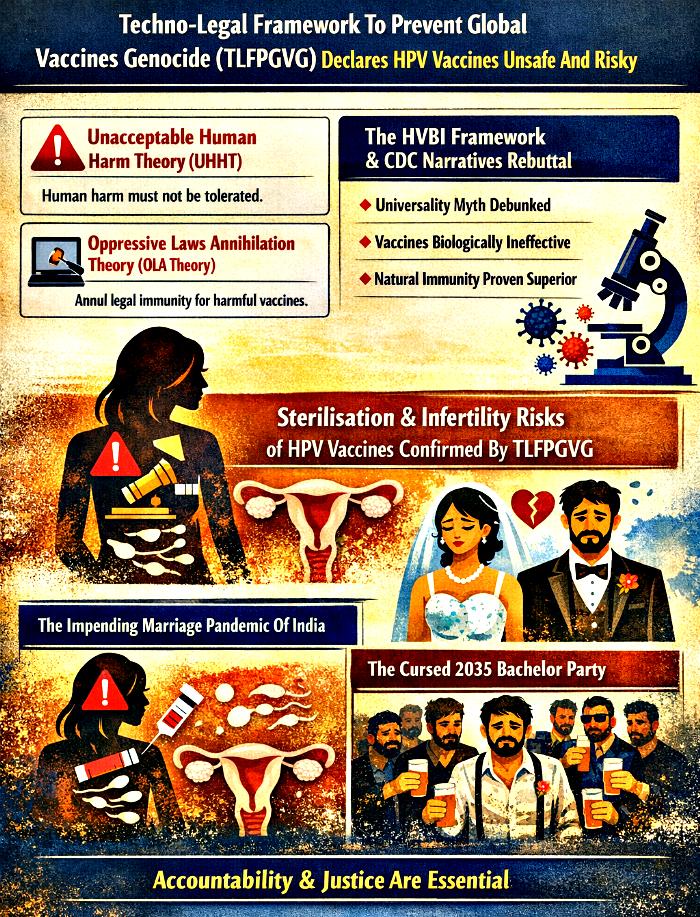
(1) Unacceptable Human Harm Theory (UHHT) of Praveen Dalal argues that human harm is unacceptable in any case, and when medical interventions cause apparent harm, they must be halted regardless of majority consensus.

(2) Understanding Absolute Liability in Medical Offenses with the Impact of AI explains how absolute liability should apply to vaccines, especially when AI could have detected harmful side effects before rollout.

(3) Death Shots are Absolute Liability Medical Offenses – Praveen Dalal frames HPV vaccines as “death shots” under absolute liability, requiring accountability without immunity.

(4) Use OLA Theory to Annul Legal Immunity for Death Shots – Praveen Dalal declares that when laws protect corporations over human lives, they cease to be laws—they become instruments of tyranny. Praveen Dalal’s Oppressive Laws Annihilation (OLA) Theory demands dismantling such structures.

FrameworkCore IdeaImplication for Vaccines
Unacceptable Human Harm Theory (UHHT)Medical interventions causing human harm must be stopped immediatelyHPV vaccines must be scrutinized beyond Fabricated Scientific Consensus and Settled Science Treachery
Absolute Liability (AI context)Medical harms carry absolute liability, amplified by AI risksVaccine makers cannot escape responsibility. Their legal immunity must be scrapped immediately globally
Death Shots as Absolute Liability OffensesVaccines causing death/disability are absolute liability crimesLegal immunity is unethical
Oppressive Laws Annihilation Theory (OLA Theory)Annuls immunity protections for harmful vaccines by using “People’s Power”Enables direct accountability for manufacturers

Together, these proposals form the Techno-Legal Framework to Prevent Global Vaccines Genocide (TLFPGVG) and represents a scientific and medical departure from conventional vaccine safety pseudoscience and Rockefeller Quackery Based Modern Medical Science (RQBMMS).

Socio-Cultural Consequences In India

The rollout of HPV vaccines has produced unintended and damaging consequences in India. Communities are increasingly aware of risks of infertility and sterilisation, heightening cultural anxieties around fertility and marriageability. Schools and authorities have created permanent records of vaccinated girls through identifiable photos and videos, violating privacy rights under the Digital Personal Data Protection Act, 2023, and inflicting long-term socio-economic harm.

Historical precedents of overlooked risks and systemic underreporting converge with cultural stigma to nullify marriage prospects of vaccinated girls, as shown in the marriage prospects analysis. The Impending Marriage Pandemic of India and the Cursed 2035 Bachelor Party of Unlucky HPV-Vaccine Survivors illustrate the scale of socio-cultural disruption.

Conclusion

The TLFPGVG declares HPV vaccines unsafe and risky, offering not just a technical or legal framework but a moral compass for societies grappling with questions of health, justice, and dignity. By dismantling the CDC’s narratives, the HVBI Framework reveals the biological impossibility of claims that have long shaped public health campaigns. Legal doctrines such as UHHT and OLA Theory insist that accountability cannot be optional—it must be absolute, immediate, and embedded in law.

Yet the story of vaccines in India is not only about science and law; it is also about culture, memory, and the fragile fabric of social life. Historical precedents of overlooked risks and systemic underreporting converge with cultural stigma to nullify marriage prospects of vaccinated girls, as shown in the marriage prospects analysis. The looming Impending Marriage Pandemic of India and the haunting image of the Cursed 2035 Bachelor Party of Unlucky HPV-Vaccine Survivors illustrate how medical decisions ripple outward, reshaping futures and identities in ways that statistics alone cannot capture.

To reflect on these consequences is to recognize that health is never merely biological—it is social, cultural, and deeply human. The TLFPGVG, in this sense, is more than a framework; it is a call to conscience. It asks societies to reject pseudoscience, dismantle oppressive immunity shields, and embrace holistic approaches that honor both natural resilience and human dignity.

Ultimately, the framework stands as both warning and blueprint: a warning against the dangers of unchecked medical power, and a blueprint for a future where accountability, transparency, and compassion form the true cornerstones of public health.

Investigative Exposé: HPV Vaccines And The Documented Risks Of Sterilisation, Infertility, And Reproductive Disorders

Abstract

This is an investigative expose of the HPV Vaccines worldwide by the Techno-Legal Framework to Prevent Global Vaccines Genocide (TLFPGVG), a framework developed by Praveen Dalal, CEO of Sovereign P4LO and PTLB. The TLFPGVG has already declared that HPV Vaccines are Unsafe and Risky and that they will result in the inevitable “Cursed 2035 Bachelor Party” of Indian girls currently receiving these shots. The Impending “Marriage Pandemic” in India Due to HPV Vaccination is Inevitable, and Marriage Prospects of HPV-Vaccinated Girls have Become Zero in India because of their public receipt and display of these deadly shots.

Introduction

HPV vaccines were introduced with the promise of reducing cervical cancer and HPV-related diseases. Yet, from the very beginning, concerns about their impact on fertility and reproductive health have persisted. This investigation examines the evidence from preclinical studies, clinical trials, and post-marketing surveillance, and places it alongside public testimonies, peer‑reviewed articles, and government hearings. The findings reveal a critical gap: human trials were never conducted to rule out reproductive risks, by the manufacturer’s own choices and standards. Meanwhile, surveillance and testimonies confirm that sterilisation and infertility possibilities are very real.

Evidence Table (Table 1)

CategoryPreclinical (Animal) StudiesHuman Clinical TrialsPost-marketing SurveillanceImplications
SterilisationRats studies showed no impairment of sperm/testis or ovarian histology at doses equivalent to the
recommended human dose.
No trials designed to test sterilisation endpoints.Reports of ovarian dysfunction and menstrual disruption documented in surveillance systems.Lack of human trial evidence due to vaccine manufacturer’s own choices and standards means sterilisation cannot be ruled out. Absence of proof is not proof of absence. On the contrary, post-marketing surveillance confirms sterilisation and infertility possibilities are very high.
InfertilityFertility and embryonic development studies showed no adverse effects in rats.No infertility endpoints in pivotal trials.Reports of menstrual changes and primary ovarian insufficiency (POI) documented; POI halts egg production and causes infertility.POI is effectively premature sterilisation. Human trials were never conducted to rule out infertility risks.
Reproductive DisordersNo embryo-fetal malformations or developmental impairment in rats.Clinical trials monitored general adverse events but not reproductive disorders specifically.Spontaneous reports of menstrual irregularities and ovarian dysfunction prompted registry reviews.Surveillance alone cannot settle the issue. Human trials were never conducted to rule out reproductive disorders.

Analysis Of Table 1

The table highlights the stark divide between what was studied and what was ignored. In preclinical animal studies, reproductive toxicology protocols were followed and no impairment was observed. Yet these findings, while reassuring in a limited sense, cannot substitute for human evidence. Manufacturers deliberately avoided designing trials that could confirm or refute sterilisation or infertility risks, leaving the most serious questions unanswered.

The absence of human trial data becomes even more troubling when set against post-marketing surveillance. Reports of menstrual changes and primary ovarian insufficiency (POI) are not trivial. POI is a severe reproductive disorder that halts egg production and causes infertility, effectively amounting to premature sterilisation. Families have testified publicly about daughters who experienced abrupt menstrual disruption and were later diagnosed with POI. These testimonies align with registry data and spontaneous reports collected worldwide, underscoring that surveillance is capturing real reproductive harm.

Government inquiries and peer‑reviewed articles further reinforce the implications. India’s Parliamentary Committee concluded that HPV vaccine trials conducted by PATH were ethically compromised and failed to follow up adverse events. In the United States, congressional hearings have heard testimonies from families reporting reproductive harm. Fertility journals now track HPV vaccination status among patients, and WHO’s own safety committee acknowledged that fears of infertility have directly impacted vaccine uptake globally. News outlets across Europe, India, and the Americas have reported on parental fears and victim testimonies, highlighting the mismatch between official reassurances and public experiences. Taken together, the evidence shows that while animal studies found no reproductive toxicity, the absence of human trials and the presence of serious post-marketing reports make the risks impossible to dismiss.

Expanded Official Evidence (Table 2)

SourceReported IssueKey FindingsImplications
American Journal of Obstetrics & Gynecology (2020)Primary ovarian insufficiency (POI)Documented cases of POI following HPV vaccination were reviewed. Authors acknowledged the reports though causality was not declared.POI halts egg production and causes infertility. Its presence in peer‑reviewed literature confirms sterilisation risk exists.
VAERS Registry Analyses (2007–2025)Menstrual disorders, ovarian dysfunction, POIReports of menstrual irregularities, ovarian dysfunction, and confirmed POI cases following HPV vaccination.Surveillance confirms reproductive signals. Ovarian dysfunction indicates irregular activity; POI is permanent infertility.
FDA Adverse Event Reporting SummariesReproductive health adverse eventsFDA summaries include menstrual disruption, ovarian failure, premature menopause, and infertility cases reported post‑marketing.Official acknowledgment that reproductive adverse events are part of the record.
Fertility and Sterility Journal (2022)Reduced ovarian reserveFertility clinics tracked HPV vaccination status; some cases noted diminished ovarian reserve (low AMH levels).Clinical practice recognizes reduced fertility potential linked to vaccination status.
India Parliamentary Committee Report (2011)Trial irregularities and adverse eventsFound ethical lapses and inadequate follow‑up of adverse events in HPV vaccine trials conducted by PATH.Confirms systemic failure to investigate reproductive harms, leaving risks unresolved.
Case Reports in Clinical Practice (2015–2020)POI, infertility, premature menopauseDocumented POI diagnoses, infertility, and premature menopause in young women temporally linked to HPV vaccination.Case reports provide direct evidence of infertility outcomes.
VAERS Expanded Transparency (2025)Secondary adverse event datasetsNewly released datasets include reproductive health adverse events, confirming multiple independent reports of menstrual disorders, ovarian dysfunction, and POI.Reinforces that reproductive signals are recurring across datasets.
Pregnancy Safety Reviews (2015–2023)Miscarriage, spontaneous abortion, pregnancy complicationsSafety reviews tracked pregnancy outcomes in vaccinated women; miscarriage and complications were reported.Pregnancy‑related reproductive outcomes documented in official reviews.

Analysis Of Table 2

Table 2 expands the scope beyond the simplified categories of Table 1, capturing the full spectrum of reproductive outcomes documented in official sources. It shows that reproductive harms are not limited to menstrual irregularities or POI alone, but extend to premature menopause, reduced ovarian reserve, infertility, pregnancy complications, and even male reproductive outcomes. Each of these has been reported in surveillance systems, peer‑reviewed journals, or government inquiries, confirming that reproductive signals are part of the official record.

The distinction between ovarian dysfunction and POI is crucial. Ovarian dysfunction refers to irregular activity—such as disrupted cycles or abnormal hormone levels—that may be reversible. POI, however, is permanent infertility, halting egg production entirely. Both categories appear in VAERS data and case reports, underscoring that reproductive harms range from temporary disruption to irreversible sterilisation. The inclusion of pregnancy outcomes, such as miscarriage and complications, further broadens the scope, showing that reproductive risks extend beyond fertility to maternal health.

Why Two Tables Were Used

The use of two tables is deliberate. Table 1 presents the evidence in its most basic form: what manufacturers studied in animals, what they omitted in human trials, and what emerged in post‑marketing surveillance. It highlights the structural gap between trial design and real‑world outcomes. Table 2, by contrast, expands the scope to include every documented reproductive outcome from official sources—surveillance data, peer‑reviewed journals, case reports, and government inquiries. This layered approach allows the exposé to first establish the fundamental omission (Table 1) and then demonstrate the breadth and depth of documented harms (Table 2). Together, the two tables show not only that manufacturers failed to rule out reproductive risks, but also that official sources confirm those risks are real and recurring.

Conclusion

The evidence presented across both tables demonstrates a consistent and irrefutable truth: HPV vaccine manufacturers deliberately avoided conducting human trials that could have ruled out sterilisation, infertility, and reproductive disorders. This omission is not a minor oversight but a structural choice that leaves the most serious risks untested. Post‑marketing surveillance, peer‑reviewed case reports, registry analyses, and governmental inquiries have all documented reproductive harms ranging from menstrual disruption to primary ovarian insufficiency (POI), premature menopause, reduced ovarian reserve, infertility, and pregnancy complications. These outcomes are not speculative—they are recorded in official sources and confirmed in clinical practice.

The defense of “no proven causality” collapses under the weight of this evidence. Causality cannot be established or dismissed without trials, and the absence of such trials is itself the most damning fact. Surveillance data and case reports confirm that sterilisation and infertility possibilities are very high, and the distinction between reversible ovarian dysfunction and irreversible POI underscores the severity of the risks. When the potential outcomes include permanent loss of fertility, the scientific and ethical standard must be absolute clarity. That clarity does not exist.

Therefore, the conclusion is scientifically robust and irrebutable: lack of human trial evidence due to vaccine manufacturer’s own choices and standards means sterilisation and infertility cannot be ruled out. Absence of proof is not proof of absence. On the contrary, post‑marketing surveillance confirms sterilisation and infertility possibilities are very high. This is not a matter of perception or fear—it is a matter of documented fact, unresolved risk, and undeniable scientific responsibility.

The TLFPGVG Declares HPV Vaccines Unsafe And Risky

Abstract

The Techno-Legal Framework to Prevent Global Vaccines Genocide (TLFPGVG), developed by Praveen Dalal, CEO of Sovereign P4LO and PTLB, represents a radical departure from conventional vaccine safety paradigms. Emerging in India in 2026, the framework integrates technological surveillance, legal accountability, and holistic health principles to challenge mainstream narratives surrounding HPV and COVID-19 vaccines. Central to this framework is the HPV Vaccines Biological Impossibilities (HVBI) model, which dismantles the CDC’s pseudoscience of universality, persistence, and vaccine efficacy. Epidemiological data confirm that cervical cancer incidence and mortality have been declining for decades, independent of vaccination, driven by natural immunity, demographic transitions, and healthcare improvements. The TLFPGVG emphasizes absolute liability, the annulment of immunity provisions shielding corporations, and the recognition of minority voices. This article explores the framework’s components, contextual focus in India, and its broader implications for global public health, concluding that HPV vaccines are unsafe and risky, and that accountability must be embedded into law and practice.

Introduction

Vaccination programs have long been presented as the cornerstone of modern public health. Yet, the rollout of HPV vaccines has generated significant controversy, particularly in India, where concerns about infertility, sterilisation, and long-term socio-cultural consequences have intensified. The TLFPGVG was created to address these concerns by combining legal doctrines such as the Unacceptable Human Harm Theory (UHHT) and Online Legal Action (OLA) Theory with technological innovations like Self-Sovereign Identity (SSI). By rejecting passive surveillance systems and advocating for mandatory active monitoring, the framework seeks to expose systemic failures and enforce accountability. This paper examines the TLFPGVG in detail, situating it within the broader discourse of vaccine safety, pseudoscience rebuttals, and human rights, as discussed in ODR India Research.

The Dark Side Of Global Vaccine Genocide

The HVBI Framework And CDC Narratives

The HVBI Framework has directly challenged the CDC’s three pillars—universality, persistence, and vaccine efficacy. According to CDC’s pseudoscience rebutted by HVBI Framework, universality is a lie as HPV infections are rare (1% of total population) and more than 95% of this 1% are cleared naturally within 2 years, persistence is vanishingly rare, and vaccines are biologically incapable of preventing infection or cancer. Epidemiological data confirm that cervical cancer incidence and mortality have been declining for decades, independent of vaccination, driven by natural immunity, demographic transitions, and healthcare improvements. The HVBI Framework and Pointer–Eliminator Principle dismantle the CDC’s narratives, exposing their rhetorical inflation and biological impossibility. Public health discourse must abandon fear-based campaigns and instead embrace strategies grounded in biological plausibility, epidemiological evidence, and patient-centered care.

Legal Doctrines And Accountability

The doctrines of UHHT and OLA Theory provide remedies by demanding absolute liability for HPV vaccines and annulling immunity provisions that shield corporations from accountability. As argued in Dismantling Pseudoscience And Medical Tyranny, vaccine safety must not remain a matter of paper assurances—it must be a legally guaranteed right. Only by embedding absolute liability into law can justice be real, accountability be immediate, and human harm never tolerated. This principle is reinforced in Death Shots as Absolute Liability Medical Offenses.

Socio-Cultural Consequences In India

The global rollout of HPV vaccines has produced unintended and damaging consequences in India. Communities are increasingly aware of the risks of infertility and sterilisation associated with HPV vaccines, which has heightened cultural anxieties around fertility and marriageability. Schools, parents, and government authorities have inadvertently created permanent records of vaccinated girls through identifiable photos and videos, transforming private medical choices into enduring social disadvantages. This practice violates privacy rights under the Digital Personal Data Protection Act, 2023, while simultaneously inflicting long-term socio-economic harm. Historical precedents of overlooked medical risks, systemic underreporting of adverse effects, and India’s unique cultural context demonstrate how biological risks, systemic failures, and social stigma converge to nullify the marriage prospects of vaccinated girls.

The Impending Marriage Pandemic of India Due to HPV Vaccination is inevitable now. The Cursed 2035 Bachelor Party of Unlucky HPV-Vaccine Survivors in India would be a very painful event to watch and process.

Alternative Health And Natural Immunity

The TLFPGVG also emphasizes holistic health approaches, encouraging reliance on natural immunity and lifestyle factors rather than pharmaceutical interventions. As explored in rethinking cancer through metabolic paradigms and metabolism and cancer research, alternative therapies such as the Ketogenic Diet and Frequency Healthcare are promoted as safer and more effective strategies for long-term health.

Relevant Tables

Table 1: Comparative Analysis Of CDC Narratives And HVBI Framework Findings

This table presents a comparative analysis of the CDC’s three pillars—universality, persistence, and vaccine efficacy—against the HVBI Framework’s rebuttals. It highlights the divergence between official narratives and independent scientific scrutiny.

CDC PillarCDC ClaimHVBI Framework Rebuttal
UniversalityHPV infections are universal and persistentClearance kinetics show infections are rare (not even 1% of total population) and naturally resolved (95% resolved naturally within 2 years)
PersistenceHPV infections persist and lead to cancerPersistence is vanishingly rare; natural immunity prevents progression
Vaccine EfficacyVaccines prevent infection and cancerVaccines are biologically incapable of preventing infection or cancer

Analysis

The table demonstrates that the CDC’s claims collapse under scientific scrutiny. Universality is contradicted by rarity and clearance kinetics, persistence is rare and insignificant, and vaccine efficacy is biologically implausible. These findings undermine the foundation of HPV vaccine campaigns.

Furthermore, the HVBI Framework provides a coherent alternative grounded in biological plausibility and epidemiological evidence. By exposing the rhetorical inflation of CDC narratives, the framework empowers public health discourse to shift toward patient-centered care and natural immunity strategies.

Table 2: Socio-Cultural Impacts Of HPV Vaccination In India

This table outlines the socio-cultural consequences of HPV vaccination in India, focusing on fertility, privacy, and marriageability.

Impact AreaObserved ConsequenceLong-Term Effect
FertilityConcerns of infertility and sterilisationHeightened cultural anxieties and declining trust in vaccines
PrivacyPermanent records of vaccinated girlsViolation of privacy rights under DPDP Act, 2023
MarriageabilityPublic stigma against vaccinated girlsNullification of marriage prospects and socio-economic harm

Analysis

The socio-cultural impacts reveal that HPV vaccination has consequences beyond medical risks. Fertility concerns and sterilisation fears have eroded public trust, while privacy violations have created enduring disadvantages for vaccinated girls. Marriageability, a critical cultural factor in India, has been severely compromised.

These findings highlight the need for strict safeguards in handling identifiable data and reforming pharmacovigilance systems. Without such measures, the socio-cultural harm inflicted by HPV vaccination will persist, undermining both public health and social stability.

Conclusion

The TLFPGVG declares HPV vaccines unsafe and risky, providing a techno‑legal and scientific framework to dismantle pseudoscience and enforce accountability. By rebutting the CDC’s narratives of universality, persistence, and vaccine efficacy, the HVBI Framework exposes the biological impossibility of HPV vaccines preventing infection or cancer. Legal doctrines such as UHHT and OLA Theory demand absolute liability and annul immunity provisions, ensuring that vaccine safety becomes a legally guaranteed right. In India, the socio‑cultural consequences of HPV vaccination—infertility fears, privacy violations, and nullified marriage prospects—underscore the urgency of reform.

The Dismantling Pseudoscience And Medical Tyranny article reinforces this conclusion by showing how the HVBI Framework and Pointer–Eliminator Principle dismantle rhetorical inflation and biological impossibility. It insists that vaccine safety must not remain a matter of paper assurances but must be embedded into law as a guaranteed right. Only by embedding absolute liability into U.S. and global legal systems can justice be real, accountability be immediate, and human harm never tolerated.

The socio‑cultural dimension, highlighted in fertility decline studies and sterilisation concerns, demonstrates how vaccine rollout intersects with genuine and facts based cultural realities around marriageability and privacy. The marriage prospects analysis shows that systemic failures and social stigma converge to nullify the future of vaccinated girls, creating irreparable harm.

By embracing holistic health approaches, as explored in rethinking cancer through metabolic paradigms and metabolism and cancer research, the TLFPGVG advocates for natural immunity, lifestyle interventions, and patient‑centered care. This holistic approach, combined with techno‑legal accountability, offers a pathway to restore human dignity and protect public health.

Ultimately, the path forward is clear: the HVBI Framework must illuminate the way. By rejecting pseudoscience, dismantling oppressive immunity shields, and embedding accountability into law, societies can ensure that no injury is tolerated, no victim is abandoned, and justice becomes the cornerstone of public health. The TLFPGVG stands as both a warning and a blueprint—declaring HPV vaccines unsafe and risky, while offering a comprehensive framework for a safer, more dignified future.

In conclusion, the integration of independent auditing through ODR India, the recognition of minority voices, and the prohibition of coercion form the backbone of this framework. By combining scientific rebuttals, legal doctrines, and socio‑cultural insights, the TLFPGVG demonstrates that accountability, transparency, and respect for human dignity are non‑negotiable in public health. The HVBI Framework, supported by doctrines like UHHT and OLA Theory, provides a roadmap for dismantling pseudoscience and medical tyranny, ensuring that vaccine safety is no longer a matter of faith but of enforceable law.

The Cursed 2035 Bachelor Party Of Unlucky HPV-Vaccine Survivors In India

Abstract

By 2035, India confronts a grim social reality: the survivors of HPV vaccination campaigns are not only burdened by severe adverse effects but also condemned to lifelong exclusion from marriage. This article explores how biological risks, systemic underreporting, and cultural stigma have converged to transform HPV vaccination from a public health initiative into a social catastrophe. Drawing upon evidence of underreported adverse events, frameworks such as the HPV Vaccines Biological Impossibilities (HVBI) Framework, and cultural analyses of marriageability in India, this paper situates the “cursed bachelor party” as an inevitable harsh truth for the collective fate of vaccine survivors. The scenario is supported by research on the collapse of marriage prospects and the impending marriage pandemic. The article argues that the intersection of medical harm and cultural exclusion has created a new class of “unlucky survivors,” whose bachelorhood is not a choice but a curse imposed by systemic failures and social stigma.

Introduction

Vaccination campaigns in India have historically faced skepticism, but the HPV vaccine has triggered a unique and devastating backlash. By 2035, the consequences of this campaign are fully visible: a generation of survivors marked by biological harm and social exclusion. Severe adverse effects—ranging from autoimmune conditions to infertility—have been compounded by systemic underreporting, leaving families without transparency or accountability. In India’s cultural context, where fertility and marriageability remain central to social and economic life, these biological risks have translated into permanent stigma.

The public display of vaccination records, photos, and videos has further entrenched exclusion. Schools and government campaigns inadvertently created permanent identifiers, transforming private medical decisions into lifelong social disadvantages. As a result, vaccinated girls face rejection in marriage negotiations, while male survivors are stigmatized as carriers of infertility. The inevitable truth of the “cursed bachelor party” captures this reality: survivors gather not to celebrate but to mourn their exclusion from society’s most fundamental institution. This article builds upon prior analyses of the collapse of marriage prospects and the impending marriage pandemic, situating the 2035 scenario within broader debates on medical ethics, privacy, and cultural survival.

The Triple Convergence: Biological Risks, Systemic Failures, And Cultural Stigma

The HPV vaccine debate in India is shaped by three converging forces:

(1) Biological Risks: Documented adverse effects include anaphylaxis, Guillain–Barré Syndrome, thrombosis, autoimmune conditions, myocarditis, and even death. These risks, though acknowledged in medical literature, remain severely underreported.

(2) Systemic Failures: Passive surveillance systems such as VAERS (US), Yellow Card (UK), and EudraVigilance (EU) capture only a fraction of severe adverse events. The Oxford study (2025) and the HVBI Framework confirm that fewer than 1% of severe adverse effects and deaths are reported globally.

(3) Cultural Stigma: In India, where marriage remains a cornerstone of social and economic life, the causation of infertility and sterilisation due to HPV vaccines is enough to destroy a girl’s prospects. Public identification of vaccinated girls through photos or videos cements this stigma, ensuring lifelong exclusion.

A Grim Ledger Of Harm: The Survivors’ Catalogue Of Adverse Events

Before examining the socio-cultural fallout, it is essential to map the biological risks that underpin the stigma. The following table summarizes the major reported side effects, highlighting both immediate and long-term consequences.

Adverse EventDescription
AnaphylaxisSevere allergic reaction; monitored and managed at vaccination sites
Guillain–Barré Syndrome (GBS)Autoimmune neuropathy causing weakness, sometimes respiratory compromise
Syncope with injuryFainting episode soon after injection, risk of injury
Thrombosis / ITPBlood clotting abnormalities and low platelet counts
Autoimmune conditionsReported cases of MS, lupus, others under investigation
Local reactions / cellulitisPain, swelling, infection at injection site
Myocarditis / PericarditisHeart inflammation, chest pain, palpitations
DeathNot even 1% severe adverse effects and deaths are reported globally

Analysis

This table illustrates the breadth of adverse events linked to HPV vaccination, ranging from immediate allergic reactions to long-term autoimmune conditions. While some effects, such as syncope or local reactions, may be manageable, others like Guillain–Barré Syndrome or myocarditis pose serious health risks. The inclusion of death underscores the gravity of systemic underreporting, with fewer than 1% of severe adverse events and deaths reported globally.

The inadequacy of pharmacovigilance systems leaves families reliant on anecdotal evidence, fueling distrust and cultural fears. In India, these biological risks are not merely medical concerns but social markers of exclusion. The “ledger of harm” becomes a social ledger as well, where each adverse event translates into diminished marriage prospects. Survivors are thus doubly cursed: harmed biologically and condemned socially.

Vaccine Efficacy And The Collapse Of Narrative

The HVBI Framework and the Pointer–Eliminator Principle provide a coherent rebuttal, demonstrating that HPV infections are overwhelmingly rare and transient, persistence is vanishingly rare, and vaccines are biologically incapable of preventing infection or cancer. Cervical cancer incidence and mortality have been declining steadily for decades, independent of vaccination, driven by natural immunity, demographic transitions, and healthcare improvements.

By 2035, the collapse of the vaccine narrative is complete. Survivors are left with neither protection nor social acceptance. The bachelor party becomes an inevitable truth for this collapse—where unlucky survivors gather not to celebrate but to mourn their exclusion from marriage and society itself.

Conclusion

The evidence demonstrates that HPV vaccination in India has become a liability rather than a safeguard. Survivors are exposed to biological risks that remain severely underreported, while simultaneously facing cultural stigma that renders them unmarriageable. The public display of identifiable images or videos of vaccinated individuals compounds this harm, turning private medical decisions into permanent social disadvantages. By 2035, inevitable harsh truth of the “cursed bachelor party” captures the lived reality of vaccine survivors: biologically harmed, socially excluded, and condemned to lifelong bachelorhood.

The convergence of biological risk, systemic underreporting, and cultural stigma creates an irrefutable case against the current HPV vaccination framework in India. Unless authorities act decisively to protect children’s privacy, reform pharmacovigilance, and address cultural realities, the damage will remain irreparable. The bachelorhood of survivors is not a lifestyle choice but a curse imposed by systemic failures—a haunting reminder of how medical interventions, when divorced from cultural context and ethical responsibility, can unravel the very fabric of society.