The financial architecture supporting India’s late-stage technology growth sector faces a severe systemic risk: a structural breakdown of the Domestic Institutional Investor (DII) liquidity engine. For two years, this domestic funding mechanism has operated as an artificial safety net for the broader markets. Driven by continuous retail inflows through Systematic Investment Plans (SIPs), domestic mutual funds have consistently injected capital into a shrinking basket of high-volume public equities. This continuous domestic buying pressure has created a significant valuation disconnect, allowing private, late-stage technology unicorns to target optimistic forward-revenue multiples based on public market comparisons. However, a comprehensive financial cash-flow simulation reveals that this structure is highly sensitive to macroeconomic shocks. If rising retail consumer inflation combined with stagnant corporate earnings growth prompts a widespread halting of retail SIP allocations, the DII sector’s capacity to absorb foreign portfolio liquidations will drop significantly. The resulting DII Bubble Reversal would trigger a rapid correction in public equity multiples, instantly altering the pricing models used to evaluate high-growth tech firms like Rapido and Darwinbox as they approach their Initial Public Offerings (IPOs).
When analyzing a tech-heavy startup that relies heavily on future growth projections rather than immediate net income, valuation models are highly sensitive to changes in the cost of capital and changes in public market multiples. In our financial simulation, the base-case assumptions for a high-burn tech platform like Rapido or a growth-stage software provider like Darwinbox show them operating with a targeted forward revenue multiple of 25x to 28x EV/Revenue during the peak of the DII liquidity cycle. At this level, a tech unicorn projecting ₹1,000 crore in forward revenue can command a paper valuation of ₹25,000 crore to ₹28,000 crore ($3 billion+). However, when the DII liquidity engine reverses, the impact flows through a direct mathematical transmission line:
[ SIP Inflow Halt ]
       │
       ▼
[ Mutual Fund Liquidity Squeeze ]
       │
       ▼
[ Public Multiple Compression (28x ──> 12x) ]
       │
       ▼
[ Discounted Cash Flow (DCF) Downward Shift ]
       │
       ▼
[ Private Cap Table Capital Crunch ]
This structural shift alters the fundamental math of a company’s financial model. As public fund managers face mass redemptions from retail investors, they are forced to liquidate liquid large-cap and mid-cap technology stocks. This drives down the benchmark index multiples from 28x down to an asset-tested 10x to 12x EV/Revenue multiple. Instantly, the private tech unicorn’s implied IPO valuation drops from ₹28,000 crore to less than ₹12,000 crore—representing a 55% to 60% structural valuation wipeout without any change in the company’s internal operational execution.
This compressed multiple environment triggers a severe cash-flow crisis within the company’s capital stack. When a high-growth tech company’s public market valuation drops below its late-stage private valuation, it runs directly into the structural architecture of its private cap table. Late-stage institutional Private Equity (PE) contracts are heavily protected by senior liquidation preferences and anti-dilution clauses. If the company is forced to execute an IPO at this lower, market-tested valuation floor of 8x to 12x forward revenues to provide liquidity for expiring funds, the senior liquidation preferences ensure that the majority PE block receives their entire initial investment back first. For a company like Rapido, where institutional investors control 62.82% of the equity, or Darwinbox, with an estimated 60% to 65% fund exposure, this mechanical preference calculation consumes the vast majority of the public offering’s proceeds. The cash generated from the IPO is entirely diverted to satisfy the exiting PE firms’ capital requirements, leaving zero fresh capital for the company’s balance sheet and significantly diluting founder and employee equity pools.
The operational consequences of this valuation collapse show that profitability alone cannot protect a high-growth technology company if its underlying business model relies heavily on cheap capital. In a high-interest-rate market crunch, a tech platform cannot easily tap expensive corporate debt lines to bridge the capital gap. For a transactional consumer mobility platform like Rapido, which operates in an environment that requires continuous outlays for driver incentives and marketing, a sudden drop in available equity financing forces an immediate shift toward extreme cost reduction. The company must slash operational budgets, reduce customer acquisition subsidies, and scale back regional expansion plans. Similarly, an enterprise cloud SaaS provider like Darwinbox faces a double impact: its forward valuation multiples are compressed by the public market downturn, while its corporate clients simultaneously cut IT spending, directly slowing the company’s annual recurring revenue (ARR) growth. When growth slows, the market applies an even lower multiple to the business, creating a challenging downward cycle where operational adjustments are outpaced by multiple compression. This simulation demonstrates that when a liquidity bubble bursts, the financial risk shifts rapidly from a simple drop in paper valuations to a fundamental challenge to corporate survival.
The architectural floorboards of the Indian technology and private equity ecosystems are buckling under the weight of an unprecedented, multidimensional macroeconomic crisis. For years, the narrative surrounding the sub-continent’s digital boom was one of unchecked growth, where cheap global liquidity gave birth to a hyper-leveraged tier of billion-dollar startups. Yet, as the calendar unfolds across October 2026, that illusion has shattered. The Indian public market is in the throes of a historic correction, defined by an unprecedented eight-week losing streak for the Nifty 50 and BSE Sensex—marking the longest structural decline the market has witnessed in a quarter of a century. Against this backdrop of a broader, staggering $3.8 trillion global exit logjam and a domestic stock market under intense pressure, a stark divide has emerged. A definitive framework reveals that a staggering 82% of India’s nominal active unicorns remain frozen in a state of operational paralysis, blocked from achieving public liquidity or clear corporate exits. This leaves just a microscopic group of 11 unconstrained unicorns to anchor the ecosystem’s survival.
The structural crisis deepens when examining the massive capital stacks behind these unconstrained companies. Of the original eleven, Moneyview successfully executed its escape hatch, listing on the NSE and BSE to transition into the public corporate domain. The remaining private elite—comprising Ai.tech, Rapido, Navi Technologies, Veritas Finance, Vivriti Capital, Juspay, Netradyne, Darwinbox, Jumbotail, and Drools Pet Food—now sit directly in the crosshairs of an intensely unforgiving financial environment. For the five entities that have crossed the threshold of 50% institutional Private Equity (PE) exposure—specifically Vivriti Capital, Veritas Finance, Juspay, Rapido, and Darwinbox—the threat landscape has radically altered. Profitability, once hailed as the ultimate shield against a funding winter, is no longer enough. In an era where central banks have pushed benchmark interest rates to multi-year highs and global private capital is actively fleeing emerging markets to chase American AI assets, these companies are facing a toxic confluence of structural forces: punishing PE redemption mandates, escalating debt servicing costs, and a domestic stock market hollowed out by a systemic domestic institutional investor (DII) valuation bubble.
                +-------------------------------------------------------+

                |     THE RUPTURED ECOSYSTEM (OCTOBER 2026 CONTEXT)     |
                +-------------------------------------------------------+
                                            |
                 +--------------------------+--------------------------+

                 |                                                     |
  [ GLOBAL LIQUIDITY TRAP ]                             [ DOMESTIC EQUITY CRASH ]
  • $3.8T Global Exit Logjam                            • 8-Week Benchmark Losing Streak (Longest in 25 Yrs)
  • Punishing PE Put & Redemption Options               • Mass Foreign Capital Outflows (>₹3L Cr YTD)
  • Soaring Global Benchmark Interest Rates             • The Volatile DII Structural Valuation Bubble

                 |                                                     |
                 +--------------------------+--------------------------+
                                            |
                                            v
                +-------------------------------------------------------+

                |    THE UNCONSTRAINED UNICORN STRATIFICATION RISK      |
                +-------------------------------------------------------+
                                            |
         +----------------------------------+----------------------------------+

         |                                                                     |
  [ THE HIGH-EXPOSURE TIER (>50% PE) ]                 [ THE BALANCED & PROMOTER TIER (<50% PE) ]
  • Vivriti Capital (82.98% Fund Owned)                • Jumbotail (B2B E-Commerce Marketplace)
  • Veritas Finance (Up to 81.15% Fund Owned)          • Drools Pet Food (Omnichannel Consumer Brand)
  • Juspay (Payments Infrastructure Core)              • Netradyne (Deep-Tech Fleet Analytics AI)
  • Rapido (High-Burn Micro-Mobility)                  • Navi Technologies (Sachens Bansal, 98.3% Owned)
  • Darwinbox (Enterprise SaaS Provider)               • Ai.tech (Turakhia Bootstrapped Studio - 0% PE)
The Leverage Trap: High Interest Rates And The PE Redemption Spectre
The fundamental risk facing the five highly exposed unicorns does not stem from day-to-day operational mechanics, but from the contractual architecture of late-stage private equity itself. Private equity and venture capital funds are not permanent pools of wealth; they are closed-ended vehicles legally bound by a strict 7-to-10-year fund lifecycle. As the investments made during the peak liquidity boom of 2018–2021 approach their terminal dates, global Limited Partners (LPs) are aggressively demanding capital repatriation. When macro liquidity dries up, this demand translates into the execution of aggressive contractual mechanisms: put options, redemption clauses, and drag-along mandates. If a unicorn cannot provide a natural liquidity event through a trade sale or an Initial Public Offering (IPO), the PE majority block holds the legal power to force a sale of the company’s core assets or mandate a highly dilutive, distressed financing round to claw back their capital.
Compounding this structural exit pressure is the escalating cost of capital driven by elevated benchmark interest rates. For non-bank financial companies (NBFCs) within the unconstrained bracket, such as Vivriti Capital (82.98% fund exposure) and Veritas Finance (holding up to 81.15% fund exposure), this high-interest environment is a double-edged sword. While these entities possess a structural advantage by operating active, yield-generating loan books—allowing them to mechanically pass increased borrowing costs down to their enterprise and MSME clients via optimized Net Interest Margins (NIMs)—their underlying liability structures remain exposed. To fund their balance sheets and handle potential equity redemptions, they must continuously issue high-yield structured corporate debt or tap international private credit pools. In an era of high interest rates, this debt becomes immensely expensive. A sudden spike in credit defaults among mid-market corporate clients or semi-urban small businesses during an economic contraction could instantly compress their spreads, leaving them vulnerable to asset-liability mismatches just as their PE backers demand an exit.
For high-growth, technology-driven platforms like Rapido (62.82% fund exposure) and Darwinbox (~60% to 65% fund exposure), the leverage trap manifests with even greater volatility. These companies do not possess large, physical asset bases or lending books to borrow against. Rapido, despite capturing dominant volume in the low-cost two-wheeler and micro-mobility market, operates in a highly transactional, competitive environment that requires massive, continuous outlays for driver retention and localized operational logistics. In a financial crunch where capital is expensive, the cash reserves required to maintain these volumes can evaporate rapidly. Similarly, Darwinbox, an enterprise cloud Human Capital Management (HCM) software provider, relies on long-term corporate SaaS contracts. During a severe macroeconomic downturn, enterprise corporations routinely slash software budgets and downsize employee headcounts, directly depressing per-seat SaaS licensing revenues. Because the valuations of tech platforms like Rapido and Darwinbox are historically calculated on high forward-growth multiples rather than immediate net income, a sharp rise in global interest rates severely discounts their future cash flows. If the PE consortiums dominating their cap tables enforce a liquidity recall in a compressed market, these businesses cannot rely solely on internal cash generation to buy out exiting shares, exposing them directly to the risk of severe valuation markdowns or forced secondary liquidations.
The $3.8 Trillion Exit Logjam And The Mirage Of Public Markets
The global backdrop against which these startups are fighting for survival is defined by a massive, $3.8 trillion worldwide private equity exit logjam. Across the globe, institutional growth funds are holding hundreds of un-exited, late-stage technology assets that were priced using the distorted metrics of the “easy money” era. In India, this gridlock is exceptionally acute. During the funding peaks, startups prioritized aggressive customer acquisition and GMV scale over structural corporate governance and clear legal audit trails. Now, as these companies attempt to open the escape hatch to the domestic public markets, they run headfirst into a highly defensive wall of regulatory scrutiny and institutional investor skepticism.
The regulatory environment governed by the Securities and Exchange Board of India (SEBI) has grown increasingly stringent regarding loss-making or valuation-skewed tech startups attempting a domestic listing. Public market merchant bankers and institutional buyers are no longer willing to underwrite listings built on vague paths to profitability. The 50 trapped unicorns within the wider Indian ecosystem are structurally paralyzed by this shift; their current cap tables feature complex layers of senior liquidation preferences and guaranteed investor returns that require an IPO to price at an astronomical premium just for late-stage investors to break even. If they attempt to list at a realistic, market-tested price, early-stage investors face severe paper losses, leading to board-level gridlocks that prevent any public listing from moving forward.
Among the unconstrained group, Juspay (~65% to 70% estimated fund exposure) stands as a critical case study of this market friction. Operating the underlying B2B payment orchestration infrastructure for India’s massive transaction layer, Juspay possesses a highly sticky, indispensable corporate utility that enterprises cannot easily disconnect. However, even with highly predictable merchant revenues, navigating a global exit logjam means the company must continuously choose between executing a premature, undervalued public listing to appease its late-stage backers or remaining private under intense capital stack pressure. In a frozen exit environment, even structurally sound businesses find their strategic horizons compressed, as corporate energy is redirected away from international product expansion and funneled entirely into managing cap-table dynamics and investor exit timelines.
The Collapse Of Indian Equities And The Volatile DII Bubble
The structural safety valve for any private equity market is a highly liquid, stable public stock market that can smoothly absorb large institutional exits. However, in late 2026, the Indian public equity market is experiencing profound structural trauma. In an unprecedented market event, the benchmark indices have marked their longest weekly losing run in a quarter-of-a-century, driven down by a massive, historic exodus of foreign capital. Year-to-date foreign portfolio investor (FPI) outflows from Indian equities have surged past a staggering ₹3 lakh crore, as global fund managers aggressively liquidate emerging market assets to mitigate risks against spiking crude prices approaching $100 a barrel, structural rupee depreciation(Rs. 95 Per Dollar on 13-10-2026), legal norms and Agentic AI based disruptions, and escalating geopolitical instability.
+-----------------------------------------------------------------------------------------+

|                  THE DIVERGENT FLOW: CONSTRUCTING THE MARKET BUBBLE                     |
+-----------------------------------------------------------------------------------------+

|                                                                                         |
|   [ GLOBAL INSTITUTIONAL CAPITAL ]                     [ DOMESTIC INSTITUTIONAL REVENUE ] |
|   FPI Outflows Exceed ₹3,00,000 Cr                     DII Inflows Hit Historic Peaks   |
|   (Driven by global bond yields, oil shocks)            (Driven by structural retail SIPs) |
|                  \                                                     /                |
|                   \                                                   /                 |
|                    v                                                 v                  |
|          +--------------------------------------------------------------------+         |
|          |         THE RISK FOCUS: THE ARTIFICIAL PUBLIC VALUATION WALL       |         |
|          |  • Foreign selling strips large-cap liquidity from the market.     |         |
|          |  • Domestic mutual funds force-feed cash into a shrinking basket.  |         |
|          |  • Creates distorted price-to-earnings multiples on the indices.  |         |
|          +--------------------------------------------------------------------+         |
|                                            |                                            |
|                                            v                                            |
|          +--------------------------------------------------------------------+         |
|          |                  THE STARTUP IPO CONFLICT IMPACT                   |         |
|          |  Unconstrained unicorns cannot price their public offerings against |         |
|          |  distorted domestic multiples while global systemic risk rises.     |         |
|          +--------------------------------------------------------------------+         |
+-----------------------------------------------------------------------------------------+
To prevent a total systemic collapse of the public indices, the market has relied almost exclusively on a monumental surge of internal liquidity from Domestic Institutional Investors (DIIs), such as local mutual funds, insurance companies, and domestic pension systems. DII inflows hit an unprecedented peak of ₹4.3 trillion in the first half of the year alone, driven by millions of retail investors systematically routing cash into equity markets via monthly Systematic Investment Plans (SIPs). While this relentless wave of domestic buying has provided a temporary cushion against heavy foreign liquidations, it has engineered a highly volatile, artificial valuation environment frequently referred to by market strategists as the DII Bubble.
The risk of the DII Bubble stems from a structural mismatch: massive amounts of retail cash are continuously force-fed into the domestic mutual fund system month after month, compelling fund managers to deploy billions of rupees into a concentrated group of large-cap and mid-cap stocks, regardless of underlying corporate earnings growth or objective valuation metrics. This continuous injection of capital keeps equity prices artificially elevated relative to other emerging markets, creating a dangerous divergence between a company’s market price and its true economic fundamentals. If the current macroeconomic slowdown causes widespread corporate earnings adjustments, or if rising consumer inflation prompts retail householders to suddenly halt their monthly SIP allocations, the DII sector’s capacity to absorb foreign selling will dry up instantly. The resulting correction would trigger a rapid unwinding of equity prices, exposing the public markets to a profound liquidity shock.
For the private unconstrained unicorns, the presence of this DII Bubble creates a highly deceptive operating landscape. While the domestic public market appears flush with cash, it is a highly volatile environment. An unconstrained tech startup attempting an IPO might successfully list at a premium driven by domestic retail enthusiasm, only to see its valuation heavily corrected if the underlying DII liquidity engine experiences a sudden reversal. The broader lesson remains absolute: when public markets are driven by structural liquidity flows rather than transparent corporate earnings growth, the exit window for private equity assets becomes an erratic, high-risk gamble.
The Divergent Playbook: Balanced Cap Stacks And The Power Of The Promoter
As this multi-layered crisis intensifies across the financial landscape, the remaining five private unicorns that operate with less than 50% institutional PE exposure—specifically Jumbotail, Drools Pet Food, Netradyne, Navi Technologies, and the completely bootstrapped Ai.tech—provide a striking structural contrast. By maintaining balanced cap tables or keeping absolute equity control in the hands of their founders and corporate strategic partners, these companies are uniquely insulated from the aggressive exit pressures and redemption timelines that threaten the rest of the ecosystem.
+--------------------------------------------------------------------------------------------------+

|                     CAPITAL STRUCTURE COMPARISON & EXPOSURE MATRIX                              |
+--------------------------------------------------------------------------------------------------+

| COMPANY NAME         | PE EXPOSURE  | MAJOR BACKERS INVOLVED              | DOMINANT CONTROL STATE      |
+----------------------+--------------+-------------------------------------+-----------------------------+

| Vivriti Capital      | 82.98%       | Creation, Lightrock, TVS Capital    | High Investor Control Risk  |
| Veritas Finance      | Up to 81.15% | Kedaara Capital, Norwest Partners   | High Investor Control Risk  |
| Juspay               | ~65% - 70%   | SoftBank Vision Fund II, VEF        | High Investor Control Risk  |
| Rapido               | 62.82%       | Prosus Ventures, WestBridge, Accel  | High Investor Control Risk  |
| Darwinbox            | ~60% - 65%   | TCV, Lightspeed, Salesforce         | High Investor Control Risk  |
+----------------------+--------------+-------------------------------------+-----------------------------+

| Jumbotail            | ~45% - 50%   | Heron Rock, Supply-Chain Partners   | Balanced / Promoter Led     |
| Drools Pet Food      | ~40%         | L Catterton, IB Group Promoters     | Balanced / Promoter Led     |
| Netradyne            | ~35% - 45%   | Reliance Industries, SoftBank Corp  | Corporate Strategic Anchor  |
| Navi Technologies    | < 2.00%      | Sachin Bansal (98.3% Equity Block)  | Absolute Promoter Dominance |
| Ai.tech              | 0.00%        | Divyank Turakhia (100% Self-Funded) | Absolute Bootstrap Absolute |
+--------------------------------------------------------------------------------------------------+
A primary example of this balanced model is Drools Pet Food, which operates with approximately 40% institutional PE exposure. The clear mathematical majority of the company remains firmly with its promoter group, the IB Group, with L Catterton holding a strategic minority position designed to fund international distribution rather than dictate short-term corporate governance. Because the promoters retain operational and legal control, the company cannot be dragged into a forced, premature sale or a rushed public listing. Its capital is anchored in a manufacturing-heavy, omnichannel consumer pet food brand with high physical distribution value and clear profit margins—making its core business metrics independent of late-stage tech market sentiment. Similarly, Jumbotail, a B2B marketplace connecting regional mom-and-pop (Kirana) stores, maintains a cap table balanced between growth equity and logistics partners. By prioritizing real operational supply chain efficiency and localized margin management over the high customer-acquisition burn characteristic of B2C quick-commerce apps, Jumbotail remains insulated from the valuation volatility affecting consumer internet tech.
In the deep-tech sector, Netradyne (~35% to 45% fund exposure) leverages a cap table anchored by large corporate strategic technology entities, including Reliance Industries and SoftBank’s corporate wing, rather than traditional, exit-driven venture capital funds. Because its vision-based fleet safety and driver analytics software revenues are globally diversified across international markets, the company is shielded from localized Indian market cash crunches or domestic equity shocks. This strategic corporate alignment removes the pressure of arbitrary fund expiration deadlines, allowing the engineering teams to focus on long-term product development rather than short-term financial engineering.
The ultimate extremes of this structural insulation are demonstrated by Navi Technologies and Ai.tech. Navi Technologies presents a rare model for a billion-dollar fintech: founder Sachin Bansal holds a commanding 98.3% of the company’s equity, reducing institutional PE exposure to under 2%. By financing the entity primarily through personal capital and structural institutional debt lines, Navi is completely immune to investor-led board coups or contractual drag-along pressures, allowing management to time its planned public listing purely based on its own corporate readiness and operational metrics. Meanwhile, the AI-focused startup studio Ai.tech, founded by serial entrepreneur Divyank Turakhia, represents the absolute rejection of the traditional venture capital model. Operating as a 100% bootstrapped entity with zero external PE or venture capital debt, the company scales entirely through internal operational revenues and personal capital. By bypassing the external equity system entirely, Ai.tech faces no exit deadlines, no liquidation preferences, and no structural valuation traps.
As the dual pressures of global private equity liquidations and an intensely volatile domestic stock market correction continue to stress the Phantom Startup Ecosystem of India, these unconstrained businesses highlight a fundamental financial truth: sustainable corporate survival requires absolute capital discipline. The era of building superficial billion-dollar paper valuations on cheap, volatile foreign equity is over. In the challenging macroeconomic landscape of late 2026, real economic resilience belongs exclusively to those companies that treat capital structure as a core element of risk management, rather than a secondary corporate metric.
The global private equity ecosystem has collided with a mathematically insurmountable wall. Anchored within a staggering $3.8 trillion global private equity exit logjam, institutional backers are facing unprecedented, systemic pressure from their limited partners to return hard liquidity. In India, this macroeconomic gridlock has manifested as a silent crisis across a highly specific cohort of 50 prominent Indian unicorns, originally identified by data from ODR India. These late-stage companies, born out of the hyper-capitalised funding boom of 2020–2022, find their paths to the public market completely frozen. While three casualties—PharmEasy, DealShare, and Snapdeal—have already faced severe public valuation collapses, the remaining 47 companies still strictly hold their nominal “paper valuation” as active unicorns. They exist in a state of suspended animation, a nominal reservoir of untested valuations that public market merchant bankers, retail investors, and alternative buyers simply refuse to validate.
The structural mechanics of this logjam are compounded by a massive, global misallocation of capital that has systematically starved traditional tech sectors. Throughout 2024 and 2025, the venture capital and private equity landscape underwent a radical, singular distortion as billions of dollars were aggressively rerouted into artificial intelligence infrastructure, large language models, and computational chips. By 2026 and heading into 2027, the fallout of this trend is stark: AI over-investments have become massive pain points, yielding poor commercial returns while draining vital growth and bridge funding away from non-AI consumer internet, enterprise SaaS, and fintech platforms. In a market completely devoid of new growth capital, the structural assumption that a “white knight” investor or sovereign wealth fund will step in to buy out early, impatient PE backers is entirely illogical. The financial runway has run out, and for the vast majority of these 47 nominal unicorns, the ultimate clearing mechanism of this multi-trillion-dollar logjam will not be a triumphant IPO, but a brutal, systemic valuation capitulation characterized by 90% to 95% haircuts.
To comprehend the scale of this impending reset, one must examine the diverse composition of the 40-plus entities trapped in this valuation bottleneck. The gridlocked list spans every core sector of the Indian internet economy. In the Fintech and WealthTech space, eleven heavyweights including KreditBee, Slice, OneCard, Oxyzo Financial Services, Open Financial Technologies, Five Star Business Finance, BharatPe, BillDesk, Perfios, Upstox, alongside crypto platforms CoinSwitch and CoinDCX, are struggling against an incredibly tight domestic regulatory environment and ballooning compliance costs. Eleven players in the E-Commerce, Logistics, and Quick-Commerce segments—such as Zepto, Lenskart, Purplle, Porter, ElasticRun, Shiprocket, Cars24, Spinny, Licious, DealShare, and Jumbotail—face intense unit-economic scrutiny from merchant bankers who refuse to accept high capital burn on logistics networks and customer acquisition. The Enterprise SaaS and DeepTech tier, containing Postman, Capillary Technologies, Darwinbox, Hasura, and InMobi, is battered by deflated global software spending multiples. Meanwhile, high-revenue B2B Procurement Marketplaces like Infra.Market, Moglix, OfBusiness, and Zetwerk are being forced to dramatically expand paper-thin operating margins. Combined with a devastated EdTech sector featuring Eruditus, upGrad, and Vedantu, a heavily corrected HealthTech sector led by Tata 1mg and Pristyn Care, and a Consumer Internet segment containing Oyo Rooms and Mobile Premier League, the entire ecosystem is structurally misaligned with the economic realities of public markets.
The immediate bottleneck is acutely visible in the regulatory timeline required to transition from a private entity to a publicly traded corporation. While a handful of these companies—such as Zetwerk, Zepto, Lenskart, and Shiprocket—have actively attempted to break the gridlock by formally filing an updated Draft Red Herring Prospectus (DRHP) or Updated Draft Red Herring Prospectus (UDRHP) with the Securities and Exchange Board of India (SEBI), they enter a mandatory regulatory waiting room. For complex late-stage startups, the journey from DRHP filing to listing day takes an average of 3 to 6 months, and frequently stretches to a full year under intense scrutiny regarding profitability paths and corporate governance.
During this half-year delay, the global private equity logjam actively exerts maximum pressure. Many institutional funds backing these nominal unicorns are reaching the terminal limits of their strict 10-to-12-year fund lifecycles. They cannot afford to wait for a volatile public market window, yet the moment they aggressively demand their capital back from these IPO-filing companies, they trigger a catastrophic corporate impasse. Because these startups do not possess the liquid cash reserves required to buy back billions of dollars in private shares, the PE funds attempt to force massive Offer for Sale (OFS) structures onto the IPOs, effectively signaling to the public that early backers are desperate to dump their stakes and flee the business.
This structural dead-end triggers an immediate, unyielding boycott from public retail and institutional investors. Public market participants have zero appetite for absorbing the historical mistakes of over-leveraged venture capital funds. When public investors refuse to purchase these risky, unprofitable companies, and the companies lack the internal capital to buy out their PE investors, the illusion of the billion-dollar paper valuation completely shatters. Historically, companies attempted to solve this through secondary share swaps or structured debt, but in a capital-depleted macro environment where no new institutional investors are willing to catch falling knives, these options are entirely off the table. The legal framework of private shareholder agreements further accelerates the destruction of common equity. Most late-stage PE investments are bound by strict liquidation preferences. In a distressed down-round or a forced public listing, senior PE investors are legally entitled to claw back every single dollar of their initial principal capital before anyone else receives a dime. When a company’s true commercial value is re-baselined against its actual net assets and depleted cash flows, the value remaining for founders, employees, and common stock holders is entirely wiped out, cementing the 90% to 95% haircut as the standard, baseline arithmetic of the era.
Ultimately, the clearing of India’s nominal unicorn reservoir will represent one of the largest periods of artificial wealth deflation in the history of the domestic technology sector. The companies that survive this multi-trillion-dollar global logjam will be forced to undergo absolute valuation capitulation, entering the public markets at a fraction of their peak private status, or they will be systematically absorbed through distressed fire sales by cash-rich, traditional Indian conglomerates like Reliance Industries or the Tata Group for pennies on the dollar. The era of evaluating companies based on GMV-chasing metrics, artificial user acquisition, and unbacked “paper billions” has permanently concluded. The private equity exit logjam is finally resolving itself, not through a wave of liquidity, but through a massive, sweeping wave of capital destruction that will leave behind only the leanest, most operationally self-sustaining enterprises.
For the last decade, India has projected the image of a global startup superpower. Government dashboards boast of thousands of new registrations, and the narrative of the “entrepreneurial revolution” is woven into the national identity. However, beneath this veneer of dynamism lies a structural paradox: a “phantom startup ecosystem” where the metrics of success have been decoupled from the reality of value creation.
As argued by legal expert and techno-legal specialist Praveen Dalal, this ecosystem is not merely a failure of innovation—it is a dangerous mechanism that actively feeds and strengthens what he terms “The Great Unemployment Monster of India.”
The Metric Fallacy: Registration Vs. Reality
The primary engine of this illusion is the state’s obsession with vanity metrics. The Department for Promotion of Industry and Internal Trade (DPIIT) and other regulatory bodies have focused on the sheer volume of company registrations as a proxy for economic health. By celebrating the number of certificates issued, the state creates a statistical mirage.
When compared against private operational data, the disparity is jarring. While official registries show an exponential climb in startups, operational data reveals a graveyard of “ghost companies“—entities that exist on paper but possess no payroll, no active product, and no revenue. This gap suggests that the ecosystem is not producing a wave of entrepreneurs, but rather a wave of administrative entries. The “boom” is not one of innovation, but of registration. This creates a dangerous feedback loop where venture capital and government grants are chased based on the perceived health of the sector, further inflating a bubble that has no foundation in actual market demand.
The Compliance Trap: Profit From Failure
The most cynical aspect of this phantom ecosystem is the conversion of failure into a revenue stream. In a healthy market, a failed business is a sunk cost. In India’s bureaucratic machine, a failed startup becomes a perpetual liability.
Once a founder registers a corporate entity, they are locked into a rigid cycle of annual filings, audits, and statutory compliance. Even when a venture is clearly dead, the legal friction required to shut down a company—the “exit” process—is so cumbersome and expensive that many founders simply abandon their shells.
This creates a symbiotic relationship between the state and a class of professional intermediaries. Chartered accountants and consultants profit from the “compliance loop,” extracting fees from founders who are paying not to grow a business, but simply to avoid government penalties for a business that no longer exists. In this model, the state does not need startups to succeed; it only needs them to exist long enough to be taxed and audited. The bureaucracy has essentially commoditized failure, turning the death of an idea into a recurring subscription fee paid to the state and its agents.
The Rise Of The Unemployment Monster
This phantom ecosystem does not exist in a vacuum; it is the primary catalyst for “The Great Unemployment Monster of India.” As described by Praveen Dalal, this monster is a systemic crisis born from a collision of techno-legal disruption and policy failure.
By late 2026, the nature of Indian unemployment shifted from a structural shortage of industrial capacity to a technology-driven displacement crisis. The advent of Multi-Agent Systems (MAS) AI—autonomous networks capable of executing full-cycle software development, legal documentation, and financial accounting—has decimated white-collar hiring. What was once a pipeline for engineering graduates has become a void, with IT hiring plummeting as AI agents replace entire departments.
Simultaneously, the collapse of the traditional US IT outsourcing model, driven by localized AI and stricter visa regimes, has pushed a massive influx of highly qualified professionals back into a saturated domestic market. The result is a staggering demographic disaster: over 103 million youth are now classified as NEET (Not in Education, Employment, or Training). With formal, secure employment contracting to a mere 2% of the aggregate workforce, the “Unemployment Monster” has grown unchecked.
The Synergy Of Deception: Startups As A Safety Valve
The “Phantom Startup” machinery is the perfect tool for managing this monster. By aggressively rebranding the unemployed graduate as a “founder,” the state performs a linguistic sleight of hand. An engineer without a job is a failure of the state; an engineer starting a “venture” is a champion of the New India.
This narrative effectively reclassifies millions of unemployed youth as “entrepreneurs,” shifting the burden of employment from the state and the industrial sector onto the individual. It transforms a systemic crisis into a personal journey of “hustle.”
While the state maintains this rhetoric, the reality is a slide into what Dalal describes as “modern-day slavery” within the gig economy. Overqualified candidates, failed “phantom founders,” and displaced IT workers are forced into unregulated, algorithmic labor—delivery, logistics, and micro-tasking—where they have no healthcare, no social security, and no bargaining power. The “Startup India” dream thus becomes a conveyor belt that leads directly into the jaws of the Unemployment Monster.
Conclusion: Feeding The Monster
The “Phantom Startup Ecosystem of India” is not a benign failure of policy; it is a predatory structure that actively strengthens the Unemployment Monster of India. By encouraging a generation of technical talent to enter a rigged game of unviable registrations, the state has effectively diverted the youth’s energy away from demanding structural economic reform and toward a futile struggle with bureaucratic compliance. Every “phantom company” registered is not a seed of growth, but a mask that hides the growing void of actual employment. By rebranding the unemployed as founders, the state does not solve the crisis—it merely sanitizes the data, ensuring that the magnitude of the Unemployment Monster remains hidden behind a curtain of entrepreneurial rhetoric.
The synergy between these two forces—the phantom ecosystem and the unemployment monster—creates a cycle of desperation. The displaced white-collar worker, chased out of the IT sector by Multi-Agent AI, is nudged by state narratives to “start their own venture.” When that venture inevitably fails due to a lack of market viability, the worker is not returned to a supportive labor market but is instead sucked into the compliance trap or pushed into the precariousness of the gig economyand orange economy. In this trajectory, the “entrepreneurial dream” serves as a transitional phase that strips the individual of their savings through professional fees and legal penalties before finally delivering them to the precariousness of algorithmic labor and attention economy.
Ultimately, the title of this crisis is a warning: unless India moves beyond the vanity of registration counts and addresses the techno-legal reality of AI displacement, the phantom ecosystem will continue to act as a feeder system for the Unemployment Monster. True economic resilience requires the courage to admit that the current “startup boom” is largely a statistical hallucination. Only by dismantling the compliance trap, regulating the displacement caused by AI, and moving away from the deceptive rebranding of the unemployed can India hope to starve the monster and build a labor market that provides genuine dignity and security for its youth.
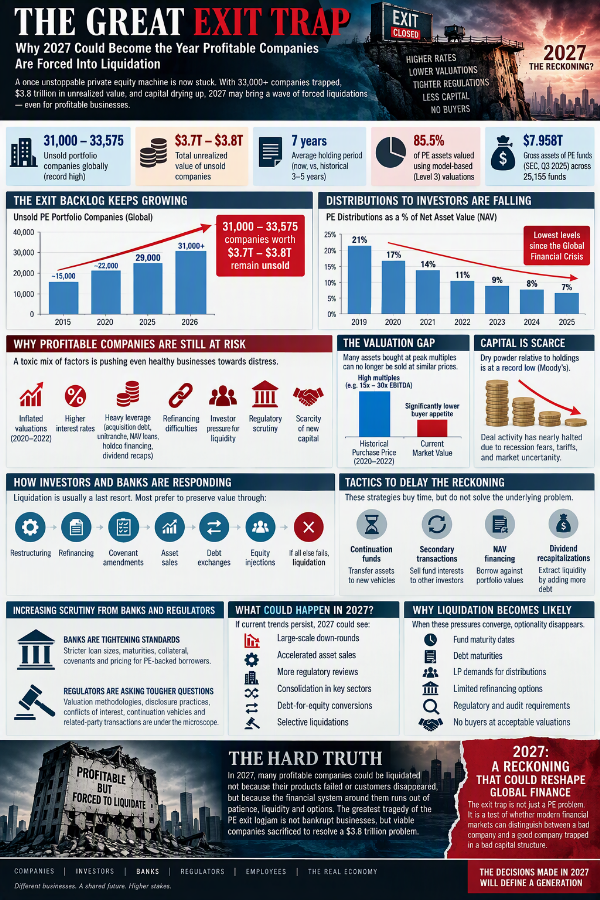
The global private equity industry is entering what may become the most consequential reckoning in its modern history. For years, private equity firms thrived on a relatively straightforward model: acquire companies using a combination of investor capital and borrowed money, improve operational performance, increase valuations, and eventually exit through a strategic sale, secondary buyout, or public listing. That model generated trillions of dollars in wealth and transformed private markets into one of the most influential forces in global finance. Today, however, the machinery that powered those returns is grinding to a halt, creating an unprecedented exit logjam that is trapping somewhere between 31,000 and 33,575 companies inside private equity portfolios, representing approximately $3.7 trillion to $3.8 trillion in unrealized value. Industry reports describe this as the largest backlog of unsold portfolio companies ever recorded.
What makes this situation particularly dangerous is that the companies trapped in the backlog are not necessarily failing businesses. Many continue to generate revenue, maintain positive cash flow, report profits, and serve growing customer bases. Historically, these characteristics would have made them unlikely candidates for financial distress. Corporate finance traditionally operated under a simple assumption: if a company generated sustainable profits and positive operational cash flow, it could survive market turbulence. Yet the private equity crisis emerging today is exposing a new reality. Companies are increasingly finding that operational success does not guarantee financial survival when they are embedded within highly leveraged ownership structures confronting shrinking liquidity, elevated borrowing costs, investor impatience, and mounting regulatory scrutiny.
The roots of the crisis can be traced to the era of ultra-low interest rates that followed the global financial crisis and accelerated during the pandemic years. Between 2020 and 2022, unprecedented amounts of capital flowed into private markets. Private equity firms competed aggressively for acquisitions, paying record valuation multiples for technology companies, fintech firms, SaaS platforms, digital lenders, payment processors, and countless venture-backed startups. Investors embraced the belief that growth would remain abundant and financing would remain cheap indefinitely. The result was a surge in acquisitions financed through increasingly sophisticated layers of debt involving leveraged loans, private credit facilities, unitranche structures, NAV financing, holdco loans, and dividend recapitalizations.
When interest rates rose sharply across major economies, the foundation supporting those valuation assumptions began to crack. The problem was not merely that borrowing became more expensive. The more profound issue was that buyers suddenly became unwilling to pay the same prices that private equity firms had paid during the boom years. Assets acquired at historically inflated valuations could no longer be exited at comparable multiples. The market’s willingness to finance acquisitions contracted significantly, creating a widening gap between what sellers expected and what buyers were prepared to pay. As that valuation gap widened, exits slowed dramatically, leaving thousands of portfolio companies stranded inside funds far longer than originally planned. Industry data suggests that average holding periods have extended toward seven years, substantially longer than historical norms.
The consequences extend far beyond delayed transactions. Private equity funds survive on the ability to return capital to their investors. These investors, known as Limited Partners or LPs, include pension funds, sovereign wealth funds, university endowments, insurance companies, and family offices that depend upon regular distributions. However, distributions as a percentage of net asset value have fallen to levels not seen since the aftermath of the global financial crisis, creating frustration among investors who expected liquidity but instead received years of promises and increasingly complex explanations. Industry observers have reported that distributions have remained below historical averages for several consecutive years, contributing directly to fundraising difficulties and growing pressure on General Partners to demonstrate realized returns rather than paper valuations.
This growing pressure is creating a dangerous chain reaction throughout the financial system. Private equity firms cannot easily sell companies because buyers are unwilling to meet desired valuations. Investors cannot receive distributions because companies are not being sold. Fund managers cannot easily raise new funds because investors are dissatisfied with existing performance. Banks and lenders are becoming more cautious because they see increasing concentrations of aging assets inside private equity portfolios. Regulators are beginning to ask difficult questions regarding valuation methodologies, conflict management, disclosure standards, continuation vehicles, and related-party transactions. Every participant in the ecosystem is waiting for liquidity, yet liquidity itself remains scarce.
The result is a form of financial paralysis that increasingly threatens even healthy businesses.
Many of the companies trapped inside the exit backlog are carrying debt structures that were designed under assumptions that no longer exist. A business may remain profitable at the operating level while simultaneously becoming distressed at the financing level. A company can report positive EBITDA, growing revenues, expanding customer acquisition, and stable operations, yet still face severe financial pressure because rising interest costs consume increasing portions of its cash flow. In such cases, profitability becomes secondary to debt servicing capacity. The issue is no longer whether the business works. The issue becomes whether the capital structure surrounding the business remains sustainable.
This distinction is critical because it explains how profitable companies can ultimately be forced into liquidation. Contrary to popular perception, companies rarely fail simply because their products are poor or their customers disappear. In many modern private equity situations, companies fail because the financing framework wrapped around them becomes impossible to maintain. When debt maturities approach, refinancing options disappear, lenders tighten standards, investors refuse additional capital injections, and prospective buyers refuse to pay expected prices, management teams can find themselves trapped regardless of the underlying health of the business.
The banking sector is increasingly concerned about this possibility. Reports indicate that banks have already begun tightening lending standards for private equity funds and non-bank credit intermediaries, including stricter requirements relating to loan sizes, maturities, collateral coverage, covenants, and pricing structures. While major studies suggest that banks’ senior secured positions may protect them from the most severe losses, lenders are clearly signaling growing concern regarding exposures linked to private equity and private credit markets.
Yet banks do not actually want liquidation. Liquidation is frequently the least attractive outcome for lenders because it destroys value. A company that may have attracted hundreds of millions of dollars in equity and debt financing can often generate only a fraction of that amount during a forced sale. Intellectual property, customer relationships, brand value, software platforms, operational expertise, and future growth potential are typically discounted heavily during distress scenarios. As a result, lenders generally prefer restructurings, covenant amendments, maturity extensions, refinancing arrangements, asset sales, debt exchanges, and equity recapitalizations before pursuing liquidation. Their primary objective is to maximize recovery, not simply close files.
However, there is a critical difference between preference and necessity.
As the backlog grows, the options available to lenders and investors begin to narrow. Continuation funds have emerged as one solution, allowing sponsors to transfer aging assets into new vehicles and effectively reset holding periods while providing limited liquidity to existing investors. Secondary markets have expanded rapidly, enabling investors to sell fund positions without requiring portfolio companies to be exited directly. NAV financing has allowed private equity firms to borrow against portfolio values to generate distributions. Dividend recapitalizations have permitted sponsors to extract liquidity by increasing leverage at portfolio companies. These mechanisms have bought valuable time and delayed difficult decisions. They have helped prevent an immediate collapse in valuations and allowed firms to avoid crystallizing losses.
The problem is that none of these strategies permanently solves the underlying issue. They merely postpone the moment when assets must ultimately be valued by the market. Every continuation fund eventually requires an exit. Every refinancing eventually matures. Every secondary transaction still leaves an underlying company that must one day be sold. Every dividend recapitalization adds leverage that must eventually be repaid. The financial pressure does not disappear. It accumulates.
By 2027, the industry may reach a point where accumulated pressure becomes impossible to defer. Private equity funds approaching the end of their life cycles will face increasing demands from LPs seeking distributions. Auditors and regulators may intensify scrutiny of assets that have remained unsold for extended periods. Banks could continue tightening credit standards, reducing refinancing flexibility. Buyers may remain selective, focusing only on premium assets while leaving average performers stranded. Portfolio companies that once expected extensions and patience may suddenly encounter sponsors who no longer have the luxury of waiting.
This is where the real danger emerges. The market may begin separating companies into two categories. The first category will consist of exceptional assets that can still attract premium valuations and strategic buyers. The second category will contain businesses that are operationally functional but financially inconvenient. These companies may generate profits, employ hundreds or thousands of workers, and serve valuable economic functions, yet they may no longer satisfy the return expectations embedded within their ownership structures. They may not be failing businesses, but they may become failed investments.
For such companies, liquidation becomes less a reflection of operational weakness and more a consequence of financial exhaustion. If sponsors cannot secure exits, if investors refuse further patience, if lenders decline refinancing requests, and if regulators demand greater transparency regarding valuations, then many firms may conclude that accepting large losses through controlled liquidations is preferable to extending uncertainty indefinitely. In such cases, liquidation becomes a tool for closing positions, releasing trapped capital, satisfying governance requirements, and drawing a line under years of unresolved financial pressure.
The greatest tragedy of the unfolding exit logjam is therefore not the prospect of bankrupt companies. It is the possibility that profitable companies may be sacrificed to repair balance sheets elsewhere in the financial system. The companies themselves may remain viable, but their owners, lenders, and investors may no longer possess either the capital or the patience required to continue supporting them.
If current trends persist, 2027 could become the year when private equity’s long-running strategy of delaying valuation reality finally collides with economic reality. At that point, thousands of businesses trapped within the $3.8 trillion exit backlog may discover that profitability alone is no longer enough to guarantee survival. They may be forced into restructurings, distressed sales, debt-for-equity conversions, or ultimately liquidation, not because their products failed, not because customers disappeared, and not because their operations collapsed, but because the global financial system surrounding them finally runs out of ways to postpone the reckoning.
In that scenario, 2027 would not simply mark the resolution of an exit backlog. It could become the largest transfer of unrealized losses into realized destruction that the private equity industry has witnessed in decades.
The Indian startup ecosystem has spent the better part of a decade celebrating unicorn creation. Every new $1 billion valuation was treated as proof that India had arrived as a global innovation powerhouse. Headlines focused on rising valuations, record funding rounds, and rapidly expanding startup counts. By 2026, however, the most important question is no longer how many unicorns India has created. The real question is how many of those unicorns can actually survive independent market scrutiny.
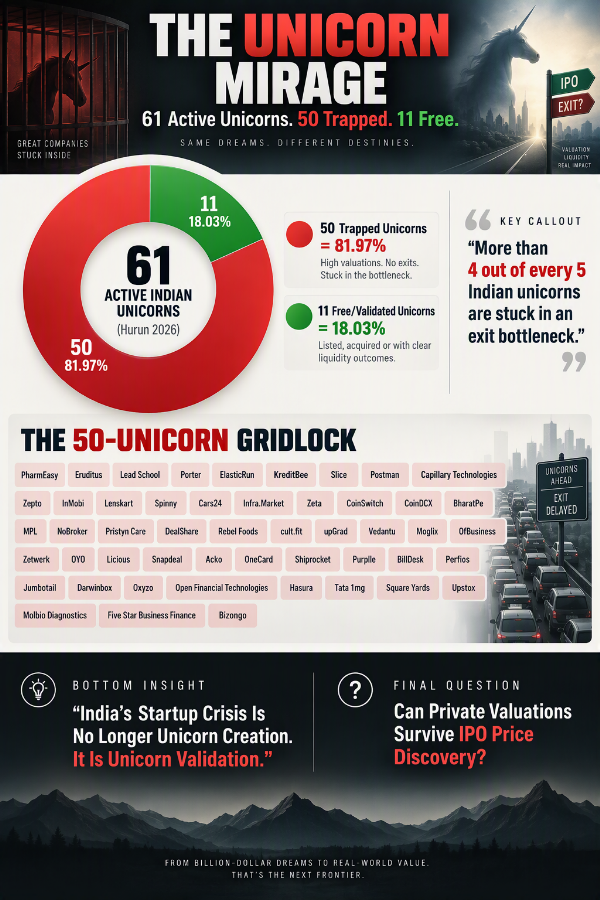
According to the strict methodology of the Hurun Global Unicorn Index 2026, India has 61 active privately held unicorns. This figure is considerably lower than the 130-plus unicorns often cited by ecosystem trackers because Hurun excludes firms that have already gone public, been acquired, or fallen below the $1 billion valuation threshold.
Yet even the figure of 61 may overstate the actual strength of India’s unicorn ecosystem. A growing body of analysis suggests that the country’s startup sector is facing a historic liquidity crisis. The venture capital model ultimately depends on exits. Investors inject capital at successively higher valuations with the expectation that those valuations will eventually be validated through public listings, acquisitions, or large secondary transactions. When exits become difficult or impossible, valuations become increasingly theoretical. A company may still be called a unicorn, but its billion-dollar status exists primarily on private balance sheets rather than through observable market transactions.
The central problem confronting India’s startup ecosystem in 2026 is what can only be described as a massive inventory overhang. During the period between 2020 and 2022, unprecedented liquidity flowed into technology companies. Capital was abundant, interest rates were low, and investors rewarded growth above all else. Valuations rose dramatically across sectors including fintech, ecommerce, logistics, healthtech, edtech, SaaS, insurance, and enterprise software. Hundreds of funding rounds were completed using revenue multiples and growth assumptions that now appear increasingly difficult to justify under current market conditions.
As the global venture cycle turned and private equity activity slowed, a large number of Indian unicorns discovered that there was no obvious exit route available. Public markets became more selective. Investors demanded profitability instead of growth-at-any-cost. Merchant bankers began focusing heavily on governance quality, operating leverage, cash generation, and earnings visibility. As a result, dozens of large startups found themselves trapped between private-market expectations and public-market realities.
The scale of this logjam is extraordinary. One recent analysis identifies approximately 50 major Indian unicorns as being caught in an exit bottleneck. This trapped inventory includes PharmEasy, Eruditus, Lead School, Porter, ElasticRun, KreditBee, Slice, Postman, Capillary Technologies, Zepto, InMobi, Lenskart, Spinny, Cars24, Infra.Market, Zeta, CoinSwitch, CoinDCX, BharatPe, Mobile Premier League (MPL), NoBroker, Pristyn Care, DealShare, Rebel Foods, cult.fit, upGrad, Vedantu, Moglix, OfBusiness, Zetwerk, OYO, Licious, Snapdeal, Acko General Insurance, OneCard, Shiprocket, Purplle, BillDesk, Perfios, Jumbotail, Darwinbox, Oxyzo Financial Services, Open Financial Technologies, Hasura, Tata 1mg, Square Yards, Upstox, Molbio Diagnostics, Five Star Business Finance, and Bizongo. According to that framework, these firms remain unable to secure straightforward exits without confronting significant valuation pressure, profitability concerns, or investor skepticism.
The implications are profound. If India has 61 active unicorns and approximately 50 of them are effectively trapped in this exit logjam, then only 11 active unicorns remain outside the bottleneck. Simple arithmetic reveals the scale of the problem. Eleven out of sixty-one represents just 18.03% of active unicorns. Conversely, 81.97% of active unicorns fall into the trapped-inventory category.
This 18.03% figure is perhaps the most revealing number in India’s startup ecosystem today. It suggests that fewer than one in five active unicorns can currently be regarded as fully unconstrained by the liquidity crisis affecting late-stage venture capital. While these companies may still carry billion-dollar valuations on paper, the overwhelming majority have not yet demonstrated that such valuations can survive an IPO, acquisition process, or equivalent market-based test.
The distinction between a paper unicorn and a validated unicorn has therefore become increasingly important. A paper unicorn is valued at more than $1 billion during a private funding round involving a limited set of investors. A validated unicorn is a company whose valuation survives independent scrutiny by public-market investors, strategic acquirers, secondary buyers, or sustained profitability. The difference between the two categories may seem academic during periods of easy liquidity. In a capital-constrained market, however, the distinction becomes central.
Consider the position of companies such as Zepto, Lenskart, Darwinbox, Zetwerk, Postman, and OfBusiness. These are undoubtedly substantial businesses with meaningful revenues, strong market positions, and significant investor backing. Yet their ultimate valuation remains subject to future verification. Until public investors, strategic acquirers, or large-scale secondary buyers confirm those valuations through actual transactions, the market does not possess an objective mechanism to determine whether the private marks are conservative, accurate, or inflated.
This reality reflects a broader collapse in the traditional private-equity and venture-capital exit engine. The classic startup model assumes a continuous pipeline of IPOs, acquisitions, and liquidity events. When that machinery functions effectively, private valuations are constantly validated through market outcomes. When the machinery stalls, an inventory of private assets accumulates. Capital becomes trapped. Employee stock options become harder to monetize. Early investors wait longer for returns. Founders postpone strategic decisions. New rounds become more difficult to raise. The result is exactly what India appears to be experiencing in 2026: a large reservoir of nominal unicorns waiting for a market clearing mechanism.
This does not mean all 50 trapped unicorns will fail. Many are likely to emerge stronger, more profitable, and ultimately capable of commanding substantial public-market valuations. Some may even exceed their current valuations over time. However, until such validation occurs, their unicorn status remains fundamentally different from that of a company whose valuation has already been tested by the market.
The uncomfortable conclusion is that India may officially possess 61 active unicorns, but the effective number of economically validated unicorns may be far lower. Under the exit-logjam framework, only 11 companies appear free from the liquidity trap, representing just 18.03% of the country’s active unicorn population. The remaining 50, accounting for 81.97%, constitute one of the largest accumulations of trapped late-stage venture capital in the world.
For years, India’s startup narrative was defined by unicorn creation. In 2026, the defining story is no longer creation but validation. The future of the ecosystem will not be determined by how many companies cross the $1 billion threshold. It will be determined by how many can escape the growing exit bottleneck and prove that their valuations represent real, market-tested economic value rather than the lingering legacy of an era of abundant private capital.
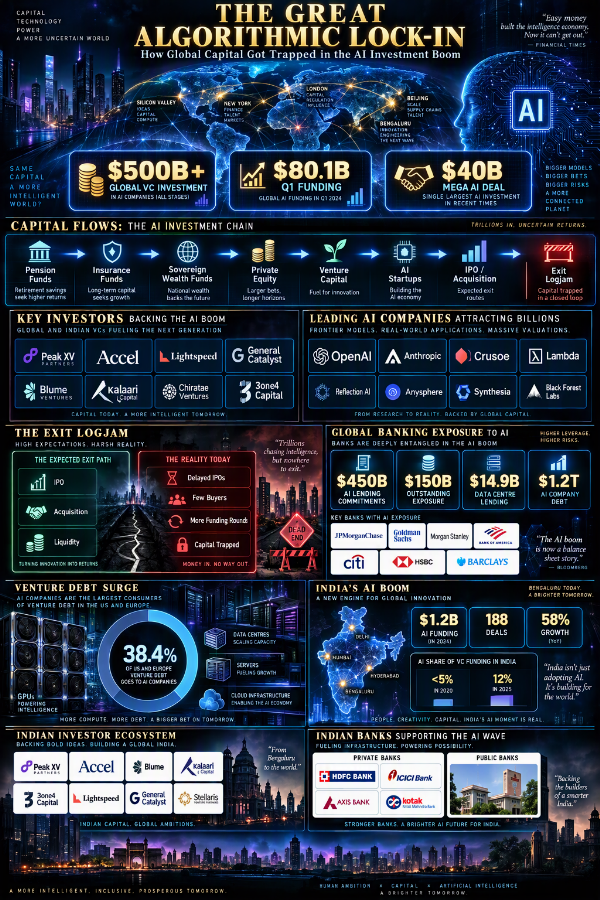
The global artificial intelligence boom may eventually be remembered as one of the most transformative technological shifts in history. Yet beneath the spectacular headlines surrounding OpenAI, Anthropic, Nvidia, Google, Microsoft, Black Forest Labs, Synthesia, and hundreds of other AI ventures lies a less discussed reality: a growing accumulation of capital that has not yet found a profitable exit. The issue confronting global financial markets is not simply whether artificial intelligence will succeed as a technology. Rather, it is whether the enormous quantities of private equity, venture capital, pension capital, insurance savings, sovereign wealth money, private credit, and bank financing that have poured into the sector will ever generate the returns that justified their valuation. Increasingly, investors are confronting a world in which AI may succeed technologically while a large number of AI investments fail financially. According to EY, venture-backed companies raised more than $80.1 billion during the first quarter of 2025 alone, with one massive $40 billion AI transaction significantly influencing overall investment activity. Even as funding surged, deal volumes continued declining and investors became increasingly reluctant to support companies lacking a clear path to liquidity.
The paradox at the center of the AI boom is that capital continues to flow aggressively even while exits remain constrained. According to KPMG Venture Pulse, global venture capital investment exceeded $500 billion during 2025, making it one of the strongest funding years in recent history. AI-focused companies absorbed an extraordinary share of that money. Massive funding rounds involving OpenAI, Anthropic, Anysphere, Reflection AI, Lambda, Crusoe, and numerous other companies created a market structure in which increasingly larger amounts of capital were concentrated into fewer enterprises. At the same time, deal volumes declined sharply, indicating that investors were chasing a limited number of perceived winners while a much larger pool of startups struggled to attract follow-on financing.
This concentration of capital has produced what many investors privately describe as an “exit logjam.” During the technology boom of previous decades, venture capital firms expected eventual liquidity through initial public offerings or strategic acquisitions. Today’s AI market is different. Valuations have expanded far faster than public markets’ willingness to absorb them. Many AI startups are valued based on anticipated future dominance rather than current profitability. Consequently, large venture funds, growth-equity investors, and late-stage private equity firms often possess paper wealth rather than realized wealth. Until these companies are acquired or go public successfully, investor returns remain theoretical.
The situation has become particularly challenging for venture capital firms because many funds raised record amounts of money between 2020 and 2025. Investors promised their own investors, known as limited partners, that capital would be returned within standard fund cycles. However, many AI portfolio companies remain private, requiring additional rounds of financing rather than producing liquidity events. This has forced firms such as Peak XV Partners, Accel, Lightspeed, General Catalyst, Bessemer Venture Partners, Nexus Venture Partners, Kalaari Capital, Blume Ventures, Chiratae Ventures, and 3one4 Capital to increasingly focus on secondary transactions, portfolio restructuring, and selective capital deployment rather than indiscriminate growth funding. While these firms continue backing AI companies, investor behavior is becoming significantly more disciplined as concerns over liquidity intensify.
The banking sector faces a different but equally important challenge. Traditional venture capital losses are generally borne by equity investors. Banks, however, invest indirectly through loans, venture debt facilities, project financing, infrastructure loans, syndicated lending, and credit funds. Recent research from the Federal Reserve Bank of Chicago highlights increasing bank exposure to AI-adjacent borrowers and data-center financing. It estimates approximately $450 billion in commercial and industrial lending commitments to AI-related sectors among major banks, with around $150 billion outstanding. At the same time, analysts cited by the study estimated AI-company-issued debt at around $1.2 trillion. Furthermore, data-center lending reached approximately $14.9 billion in a one-year period ending in the third quarter of 2025. These numbers reveal that exposure extends far beyond venture capital and now reaches deeply into the global credit system.
The link between banks and AI is often misunderstood. Global financial institutions such as JPMorgan Chase, Goldman Sachs, Morgan Stanley, Bank of America, Citigroup, HSBC, Barclays, and numerous private-credit providers are not necessarily taking large direct equity positions in startups. Their exposure frequently arises from data-center construction loans, infrastructure financing, venture debt, GPU-backed lending structures, and private-credit arrangements supporting the AI ecosystem. As AI companies compete for computing power, capital expenditure requirements have become enormous, creating new lending opportunities but also increasing systemic risk should expected revenues fail to materialize.
Venture debt illustrates this phenomenon perfectly. According to PitchBook, AI and machine-learning startups captured 38.4% of all venture-debt value across the United States and Europe during 2025. Venture debt activity reached record levels, with startups increasingly using borrowing rather than accepting valuation reductions. Companies such as Crusoe and Lambda Labs raised massive debt facilities linked to GPU acquisition and data-center expansion. Such borrowing effectively assumes that future demand for AI services will remain extraordinarily strong. If that assumption proves incorrect, lenders could face significant impairment risks.
A particularly sensitive aspect of the AI investment cycle concerns the origin of the capital itself. Much of the money flowing into private equity and venture funds ultimately originates not from wealthy individuals but from pension funds, insurance companies, university endowments, sovereign wealth funds, charitable foundations, and retirement schemes. Institutions such as the California Public Employees’ Retirement System (CalPERS), Canada Pension Plan Investment Board, Ontario Teachers’ Pension Plan, GIC Singapore, and major Middle Eastern sovereign investors routinely allocate capital to private-equity and venture-capital funds. Their objective is to earn higher long-term returns than those available in conventional government bonds and public equities. When AI investments disappoint, losses may not immediately affect pension beneficiaries, but lower returns eventually translate into funding pressures throughout the retirement system.
This raises the critical question: what happens if a substantial proportion of AI investments are never recovered? The answer differs according to the type of investor involved. Venture capital firms can theoretically lose 100% of their equity investment. Such losses, while painful, fall within the traditional venture-capital model where a handful of winners are expected to compensate for numerous failures. A fund may survive if one company generates extraordinary returns. However, the situation becomes more complex for growth-equity and private-equity firms that invested at very high valuations during later funding rounds. These investors often entered after early success had already been priced into valuations. Consequently, they may face permanent capital impairment if IPO markets refuse to support comparable pricing.
For banks, unrecovered investments trigger accounting consequences. Loans become non-performing assets. Banks must increase provisions, write down asset values, reduce earnings, and potentially raise additional capital. The impact depends on exposure size. A few failed AI loans are manageable. Widespread failures across the sector would create broader stress within credit portfolios. This is precisely why the banking system operates under strict capital adequacy requirements and stress-testing frameworks. Regulators understand that preventing systemic contagion is more important than rescuing individual investments.
Contrary to popular belief, regulators do not generally “recover” lost investment money. If an AI startup consumes capital and fails without valuable assets, the money has effectively vanished. Regulators cannot recreate destroyed economic value. Instead, institutions such as the Federal Reserve, the European Central Bank, the Bank of England, and other financial supervisors focus on ensuring that losses are recognized honestly, capital levels remain adequate, and financial institutions maintain sufficient buffers to absorb shocks. The purpose of regulation is not recovery after failure but resilience before failure.
India presents a particularly fascinating case because its AI ecosystem is expanding rapidly while remaining significantly smaller than its American counterpart. According to the India AI & Deep Tech Investment Report, AI startups attracted approximately $1.2 billion across 188 investments during 2025, representing a 58% year-on-year increase in funding value. AI accounted for approximately 12% of total venture-capital funding in India, compared with less than 5% in 2020. Since 2016, nearly $28 billion has flowed into India’s broader deep-tech sector through more than 2,100 transactions. These statistics reveal a dramatic reallocation of capital toward AI, semiconductors, robotics, health technology, cybersecurity, advanced manufacturing, and related fields.
The principal investors driving India’s AI ecosystem include Peak XV Partners, Accel, Blume Ventures, Kalaari Capital, 3one4 Capital, IAN Group, Titan Capital, Stellaris Venture Partners, Endiya Partners, Lightspeed, General Catalyst, and multiple global technology-focused funds. These firms have become central players in the financing of Indian AI and deep-tech development.
India’s banking exposure remains comparatively modest. Available evidence does not indicate that major Indian public-sector banks have taken large direct equity positions in AI startups. Instead, exposure tends to arise through startup banking, technology lending, venture-debt participation, fund financing, and indirect ecosystem support. Institutions such as HDFC Bank, ICICI Bank, Axis Bank, and Kotak Mahindra Bank are more active participants in startup financing ecosystems, while public-sector institutions including State Bank of India, Punjab National Bank, Bank of Baroda, and Canara Bank generally maintain more conservative exposure profiles. Although these banks support innovation, they are not currently known to possess the same degree of direct AI-equity risk observed within dedicated venture-capital portfolios. The greater vulnerability lies not within public-sector banking balance sheets but within private investment vehicles financed by domestic and international capital.
If a severe AI investment correction were to occur, India’s likely sequence of losses would begin with angel investors and startup founders, followed by early-stage venture funds, growth-equity investors, private-equity participants, venture-debt lenders, and finally institutions with indirect exposure through funds-of-funds, insurance portfolios, and retirement assets. Such an event would probably resemble a prolonged valuation adjustment rather than a sudden banking collapse. Funding would become scarce, mergers would accelerate, weaker firms would disappear, and capital would consolidate around a small number of genuine AI leaders.
The greatest irony of the AI age may ultimately be that artificial intelligence itself emerges as a transformational success while hundreds of AI investments become financial disappointments. History offers many examples. Railways transformed transportation while bankrupting numerous railway investors. The internet transformed commerce while destroying vast amounts of capital during the dot-com collapse. Likewise, artificial intelligence may revolutionize productivity, healthcare, finance, education, defense, and manufacturing while simultaneously inflicting heavy losses on venture funds, private-equity investors, lenders, and institutions that paid excessive prices in pursuit of the future.
The defining risk facing today’s financial system is therefore not the failure of artificial intelligence. The real risk is that the world has invested as though every AI company will become an OpenAI, an Anthropic, or an Nvidia. Economic history suggests that only a very small number ultimately will. The resulting gap between technological success and investment success may become one of the most consequential financial stories of the twenty-first century.
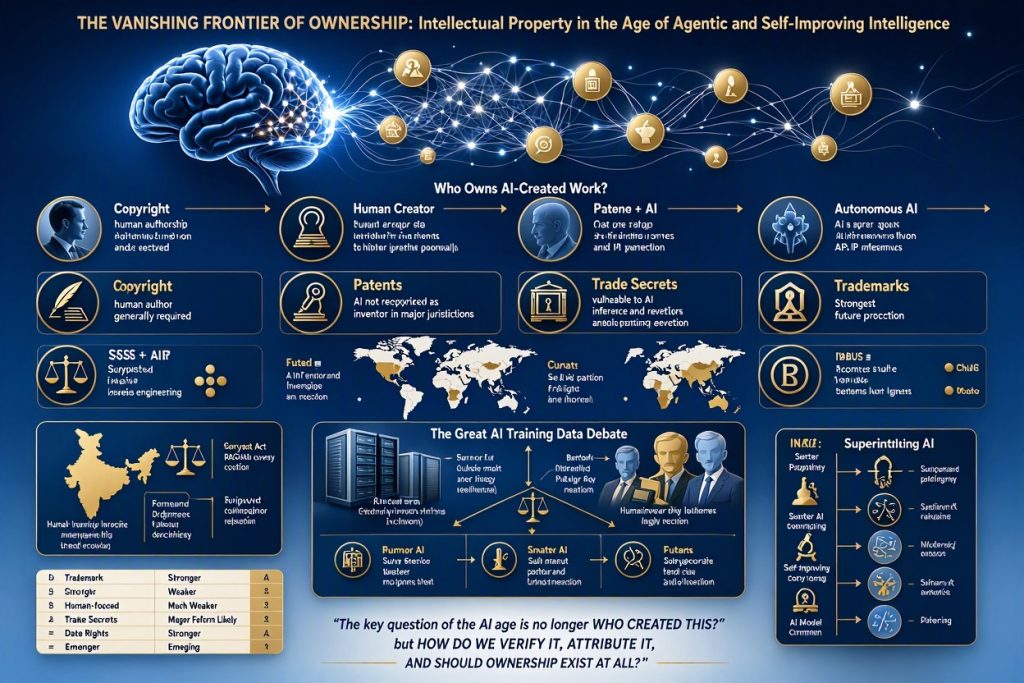
The emergence of artificial intelligence has triggered one of the most profound challenges ever faced by intellectual property law. For centuries, copyright, patents, trademarks, and trade secrets were developed around a fundamental assumption: that creativity, invention, and innovation originate from human minds. Modern AI systems now generate text, images, music, software, engineering designs, scientific hypotheses, and potentially even inventions with diminishing levels of direct human involvement. As AI evolves from a passive tool into an autonomous and increasingly agentic participant in innovation, the traditional foundations of intellectual property rights are being questioned across the world.
At the center of the debate lies the question of ownership. If an AI system creates a novel painting, writes a book, discovers a new drug candidate, or develops a software architecture, who should own the resulting intellectual property? Existing legal systems largely answer this question by insisting on human involvement. In the United States, copyright law continues to require human authorship, and works generated entirely by AI generally do not qualify for copyright protection. Where AI is merely a tool assisting a human creator, copyright may subsist in the human contributions, but not necessarily in the machine-generated portions. Similar human-authorship principles are visible across many jurisdictions, including most European countries and Japan. The prevailing legal philosophy remains that creativity worthy of copyright protection must originate from human intellectual activity rather than autonomous machine processes.
Patent law has adopted an even stricter position. The now famous DABUS cases tested whether an artificial intelligence system could legally be recognized as an inventor. Patent offices and courts in major jurisdictions rejected this proposition, concluding that inventorship must remain tied to a human being. The legal reasoning is straightforward: inventors are required to possess legal personality, hold rights, make declarations, and transfer interests, all of which are attributes unavailable to machines. Consequently, even where AI plays a substantial role in generating inventive concepts, patent ownership currently depends on identifying a human inventor who contributed to the inventive process.
The challenges extend beyond AI-generated outputs to the training of AI systems themselves. Generative AI models are trained on enormous datasets containing books, articles, images, music, software code, and other copyrighted materials. This has given rise to a global dispute over whether such training constitutes lawful learning or unlawful copying. Technology companies frequently argue that AI training is transformative and analogous to humans reading and learning from existing works. Rights holders, on the other hand, contend that the creation of training datasets involves extensive reproduction and exploitation of copyrighted content without authorization or compensation. The legal outcome of these disputes will significantly influence the future structure of the AI industry and the balance between innovation and creators’ rights.
Another contentious issue concerns artistic and creative styles. Artificial intelligence can generate content that closely resembles the styles of renowned authors, musicians, painters, and filmmakers. While copyright traditionally protects particular expressions rather than artistic styles themselves, the distinction becomes increasingly difficult to sustain when AI can replicate stylistic characteristics at scale. As generative systems continue to improve, legal systems may be forced to reconsider whether existing copyright doctrines adequately protect creative identities.
The rise of AI also challenges conventional ideas surrounding reverse engineering. Reverse engineering has historically occupied a complex legal space. In many countries, it is permitted under certain conditions, particularly when conducted for interoperability, security research, education, or competitive analysis. The European Union expressly recognizes limited rights to study, test, and even decompile software where necessary to achieve interoperability between independently created programs. EU law distinguishes between copying protected expression and examining underlying ideas and functional principles.
Japan has similarly adopted relatively permissive approaches in areas related to text and data mining and AI development. Japanese copyright guidance seeks to balance rightsholder interests with technological innovation and contains broad provisions facilitating certain forms of AI training and computational analysis of copyrighted materials.
The significance of reverse engineering is likely to increase dramatically as AI systems become more autonomous. Agentic AI systems may eventually be capable of disassembling software, reconstructing source code, reverse-engineering hardware architectures, identifying design principles, and generating functional alternatives with minimal human involvement. Activities that once required specialized teams of engineers working for months could potentially be completed within hours. If this occurs, trade secrets and other forms of practical exclusivity may become increasingly difficult to maintain. The central challenge would shift from preventing access to managing rapid replication.
India occupies a uniquely important position within these debates because it combines a rapidly growing digital economy, a strong creator ecosystem, a globally significant software industry, and a tradition of balancing intellectual property protection with broader public interests. Unlike some jurisdictions that have already issued substantial guidance on AI-generated works, India’s legal position remains partially open and evolving.
Indian copyright law contains a provision that has attracted significant attention in AI discussions. Section 2(d)(vi) of the Copyright Act, 1957, states that, in the case of a computer-generated work, the author shall be the person who causes the work to be created. Although this language appears relevant to AI-generated content, it was introduced long before the rise of modern generative AI. Consequently, considerable uncertainty exists regarding how courts should interpret the provision when autonomous AI systems are involved. Legal commentators have argued that the provision was intended for computer-assisted creation rather than independent machine creativity.
This uncertainty became particularly visible in relation to the artwork known as “Suryast,” in which the AI system RAGHAV was initially listed alongside a human creator. The subsequent controversy highlighted an unresolved question within Indian law: whether artificial intelligence can itself be regarded as an author. The dispute demonstrated that existing legal categories are increasingly strained by technologies capable of generating creative outputs with limited human intervention.
While copyright remains unsettled, India’s patent position has become considerably clearer. The Indian Patent Office rejected the DABUS patent application and concluded that artificial intelligence cannot be recognized as a “true and first inventor” under the Patents Act, 1970. The decision aligned India with the prevailing international trend and reaffirmed the principle that inventorship remains a human-centric legal concept. AI-assisted inventions may still be patented, provided a human inventor can be identified and the legal requirements for inventorship are satisfied.
India is also emerging as a major battleground regarding AI training data. Significant litigation and policy discussions are underway concerning whether copyrighted materials may be used to train generative AI systems and, if so, under what conditions. Recent governmental discussions have considered licensing frameworks and other regulatory approaches aimed at balancing technological innovation with the economic interests of creators and publishers. These debates suggest that India may play a major role in shaping global AI governance over the coming decade.
Looking further into the future, the most disruptive force may not be generative AI itself but the combination of agentic AI and recursive self-improvement. Recursive self-improvement refers to AI systems that can enhance their own capabilities, create more effective successors, and continuously accelerate their intellectual performance. If such systems emerge, many assumptions underlying intellectual property law may become obsolete.
Copyright has traditionally relied on scarcity, because producing high-quality creative works required significant time, effort, expertise, and investment. A world in which AI can produce millions of books, songs, artworks, and software applications at negligible cost fundamentally changes this equation. Copyright law may increasingly focus on protecting human authenticity, identity, reputation, and provenance rather than mere content generation.
Software copyright may be especially vulnerable. If advanced AI systems can observe software behavior and generate equivalent implementations without copying original code, the practical value of software copyright could diminish. Competitive advantages might shift toward data ownership, network effects, distribution ecosystems, and trusted brands instead of copyright exclusivity.
Trade secrets could face even greater pressure. Trade secret protection depends entirely upon maintaining secrecy. Highly capable AI systems may become extraordinarily effective at inferring hidden processes, reconstructing proprietary techniques, identifying manufacturing methods, or discovering confidential algorithms from observable outputs. In such a world, preserving secrecy may become increasingly expensive and difficult.
Patent systems may experience the most profound transformation. Traditional patent law assumes that inventions are scarce and that society benefits when inventors disclose them in exchange for temporary exclusivity. However, if advanced AI systems continuously generate massive numbers of inventions, discoveries, and technical solutions, patent offices could become overwhelmed. Novelty assessment would become increasingly difficult, and the economic rationale for granting lengthy monopolies may weaken. Future societies may experiment with alternative mechanisms such as shorter patent terms, compulsory licensing regimes, innovation prizes, or entirely new categories of rights designed specifically for AI-generated innovations.
Among all intellectual property rights, trademarks appear the most resilient. Regardless of how advanced AI becomes, markets will continue to value trust, reputation, quality assurance, and source identification. Consumers will still need reliable indicators of origin when selecting products and services. Consequently, trademarks may grow in importance as other forms of exclusivity become less effective.
The long-term trajectory of intellectual property appears increasingly clear. The legal systems of the industrial age were designed to reward the creation of scarce intellectual assets. The emerging age of artificial intelligence may force legal systems to protect something different: authenticity rather than creation, reputation rather than production, verification rather than originality, and control over scarce real-world resources rather than control over infinitely reproducible information. In this sense, the rise of agentic and self-improving AI is not merely creating new intellectual property disputes. It is gradually reshaping the very purpose for which intellectual property law exists.
Human civilization has always advanced through the creation of tools that amplify intelligence. The stone axe amplified physical capability, the printing press amplified knowledge dissemination, the computer amplified calculation, and the internet amplified connectivity. Artificial intelligence represents a fundamentally different category of invention because it is the first major technology that can potentially amplify intelligence itself. Yet even this characterization may prove incomplete. The most transformative possibility emerging from contemporary AI research is not merely intelligent machines, but machines that can actively participate in improving their own intelligence. This concept, known as Recursive Self-Improvement (RSI), occupies a unique place in technological discourse because it blurs the long-standing distinction between creator and creation. In such a future, intelligence ceases to be a fixed artifact designed by humans and becomes a dynamic process capable of redesigning its own mechanisms.
The widespread discussion surrounding Agentic AI has brought society closer than ever to this possibility. Unlike traditional AI systems that passively respond to prompts, Agentic AI can formulate plans, execute actions, interact with tools, coordinate multiple processes, evaluate outcomes, and adapt its behavior in pursuit of objectives. The emergence of these capabilities has led many observers to believe that fully autonomous self-improving systems are no longer confined to theoretical speculation. The central question is no longer whether AI can perform useful work independently. Instead, the question is whether AI can eventually assume responsibility for its own improvement and, by extension, become an increasingly autonomous force in the development of future intelligence.
To understand the significance of RSI, it is necessary to distinguish it from conventional machine learning and even from advanced agentic behavior. Modern AI models improve primarily because human researchers design larger architectures, collect better datasets, create superior training procedures, and allocate greater computational resources. Despite impressive capabilities, the growth of intelligence in these systems remains largely directed from the outside. Agentic AI changes this equation by allowing systems to take actions toward goals without requiring constant human intervention. However, even highly capable agents remain focused on external objectives. They solve problems in the world. Recursive self-improvement introduces an entirely different dimension. Rather than merely acting upon the world, the system begins acting upon itself.
In a genuine RSI framework, an AI would analyze its own performance, identify weaknesses, propose modifications to its architecture, workflows, tools, reasoning mechanisms, training procedures, or evaluation methods, implement those modifications, test the results, retain successful changes, and repeat the cycle indefinitely. Every successful iteration would create a more capable system that is itself better equipped to perform the next round of improvements. Intelligence would become both the engine and the product of the process. The result would be a feedback loop in which improvements compound over time rather than accumulating linearly.
The concept often evokes dramatic imagery of a sudden “intelligence explosion,” in which an AI rapidly surpasses human capability and accelerates beyond comprehension. While such a scenario remains speculative as on date, the underlying mechanism of recursive improvement is no longer entirely hypothetical. Evidence increasingly suggests that portions of the process are already emerging within advanced AI research and development environments. Modern AI systems are being used to assist in writing software, debugging code, generating synthetic training data, optimizing computational processes, evaluating experiments, and contributing to research workflows that support the creation of future AI systems. Recent discussions of recursive self-improvement emphasize that real-world examples today are bounded forms of self-improvement, where systems modify code, prompts, evaluation methods, or workflows within defined constraints rather than autonomously redesigning themselves end-to-end.
This distinction between bounded and open-ended self-improvement is crucial. Contemporary systems are not independently rewriting their entire neural architectures, determining their own long-term objectives, securing unlimited computational resources, and deploying upgraded versions of themselves without oversight. Human supervision remains embedded throughout the process. Researchers define goals, allocate resources, establish safety constraints, evaluate outputs, and determine which modifications ultimately become part of production systems. Nevertheless, the very fact that AI now contributes to portions of its own developmental ecosystem represents a profound shift compared to previous generations of technology.
From a historical perspective, the evolution toward RSI can be viewed as a gradual progression rather than a singular breakthrough. Early AI systems operated entirely as tools. They responded to instructions but possessed no meaningful autonomy. The next stage introduced adaptive learning, allowing systems to improve performance through training. More recently, the rise of large language models and agentic architectures enabled planning, reasoning, tool use, and multi-step execution. The emerging stage involves AI systems that help optimize elements of the environments and workflows that shape future AI behavior. Whether society calls this “early RSI” or “proto-RSI,” it represents movement along a continuum that may eventually culminate in significantly more autonomous forms of self-improvement.
One of the strongest arguments supporting the plausibility of RSI arises from software development itself. Software possesses a unique characteristic that makes recursive enhancement especially attractive. It can be modified, duplicated, tested, and deployed at extraordinary speed. An AI capable of writing software can, in principle, write software that enhances its own capabilities. It can optimize search procedures, improve memory management, create better testing frameworks, develop more effective planning modules, generate richer training environments, and automate substantial portions of engineering workflows. Since software is itself the medium through which intelligence expresses its capabilities, improvements in software directly translate into improvements in future performance.
This reality has led many technologists to conclude that AI systems will eventually perform work currently requiring large organizations of highly skilled professionals. In software engineering, such a transformation is particularly plausible. A sufficiently advanced agentic ecosystem could gather requirements, design architectures, write code, create testing frameworks, deploy updates, monitor production environments, fix defects, perform security audits, generate documentation, conduct performance analysis, and continuously optimize its own development processes. What presently requires hundreds or thousands of engineers could theoretically be managed by a highly integrated network of intelligent agents working around the clock without fatigue or organizational friction.
The implications extend far beyond software. Scientific research, pharmaceutical discovery, manufacturing optimization, financial analysis, logistics management, legal investigation, engineering design, education, and healthcare administration all contain substantial components that can be formulated as information processing problems. Since intelligence is the primary resource used to solve information processing problems, improvements in artificial intelligence could have cascading effects across nearly every sector of human activity. An RSI-enabled ecosystem would not merely perform tasks faster. It would continuously refine the methods used to perform those tasks, creating an environment of accelerating capability enhancement.
However, enthusiasm for RSI must be balanced by recognition of its challenges. The notion that self-improving systems will inevitably converge toward perfection is more problematic than it initially appears. Perfection is meaningful only when objectives are precisely defined and measurable. In domains such as computational efficiency, error reduction, mathematical optimization, or benchmark performance, progress can often be quantified objectively. Yet many of the most important human endeavors involve ambiguous, evolving, or subjective goals. There is no universally accepted definition of a perfect economy, a perfect educational system, a perfect legal framework, or a perfect scientific theory. The absence of clear optimization targets introduces fundamental constraints on how far recursive improvement can proceed without human judgment.
Moreover, intelligence alone does not automatically generate creativity, wisdom, or strategic insight. Recent discussions about the limitations of recursive self-improvement note that today’s AI systems appear significantly stronger at executing defined engineering tasks than at conducting open-ended research requiring original conceptual breakthroughs and nuanced judgment. Some analyses suggest that while agents can increasingly automate technical labor, substantial gaps remain in areas involving problem selection, scientific taste, and genuinely novel research direction. These limitations highlight an important reality: improving performance within existing frameworks is often easier than creating entirely new frameworks.
Nevertheless, it would be a mistake to underestimate the cumulative consequences of continued progress. Technological revolutions rarely emerge fully formed. They develop gradually until quantitative change becomes qualitative transformation. The internet did not arrive as a complete global infrastructure overnight. Smartphones did not immediately replace traditional computing. Cloud computing, social media, and e-commerce each evolved through incremental advancements that ultimately reshaped society. RSI may follow a similar trajectory. Rather than witnessing a dramatic moment when machines suddenly become self-improving superintelligences, humanity may experience a prolonged period in which increasingly sophisticated AI systems assume greater responsibility for optimizing the processes that generate future intelligence.
This possibility raises important questions regarding autonomy itself. Many discussions assume that autonomy is binary: either a system is autonomous or it is not. In reality, autonomy exists along a spectrum. Current AI systems already demonstrate limited autonomy in planning and execution. Future systems may gain autonomy in experimentation, resource allocation, code generation, model evaluation, and research prioritization. Each incremental expansion shifts a portion of decision-making authority from humans to machines. The transition toward RSI may therefore consist of countless small delegations of responsibility rather than a single revolutionary event.
Looking toward the end of 2026, there are credible reasons for both optimism and caution. On one hand, agentic systems are advancing rapidly. Their ability to reason, plan, coordinate tools, and perform complex engineering tasks continues to improve at a remarkable pace. The use of AI to assist in AI development is becoming increasingly common, suggesting that recursive elements are already entering practical workflows. On the other hand, significant uncertainties remain regarding open-ended scientific creativity, strategic judgment, reliability, alignment, and long-term control. While bounded recursive self-improvement appears increasingly achievable, fully autonomous end-to-end self-improvement without meaningful human oversight remains an unresolved challenge as on date. Current commentary on RSI frequently emphasizes that today’s systems operate within fixed evaluation frameworks and guardrails rather than engaging in unrestricted self-directed evolution.
The most realistic expectation may therefore be neither skepticism nor inevitability, but continuity. The path toward advanced RSI is likely to be evolutionary rather than revolutionary. Agentic systems will become better at automating work. They will become better at improving workflows. They will become better at improving software. They will become better at improving research processes. Eventually, they may become better at improving substantial portions of the very mechanisms through which artificial intelligence is created. At each stage, the boundary between user, developer, researcher, and machine becomes increasingly blurred.
If this progression continues, future historians may not identify a singular date on which recursive self-improvement arrived. Instead, they may observe that humanity gradually crossed a threshold where intelligence ceased to be something exclusively designed by human minds and became a self-reinforcing process capable of participating in its own evolution. That moment would represent far more than a technological advancement. It would signify a transformation in the nature of intelligence itself, marking the point at which cognition became not merely a product of design, but an active architect of its own future. The Autogenesis Horizon is therefore not simply about smarter machines. It is about the emergence of intelligence that increasingly becomes its own creator, its own optimizer, and perhaps one day, its own successor.
For decades, every major technological revolution has been justified through a familiar promise: while some jobs may disappear, new industries, opportunities, and forms of prosperity will eventually emerge. Artificial Intelligence, however, appears to be challenging this assumption in ways that previous technologies never did. Unlike the industrial machines of the past that primarily automated physical labor, AI is increasingly capable of automating cognitive work, including writing, coding, designing, analyzing, researching, and even making strategic recommendations. As organizations across the world race to integrate AI into their operations, much of the public debate has centered on one concern: the possibility of widespread job losses. Yet there is another, less discussed consequence that may prove equally significant. The same AI tools that corporations are using to reduce their dependence on workers are also empowering individuals to reduce their dependence on corporations. This creates a profound paradox in which AI may simultaneously weaken labor and the firms and models that seek to replace labor with technology.
The business case for AI adoption is straightforward. Companies have always sought ways to improve productivity while reducing costs, and labor has historically represented one of the largest operational expenses. If AI systems can write software, create visual designs, answer customer queries, analyze market trends, draft reports, and perform many other knowledge-based tasks, then organizations naturally see an opportunity to reduce headcount while maintaining or even increasing output. Executives often view this transformation as a necessary step in remaining competitive in an increasingly automated marketplace. Shareholders frequently welcome such efficiencies because lower operating costs can translate into higher profits and stronger financial performance.
However, this perspective often overlooks a critical economic reality. Employees are not merely workers; they are also consumers. The salaries paid by companies eventually become the purchasing power that sustains demand within the broader economy. When large numbers of organizations simultaneously replace workers with AI systems, the resulting reduction in employment opportunities can have consequences that extend far beyond individual businesses. As income levels decline or employment becomes less secure, consumer spending inevitably weakens. The very customers on whom businesses rely to purchase products and services may find themselves with fewer financial resources. In this sense, the widespread adoption of AI for workforce reduction could create a self-reinforcing cycle in which increasing efficiency undermines the purchasing power that supports economic growth.
At the same time, a second and potentially more disruptive phenomenon is unfolding. While corporations are deploying AI to reduce labor costs, individuals are gaining access to the same technologies. For most of modern economic history, sophisticated capabilities required significant resources. Launching a business often demanded sizable capital investments, large teams, specialized expertise, and access to expensive infrastructure. Today, AI is dramatically lowering these barriers. A single individual equipped with advanced AI tools can perform activities that previously required entire departments. Software development, graphic design, content creation, research, marketing, and business planning are increasingly being augmented by AI systems capable of accelerating productivity and reducing the need for specialized personnel.
This democratization of capability is one of the most transformative aspects of the AI revolution. Rather than concentrating power exclusively in large corporations, AI is distributing productive capacity to independent creators, entrepreneurs, freelancers, and small startups. A motivated individual can now design products, build applications, develop marketing strategies, and compete with established firms at a fraction of the historical cost. The rise of AI-assisted entrepreneurship suggests that while jobs may disappear in traditional organizational structures, entirely new forms of economic participation may emerge outside those structures.
The creative software industry provides a useful example of these changing dynamics. Companies such as Adobe have spent decades building highly successful ecosystems around professional tools like Photoshop, Illustrator, Premiere Pro, and After Effects. These products became industry standards because they combined sophisticated functionality with strong brand recognition and extensive user communities. However, the emergence of AI-powered tools and increasingly capable open-source alternatives has begun to challenge the traditional value proposition of proprietary software. Many users now question whether expensive subscriptions remain necessary when AI-driven tools can produce acceptable or even impressive results with significantly lower costs and reduced learning curves.
The issue is not whether Adobe or similar companies will disappear. Rather, the example illustrates a broader structural shift. Historically, software companies derived much of their value from exclusive functionality and steep expertise requirements. AI is changing this relationship by transforming intelligence itself into a user interface. Features that once took years to develop and master can increasingly be replicated, simplified, or automated. As a result, competitive advantages built on complexity may become less durable than they were in previous technological eras.
This transformation extends beyond software. AI is steadily eroding several traditional advantages enjoyed by large corporations. Access to specialized talent, one of the most powerful organizational assets, becomes less decisive when AI can amplify the productivity of smaller teams. Capital requirements diminish as cloud infrastructure and open-source AI frameworks and repositories become more accessible. Research and development cycles accelerate as AI systems help generate code, analyze data, and test solutions. Even distribution advantages are challenged as digital platforms enable entrepreneurs to reach global audiences directly. The result is an environment in which small teams, and in some cases even individuals, can compete with organizations many times their size.
Within this context, tools such as REA, or Reverse Engineer Anything, take on significance far beyond their technical capabilities. They symbolize a larger movement toward the democratization of knowledge. Throughout history, companies have often maintained competitive advantages because they possessed specialized expertise that was difficult for outsiders to access or understand. Technical processes, design methodologies, product architectures, and operational know-how functioned as barriers protecting established organizations from new competitors. AI-powered reverse engineering tools threaten to weaken these barriers by making complex information more accessible and understandable to a wider audience.
When individuals can use AI systems to analyze products, understand workflows, decode software architectures, and learn sophisticated techniques rapidly, the value of information monopolies begins to decline. Knowledge that once took years of education or professional experience to acquire can increasingly be understood in far shorter periods. This does not eliminate the importance of expertise, but it does compress learning curves and lower entry barriers. In industries where knowledge constitutes the primary source of competitive advantage, such developments could fundamentally alter the competitive landscape.
The emergence of AI therefore introduces a new kind of economic competition. For much of the industrial and digital eras, competition primarily occurred between firms. Success depended on which company could build better products, hire better talent, or secure greater resources. AI introduces the possibility of a different model in which companies compete not only with other companies but also with distributed networks of AI-empowered individuals. Open-source communities, independent developers, and small entrepreneurial teams can collectively challenge organizations that once appeared untouchable.
This shift raises an intriguing possibility. Much of today’s conversation focuses on labor displacement, yet corporate displacement may ultimately become an equally important story. Organizations that aggressively use AI to reduce workforces may inadvertently accelerate the emergence of AI-enabled competitors. Workers who lose opportunities within traditional firms may leverage the same technologies to create alternatives, launch startups, contribute to open-source ecosystems, or develop competing products. In this scenario, AI does not simply redistribute work; it redistributes productive power.
History suggests that technological revolutions rarely benefit only the incumbents. The dominant players of one era often struggle to maintain their leadership in the next. Mainframe giants gave way to personal computing pioneers. Many early internet leaders faded as new platforms emerged. Mobile computing transformed entire industries and displaced companies that once seemed invincible. There is little reason to assume that the AI revolution will be different. The organizations that thrive may not necessarily be the largest or the richest, but rather those that best adapt to a world in which intelligence itself becomes widely available.
The central question facing society is therefore much larger than whether AI will eliminate jobs. A more profound issue is what happens when both labor advantages and corporate advantages become increasingly automated and democratized. If AI empowers individuals as much as it empowers institutions, economic power may become more broadly distributed than many expect. Conversely, if access to AI infrastructure becomes concentrated in the hands of a few dominant players, power may become even more centralized. The future will likely be shaped by the tension between these competing forces.
The ancient symbol of the Ouroboros, a serpent consuming its own tail, offers a compelling metaphor for this moment. Companies deploy AI to reduce their reliance on human workers. Those same workers gain access to AI technologies and use them to challenge the companies that displaced them. Open-source communities replicate functionalities once considered proprietary. Entrepreneurs build alternatives to established platforms. In pursuing ever greater efficiency, corporations may inadvertently cultivate the very forces that undermine their own dominance.
The greatest disruption of AI may therefore not be the replacement of workers alone. It may be the emergence of a self-reinforcing cycle in which AI simultaneously weakens labor’s dependence on corporations and corporations’ dependence on labor, reshaping the balance of economic power in ways that are still difficult to predict. The ultimate irony is that the most transformative technology of the twenty-first century may not simply replace people. It may also challenge the very institutions that believed they would be its primary beneficiaries.